The Decca LP of the cast recording of the 1963 Theatre Workshop production Oh What A Lovely War came into the Exeter Oxfam music shop today, and has found its way online. I’ve written about Joan Littlewood and the Theatre Workshop in in the context of the film Sparrows Can’t Sing. Oh What A Lovely War was one of the most celebrated productions which Littlewood and her partner Gerry Raffles put on at the Theatre Royal in Stratford in the East End of London. Obviously with the record you won’t get the ironic juxtaposition of the back projected photographs from the war and the rolling statistics underlining its terrible cost, but the mixture of music hall numbers, propagandistic crowd pleasers and satirical and political anti-war songs still offers a powerful mixture, and a good example of the workshops blending of performance styles. The record was released in 1969, presumably to coincide with the release of Dickie Attenborough’s film of the show, a pale shadow of the original. Many of the cast of Sparrows Can’t Sing here appear as the pierrot singers, Workshop stalwarts all: Avis Bunnage, Fanny Carby, Griffith Davies, Brian Murphy, George Sewell, Victor Spinetti and, of course, Murray Melvin. There are also guest appearances by a number of theatre worthies, who sing particular songs: Jean Pierre Cassel sings Belgium Put The Kaibosh On The Kaiser, Penny Allen We Don't Want To Lose You (Your King And Country Need You), Maggie Smith the terrifying I'll Make A Man Of You, Corin Redgrave and Joe Melia Good-Bye-Eee, Pia Colomba Adieu La Vie, Maurice Arthur When This Lousy War Is Over, Richard Howard Far, Far From Wipers, and Joanne Brown Keep The Home Fires Burning. Sadly, Barbara Windsor, the co-star of Sparrows Can’t Sing, and who featured in the Broadway run of the play, isn’t present. This is a great record of a truly momentous and groundbreaking theatrical event. I’m really excited to see that Murray Melvin, who is now the official archivist of the Theatre Workshop (all on his own time, mind) will be giving a talk at the Theatre Royal as part of the Open House London weekend at 3.00 on Sunday 18th September. I shall certainly try to get along and hear what he has to say about the history of the remarkable institution (if such it can be called, given its anti-establishment stance) in which he played such a central part.
Some more good folkie stuff has also gone online. On the 1974 Topic LP The Rose of Britain’s Isle accordion, concertina and melodeon player John Kirkpatrick is joined by his other half Sue Harris, who plays oboe and hammered dulcimer, for a series of traditional English folk songs and tunes. Staverton Bridge, whose eponymous 1975 LP was released on Saydisc Records, were a Devon folk band featuring Tish Stubbs, Paul Wilson and Sam Richards. They tended towards the more leftward leaning side of the traditional folk repertoire (including Ewan MacColl's We Don't Want to Live Like That), mixing guitar, lute, banjo and whistle with harmonium, group percussion and medieval vocal harmonies. Staverton is a small and picturesque village just outside Totnes, a town which has a very pronounced alternative culture (it's one of a number in the country which posseses its own local currency) from which the group presumably emerged. The Watersons’ For Pence and Spicy Ale is a 1975 Topic Records LP in which the first family of traditional English folk, Mike, Lal and Norma Waterson, are joined by Martin Carthy for their first record of the 70s, a collection of traditional songs (plus one by the late Mike Waterson) such as the Swinton May Song, the Apple-Tree Wassailing Song, Swarthfell Rocks, the Maplas Wassail Song and The Good Old Way. The sleeve notes on the back cover are written by A.L.Lloyd. The Albion Country Band’s 1976 Island Records LP Battle of the Field features a mid-70s incarnation of ex-Fairport Convention man Ashley Hutching's ever-changing folk rock group The Albion Band. Martin Carthy on guitar and vocals, Sue Harris on vocals, oboe and hammer dulcimer, and John Kirkpatrick on accordions, melodeon and concertina turn up again, along with fellow Fairporter Simon Nicol on guitars and dulcimer and Roger Swallow on drums. This group is enhanced by another Fairport member, Dave Mattacks, on drums on the second side, as well as a bunch of Sackbut players. We also have the 1970 LP Folk on Friday, offering (as you might guess) recordings from the BBC Folk on Friday radio series, presented by future Folk on Two main man Jim Lloyd. Robin and Barry Dransfield feature, as do Dave and Toni Arthur, the latter yet to enter her iconic role as a Play School and Playaway presenter. Dave and Toni remark, on the back cover sleeve notes, that 'when they are not performing they are deeply involved in research and have made a study of seasonal rituals, customs and folklore'. Hear the results of their, and other's esoteric investigations here. Dave and Toni sing The Death of the Earl of Essex and Two Pretty Boys, whilst the Dransfields, by way of contrast, offer Talcahuano Girls and an instrumental medley. There’s a great sleeve by BBC Records graphic designer Roy Curtis-Bramwell, too.
Tolkien has always been a folkie favourite, and we have a fascinating recording here of The Hobbit, a 4 LP boxed set on Argo Records from 1974. This is a 'dramatic reading' of the story which introduces the Middle Earth mythos, made by Nicol Williams. Williams played a very eccentric Merlin in John Boorman's 1979 film Excalibur - hear what he makes of Gandalf here. There is a sparing use of music for dramatic effect and during interludes. This largely derives from medieval sources and is produced by Professor Thurston Dart and Bob Stewart, who plays harp, brass, shawms, flutes and a hurdy-gurdy. The illustration on the cover of the box is by Tolkien himself. At the opposite end of the spectrum, we have the 1965 Turnabout LP, Electronic Music, which gathers together 3 classic pieces of electronic music from the 50s and 60s. Turkish-born composer IlhanMimaroglu's Agony, created in May 1965 at the famous Columbia-Princeton Electronic Music Centre, uses purely electronic sound sources in a manner suggesting musique concrete. It is subtitled Visual Study No.4 after Arshile Gorky, taking inspiration from the great Armenian artist's abstract paintings. John Cage's Fontana Mix is an early classic of electronic music, composed at the Studio de Fonologia of Italian Radio in Milan. Existing in several arrangements, this is the one for magnetic tape alone. Luciano Berio's Visage, also produced at the Studio di Fonologia in 1961, is a piece of musique concrete in which the composer manipulates the vocal sounds produced by his wife, the singer Cathy Berberian. All marvellous stuff, whether it be the sound of oscillating electronic tones, the shimmer of hammered dulcimer strings or the haunting echo of popular songs from a previous century with a secret purpose.
Two of my favourite groups or artists have recently released fantastic new albums: The North Sea Radio Orchestra with I, A Moon and The Advisory Circle with As The Crow Flies. The North Sea Radio Orchestra are a 10 piece chamber group who blend classical arrangements with folkish pop to produce a quintessentially English music. They have previously set the words of English (and Irish) poets such as Blake, Hardy, Tennyson and Yeats, but here the lyrics are all written by Sharron and Craig Fortnam, the married couple who are at the heart of the group. They tend to relate astronomical imagery to the inner state of the individual, generally conveying a sense of dreamlike detachment, of orbiting weightlessly some way above the Earth’s surface (as the titles I A Moon and The Earth Beneath Our Feet would suggest). There is an air of discorporeality which pervades the songs, which suggests that this is music for the head and the dreaming mind rather than the body – which is not to say that you couldn’t dance to it.
The album opens with a chiming vibraphone chord before Craig Fortnam’s plucked, classical guitar chords are introduced, instantly familiar from previous North Sea Radio Orchestra records. The bassoon, clarinet and strings soon colour in surrounding harmonies and complete the customary components of the Orchestra’s sound. Sharron’s vocals are at their most Kate-ish (Bush, that is), with similarly slurred r’s and the hint of a suburban London tone. The Morpheus Miracle Maker of the title seems to be some sort of dream recording machine, establishing the album’s vaguely science fictional air. I A Moon twins organ and tuned percussion (vibraphones and celestes) to produce a late Medieval or early Renaissance feel. You could imagine David Munrow bringing his full panoply of early music instruments to bear on this tune. It creates an appropriate ambience for Sharron Fortnam’s slightly melancholic music of the spheres, the lyrics painting the self as heavenly body. Guitar Miniature No.3 (numbers 1 and 2 can be found on the debut album and its follow up Birds) unfolds in a stately fashion over a humming organ drone. Heavy Weather is a gently swaying shanty charting a seafaring trip, with the refrain of ‘So, heave-ho, down below we go’ suggesting that it’s a voyage inward upon the ship of the self as a much as a material journey. Percussion and organ back Sharron’s vocals, re-inforced from time to time by viola, cello and piano, periods of calm interspersed with the deeper swells of stormy weather. The organ goes off-kilter at some point, suggesting that we are drifting from our course, but brass is re-introduced towards the end to wake everyone up again and steer us true with a full, swaying singalong shanty.
Berliner Luft is an instrumental starting off with bassoon and clarinet outlining its jagged melody. It sounds very Zappa-ish (via Stravinsky), and the title is perhaps a nod to Frank’s Holiday in Berlin from the Mothers’ Burnt Weenie Sandwich LP (a track which follows on from Igor’s Boogie, his tribute to Stravinsky). The xylophone echoes the playing of Ruth Underwood on some of Zappa’s 70s records, One Size Fits All in particular. This piece has a new sound, too, with a synthesiser adding an electronic element to the Orchestra’s previously predominantly acoustic palette. As it develops, the Zappa comparisons fade away, with emotive strings introducing a British pastoral element in the manner of George Butterworth or Vaughan Williams. Chimes at the end of the track lead us directly into Morpheus Dream, another instrumental which refers back to musical themes from Morpheus Miracle Maker. Here, a reverb enlarged cello entwines its melody above and below a string drone. Chimes and cowbells at the end once more lead us straight into the next track, making this something of a mini three piece suite. The Earth Beneath Our Feet is a song of disembodied flight in which Sharron’s yearning vocals are backed largely by the strings of guitar, cello and viola. The arrangement draws great emotional power from allowing these instruments to drop out at an appropriate moment, leaving the voice accompanied only by percussion, before building up once more. Ring Moonlets is a joyful instrumental, its silvery melody played on gliding synth, haloed with glittering celeste, an organ drone suggesting the earth passing by below. When Things Fall Apart (a Yeats reference?) furthers the astronomical metaphor, with comet tails, moon valleys and ‘the beautiful endless night’. There are some magical harmonic shifts here of the kind at which the Orchestra are particularly adept. Initially a duet between Ben Davies’ piano and Sharron Fortnam’s self-harmonising vocals, the introduction of cello and viola colours the song with a Delius or Debussy style pantheistic romanticism. Finally, we go out on the joyous surge of Mitte der Welt, whose German title alludes to its Krautrock (or, perhaps more appropriately in this context, kosmische musik) feel, with the gently driving organ, synthesiser and percussion conjuring up the spirit of Cluster and Harmonia. All the instrumental forces join in to bring the album to a rousing conclusion.
The Advisory Circle’s (aka Jon Brooks’) As The Crow Flies, on Ghost Box Records, is graced by a wonderful Julian House cover design. The album opens with a audio cut up, radio pips interrupted by the slightly ill-tuned voice of the imaginary government body which gives Brooks’ project its name announcing itself and declaring, with a mixture of reassurance and authoritarianism, ‘we make the decisions – so that you don’t have to’. The first piece proper, Now Ends the Beginning, times us in with some descending chimes, which are juxtaposed with overlapping, descending melodic lines, the whole giving the hypnotic feel of a tune being set in permanent, circling motion, winding up and down again and again. Of all the Ghost Box artists, Brooks has the greatest ear for melody, and this is immediately evident on Here! In the Wychwoods, in which the songlike lines unwind over a shimmering chordal background. The synth sounds on this LP are redolent of the mid-to late 70s and even early 80s period. The Radiophonic Workshop perhaps inevitably comes to mind, but in the form of composers like Paddy Kingsland and Peter Howell rather than the usual suspects, Delia Derbyshire and John Baker. The whistling, flute like sounds on this track and Innocence Elsewhere remind me of the soundtracks to the late Tom Baker and early Peter Davison Doctor Whos – stories such as The Keeper or Traken, Logopolis and Castrovalva, with music produced by Roger Limb and Peter Howell. Paddy Kingsland’s theme for The Changes is also a touchstone, finding echoes in Everyday Hazards and Modern Through Movement. As ever, imaginary 70s TV programmes flicker into being in the minds eye. There is a lovely set of screenshots for invented programmes inside, all of which share the common element of a rising or falling disc of sun or moon, and thus appear to form some kind of pagan televisual continuum. The frames from As The Crow Flies in particular evoke a mystically minded archaeology programme presented by a wild-haired professor with a bagful of eccentric theories on the real meaning of Neolithic burial sites. After the lift off provided by a reverb enhanced clarinet glissando, we follow the crow’s flight on the wings of a Neu-ish synth riff. The crow isn’t the only bird with magical associations appearing on the album. Learning Owl Reappears begins with an authoritative BBC-style voice explaining to us why our assumption that the traditional twit-twoo is the tawny owl’s song is wrong. The ensuing music gives us a moonlit melody against which we can picture silent forms gliding through pine forests. It all ends with a little upward gliding arpeggio, suggesting a graceful landing for a branch roost. TV music of a different stripe is conjured with Ceridwen, in which the carefully picked, waltz-timed guitar chords with synthesiser backing evoke a mildly psychedelicized version of Freddie Phillips’ music for Trumpton, Chigley and Camberwick Green (no Brian Cant vocals, though – maybe some other time).
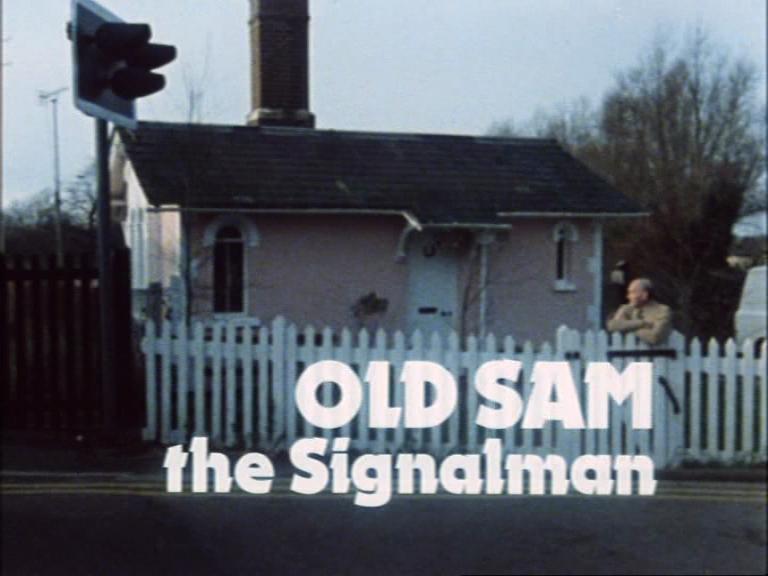
Brooks dedicates a track to his friend Trish Keenan, who passed away at the start of the year. The Patchwork Explains has a haunted but uplifting atmosphere, lighter than air scales ascending heavenward over gently propulsive Kraftwerky rhythms. He could equally have dedicated We Cleanse This Space to her. It evokes an East European fairy tale film with its percussive, pattering Arabic drum, flutes and chanting children echoing in the acoustic of what sounds like a large cave (or one of Pauline Oliveros’ underground water cisterns), and a final, closing of the storybook line: ‘and they were afraid no more’. There is a new age shimmer to some of these tracks, in particular Innocence Elsewhere, with its wind chime stardust and synth wash chords and pure-toned whistle sounds. It all goes a little off at the end, however, with the sound of a frog or toad croaking to remove any crystal-gazing associations. Unforgotten Path, too, with its background wave or wind susurrations , gently struck chimes and whistling synth lines has the sound of one of the tapes you used to find in new age shops from Totnes to Glastonbury, probably with subliminal messages telling you that you were at one with everything and everyone. Brooks has a great ability to produce melodies of affecting melancholia, too, which dig deep into the wells of yearning nostalgia for times past, as evidenced in Beyond the Wychelm. With an underlying bed of a Steve Reich, Different Trains pulse and echoing mandolin-style chords, the portamento-slurred notes of the gossamer tune weightlessly drift and settle down. A tune for the bitter sweet atmospheres of late summer. The turning of the Wheel of the Year is suggested by a repetitive, sequenced arpeggio in a slightly less demonstrative and upfront Tangerine Dream style, with the melody played on what sounds like a monophonic synth, each metallic, spring-like note carefully and singularly picked out. The final track, Lonely Signalman, takes its opening quote from the 1982 British Rail film Sam The Signalman, which can be found on the bfi dvd The Age of the Train (volume 7 in its British Transport Films Collection). It’s in the Devon library system if you’re curious and happen to live down this way. Sam, played by Frank Middlemass in typically avuncular style, tells young children how to avoid certain death by observing a few rules at the level crossing. On the bfi discs, this comes shortly after Peter Purves has put on his serious voice to show children how messing about on railway lines to impress your mates can leave you hideously maimed for life, and a disastrous sports day taking place by a railway cutting and tunnel has demonstrated just what would have happened to that wounded runner had Jenny Agutter not waved her pants at an approaching train to stop it in The Railway Children. This is another one of Brook’s melancholy tunes, and its mood is enhanced by wistfully vocodered vocals repeating that ‘signalman lives all alone’. This inevitably brings to mind the classic BBC ghost story adaptation of Charles Dickens’ The Signalman, and this track could provide the theme to a modern (circa early 80s) updating, with DMUs rather than steam engines. A final discordant downward strum inside a piano provides a sudden and sinister ending. Has the loneliness got too much for Sam? Did he see something which he wished he hadn’t? The Advisory Circle leave us with one final message before we end this excellent album, and I offer it to you, too: ‘Look after yourselves – mind how you go’.
The Sky Crawlers is a 2008 anime film directed by Mamoru Oshii, who was responsible for one of the defining films of the modern genre, Ghost In The Shell. It concerns a group of genetically bred children who are seemingly created specifically to fight in an endless war in the air. Its origins and aims are obscure, not least to those whose lives are dedicated to its pursuit, but it appears to be partly a militarisation of global corporate rivalries and partly a manufactured spectacle, a mass distraction designed to engage the enervated attention of a weary populace. The majority of the film’s action (and I use the word loosely) takes place on the ground, slowly orbiting around the blank and affectless lives of Yuichi and his female commanding officer Suito and the sense of connection which they feel between them. The pace is very slow moving and may frustrate those eager for the more traditional anime pleasures of city crushing giant robots and deadly cyberpunk-doll heroines, or the wide-eyed wonder of the colourful fantasy worlds of Hayao Miyazaki and Studio Ghibli. These are all great, it goes without saying, but Oshii has something else to offer, and rewards the patient and receptive viewer. He is, in many ways, the Tarkovsky of the Japanese animation world, bringing a weighty and reflective (some would say ponderous) philosophical perspective to bear on genre material.
Landings - returning to the world
The film begins in the midst of an air-battle, planes threading through the sky in thrilling loops in a deadly dance of evasion and pursuit. One plane swiftly demonstrates its dominance, however, sending another plummeting into the ocean below. It glides into the foreground and we see the fierce logo of a black panther on its side. If this is a dog fight, then it is clearly set apart from the pack. From this all-action opening, we drift downward in a dreamlike descent through formless clouds, to the accompaniment of Kenji Kawai’s beautiful, Celtic-inflected title music. I gather from the credits at the end that the prominent harp theme is played by none other than Joanna Newsom. This would have been after the release and huge success of Ys, so I can only assume that her participation is an indication that she is a fan of Oshii’s work. We see the geometric, straight-edged patterns of a landing strip and the buildings of the base which surround it. The duality between earth and sky, between predetermined pattern and order and the open spaces of freedom is immediately established. This duality is embedded in the very surface form of the film. The sky sequences are hyper-real, using the latest computer-aided animation techniques, whereas the ground-based core of the story uses the more traditional craft of painted backdrops and hand-drawn frames. The airborne scenes thus have a transcendent shimmer, whilst the earthbound ones have a more static feel – the quality of slightly unreal figures moving about through artistically rendered landscapes. This suits the underlying sense of the film perfectly. The story retains a certain vagueness in terms of specific detail throughout, which leaves the central symbolism open to interpretation. The duality between earth and sky could be that between the imaginative and the practical sides of the mind; between the material and the spiritual aspects of human nature; or a representation of the Taoist division between the counterbalancing forces of earth and heaven, regarded as embodiments of female and male principles. Of course, it could encompass all of these and more.
Basset joy - Sasakura and hound
When we touch down on the earth for the first time in the film, the perspective shifts and we become aware that we have been seeing the world through the windows of an airplane cockpit as it descends from the sky. The pilot is our protagonist, Yuichi, who lights up cigarette as soon as he touches the ground and discards the match, which lies burnt and withered on the runway’s surface. The spent match is dwelt upon at significant length, and is representative of lives used up, briefly burning before they are extinguished and thrown aside. As with the cigarettes which the young characters smoke throughout and the pins in the bowling alley which they go to in the city, which are knocked down only to be mechanically set up again, the ball rumbling back down the chute, they are symbolic of the recurrent round of death and rebirth; a speeded-up version of the Buddhist view of cyclical existence. On landing, Yuichi is greeted by a basset hound who patters across the tarmac with his waddling run, ears and tongue flapping with joy, and in rather more restrained fashion by Sasakura, who is the base engineer. A woman of practicality and sense, she is the earth mother, the spirit of the earth. Basset hounds are Oshii’s signature creature, turning up in most of his films. They also represent a grounded sensibility (being, with their short, stubby legs naturally close to the ground), and a patient, simple wisdom which eludes his human characters, who are always seeking some sort of transcendent or hidden knowledge. In Oshii’s live action film Avalon, the (real) basset hound becomes almost an embodiment of divine love, and a guide towards a more authentic reality. The one moment of genuine, unguarded love and affection in the film comes when the protagonist, Ash, comes home to her bleak, Spartan flat and prepares food for her basset. It’s really quite upsetting when she subsequently returns to find that he has gone. Oshii is evidently a dog lover. In an accompanying interview on the dvd, he notes how the names which the pilots have on their helmets are all those of breeds of terrier. I have to say that, apart from Yuichi’s Cairn, I didn’t notice these, but Oshii explained such details by simply observing that he liked terriers.
Dream corridors - suspended light
The film’s existential cards are also laid on the table early on, during the first meeting of Yuichi and his commanding officer Suito. Yuichi comments that ‘the glare of the sun was unbearable’, which prompts Suito to ask him if he’s been reading Camus, referring to the French writer’s novel The Outsider, from which this line quotes. In fact, Yuichi is not an isolated figure like Camus’ protagonist Mersault but shares his condition of existential alienation with his fellow youthful pilots, and with Suito in particular. All of them live in an extended present, with almost no memory of (or particular concern for) their origins and little presentiment of what lies in their future, other than an awareness of the possibility of sudden death in the air. Their lives float in aimless suspension, and they drift through life as if in a dream. The world is like a waiting room, an intermediate state. The interior of their quarters is illuminated from without by shifting rays of light which create a hazy, unreal radiance through which characters walk as if it has a gelid substance, and which makes walls and floors seem insubstantial.
Sad cafe - displaced American Diner
The whole world of the film is suffused with a sense of belatedness, of everything having already been experienced to the extent that it has become worn and overfamiliar. The young pilots emerge out of nowhere, dropping from the pregnant sky in their new planes, and whilst they have vague intimations about there having been some ‘before’, they show no real curiosity about their past. Yuichi is told that his predecessor was called Jinroh Kurita, and intuits that this may have been one of his previous ‘incarnations’, but he remains indifferent in the face of such revelations. He merely accepts his condition and does nothing to actively seek out his true nature. The ‘Blauer Fisch’ music box in Suito’s office acts as a metaphor for the lives of the pilots, its revolving discs wound up to slowly reel through the same tune each time, its melody etched immutably into the copper surface. When the mechanism runs down, the tune decelerates and comes to a stop, only to be wound up once more to play in precisely the same manner. We witness the same pattern occurring with the pilot Yudagawa, a distinctive looking albino with a habit of reading the daily newspaper and fastidiously folding it once he’s finished. He is killed in an air battle, but another identical-looking pilot turns up shortly thereafter, with precisely the same habit. Only the name is different. A constant sense of déjà vu pervades the world; nothing seems new, everything is wearily familiar, even if it is apparently experienced for the first time. When Yuichi goes with his roommate Tokino to the café, he is told that he will like the meat pie, and seems to have some kind of direct sensory memory of its taste. The next time he goes to the café, alone, the pie is presented to him as his ‘usual’. Tokino’s solution to existential numbness is to lose himself in a daily round of sensual indulgence, of drink, food and sex. He instinctively and enthusiastically follows Blake’s dictum that the ‘road of excess leads to the palace of wisdom’. He takes the newly arrived Yuichi up to the distinctly palatial mountainside brothel, where he is greeted as if he is a regular, returning customer, despite the fact that this is the first time he can remember coming here. Everybody seems to know him except himself.
Internal skies
The sky seems to offer the possibility of transcendence, some kind of heightened experience, or just escape. Yuichi’s eyes are repeatedly drawn to it. In the brothel, he gazes up at the decorated ceiling panel with its mural depicting the blue yonder interlaced with swirls of fabric which look like plane trails; and in the anonymous old city he looks up at the featureless night sky rather than at the venerable buildings which surround him, the lights pendant from electrical wires seeming like stars fallen to earth, almost in reach. But when he and the other pilots do take to the air in their propeller driven planes, the experience is depersonalised and dehumanised. They are locked into their cockpits, their vision limited to the narrow canopy above their heads. Their helmets and goggles make them indistinguishable one from the other, and their respirators look like muzzles, giving them an animalistic, dog-like appearance. Oshii’s terrier call names complete the allusion; these people are dogs of war, but small and well-trained ones, who do as they are told. When they are in the air, they even talk in a different, radio-distorted language – English (this if your watching the Japanese language version. This subtlety is lost in the US dub). There is a sense that their individuality has been subsumed by the aeronautic technology within which they are encased. The plane is the important thing, they are merely the software component.
Child's play - war as a game
The pilots are known as ‘kildren’, a name which conflates the words kill and children; Children who kill and who are killed. They are seemingly immortal and remain in an unchanging state of early adolescence until they meet an untimely end. And as Yudagawa’s return suggests, even this is not really the end. It is childhood as a state of non-blissful ignorance, but not of innocence. The tragedy of such a permanently arrested development is made clear by the visit to the base of Suito’s daughter Mizuki, who is rapidly approaching her in terms of physical age. Mizuki also has the strange appearance of being out of time, dressing like a Victorian child. When she asks Yuichi why the kildren don’t grow up, he replies that ‘it’s not that we can’t, it’s that we don’t’. This may indicate that there is an element of choice to their condition, but sounds more like denial; a reluctance to admit to an essential powerlessness to a bright and inquisitive young girl. Mitsuya, a young woman whom they meet at another base, urgently offers a potential explanation to Yuichi for the kildren’s existence, for their changeless, immortal youth. It’s a rational framework for a metaphorical expression of the human condition in a stagnant age defined by consumerism. Kildren was initially the product name of a drug developed by the Rostock Corporation, whose age retarding properties were ‘the accidental by-product of research into gene modulators’. They are all, essentially, corporate product. Mitsuya desperately needs an engaged recipient of her knowledge, someone to acknowledge it and share in her shock. Yuichi remains lying on his bed, his back to her, unstirring.
Waving the corporate flag - war tourism
The war which gives purpose to the kildren’s regimented lives is like a strange form of play for them, harnessed to the needs of the corporate state. This is suggested by the scene in which Yuichi and Tokino perch on toy coin-operated plane rides and reflexively bounce up and down on them as they engage in disconsolate conversation. The aims and moral or political bases of the war are obscure, but it seems to be a permanent and accepted facet of society. Just as the endless war in George Orwell’s 1984 is a way of conditioning the populace of Airstrip One and creating a pretext for its police state, so the conflict here is a way of maintaining the dominance of corporate blocs. The kildren fight for Rostock against their rival corporation, Lautern. People support either side as they would a sports team, an extension and intensification of brand loyalty. Reports are constantly broadcast on television and printed in papers owned by the respective corporations. A group of tourists turns up at the airfield base to see where the action happens, and Yuichi has to show them around, posing awkwardly for photos and blandly answering their questions (put to him in English, spoken with an English accent). One them tells him that they are ‘cheering for your team’. It is war as a spectator sport which takes place in safely neutral zones, over seas or barren moorland. People in cities look up to see squadrons of fighter planes rumbling overhead with no sense that they are in any imminent personal danger. In the cafes and bars, the war plays out in the background on TV screens, largely ignored or at best casually glanced at by the patrons. Major attacks are reported as they happen, with manoeuvres openly revealed by excited presenters. It is a fake conflict, carefully managed, given form and narrative, and perpetuated. Newspaper headlines such as ‘no warning was given’ and ‘let’s win for justice’ provide the necessary outrage and vague inspirational propoganda slogans. Suito tries to get Yuichi to question his role in the war, pointing out that he has no idea what he’s fighting for. It’s war as an expression of free market business, she suggests, literally making a killing, with the kildren as manufactured game pieces – corporate pawns. ‘It’s a game so we can kill and be killed legally’, she says. For the ever-passive Yuichi, however, it remains just a job, and the only purpose he has been given. ‘An interesting view’, is his disinterested response.
Old and New Worlds - Standing stones and convertibles
The world in which the film takes place is a patchwork landscape, both geologically and culturally. Beyond the base, there are coastal roads, moorlands and a solitary American diner. A large and stately baroque mansion in the hills, reached by a hidden side track, houses the brothel. There is also an old East European city (which seems to have Polish street signs), of the kind to which Oshii repeatedly returns, complete with his signature trams. These seem to be isolated components in a geography of surrealist juxtapositions. The locales to which the kildren travel often seem almost entirely bereft of other inhabitants. The streets of the old city are deserted, its trams empty, illuminated shells, the tables of its cafes and restaurants all free. When they do encounter adults, they are full of a paralysing anomie and seem incapable of lifting themselves from a weary, dispirited slump. One old man appears to have taken up permanent residence on the steps outside the American diner, crouched over with his head hung in despair. The HQ of the corporate military powers is located beneath a Ballardian concrete block rooted squarely and brutally on the edge of a sea cliff, in contemptuous defiance of the processes of erosion which have given the surrounding rocks more complex forms. Suito and Yuichi are blankly denied access to its hidden spaces and the secret knowledge which they might contain. Their subordinate position is made quite clear. They are not allowed to see where the adults play.
Riding the illuminated carriage of the night - trams and East European cities
When we see a large, Dr Strangelove style map of the world upon which a large scale raid is planned, it is clearly not our world (although earlier on, the front page of a newspaper clearly depicts the familiar outline of the British Isles, suggesting that the kildren's base is located in some version of this country - Scotland, maybe). There are two monumental continental land masses facing one another across an ocean; a simplified cartographical reproduction of bipolar global conflict, reducing it to its essentials. There are hints of a more deeply rooted culture in the landscape, as we glimpse stands of megaliths out on the moor, with spiral patterns carved into their stone surfaces. The non-kildren speak English (which is also the language of the TV broadcasts), whilst everyone at the base speaks Japanese (except when they’re in the air – perhaps for the benefit of viewers on the ground). Perhaps Oshii is making some comment on the cultural drift of his own country, its loss of identity in the wake of globalisation and the assimilation of dominant western styles and preferences.
The play of love and death
Yuichi and Suito develop a close bond as the film progresses, which wavers between the twin Freudian poles of Eros and Thanatos. Suito has clearly known and felt strongly drawn to Yuichi through previous incarnations. It becomes evident that she has also killed him before, and is prepared to do so again, something of which the other kildren are aware, and which creates strong feelings of distrust towards her. In fact, the killing was at the request of Yuichi’s predecessor, Junroh, and was, in its own strange way, an expression of love, inverted and manifested through the fulfilment of the death drive. Desire and death are tragic, closely intertwined bedfellows. In the end it is Suito who urges Yuichi to kill her. He fires the gun, providing the climax, but deliberately aims it just to the side so that it misses her head and shatters a pane of glass instead. ‘You have to live’, he tells her as she opens her eyes to the world once more, ‘until you can find a way to change things’. It’s a harder choice, but a necessary one.
The sign of the owl - guide and guardian
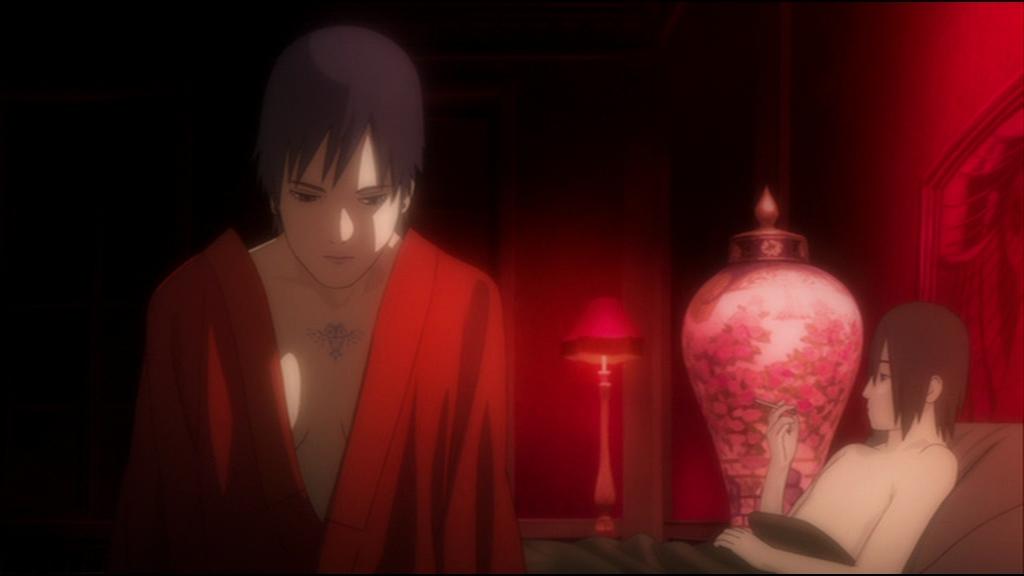
Death can be found easily enough in the sky, anyhow. The kildren are in awe of a pilot known as the Teacher. He is a figure of mythic status who defected from Rostock to the Lautern Corporation and has apparently grown beyond his arrested adolescence into adulthood – a dual betrayal. His lesson is on the limits of knowledge and the impossibility of transcendence and enlightenment. He is the harsh father figure of the sky, just as Sasakura is the nurturing mother figure of earth. The savage black panther on the side of his predatory plane is the opposite of the gentle, soppy and sorrowful basset hound which is Sasakura’s familiar. There is a third, intermediary figure, known as Fooco, whom Yuichi meets in the brothel. An intense, witchy figure, she has a tattoo of an owl above her breast, the creature of Athena. She is a guide, a protector and a source of wisdom. She arrives in the middle of the moor, miles from anywhere, to pick up the wounded Suito and take her home when she crashes to earth after her encounter with the Teacher. Somehow, she knows when she will be needed, and takes Yuichi under her wing almost as soon as he returns to the world.
Watching the skies - waiting for the return
Finally, Yuichi decides to confront the Teacher, knowing that it will probably result in his death. He takes to the sky in order to kill his father, as he puts it in starkly Freudian terms. His short round on earth has taught him something this time, however, despite his passivity throughout. ‘You can change the side of the road that walk down everyday’, he muses as he flies along the coastline, looking down at the winding path following its contours. ‘Even if the road is the same, you can still see new things. Is that not enough in life? Or is it not enough because that’s all there is?’ It is. The earth, not the sky, was the locus of enlightenment all along. His plane is torn apart by the Teacher’s unforgiving bullets.
Canine wisdom - the spent match
After the credits have rolled (to the sound of Kenji Kawaii’s beautiful, plangent score) a new plane lands on the familiar runway. We see a figure from the rear climbing out of the cockpit. His helmet identifies him as being a Norfolk terrier now. He lights a cigarette and throws the spent match onto the tarmac, where it lies, bent, black and shrivelled. Sasakura walks out from the hangar, turning wearily away when she sees him. He walks into Suito’s office (still viewed from the rear) and introduces himself as Isamo Hiiragi. Suito looks up and dispassionately greets him. ‘I’ve been waiting for you’.
Last Saturday saw the beginning of a lengthy season of films and events celebrating the golden days of repertory cinema in London, and in the Scala Cinema in particular – Scala Forever. There’s a fantastic trailer for the season, made by Justin Harries of the Filmbar 70 (cult film and a pint of beer – I like the sound of that) which filters various clips through a dizzyingly unfocused two-toned tint, which both emulates the off-centred visual style of the Scala programmes and gives a wry nod to the imperfect nature of some of the old Scala prints. The Hilarious opening quote, in which a chap styled for the lounge, with cravatte daringly worn outside his shirt, stridently declares ‘this is my happening and it freaks me out’ is taken from Russ Meyer’s 1970 film Beyond the Valley of the Dolls, and was directly quoted by Mike Myers in the first of his Austin Powers films. There follows a delirious eyeflash progression of images from Zombie Flesh Eaters, Once Upon a Time in the West, Valerie and her Week of Wonders, Zardoz, Pink Flamingoes, Black Sunday, Dawn of the Dead, Seconds, Deep Red, Jules et Jim, After Hours, Glenn or Glenda, A Night At the Opera, King Kong, A Clockwork Orange, and Aguirre, Wrath of God, with the comic end title music from Dawn of the Dead to round it off. Last Saturday's edition of Jonny Trunk's OST show on Resonance fm was also dedicated to the season, and to the kind of films the Scala used to show, and should hopefully turn up on the station's podcast archive page sometime soon. Of all the old repertory cinemas in the capital, from the Everyman in Hampstead and the Ritzy in Brixton, to the Electric in Portobello Road and the Riverside in Hammersmith, the Scala seems to be remembered with the greatest affection. A ramshackle and barebones operation, it offered more than just a wildly eclectic programme of cult, classic and arthouse films. The Scala was an experience, a clublike hangout and for some a welcoming and familiar home from home – a church of cinema which was open to all believers and seekers alike. The Scala Forever site has already begun to amass an anecdotal drift of fond memories, and a book gathering together further reminiscences is promised for everyone who buys a ticket to any of the season’s screenings. I was one of the Scala regulars in the mid to late 80s, and see no reason not to add to this nostalgic outpouring with my own remembrance of the place where I received my formative film education (a significant improvement on my parallel formal schooling, and with a longer-lasting impact).
I would travel up from the south-eastern suburbs several times a month to see double or triple bills and occasionally test my endurance with a Saturday all-nighter. I would eagerly collect the latest programme, which was a highly desirable artefact. It folded out into a four A4-panelled poster, which would be attached to my bedroom wall. These posters were fabulous graphic works in themselves, assemblages bringing together cult actors and actresses and thrillingly evocative stills and posters, often printed in striking shades of gold, green or red. I would cut out various of these pictures to add to my own ever-growing collages, where Marlene Dietrich would find herself mingling with Peter Cushing, Daffy Duck with Bob Dylan. I still have a couple of panels of this wall-spanning, vaguely obsessive product of teenage toil, those fragments now all that remains of the old programmes. The Cinema Museum promises to put some of them on display on its Scala Day on 17th September. You can also see one from the Scala’s latter days accompanying the Lost World of the Double Bill article in the August 2008 Sight and Sound. The circular entrance on the corner of Pentonville and Caledonian Roads immediately gave a sense of occasion, of crossing over into a magical space. You got your tickets from an attendant in an old fashioned booth, a small enclosed room which looked rather cosy. Climbing the turning stair, you arrived in the lobby where people gathered before going in to see the film or refreshed themselves in the interval with a cuppa or something stronger from the serving hatch at the far end. At some point during my Scala years, a couple of artists who I believe styled themselves the Urbanites painted the walls and ceilings with a mural depicting famous film scenes (or scenes which would be familiar to regular Scala-goers), all reduced to witty stick figure form. You could crane your neck and pan across the barrelled expanse of the ceiling, scoping in an eccentric pattern, connecting one to another and thus creating your own random double and triple bills. You can see some pictures of the lobby and the auditorium over here.
Walking up another short set of steps, you entered the auditorium halfway up its fairly steeply graded slope. You could either continue upwards into the larger seated area or head down past the partition barrier to the lower depths where, a couple or rows at the top apart, it was a question of sprawling on the tiered, carpeted steps and gazing up at the screen. Whichever direction and mode of disportment you opted for, you had had to stumble along in near total darkness. I remember performing a spectacular trip and forward sprawl on one occasion, a piece of slapstick whose perfection could only be achieved through complete lack of intention. Sometimes, if you arrived a little early and didn’t fancy lingering in the lobby, you could wander in and catch the latter stages of whichever favourite was just reaching its climax. I remember opening the doors and entering the auditorium to hear Charlton Heston cry ‘you maniacs! You blew it up! God damn you!’, as he fell to his knees on the shore and stared out at the half-buried ruin of the statue of liberty in Planet of the Apes. Walking in during a scene of a well-loved film was a real thrill – an anticipation of a pleasure which would be more fully and completely enjoyed later.
The recurrence of particular films, either in the same programme or in changing combinations, meant that you could become thoroughly acquainted with their every detail and nuance; a precious and rare opportunity in the early days of video when the availability of less mainstream fare was very limited (and even when issued, limited by the unsatisfactory nature of the medium). Films to which I returned again and again became like familiar landscapes, complete with the scratches and jumps etched into the prints, and other peculiarities particular to the Scala’s copies. The white onscreen subtitles accompanying Cocteau’s Testament D’Orphee became completely illegible whenever they weren’t superimposed over a darker area of the projected scene. Entering the cinema and seeing one of these films or programmes was like coming home, or perhaps returning to a regular holiday haunt. You could lose yourself for hours, for whole days or nights in here. No-one was about to kick you out if you decided that you’d like to sit through that whole triple bill again. Indeed, some did effectively make their home there. Richard Stanley, the director of Hardware and Dust Devil (and contributor to the upcoming anthology picture The Theatre Bizarre) writes about his Scala experiences in Dying Light: An Obituary for the Great British Horror Movie, a piece published in Steve Chibnall and Julian Petley’s 2002 critical anthology British Horror Cinema. He recalls coming to London at 16 years of age, where he ‘took refuge in those aisles…as much for warmth as anything else…The Scala became my sanctuary, my alma mater, a house of dreams redolent of an opium den with its haze of psychoactive smoke and its delirious, half-glimpsed denizens. I would camp with my bedroll on the front tiers of the red-lit, cat-haunted auditorium’. Not sure about the smoke haze; as I recall, the auditorium was a no-smoking area, although a vague waft of aromatic herbal scents would drift across during films such as Easy Rider or 200 Motels (Frank wouldn’t have approved). Later, exhausted and bankrupted by the production debacle of his would-be magnum opus Dust Devil, Stanley once more found himself ‘taking refuge in the only sanctuary left to me: the Scala cinema, where Jane Giles allowed me to spread my bedroll in a room above her office’.
Others have recalled the cinema as being a refuge in which outsiders and misfits could take up regular residence in an otherwise unforgiving era, and also a place in which revelatory experiences were possible. Peter Strickland, who spent years struggling to produce his first feature Katalin Varga, remembers (in the November 2009 issue of Sight and Sound) ‘when I was 16, I went to the Scala in London to see Eraserhead. It was unlike anything I was accustomed to…Suddenly here was something that conveyed a state of mind. The cinema smelled of cats, dope and beer. The Northern Line ran underneath. It was a huge epiphany’. The August 2008 Sight and Sound contained a celebration of the Scala and the lost era of repertory cinema with an article written by Jane Giles, a former programmer at the cinema who went on to head of acquisitions at Tartan films (and there’s no doubt that the Scala would’ve been at the forefront of the discovery of the new wave of Asian horror films, the likes of Ring, The Grudge and Audition). Giles recalls how ‘the cinema’s extraordinary atmosphere affected the audience profoundly, acting on their senses in a way that is hard to imagine in more mundane or domestic environments’. She also quotes Derek Jarman, writing in 1989, declaring that ‘The Scala is one of very few, and I’m afraid, a shrinking number of venues where it is possible for a young audience to see our film history. Any threat to the cinema is indirectly a threat to the industry as a whole, for here new audiences are educated and a whole generation that is active in our cinema has found its task’. It’s certainly a statement which is backed up by the experiences of the young Strickland and Stanley. Sight and Sound editor Nick James, in his editorial for the June 2007 Grindhouse issue, he remembers how ‘at the Scala…in the 1980s I was one of the many watching scratchy prints of the likes of Faster, Pussycat! Kill! Kill!, Pink Flamingos, Reefer Madness, Detour, The Warriors, Thundercrack!, and Assault on Precinct 13’. He also remarks, in the August 2005 Sight and Sound, on the intense experience of seeing related films one after the other, recalling a film noir all-nighter featuring three Robert Mitchum films (Out of the Past, The Big Steal and Where Danger Lives). ‘It was a formative cinematic experience for me’, he writes, ‘not least because I drifted off occasionally so the three films intermingled to become one unforgettable epic that was like a paradigm for the best of Mitchum’s early films and for noir itself’.
The auditorium had its own particular acoustic imprint, as if the building were subtly altering the films to make them its own. Every one became a Scala film – they were never quite the same elsewhere. The speakers may not have been of the highest quality, but there somewhat crude and echoing sound seemed perfectly suited to the old place, adding a certain time-haunted quality (instant hauntology before its time). The sonic mix was occasionally added to by trains which periodically rumbled by beneath, also giving your seat a bit of a William Castle tremble. Although these were probably just on the City Thameslink line headed for Blackfriars and beyond, I believed at the time that they were Northern Line underground trains, and that there was therefore a connection with a whole world of subterranean tunnels (perfect if you were watching Death Line or An American Werewolf in London). There was also a cat who wandered along the backs of the seats, sometimes brushing the nape of your neck with its tail, which could be rather unnerving, particularly if you were watching The Tomb of Ligeia, Cat People or, indeed, The Black Cat at the time (but pretty cool if you were watching Breakfast at Tiffanys). There were never any luxuries like heating or air conditioning, but somehow the ambient temperature always remained comfortable. You could always keep your coat on if it got a bit chilly.
As Nick James notes above, the cinema was particularly associated with camp, trash and gay cinema. Many of the films could be said to fall within the catch-all definition of a chapter title from Kim Newman’s recent update and rethink of his survey of contemporary horror Nightmare Movies (first published when the Scala was still up and running, and indeed christened with a launch party at the cinema in 1988): The Weirdo Horror Film or: Cult, Kitsch, Camp, Sick, Punk and Pornography. The films of Russ Meyer, Walerian Borowczyk, John Waters, Paul Morrissey and George Kuchar were often all of the above at once. Kuchar’s Thundercrack! (these films often require that exclamation mark in the title) seems to be one which brings back particularly strong memories in the old Scala crowd. It certainly appears to be something which few have been able to forget (even if they wished they could). Newman notes that ‘since it joined Pink Flamingoes on the late-night cult circuit, Thundercrack! has become the most walked-out-of film this side of Michael Snow’s La Region Centrale’. Couples shared intimate moments during these screenings (and Jane Giles recalls the popularity of the women-only Russ Meyer nights) watched over by the oversized tutelary spirits of Divine, Joe Dallessandro or Tura Satana, celluloid gods and goddesses of love and genii loci.
My Scala favourites tended towards the fantastic and classic elements of their repertory. I always went to see their Cocteau triple: La Belle et La Bete, Orphee and Testament D’Orphee, and If…, which was usually shown with Blow Up and, if I was lucky, Performance, if not, Godard’s unbearable Sympathy for the Devil. I also caught any Powell and Pressburger films which were shown (they were just then being rediscovered, with new prints being released) and Tarkovsky’s Stalker, Solaris, Nostalgia and The Sacrifice. All of these remain firm favourites to this day, and I could probably quote chunks of them verbatim, or play back scenes with some detail in my head. The sublime Christmas angel double-bill of Wings of Desire and It’s a Wonderful Life was also essential, a highlight of the season. I also saw a rare John Cassavetes double bill of Gloria and Love Streams, having been introduced to his films at an ICA season in the mid 80s. Love Streams (John’s last film proper) remains incredibly hard to get hold of these days. A Hitchcock/Jimmy Stewart triple of Rope, Vertigo and Rear Window introduced me to the wonders of Hitch beyond Psycho. You really haven’t seen Rear Window properly until you’ve watched it on the big screen, and seen the blinds slowly pulled back at the start to unveil the view which you’ll be gazing at alongside Stewart for the rest of the film. Henri-Georges Clouzot’s Wages of Fear and Les Diaboliques was always a good, white-knuckle double (hmmm, or was that at The Everyman – memory has a tendency to compress and compact these experiences). Franju’s Les Yeux Sans Visage was definitely on at the Scala, however, and offered one of two scenes which I found myself having to look away from (the other being Martin’s first drinking of blood in George Romero’s film). A beautiful piece of dreamy black and white surrealism, it was one of those films which was perfectly in synch with the setting, the slightly unreal feel of the place enhancing its mood.
The Scala showed a fondness for 60s music and counterculture, and I saw many films from that era, which I preferred to the one in which I was growing up. Easy Rider was a regular, sometimes shown with Roger Corman’s The Trip, also featuring Dennis Hopper and Peter Fonda (and with Hopper going characteristically off-script, inserting a ‘man’ between every other word). The Monkees’ Head was a real surprise, one of the best films from that era, self-mocking and full of wild pop surrealism and fantastic music (and Frank Zappa leading a large cow across a backstage lot). I remember a psychedelic all-nighter in which it played with Zappa’s incomprehensible mess 200 Motels, the rather dull Grateful Dead Movie, Here We Go Round the Mulberry Bush (which vied with Sympathy for the Devil as the worst film I saw at the Scala – although I find both interesting these days for their background detail and the attitudes which they convey, as long as I have the remote to hand for fastforwarding and rewinding) and the Magic Roundabout feature Dougal and the Blue Cat. The beat connection was also made with a triple bill linked together by the presence of Allen Ginsberg (always the great connector and bridge between different scenes): The documentary Whatever Happened to Jack Kerouac, the Kerouac narrated Pull My Daisy and DA Pennebaker’s Dylan doc. Don’t Look Back. Pop 60s science fiction was represented by Barbarella and Thunderbirds Are Go, the latter with music provided by puppet versions of Cliff and the Shadows (spot the difference, an unkind observer might note). I think I may have seen a 2001 and Silent Running double too. I don’t see why I wouldn’t have. Nic Roeg was always a favourite of Scala programmers, and I recall seeing Walkabout, The Man Who Fell to Earth, Don’t Look Now and Performance in various combinations. There were also spaghetti westerns and eastern epics. I first saw Once Upon A Time in the West at the Scala, and also fell under the spell of A Touch of Zen. If I recall correctly, I also saw the amazing kabuki-style ghost story compilation Kwaidan here. There were also Woody Allen triple bills from his mid-Mia late prime, small black and white gems such as Broadway Danny Rose, Zelig and The Purple Rose of Cairo.
Horror was a big focus of the Scala. Nik Powell and Stephen Woolley had established the Scala at the new venue (it had previously been based in Charlotte Street) and also used it as the base for their new distribution business Palace Pictures (which would eventually also expand into production). Palace acquired the rights to Sam Raimi’s The Evil Dead, and its huge success (aided no end by the indignant furore which it stirred up as an exemplar of the ‘video nasty’) set the tone for the gaudy comic book horrors of the rest of the decade. I remember seeing several examples at the Scala, where they often received their premieres: The Return of the Living Dead, Re-Animator, Evil Dead 2 and Nightmare on Elm Street 3 (during which the audience let out a rousing cheer at the return of Heather Langenkamp’s character). Although enjoyable enough at the time, few of these made any long-lasting impact or made you want to go back and see them again. It was the dawn of the disposable multiplex horror movie, a mindless ghost train thrill ride with added entrails and buckets of blood liberally thrown in, and a line-up of good-looking but characterless teenagers lined up for the slaughter. The films which I did return to at the Scala were those of George Romero and David Cronenberg. Romero in particular featured often in the programmes, and I remember an all-nighter featuring Night, Dawn and Day of the Dead alongside Martin and (I think) Creepshow. Dawn of the Dead is another film which has the indelible imprint of the Scala for me.
Whilst Romero largely went off the radar during the latter half of the eighties, Cronenberg was still producing distinctive films, with a more mainstream sheen than before, but still with his characteristic mix of distanced intellectualism and an insistence on the physical nature of being: the likes of the Fly and Dead Ringers, both of which were released during my Scala era. I didn’t see either of those at the Scala, but I did (if memory serves) see what remains, to my mind, his best film, Videodrome (in which he splices and grafts elements of JG Ballard, Philip K Dick and William Burroughs and possibly also gives a nod to Harlan Ellison with the name of one of the characters) and also caught up with some of his earlier films, from his breakthrough picture Scanners (with a post-Prisoner role for Patrick McGoohan) to earlier efforts such as The Brood (featuring Oliver Reed in a role of typical sotto voce intensity), Rabid and Shivers. Dario Argento was the third of the feted 70s horror auteurs to feature at the Scala, but I’ve never enjoyed his films, which always seem to centre around lingeringly brutal misogynistic violence. Their undoubted stylishness and visual panache can’t distract from this essentially repugnant core, a depressing component of too much modern horror, and never justifiable no matter how often Poe is invoked. An auteur in terms of ideas if not in terms of polished technique, Larry Cohen was also a Scala mainstay, with satirical and sardonic films such as Q: The Winged Serpent and The Stuff retaining the social bite of the genre in the 70s, and also bucking the 80s trend by featuring well-drawn and adult characters.
The Scala building itself has an interesting and colourful history. Its construction was interrupted by the advent of the First World War and it became a workshop for the manufacture of aircraft parts for the duration. After the armistice, it became a labour exchange for the returning soldiers. It finally opened as a movie house in 1920, and was run as the Kings Cross Cinema under the management of Gaumont British Pictures. It was damaged during the blitz, and re-opened after an extensive refurbishment as the Gaumont in 1952. The Odeon took over from 1962 to 1970, when the general downturn in cinemagoing resulted in its led to it following the depressing trend of many London cinemas and switching to a programme of softcore porn. This didn’t work either, however (Soho cinemas had the benefit of local, Met-assisted economies of scale) and it returned to showing mainstream films in combination with a series of late night concerts. This memorably included a 1972 performance by Iggy and the Stooges, at around the time that they were recording Raw Power in London. The photos on the cover of that LP are all taken from the Kings Cross Cinema show. The live music came to a halt in 1974, with local residents perhaps understandably proving none to keen on the idea. The cinema, like so many others in the early and mid-70s, bowed to the inevitable and, offers from Bingo chains not forthcoming, closed down.
Then, five years later, came the really bizarre interlude in the building’s history. It was re-opened as a primatarium (a word I suspect the new owners made up), a hokey ‘ecological’ exhibition with a sorry collection of caged monkeys as its central attraction. Such a throwback to carnivalesque hucksterism would be unthinkable now, with its blatant exploitation of the animals involved, and shows once more what a wholly different country the 70s were. Richard Stanley, in his dying light article, remembers ‘a vast ape house, painted jungles crawling across its walls and its sepulchral auditorium filled with Astroturf. When I last looked there were still deserted cages in the basement and if you inhaled deeply enough you could just catch the faint hint of musk and dried urine, a safari smell that took me back to my earliest childhood’ (he was born in South Africa). Unsurprisingly, the primatarium didn’t last long, and Stephen Woolley and Nik Powell brought the building as a place to rehouse the Scala and their nascent Palace Pictures business in 1981, opening in July. Their first film, in acknowledgement of the previous use to which the building had been put (and in regard to what Stanley said above, perhaps intending to take advantage of the lingering aroma to present it in its first smell-o-rama version), was King Kong, which was also the film which launched the current Scala Forever season. The Scala was open for 12 years, until it was finally scuppered by a law suit from MGM over its illegal screening of A Clockwork Orange. I had though that this was a self-destructive final act, a deliberate decision to go down in a final blaze of glory (and possibly provide the publicity to reverse the absurd ban on a film which anyone could see with very little effort) given Michael Heseltine’s decision to plough the proposed cross channel rail link through the area. But Stanley claims that it was all down to a treacherous projectionist who bargained his way into a cushy job at the MGM preview theatre, betraying his former employers by testifying against them in court. A great postcard advertising the trial fund appeal (wittily titled droog in the dock) shows the Scala cat rising atop the rooftop dome of the corner tower in paws raised in playful feline fashion – a kitty Kong. In truth, the cinema had been struggling for some time in the face of Major’s recession. It’s time had come, whether through redevelopment, prosecution or simple bankruptcy. It finally closed down in May 1993. With a self-conscious gesture towards circularity and closure, its final film was King Kong.
The Scala may be dead, but its spirit has risen again. The range of venues in this seasons suggests that repertory cinema is once again in hale and hearty health in the capital, enabled by the ease and portability of digital projection. The old school cinemas are represented by the Phoenix in East Finchley, the Rio in Dalston, the Ritzy in Brixton and the Riverside Hammersmith. The Phoenix is covering the musical side of things with a double bill of the 1958 Newport festival film Jazz on a Summer’s Day and Peter Whitehead’s swinging sixties pop ‘concerto’ of studio and concert footage combined with interviews with the likes of Julie Christie, Mick Jagger and David Hockney (and, more bizarrely, Lee Marvin) Tonite Let’s All Make Love in London. The Rio provides a programme of experimental cinema achieved with mixed levels of success, combining Jean Genet’s Un Chant D’Amour (surely crying out to be combined with Fassbinder’s Querelle, an old Scala favourite) with Ed Wood’s Glen or Glenda (as experimental as they come), and following it with the component parts of Kenneth Anger’s Magick Lantern Cycle. Anger codified the Scala trash aesthetic in his book Hollywood Babylon, and so is an appropriate choice on several levels. The Riverside showed a Marx Brothers double to kick off (A Night At the Opera and A Day At the Races) and is following it up with a series of classy billings which reflect the spirit of the Everyman more than the Scala. The Ritzy meanwhile will be providing a pairing of two of Hitchcock’s blackest films, both of them centring around brutal stranglings – Rope and Frenzy - before moving on to two coolly observed depictions of psychotic breakdown within prescribed interiors: Polanski’s Repulsion and Kubrick’s The Shining.
There are a number of interesting smaller venues of varying degrees of permanence or peripateticism. The cinema at the Tricycle Theatre in Kilburn is offering a juicy double bill of Theatre of Blood, which gives Vincent Price full reign to camp and thesp it up, and Bunuel’s Viridiana. Both feature anarchic and murderous bands of tramps, and both have scenes centring around blasphemous and ill-mannered feasts: Viridiana with a Church-baiting restaging of Leonardo’s Last Supper, and Theatre of Blood with a Shakespeare-mauling restaging of one of the gruesome scenes from Titus Andronicus, in which Robert Morley is force-fed his two ‘babies’ – pampered poodles. The Lexi cinema, ‘the UK’s first social enterprise independent boutique digital cinema’, which is housed in what looks like a small church hall lodged between two suburban semis, is teaming up with the Screen on the Green to put on outdoor screenings, including Some Like it Hot and The African Queen in Holland Park and Richmond Park. Whirled Cinema (nice punning name) is located in what looks like a very cosy railway arch (no.260) near Loughborough Junction in South East London and will be showing a great double bill of recently rediscovered films set in London, Bronco Bullfrog (1969) and Private Road (1970), the latter of which stars Withnail and I writer and director Bruce Robinson. Close-Up cinema meanwhile takes over the Bethnal Green Working Men’s Club to show the first four episodes of Kieslowski’s Dekalog series (the first of which I found deeply upsetting, so be warned). The Portobello Pop Up Cinema is a ‘microplex’ situated in an underpass beneath the Westway, and as if to offset the grey, Ballardian concrete surrounds, it will be showing Sergei Paradjanov’s The Colour of Pomegranites, a sumptuous feast of intoxicating colour and obscure yet compelling symbolic tableaux. The Atomic Bark (and check out their excellent site here) film club takes up residence in Ryan’s Bar in Stoke Newington for what promises to be an excellent evening, with Fellini’s Toby Dammit section from the 60s Poe anthology Spirits of the Dead, featuring a dissolute Terence Stamp, providing a prelude for Corrado Farina's Baba Yaga, not a version of the Russian legend of the witch with a chicken-legged hut, but a weird and warped 1973 Italian giallo (described by Kim Newman in Nightmare Movies as ‘enormously boring’, but maybe it has some redeeming features) – and all for free, too!
It is the Roxy in Borough High Street which is becoming the proxy Scala for the duration, however. It is restaging a few themed all-nighters, including an 80s horror bill which includes Re-Animator, Basket Case, Humanoids from the Deep, Slugs (my god, they made a film of that – presumably with the tag-line ‘an agonisingly slow death’), and Phantasm (the original which, in its crazy way, achieves moments of delirious surrealism and even the odd bit of reflective sadness as it circles around the unacknowledged loss of an elder brother). The zombie all-nighter looks a bit of a treat, too, ranging from the sublime (Val Lewton’s majestic I Walked With A Zombie and Romero’s gore spattered epic Dawn of the Dead with its glacially paced core of self-examining interiority) to the logic-defying Euro weirdness of Lucio Fulci’s Zombie Flesh Eaters (1979), Umberto Lenzi’s Nightmare City (1980) and Amando de Ossorio’s Return of the Blind Dead, in which the Knights Templar return from the grave (this made at a time, lest we forget, when Franco was still in power). Further horror is on offer in the form of a completely unrelated but nevertheless enticing pairing of Mario Bava’s classic gothic chiller Black Sunday with the 1973 blackly comic British movie Horror Hospital, directed by sometime William Burroughs collaborator Anthony Balch, with Michael Gough relishing his role as a demented scientist. You’ve already either seen or missed the pairing of the magical Czech fairy tale Valerie and her Week of Wonders with Juraj Herz’s 1973 gothic melodrama Morgiana, intriguingly described as ‘opening the doors on a fetid, decaying snow-globe of a world where Hammer meets Chekhov with remarkably macabre results’. One to look out for on the Second Run DVD release. There’s an interesting 70s science fiction double, with Michael Moorcock’s Jerry Cornelius brought to the screen to distinctly underwhelming effect in The Final Programme, and John Boorman creating a strange, mythopoetic future world in the hills and valleys of Ireland in Zardoz (a much-derided film which I, for one, think is great). There are Fassbinder and Herzog doubles, and Klaus Kinski turns up in the spaghetti western Grand Silence, playing with that most magisterial example of the sub-genre, Once Upon a Time in the West. Finally, there is a screening of Powell and Pressburger’s ode to vanishing British values The Life and Death of Colonel Blimp, a deeply moving piece of romantic conservatism which always affects me even though I don’t agree with its outlook, which should hopefully be introduced by Tilda Swinton. The whole thing ends with a screening of A Clockwork Orange on the 2nd October. Only this time, the lawyers from MGM won’t be getting on the phone.


 Some more good folkie stuff has also gone online. On the 1974 Topic LP The Rose of Britain’s Isle accordion, concertina and melodeon player John Kirkpatrick is joined by his other half Sue Harris, who plays oboe and hammered dulcimer, for a series of traditional English folk songs and tunes. Staverton Bridge, whose eponymous 1975 LP was released on Saydisc Records, were a Devon folk band featuring Tish Stubbs, Paul Wilson and Sam Richards. They tended towards the more leftward leaning side of the traditional folk repertoire (including Ewan MacColl's We Don't Want to Live Like That), mixing guitar, lute, banjo and whistle with harmonium, group percussion and medieval vocal harmonies. Staverton is a small and picturesque village just outside Totnes, a town which has a very pronounced alternative culture (it's one of a number in the country which posseses its own local currency) from which the group presumably emerged. The Watersons’ For Pence and Spicy Ale is a 1975 Topic Records LP in which the first family of traditional English folk, Mike, Lal and Norma Waterson, are joined by Martin Carthy for their first record of the 70s, a collection of traditional songs (plus one by the late Mike Waterson) such as the Swinton May Song, the Apple-Tree Wassailing Song, Swarthfell Rocks, the Maplas Wassail Song and The Good Old Way. The sleeve notes on the back cover are written by A.L.Lloyd. The Albion Country Band’s 1976 Island Records LP Battle of the Field features a mid-70s incarnation of ex-Fairport Convention man Ashley Hutching's ever-changing folk rock group The Albion Band. Martin Carthy on guitar and vocals, Sue Harris on vocals, oboe and hammer dulcimer, and John Kirkpatrick on accordions, melodeon and concertina turn up again, along with fellow Fairporter Simon Nicol on guitars and dulcimer and Roger Swallow on drums. This group is enhanced by another Fairport member, Dave Mattacks, on drums on the second side, as well as a bunch of Sackbut players. We also have the 1970 LP Folk on Friday, offering (as you might guess) recordings from the BBC Folk on Friday radio series, presented by future Folk on Two main man Jim Lloyd. Robin and Barry Dransfield feature, as do Dave and Toni Arthur, the latter yet to enter her iconic role as a Play School and Playaway presenter. Dave and Toni remark, on the back cover sleeve notes, that 'when they are not performing they are deeply involved in research and have made a study of seasonal rituals, customs and folklore'. Hear the results of their, and other's esoteric investigations here. Dave and Toni sing The Death of the Earl of Essex and Two Pretty Boys, whilst the Dransfields, by way of contrast, offer Talcahuano Girls and an instrumental medley. There’s a great sleeve by BBC Records graphic designer Roy Curtis-Bramwell, too.
 Tolkien has always been a folkie favourite, and we have a fascinating recording here of The Hobbit, a 4 LP boxed set on Argo Records from 1974. This is a 'dramatic reading' of the story which introduces the Middle Earth mythos, made by Nicol Williams. Williams played a very eccentric Merlin in John Boorman's 1979 film Excalibur - hear what he makes of Gandalf here. There is a sparing use of music for dramatic effect and during interludes. This largely derives from medieval sources and is produced by Professor Thurston Dart and Bob Stewart, who plays harp, brass, shawms, flutes and a hurdy-gurdy. The illustration on the cover of the box is by Tolkien himself. At the opposite end of the spectrum, we have the 1965 Turnabout LP, Electronic Music, which gathers together 3 classic pieces of electronic music from the 50s and 60s. Turkish-born composer IlhanMimaroglu's Agony, created in May 1965 at the famous Columbia-Princeton Electronic Music Centre, uses purely electronic sound sources in a manner suggesting musique concrete. It is subtitled Visual Study No.4 after Arshile Gorky, taking inspiration from the great Armenian artist's abstract paintings. John Cage's Fontana Mix is an early classic of electronic music, composed at the Studio de Fonologia of Italian Radio in Milan. Existing in several arrangements, this is the one for magnetic tape alone. Luciano Berio's Visage, also produced at the Studio di Fonologia in 1961, is a piece of musique concrete in which the composer manipulates the vocal sounds produced by his wife, the singer Cathy Berberian. All marvellous stuff, whether it be the sound of oscillating electronic tones, the shimmer of hammered dulcimer strings or the haunting echo of popular songs from a previous century with a secret purpose.