Wednesday, 10 July 2013

Alan Garner on TV: The Owl Service, Red Shift and The Keeper

Red Shift - Tom and Jan on the heath

PART TWO
The power or spirit of place is always central to Alan Garner’s novels and his television work. This power is enduring and remains on some level untouched by the transformations of time and human inhabitation. In Red Shift, Rudheath, Mow Cop and Bartholmey church are the loci of events in all three time periods. They each exert their own particular atmosphere, and seem to provide the natural stages upon which certain acts in eternally recurrent dramas are acted out. Rudheath is the cursed heath, the lifeless interzone through which the motorway ploughs in Tom and Jan’s time. In the civil war episode, Madge calls it ‘a terrible place’ as she flees in the night through its low-lying scrub of trees and bushes with her wounded husband Thomas and the renegade Thomas Venables, who has both betrayed and saved them. The blasted plain is a symbolic landscape betokening a psychological state of despair and hopelessness. It’s most famous literary use is in Shakespeare’s King Lear, which is alluded to in Tom’s comment in the book, when they are in Bartholmey Church, ‘Tom’s a cold’. This is a line repeated several times by Edgar, the beleaguered son of the Earl of Gloucester, who has donned the disguise of Tom, a wretched madman (a variant of the traditional character Tom o’Bedlam). Lear and his loyal fool meet him in a hovel as they wander across a heath. Tom in Red Shift is clearly and self-consciously (and perhaps even a little self-pityingly) casting himself in this role.

The Owl Service - Gwyn by the mountain stream
The high promontory of Mow Cop and Bartholmey Church tower mirror mirror each other across time, both sacred spaces and lookout points. They are sanctuaries which can offer the platform for a more expansive vision, but can also become traps if the sanctity of the place is defiled. Holy sites and cursed ground can be co-existant, the divisions between states a matter of spiritual affinity or tribal affinity, or some more metaphysical distinction. In The Keeper, the cottage is a cursed place from the perspective of Sally and Peter and the local populace, as haunted houses tend to be by definition. But the land beneath is sacred. The pervading sense of wrongness derives from its violation through human incursion and the presumption of control over the surrounding land signified by the building of a gamekeeper’s cottage. In The Owl Service, the river, the hill with its crowning copse, the mountain and the whole enfolding valley itself are all imbued with a particular power, humming with inherent history and myth. Each landscape feature conveys a discrete episode in the overall story. When Gwyn climbs to top of the mountain, with the intention of crossing the ridge and walking straight on out of the imprisoning valley, thus abdicating his role in the drama, he is confronted by Huw, who seems to know everything which is happening on the land he claims as his own. He babbles on about the time when they stole the hogs from the neighbouring lord with the help of his (or Gwydion’s) magical trickery. He is relating another of the stories from the Math Son of Mathonwy branch of The Mabinogion, hinting at further tales attached to other landscapes. There is a geographical and narrative continuum which extends beyond the valley, which harbours just one chapter of the ongoing universal drama.

Paul Nash - Landscape of the Moon's Last Phase (1943/4)
The standing stones, copses of trees on hills and recurrent circle motifs in The Owl Service are all characteristics of the late paintings of Paul Nash, in which he imbues the landscape of the Wittenham Clumps in Oxfordshire with a symbolism which is both universal and intensely personal. That sense of connection to a landscape, of an interior affinity with its contours and features, can lead to a deeper awareness of hidden aspects of the self. The possibilities (and dangers) of such self-knowledge are represented in The Owl Service by the positioning of mirrors in the woodland surrounding the house. This also adds a touch of surrealism. The props of the domestic interior (and we’ve seen the prominent dressing table mirror in Alison’s room earlier) take their place along the borders of the wild exterior. This is the landscape of the waking dream. The semi-cultivated forest of the unconscious shallows interpenetrating with the conscious furnishings of the ‘civilised’ mind. The boundaries between the interior of the house, the realm of Nancy and Alison, and the exterior patrolled by Huw and Gwyn is not clearly defined. Whilst Huw and Nancy, by now fixed in their roles, keep to their zones (Huw looks extremely awkward when he has to make a brief incursion into the house, his beatific expression temporarily dropping from his face), Alison and Gwyn are still flexible enough to pass regularly back and forth through (Alison creeping out of her room at night). Alison pleads with Gwyn to take her even further outside of her territory, to lead her along the ancient trackways which wind their way up the mountainside. These are the paths which the local inhabitants trod when they went to cut peat mountain’s flank. She wants to share in the connection to the land which Huw and Gwyn share through their ancestry. These trackways are a record of old human patterns of work and civilisation left on the land, lightly sketched traces scratched on the surface of the deeper temporal formations of geological and climatic forces. It is these forces which Gwyn refers to when they do make their ascent, leading Alison with the offhand order ‘let’s climb this metamorphic Welsh mountain’.

In The Keeper, the spirit of place is embodied (or disembodied). We are able to see through its eyes (or its point of view) without ever witnessing a visible manifestation. The spirit of place is the place. It’s also the place through time – what has been built upon as well as what has been built up. This spirit is a wounded and defensive entity, intent on guarding against further encroachment. It marks the increasing awareness of environmental degradation and the growth of the green movement, and is in tune with the sense of humanity’s disharmonious presence within the natural world. Sally and Peter fold out their own chairs and table in the cottage, and set out their scientific equipment all around. It is only when Sally finally sits on the chair in front of the fire, which we have witnessed the spirit of the place settling down into from the suggestive camera POV several times, that a connection is made. ‘All it wants is to be left alone’, she says. ‘The earth not broken’. The place has become cursed because of human presence. They are the ones who haunt it.

The Owl Service - red Alison with her coded snooker ball
There is a human rootedness in place which grows stronger over time (and so more difficult to break free from). In The Owl Service, Huw seems a part of the land, as much its guardian spirit as the invisible Keeper. He is generally rooted to the ground with rake or broom, which he leans on as a conductor of the earth’s power (wood being appropriate in this symbolic sense) as much as a contemplative and conversational prop. He rakes over the gravel of the drive as if to remove the traces of Alison’s father Clive and his wife Margaret’s invasive presence. His beaming face appears between the bracketing necks of a bronze statue of paired cranes, as if he too were a part of the fauna. After Gwyn has spent the night with Alison in the birdhouse in the woods, Huw, assured that the old tale is playing itself out once more, grows heady with his sense of his mythological nature, declaring himself to be the lord of the valley and that lives within it. Later, when Gwyn tries to escape the valley, Huw passes on his proprietorial position, along with the paralysing rootedness it brings with it (how long before he finds the equivalent of broom or rake?). ‘You are lord of the valley now’, he tells him. ‘The heir in blood’. The valley is likened to a reservoir of power, with the eternal triad her incarnated as Alison, Roger and Gwyn acting as conduits for its psychoactive narrative current. Stephen McKay, in his booklet notes to the Network dvd release, points out the colour symbolism running through the series. The three young characters are each represented by a colour corresponding to one of the wires in a plug (as they were coded in 1969). This is seen in the predominant colours of the clothes they wear. Alison dresses in red, Roger in green and Gwyn in black. There is also a scene in which they are all in the games room, rushing around the snooker table colliding their respective red, green and black balls against each other across the green baize surface.

In Red Shift, the atmosphere of place is associated with historical moments involving the clash of native and invading forces. There is a sense that the particularity of certain landscapes exerts a strong influence on human behaviour, and that they are stage sets waiting for certain acts in the dramas of the age to be performed. This is obviously the case in a military context, in which geography plays an important strategic role. Certain routes are ideal for an invading army, and certain elevated features offer advantageous positions from which to make a defensive stand. Rudheath is the place where the Roman legionary soldiers suffer ambush and attack, and are forced to retreat. In the book, on the other hand, it is the route they take on the way to launching a flash raid on the local ‘Cat’ village. It’s the direction from which the Royalist attack on Bartholmey comes. The heath is a transitory zone, steeped in an atmosphere of fear and uncertaintly. Tom lives adjacent to it in a static caravan with his parents, whilst Jan lives nearby in a bungalow with hers. Jan’s house is one of a series she has lived in as her parents move around the country according to the peripatetic needs of their work. Both are temporary and unstable homes, akin to the tents which the Romans set up.

Red Shift - John Fowler directs the church defences
Rudheath is an open and exposed place, both literally and symbolically, where lives are lived in a state of vulnerable uncertainty. Those who find themselves there are looking for the first route out. In contrast, Bartholmey Church and its surrounding village, set in its enfolding valley, is a place of retreat and entrenchment. Tom suggests that it could be ‘a Come to Britain poster’, a Batsford book cover rural idyll. The empty church becomes a sanctuary for Tom and Jan, a place apart from the judgemental scrutiny of his parents. It’s in the hushed surrounds of its nave that they both come to the realisation that Tom’s mother has been intercepting Jan’s letters and disposing of them. For them, it becomes a place where truth is revealed, an enclosed space of sacrosanct intimacy (despite Tom’s unstoppable flow of sardonically clever comments). In the Civil War era, John Fowler leads the villagers into the church in anticipation of the Royalists’ arrival. His attempts at an honest expression of his feelings towards Madge are firmly rebuffed, and we gain the impression that have become a frequent and unwelcome imposition. The church becomes a sanctuary besieged and eventually breached. John refuses to step forward when his name is called by the Royalist commander ‘for breach of the King’s peace’, even when his fellow villagers are killed one by one. It is his father who finally betrays him for the sake of the others (a futile gesture, as it turns out). The sacrosanct, sheltering space which has allowed Tom and Jan to find an element of truth and honesty is here defiled. John’s silence, which condemns his neighbours to death, echoes the silence which Tom’s mother tries to impose on Jan by stealing her letters. Her duplicity is uncovered by her son’s openness in questioning Jan, whereas John’s disavowal of responsibility is uncovered by the passive father. He is the local vicar and thus, in a sense, the guardian of the sacredness of the place.

Red Shift - Macey with the killing axe
Mow Cop, a holy site for the Celtic Cat tribe, also becomes a sacred space besieged and desacralised when the Roman soldiers make defensive camp there. They are safe while they remain there. Logan, their leader, who knows all about local customs and beliefs, sees the tribal heads carved from stone and realises that they have ‘touched sacred ground – blood can’t be shed on it’. In the Civil War period, too, the villagers are led out from the church before being lined up and slaughtered. We are witness to the bloody history running beneath the placid pastoral poster image of Britain. The historical episodes in Red Shift represent a progression from warring tribalism to settlement and towards an intimate and self-contained domesticity. This progression follows a geographical progression from Rudheath in the north (on the Cheshire Plain near Northwich), through Crewe (where Tom and Jan meet at the station), then east to Bartholmey and Mow Cop. Crewe was a town built around the railway and its manufacturing needs. As such, it can be considered an extension of Rudheath, in that it was inherently a transitory place, and one associated with the needs of a particular industry. We go from the open heathland where nothing substantial takes root and everything is vulnerable to external influence or assault, and then to Crewe, a no-place until its growth in the mid-nineteenth century to facilitate people getting elsewhere. Heading east, we come to the village in the valley, and from there to the cottage, the sacred cave and the tower on the hill. This progression is also reflected in the change in the status of the stone axe-head which is used by Macey in the Roman period and subsequently rediscovered in the Civil War and modern eras. It begins as a violent, bloodstained weapon, with which Macey fells tribal attackers left and right during one of his berserking frenzies. When he becomes close to the corn goddess, however, he rejects its violent use, telling her that the killing is ‘not from me’. When Thomas unearths it from the streambed in Bartholmey, it becomes a ‘thunderstone’, a talisman lodged in the fireplace to bring protection to hearth and home. Tom finds it still in place in the ruin of Thomas and Madge’s cottage atop Mow Cop. It then becomes the token of Tom and Jan’s intimacy, and of a continuity with a domesticised past, which offers the hope of a future in which they too are settled. When Tom sells it to a museum, he betrays their intimacy, and undermines that hope.

Holding history - unearthing the axe-head
The axe-head connects the characters from their separate times, bridging the divide of centuries. It also implicitly makes connections with inhabitants of more distant eras, since it is evidently an object which Macey has himself discovered and appropriated for his own use. Tom’s studies reveal that it was ‘a votive axe from the Beaker period. 3,500 years and it had survived’. Its smooth roundedness is designed for the firm grip of a hand, which gives it a symbolic weight and solidity, the conjunction of geology and history made tangibly real in the holding. This conjunction is given a further cosmic dimension as the camera circles its holed, sinusoidally curved oval form at the end of the story. It’s a shot which echoes the circling nebulae which we saw in the opening credits sequence, the axe a similarly illuminated form set within depths of surrounding darkness. Layers of human, historical, geological and cosmological time are embodied in this one simple yet symbolically complex piece of worked stone. It ends up encased beneath museum glass, an objectified artefact on display to all. But it can no longer be held or touched, and so the feeling of a direct physical connection to generations past is broken.

Artefacts charged with externally imposed meaning also feature in The Owl Service. Guilty relics associated with the betrayal and murder in the recurring Mabinogion tale are squirreled away in a rocky cleft on the top of the mountain. The arrowhead from Gronw’s spear and the brake blocks which Huw removed from Bertram’s motorbike, inadvertently leading to his death, lie side by side. Gwyn replaces the arrowhead with a cheap tourist gewgaw with an owl design, bought in the village but made in England. In a present in which the substance of local myth and ancestral history grows more attenuated, its form altered to sell as a romanticised and sanitised package to tourists and outside investors, the authentic is replaced with the manufactured facsimile. Deeper meaning has been drained away, the stories trivialised and their darker, more profound currents diverted.

The Keeper - the empty room
The cottage in The Keeper is also a place to which stories adhere. Peter’s grandmother had told him ‘tales’, and the suicide of the original gamekeeper, followed by his daughter’s decision to let the house fall into a natural state of ruin rather than profit from its sale, make it clear that there has been a foreboding atmosphere about it from the beginning, which has echoed down the years. There is a deeper substrata underlying the building which stretches beyond history and into geological expanses of time. The Keeper embodies and ancient, pre-human spirit of place. The generational stories attesting to its presence are reminiscent of the layered hauntings in Nigel Kneale’s 1972 TV play The Stone Tape, which are successively erased until only some formless, pre-historic abyss remains, along with whatever inhabited its dark depths. The cottage opens upon a similar abyss, and as in The Stone Tape, ends up becoming an ageless prison or tomb. In the final shot, Sally and Peter are no longer there, and their equipment has been cleared away. The chair in which Sally sat and the window which she looked out of and in which her face was reflected are both now bare. The fire burns in the grate once more, the chair still rooted in place in front of its warm glow. It’s as if they’d never existed, never crossed the threshold of the cottage’s front door. This has become a place of disappearance, of non-being. Sally’s reading book, Schindler’s Ark, which we glimpsed earlier, connects this metaphysical abyss with more particular historical disappearances and erasures.

The Owl Service - making owls in the doll's house
Garner’s characters often find themselves confined within enclosing spaces. It’s a confinement which is a reflection of psychological states as much as it is a delineation of literal limitations. In The Owl Service, the valley forms such space, albeit a fairly expansive one, with the house another set within it. House and valley are separate realms, as we’ve seen. Nancy seldom leaves the house, as if to do so would deprive her of some essential part of herself, which is inextricably connected to this dark interior. Huw, meanwhile, is rooted to the valley outside, only occasionally retreating to the shabby shed in the grounds where he sleeps. The two are often caught gazing at each other from their divided worlds, separated by panes of glass. Huw has become so accustomed to his limited horizons that he acknowledges nothing beyond the valley’s rim. Gwyn tries to remind him that ‘there’s a world outside’, but his own attempts at leaving the valley prove futile. Gwyn also attempts to point Alison towards farther, more expansive horizons when he finds her hunched up in the woodland hen coop. She has escaped the house and her bedroom sanctuary to retreat to this even more claustrophobic and constrained space. ‘You can’t spend your life in a doll’s house’, Gwyn tells her, with possible reference to Ibsen’s play about the frustrations arising from the domestic respectability expected of women of a certain class in late nineteenth century society. But the rather whiny and spoiled Alison shows little signs of having the individual will or strength of character to cast off the comfortable privileges which such a constrained life can afford. Roger is also to be found in the confined space of the basement, where he sets up his photographic developing studio. Hanging up the images he has taken through the ‘eye’ of the Stone of Gronw, he is able to ‘see’ further in this room with no windows than in the outside world of objective vision. This is an inner space, the confining white-washed walls of the basement those of his own skull. Clive, meanwhile, can generally be found polishing his car. This is the confined space he’d prefer to be inhabiting, mobile and heading away from this place. As his car would retreat down the drive, Huw would be raking over his traces behind him.

Red Shift - Tom in his headphone world
In Red Shift, Tom is marooned in the confined space of the family static caravan. This is not the forced proximity of the family holiday, however, but the permanent situation in which he must exist. The caravan is further subdivided, at convenient moments, into separate living spaces, everybody retreating into their own private cells. Tom retreats even further into his headphone space, blocking out the sound of his parents and their TV programmes. He goes so far inwards that he is in danger of losing contact with the world outside of his head altogether. We see the outside of Jan’s house (her parents’ bungalow) but never go inside. Her life is, to a certain extent, closed off to Tom. An essential element of mystery and separation remains. In the Roman period, the soldiers lie within their small tents upon the heath. These offer wholly inadequate protection when they are penetrated and slashed by the swords and spears of tribal attackers outside. Up on Mow Cop there is another enclosed, womblike space, in which the corn goddess is discovered. Macey and the tribal Celt enter through its narrow aperture to commune with her, the other soldiers blunder through to violate her. The church and its tower are the spaces into which people retreat in the Civil War period. All of these confining interiors are places in which to gain some necessary or protective distance from the world, to shut it out. But the world keeps forcing itself in.

The Keeper - Interstitial spirit
In The Keeper, the spirit of place whose perspective we share via the camera’s point of view crawls around the margins of the cottage’s central room, keeping to the crumbling and splintered interstices of the walls. It drifts about, looking out from the cold darkness behind the hearth. This spirit of the natural environment has been driven to the wainscot spaces within the larger confining space by human habitation, or civilisation, to take a broader outlook. If the cottage, like Roger’s basement, can be seen as analogous to the mind, an interior space, then this is the instinctive level of consciousness pushed to the borders by human intelligence. It represents the freedom of the pre-rational mind, before the development of self-awareness and the resultant separation from the surrounding world (the Fall, essentially); a dispersed consciousness free from the cage of rationality and the self.

The Owl Service - On top of the world
These confined spaces open up into wider universal perspectives, if only the characters are able to perceive them. In The Owl Service, Gwyn and Alison climb the mountain and rest against the Ravenstone outcropping at its peak. From here, they look out across the valley and to hills and mountains beyond, gaining a godlike view of their environment and the lives they’ve been leading within it, and a heady sense of new and unlimited possibilities. They temporarily rise above the restraints of inheritance and learned social assumptions. Alison’s desire to climb the old path, with all its associations with traditional manual labour, and to climb it with Gwyn as her guide indicates a desire on her part to rise above the limitations and expectations of her social and class status. Huw is also affected by his ascent to the mountaintop, the boundaries of his kingdom expanding to infinity as he proclaims ‘my land is the country of the summer stars’. The small, enclosed valley is suddenly one with the vast expanse of the cosmos.

Red Shift - cosmic perspectives in the local landscape
In Red Shift, too, events are seen within the compass of a cosmological scale. We move from the particular and the inwardly personal to the universal. Tom has a star chart on his wall in the caravan, beneath which he studies the Neolithic stone hand-axe which he has discovered with Jan on Mow Cop. The expanses of deep space and the layers of deep, geological time and human pre-history are all connected, each enfolding or unfolding within the other, and each encompassed by the human mind. Tom and Jan place themselves within the cosmological perspective, orienting themselves when separated in space by looking up at Delta Orionis in the belt of the Orion constellation. This is in fact a multiple star, with three stellar bodies orbiting each other, and thus also acts as a cosmological metaphor for the connection between Tom, Thomas and Macey across time. In looking at an object across such vast distances, Tom and Jan are also effectively looking back in time, the light which is focussed onto their retinas having taken many hundreds of years to reach them. ‘We’re looking at it as it was when the Roman’s were here’, Tom tells Jan. When they cycle out from Crewe towards Bartholmey, which will establish a further connection across time through the experience of the spirit of a particular place, we see the great white oval of the Jodrell Bank radio telescope. Its dish is tilted up to point at distances far beyond the Earth’s atmosphere and drink in the radiation emitted across the spectrum from all directions, connecting the Earth with the cosmos. The Jodrell Bank dish can also be seen in the documentary on Garner included on the Owl Service dvd, a grand big science construct in the rural landscape neighbouring the reconstructed medieval farmhouse where he lives. So these connections across time and space are ones which he makes in his own life, too.

The Keeper - weathering the storm
In The Keeper, Sally and Peter are subjected to a terrifying assault of banging noise reminiscent of The Haunting, as if something were trying to smash its way through a door or boundary wall to get to them on the other side. They are also cowed by a howling wind and what seems to be a crushing increase in the density of the local gravity, which forces them to the ground. They cling on to each other to prevent themselves being swept away into some netherworld. Their minds are forcibly opened to a dimension lying beneath the surface layer of human civilisation and its attendant boundaries built up by the rational mind. There is a deep series of substrata underlying the walls which humanity has built, beneath the very thin layer of history silted up on top.

The Owl Service - Bloduedd revealed
The opening up of space is accompanied by an opening up of time. In The Owl Service, the past is a part of the present. Again, it rises through like underlying, granitic substrata once the surrounding territory has been eroded away. This is directly represented by the disintegration of part of the wall in the games room, revealing the painting of Blodeuwedd beneath. This is actually a reproduction of one of the female figures from Boticelli’s Primavera, her eyes grown hollow and shadowed. Spring has entered her autumn. The use of this reproduction might have been due to time or budgetary restrictions, but it actually works quite well, linking the Mabinogion character to wider mythic traditions. Huw talks about the legend in the present tense. Indeed, his speech generally avoids the use of the past tense. He exists in a temporally transcendent state, the eternal present of mythic time. Hauntings and possessions, the stuff of supernatural fiction, are here a manifestation of the collapse of the temporal perspective inherent in ordinary human consciousness. Gwyn intuits this when he suggests that the re-emergence of ancient mythic archetypes is a temporal phenomenen - ‘not haunted, more like still happening’.

Oral history also keeps the past alive in the present. Huw’s telling of the legend makes it feel as if it is happening now. When such oral histories are written down, they are also fixed for future generations, and can be brought to life again in the minds of literate societies. Gwyn and Alison read the Mabinogion, and through it come to a better understanding of the present and their own part in the eternal story. Gwyn’s seemingly native knowledge of the valley is also a product of oral history and storytelling. He grew up in North Wales, but has learnt all about the place from his mother, who never really left in spirit, and knows it better then the landscape of his childhood.

Red Shift - Thomas looking out from the church tower
In Red Shift, the erosion of temporal boundaries is suggested by camera angles and editing. Film editing splices time within the same space. What is implied in the form and structure of the Red Shift film is also present in The Owl Service. Roger’s camera captures moments of frozen time, with the ‘eye’ in the Stone of Gronw forming a megalithic focal point, a locus of power which enables the collapse of temporal boundaries. In Red Shift, we see Thomas in the tower of Bartholmey Church in the Civil War period looking east to Mow Cop. We see Macey and the legion encamped there looking west, and then Tom looking out from the ridge of the outcropping. Thomas is like a fulcrum connecting these two distant eras together. The rubbled remains of his cottage, where he settled with Madge, are the ruins of time, implying a domestic life after they’d fled Bartholmey. It’s a life we never get to see, however. The shifts in time are brought about not by periods of quiet and contentment, but by moment of crisis, of personal and historical fracture.

Red Shift - the blooded axe
Blood and ancestry is another way through which different times are connected. Blood is used as a symbol in The Owl Service and Red Shift. In The Owl Service, Alison draws blood from Roger’s cheek soon after she has been ‘possessed’ by the mythic energy contained in the owl patterned plates. The three lines from her raked fingers are like the scratch of an owl’s razored claws. The blood on the axehead is also a mark of violence which connects Macey with Tom’s smashing of the caravan window, and his shedding of his own blood in anger. As mentioned before, the sacred space on Mow Cop is ground on which blood is not allowed to be spilled. The same goes for the church at Bartholmey. Rape and violation, which occurs in and around both sites, is a way in which the invader or outsider can impose or imprint themselves on the territory which they claim, both psychologically and genetically. So, the Royalist soldiers rape the village women whose husbands they have just killed outside the church, and the Roman soldiers rape the corn goddess in her holy cave. Logan, the legionary commander, makes things quite clear when he points to the goddess pregnant belly and says ‘that’s the legion in there’. This is more explicitly chilling in the novel, where they take her as a captive from the village they raid. In the television adaptation, she is already heavily pregnant when they find her in the cave. But the sense of a more insidious invasion, carried in the blood, is evident. At the end of Red Shift, Tom confronts Jan over her ‘betrayal’ of him. He has spied on her in London, where he intended to surprise her by meeting her at Euston rather than Crewe, and seen her with another man. Refusing her explanations, he attempts to claim her by having sex with her. It’s a scene which connects uncomfortably with the scenes of violation in the other eras which we witness. Jan makes it very clear that she feels she has been used as an object. ‘It would like to go now’, she says through clenched teeth.

Father figures - Macey and Logan
A certain ancestral connection between the characters in each time is also implied in their shared name, with its different variants: Tom, Thomas and Macey. Tom comes out with the old phrase ‘more know Tom Fool than Tom Fool knows’ at the beginning of Red Shift. The Toms are in a sense aspects of the archetypal figure of the fool. The fool is not necessarily an idiot or jester, but can be seen as someone at the beginning of the journey through life, taking the first steps along the road. They have experienced little of the world, and have yet to accumulate any significant wisdom. They are, in fact, something of a blank slate. But their naivety and innocence can sometimes lead to insights which the more world-weary and cynical might miss. The three aspects of Tom are all attempting to set out into the world, to become themselves more fully. To do so, they have to gain some distance from the respective father (or mother) figures who have shaped their lives up to this point. Tom needs to get away from the moralising scrutiny of his mother and from his father’s weak attempts to assert his paternalistic authority. Thomas needs to get away from the baleful influence of John Fowler. And Macey needs to break free from Logan, his surrogate father. All three father figures have the aspect of military leaders to some extent or other. Logan is the legionary commander; John Fowler organises the defence of the church and is clearly the dominant voice in the village; and Tom calls his father the sergeant major, whether because he is in the army or just as a jocular mode of address is not made clear. In order to establish themselves in the world, to assert their individual, sovereign selves, the Toms must free themselves from this paternalistic authority.

To be concluded
PART ONE is here.

Saturday, 29 June 2013

Richard Matheson


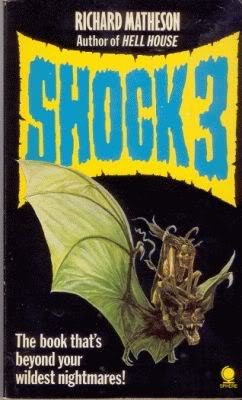
Richard Matheson, who died earlier this week, began his life as a writer with stories sold to the thriving SF and fantasy magazine market in the post-war period. His first published work was Born of Man and Woman, appropriately enough, which appeared in The Magazine of Fantasy and Science Fiction in 1950. Many of these short stories were later gathered together in the numbered series of Shock collections, whose 70s paperback editions had particularly lurid pulp covers which belied the quality of their contents. Which wasn’t to say that Matheson didn’t sometimes resort to slick fantasy plots which revolved around last minute revelations turning everything topsy-turvy: the desolate alien planet is really a post-apocalyptic earth, the beautiful woman has been an android all along, what was assumed to be heaven is really hell, and so on. But these cheap (albeit often rather effective) devices were generally an incidental way of rounding off the story with a memorable flourish. The true substance lay in their psychological portraits of characters confronting a universe which is beyond their comprehension or control.


Matheson is probably more widely known for his work in film and television, which he began to concentrate on from the late 50s onwards. Nevertheless, the written word was always at the heart of his screenwriting. Many of the original scripts he produced were actually adaptations of previously published novels. This was the case with The Incredible Shrinking Man, his 1956 novel, which was filmed the following year from his script. It displayed many of the preoccupations and concerns which would characterise his work over the following decades. The protagonist begins steadily to diminish in stature after being dusted by a cloud of atomic radiation. The use of radiation as a catalyst for his condition is in some ways nothing more than a casual, plot device of its time, used to explain away all manner of transformations and monstrosities. But the anxieties and fears which run through Matheson’s stories reflect an underlying unease trembling beneath the affluent surface of the Cold War America of the 50s and 60s, with the bomb as the everpresent threat hanging Damoclean above everyone’s head. We experience his existential angst via his narration of his inner thoughts. He becomes increasingly isolated in the world. In one particularly touching sequence, he makes temporary friends with a midget from a travelling circus whom he meets whilst going on a night walk through the local park. But soon he has begun to recede from her too, and is left all the more lonely. The shrinking man is also driven to question his, and by extension humanity’s place in the universe. He has constantly to adjust to the changing nature of his relationship to his surroundings. These remain largely domestic throughout, but the family home becomes an environment as alien as any distant planet. The everyday made strange and frightening is another Matheson trait. The way in which the domestic environment becomes a comfortless, alienating and increasingly dangerous prison for the shrinking man can also be seen as an externalisation of mental disintegration. SF and fantasy is a great way in which to make the metaphorical real, to create solid manifestations of inner demons and subconscious fears. Matheson’s isolated characters are frequently taken to be delusional or mentally unbalanced. His famous Twilight Zone story Nightmare at 20,000 Feet features William Shatner as a nervous and twitchy (he was always good in such roles) airline passenger who has just recovered from a breakdown which occurred on a previous flight. This proves an added complication when he begins to see a gremlin scuttling about on the storm-lashed wing of the plane. If it would be difficult to credit someone babbling about an inhuman creature tampering with the engines in mid-flight, this goes double for someone with a known history of mental illness. Shatner’s character realises this, and from then on is another of Matheson’s characters who must face the incursion of the strange into the everyday alone.


The domestic setting of The Incredible Shrinking Man also reflects a certain amount of gender anxiety. The protagonist is confined to the home, where his wife increasingly towers over him. Matheson uses the fantastic to reflect social changes and the tensions which they create. There are broader Darwinian fears, too, as he ceases to be the dominant species in the food chain, eyed up first by the family cat and then by the scurrying spider in the basement into which he falls. A lengthy sequence details how he uses his brains to defeat the spider, which is now a deadly predator far too powerful and quick for him to escape without the use of all his native intelligence. The ending demonstrates an abiding spiritual side to Matheson’s work. As the shrinking man diminishes to the point of invisibility, he climbs out of the basement and enters the garden. He begins to contemplate the universe from the atomic scale, a recessive vastness as awe-inspiring as any cosmic distances. There is a persistence of consciousness as he effectively leaves the human world, however, and he talks of merging with creation, still a part of its fabric (this comes with a certain amount of Godly rhetoric, de rigeur for the climax of 50s SF films, although at least there are no Biblical quotations). Matheson would remain fascinated with this idea of the persistence of consciousness. The journey into an afterlife was central to his 1978 novel What Dreams May Come, turned into a film in 1995. Somewhere in Time, the 1980 film which he adapted from his 1975 novel Bid Time Return also re-united its time-crossed lovers beyond death.


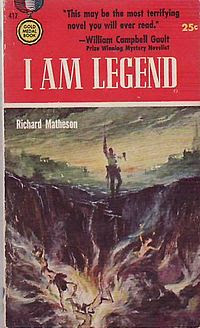
Perhaps Matheson’s best known novel is I Am Legend, first published in 1954. It’s a rationalised fantasy, positing a world ravaged by a pandemic which has seemingly infected everyone but the protagonist, the first person narrator of the story. The disease with which humanity is infected brings with it many of the symptoms associated with the vampire of gothic fiction. These are all given biological or psychological explanations. Matheson was essentially bringing the monsters of the Romantic period into the godless modern age or scientific rationalism. His vampires are the precursors of the zombies which have now overrun horror cinema. But whereas zombies are reductive lumps of ambulatory meat, his creatures remain human, something which the protagonist of I Am Legend is forced to recognise in the end. He is another of Matheson’s lonely men, wandering the crumbling city streets alone in the daylight, holing up in his bunker before they emerge at nighfall. It’s a novel which has proved irresistible to Hollywood, but thus far they have flunked it. The first adaptation, Last Man on Earth (1964), was initially scripted by Matheson, but was altered so much that he all but disowned it. He was none too keen on The Omega Man (1971) either, although it has its moments, and is the best of the three. The 2007 film uses the original title, but is largely an excuse for cgi backdrops of a ruined and overgrown New York and plentiful zombie shoots. Matheson would bring the old monsters into blinking into the modern world once more in his two Kolchak the Night Stalker TV movies. These featured an investigative reporter stumbling across the supernatural in the brightly lit world of Chicago; in the first case a vampire, and the second an immortal murderer who keeps himself alive with human blood. Of course, no-one believes the slightly shifty Kolchak, and although he defeats the forces of darkness, his stories never see the light of day. The Legend of Hell House (1973), adapted from his 1971 novel Hell House, is also a rationalised fantasy, with Roddy McDowell’s scientist conducting empirical experiments to reveal the secrets of a haunted house.


Matheson translated the work or other writers’ work for the screen as well as his own. Night of the Eagle (1961) is a particularly fine adaptation of Fritz Leiber’s novel of campus rivalry manifested through the witchcraft practised by faculty wives to promote the careers of their husbands. It’s another story in which gender anxieties are central. Peter Wyngarde’s professor’s horror at the idea of the supernatural being real is as much to do with his disbelief in the notion that his wife could have had anything to do with his success as it is with the disruption of his rigidly held rationalist worldview. The script was a collaboration with Charles Beaumont, who was something of a fellow spirit. Both wrote some of the most memorable Twilight Zone stories, which were generally suffused with paranoia and psychological terror. They both also wrote the scripts for Roger Corman’s series of Edgar Allan Poe adaptations. Matheson wrote the original run, beginning with House of Usher in 1960, followed by The Pit and the Pendulum (1961), the compendium Tales of Terror (1962) and The Raven (1963). These allowed his literary side to come out, and he provided some wonderful dialogue and dramatic setpieces for genre veterans like Vincent Price, Basil Rathbone, Boris Karloff and Peter Lorre. He also demonstrated a fine sense of comedy and the absurd in the hilarious wine-tasting scene in the Black Cat segment of Tales of Terror, in which the florid language of Vincent Price’s oenophile is contrasted by Peter Lorre’s more basic guzzler’s vocabulary; and in the voluble titular bird of the Raven, and its climactic magicians’ duel between Boris Karloff and Vincent Price. It’s particularly nice to see Boris showing a lighter side here.

Wine-tasting duel - Tales of Terror
My favourite Matheson moments come in his Twilight Zone stories, however, which for me are the best distillations of his dark art. This is horror which makes an impact on an existential as much as a visceral level. Nightmare at 20, 000 Feet is oft cited as the classical Twilight Zone story, but there are Matheson gems scattered throughout the five series aired between 1959 and 1964. Shatner stars again in Nick of Time as a young newlywed man who stops off at a diner with his new bride. He becomes obsessed with the novelty fortune telling machine at his table, which dispenses cards with aphoristic insights which seem to voice his inner thoughts. It’s a perfect expression of the underlying self-doubt which plagues someone who’s just setting out on an entirely new course in his life. Third from the Sun is a good encapsulation of Cold War anxieties, as two families of scientists involved in a rocket programme look to the future and find it to be short-lived as the world plummets headlong towards apocalyptic conflict. They steal the rocket and escape from what seems to be contemporary America. Of course, you guessed it, the planet they’ve identified as their new home is…Earth. The story nevertheless is a strongly and sympathetically observed depiction of common fears at the time. Little Girl Lost anticipates Poltergeist in its tale of the young daughter of an ordinary American family who falls through into some noplace dimension from which her frightened voice can be heard in her bedroom. Another tale of domestic fears, its atmosphere is notably enhanced by Bernard Herrmann’s brilliant score. A World of Difference is a psychological tale in which a man’s ordinary day’s work at the office is suddenly disrupted by the cry ‘cut’, at which point he discovers that his whole life is nothing more than a film script, his office prop flats. It’s a plot which makes manifest the protagonist’s alienation from his own routine existence, the feeling that he’s not altogether present in his own life.

Matheson displayed his comical side once again in Once Upon A Time, in which he gave Buster Keaton the chance to show off a few routines, old and new, in his role as a nineteenth century janitor who inadvertently dons a time-travelling helmet which plunges him into the present day. And When The Sky Opened is a genuinely unsettling metaphysical horror story, seen from the point of view of one of three astronauts returning to earth from a pioneering rocket launch into deep space. They have no recollection of what went on up there, and then one of them simply vanishes. But this is no ordinary disappearance. He has ceased to exist, at this or any point in time. Newspaper headlines now report that tow astronauts went into space, and no-one can recall the colleague about whom our protagonist makes increasingly frantic enquiries. When the second astronaut suffers a similar fate, he is left alone, the sole witness to a reality which is being systematically edited. He realises that he will be the next to be erased by whatever force has been set in motion. We never discover the nature of that force – no trite revelations here, just an acknowledgement that there are vast and unknowable mechanisms at work in the universe, in the face of which human lives count for very little.

Lee Marvin in android drag - Steel
In Steel, Lee Marvin plays a boxing promoter in a future world (1974!) in which fighting has been abolished. The sport continues with android combatants, however, and it is one of these that he carts around the country on Greyhound buses, his weary mechanic in tow. Their machine is an obsolete model which has long seen better days. It pops a spring and gives up the ghost before the fight is about to begin. Marvin’s character, a sweaty, desperate hustler who’s fallen well behind the game, decides to take to the ring himself rather than forfeit the money. Inevitably, he takes a bloody pounding from the dispassionate machine he faces, and gets roundly booed for putting up such a poor show. Collapsing onto the floor of the ‘workshop’ changing rooms, he sends the mechanic out to get the money, and has to accept, through bloodied teeth, when he comes back with just half. It’s a compellingly bleak tale of human beings struggling to survive at the bottom of the heap, unable to adjust to a mechanised world which has made them redundant. Marvin’s heroic if foolhardy stand goes entirely unnoticed, and he leaves town completely humiliated, but still determined to carry on with his pitifully outmoded fighter, Battling Maxo. Rod Serling’s customary summation reads the story as a parable of the indomitable human spirit. That seems a hopelessly optimistic interpretation of this sombre and downbeat tale.

Howling into the storm - Nightmare at 20,000 Feet
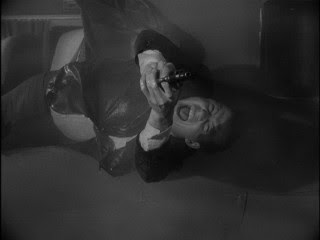
Nightmare at 20,000 Feet has been mentioned already. But what a masterpiece of pacing and sustained tension it is. Set within a claustrophobic environment, the interior of a small plane, it slowly builds up from initial glimpses of the gremlin to Shatner’s character’s realisation that he alone can act to save the plane and everyone in it. To do so he must behave in a way which will make everyone think he has lost his mind once more. The story reaches its climax as he is sucked out of the emergency exit window, tenuously harnessed by his safety belt, and faces the beast which slowly stalks towards him along the wing in the howling rain. The camera focuses in on his screaming face as he aims his wild shots with the gun he has lifted from a security guard – a moment of cathartic intensity as he is loosed from the confines of the plane and from his artificially maintained façade of calm sanity. It’s not difficult to see how this particular story has lodged in the minds of so many who have seen it over the years. It was inevitable that it would be one of the episodes chosen for the anthology film made in the 1980s. Matheson would enjoy pushing Shatner to the edge again in the Star Trek episode which he wrote, The Enemy Within. Kirk's personality is sheared off into two distinct entities when the transporter goes awry - a good Kirk and a bad one. Perhaps he realised that Shatner was at his best when playing neurotic or psychotic characters.

Night Call derives from an early short story published in 1953, Long Distance Call, and expands upon it to produce an emotionally draining tale which once again makes maximal use of a confined space. An old woman, Miss Keene, house and wheelchair-bound, receives a phone call in the middle of a storm-tossed night, and is plagued by further calls thereafter. The caller on the other end of the line is initially inaudible, but soon begins to emit pained groans, and then an effortful ‘hello (spelled out ‘h-e-l-l-o’ in the story), as if he has not uttered words for a very long time and is unused to their sounds. Miss Keene, who has been persistently calling the exchange about her nuisance calls, is finally informed that a team has come to repair the storm-damaged line near her home. She couldn’t have been receiving any calls, they tell her. The line has come down – over the cemetery. In the Twilight Zone episode, we go on to discover that the lines are grounded in the grave of her fiancé, who had died many years ago as a result of her negligent driving. She had been a domineering companion, controlling his simple and passive soul. She realises that it was him who had been trying to get through to her on the phone, and wills him to call her again. But she had told him to let her be, and he once more obeys her command, leaving her alone and desolate in her remote house. The Twilight Zone version has a powerful emotional charge. But it does lack the kick of the original story’s final line, in which the anonymous graveyard caller rings again and says ‘hello, Miss Elva. I’ll be right over’.

The amazing Agnes Moorehead in The Invaders
My favourite of Richard Matheson’s Twilight Zone stories is The Invaders. It’s a bold and stark drama which is almost entirely free of dialogue, and is a one-hander. As such, it’s the purest expression of his lonely person theme. It’s set in a remote farmhouse inhabited by a solitary, independent woman. On one calm, still night a spaceship crash lands onto her roof. It’s a small vessel, a classic 50s saucer. In fact, it’s the model used in Forbidden Planet, a film whose props and sets turn up in several Twilight Zone episodes (Robbie the Robot even makes a special guest appearance in one). The story details the woman’s increasingly desperate attempts to fight off the tiny invaders, robotic figures which sting her with burning ray guns, stab at her with her own kitchen knives, and burn entrance holes in the wainscoting like mice. Matheson’s economical script benefits immensely from an extraordinary, bravura performance by Agnes Moorehead, who makes us feel the bewilderment and escalating desperation of this beleaguered but strong and indefatigable woman. Jerry Goldsmith’s score also ratchets up the tension throughout, and he is wise enough to know when silence is more effective than any sound. In the end, the woman climbs up on to the roof and smashes the miniature spaceship with an axe. We feel a sense of triumph before hearing the distress call emanating from the wrecked vessel, announcing the disastrous termination of the mission. The menacing little robots are given ordinary human names. The camera pans around and, yes, the insignia reads USAF Probe. It’s an Earth ship which has found itself on a planet of giants. But it has been pre-emptively aggressive and belligerent, assaulting a lone woman in her home. There’s a definite anti-militaristic slant here, and we can feel no sympathy for the tiny people whatsoever as they face their end so far from home. This is a daring and brilliantly sustained piece of minimalist storytelling. It anticipates the similarly concise and single-minded Duel (1971), Stephen Spielberg’s early TV film which was based on a Richard Matheson short story.

I watched Steel, Night Call, Nightmare at 20, 000 Feet and The Invaders last night as a tribute to Richard Matheson. What a treat it was. There’s no better way to remember his singular talent, so go out and find them now.

Thursday, 27 June 2013

Gwyneth Herbert, Fiona Bevan and Nancy Elizabeth at the Phoenix Arts Centre, Exeter


There were two excellent gigs at the Exeter Phoenix Arts Centre last week, featuring three fine female singers, each with their own distinctive voice and songwriting style. On Thursday, Fiona Bevan was introduced by headliner Gwyneth Herbert, who declared that she had fallen in love with her the first time she saw her perform. It soon became apparent why. Her songs were filled with a natural joie de vivre, even when they entertained an element of heartbreak (as in the wittily titled Dial D for Denial). Poppy and eminently hummable, they nevertheless had real substance, and bore the stamp of lived experience sincerely expressed, without straying into Joni or Janis (Ian) confessional territory (a territory I’m always happy to venture into, I should add). She accompanied herself with simple but deft and surely strummed and plucked chords on a nylon-strung classical guitar. She did pick up the ukelele at one point, its happily chugging chordlets providing the perfect complement to her smiling presence, whilst studiously avoiding any nodding and winking Formbyisms. Cradling such a tiny instrument emphasised her tall frame, which was topped by a coronal bubble of hair worthy of Marlene in Blonde Venus. This alternately absorbed the radiance of the stage spotlights, becoming a varicoloured stellar beacon, or provided a retinal after-image silhouette hovering before the backdrop. Her voice was lilting, light and honeyed, with a jazzy, Billy or Ella vibrato leaving the end of each line lingering in weightless suspension in the air, as if she were cherishing the shape and sound of her words. Vocalise syllables were effortlessly overlaid in the upper range, seemingly for the sheer joy of it, and further demonstrated her versatility and assurance without being in any way showy. Alone in front of the untenanted array of instruments waiting for the full band to come, she nonetheless commanded the attention of the audience, and had them spellbound throughout.

Fiona Bevan
Fiona returned to her centre stage spot for Gwyneth Herbert’s performance of The Sea Cabinet, a suite of songs commissioned by Snape Maltings and inspired by a residence along the exposed and windswept Eastern coastline of Suffolk. Herbert’s seasongs are part of a noble lineage. Snape Maltings was converted into a concert hall in the 1960s under the guidance of Benjamin Britten to house the expanding festival based in nearby Aldeburgh which he had instigated in 1948. Britten’s own music had been inspired by the coastline here, and the sea and local landscape is a dominant presence in his best known opera, Peter Grimes. There are faint echoes of the moods painted in the Four Sea Interludes extracted from that opera in some of her settings, from the pizzicato pointillism of Sunday Morning (heard in Drip and Fishguard Ladies) and the sparse evocation of empty expanses of space in Dawn (which she depicts in her own song interludes).

Gwyneth’s songs were akin to short stories, depicting events from particular viewpoints or portraying the inner lives of her characters. She took on their roles, adopting the appropriate singing style, and was occasionally joined by Fiona in what became dialogue duets. This was particularly notable (and hugely enjoyable) in the lustily sparring shanty narrative of The King’s Shilling. Herbert’s pleasingly burred voice dovetailed with Bevan’s higher and lighter tones with harmonious congruence. The role-playing aspect fitted in with the theatrical nature of the evening. The songs were interspersed with a story, read by Gwyneth, about a woman wandering the shoreline, combing for washed-up artefacts which she collects, notes, classifies and takes home to file in her sea cabinet. The songs arise from these lost and discarded objects. They become the imaginative seeds for further stories and portraits, which span the decades and centuries and range from the personal to the folkloric, both tales bold and tall and glimpses of untold lives on the margins and in the shadows. Gwyneth reads these interludes beautifully, with great sensitivity and feeling. She would have been great on Jackanory, and could quite easily have a sideline recording audiobooks.


The words convey the melancholic and time-scoured sense which seems inherent in this landscape. In collecting these drifted fragments of other people’s lives, the cabinet curator seems to be trying to make sense of her own. The songs could be seen as projection of her own displaced self, exhibiting varying degrees of fantasy, the trying on of different personae. But the character in Promises, who remains true to a marriage which swiftly descends into disappointment and abandonment, remaining rooted also to place, perhaps gets closest to the truth. The final image, of a wedding gown made from torn fishing nets hung from her bedroom wall, suggests that a marriage to the sea may be the ultimate conclusion of this lifelong hunting and gathering. A ghost in her own life, she will end up spectrally adrift on the North Sea swell, until she herself becomes a piece of the flotsam, the sorting of which has so fully occupied her years – bones on the shore. Perhaps she will take her place alongside the east coast hauntings of MR James’ ghost stories. It reminds me of the powerful end of the extraordinary narrative poem The Laughter of Stafford Girls’ High by Carol Ann Duffy (who I’m looking forward to seeing and hearing at the forthcoming Ways With Words literary festival at Dartington), included in her collection The Feminine Gospels. Mrs Mackay, who has roamed out of her marriage and across the country, but who ‘had finally run out of land’, walks out into the waves, which ‘danced her away like a groom with a bride’.


The bleak, flat expanses of the east coast, the end of the land on Britain’s flood-levelled rump, lend themselves to such sorrowful songs and backward-looking introspection. It is a place where people wash up, where lives run out, and where time seems to hang a little heavier, the past lingering on in local pockets of dense gravity whilst the modern world beyond rushes on. The delicately wistful piano and wordless vocal prelude summons up the atmosphere of reflection and reminiscence which pervades the Sea Cabinet and the intertwined narrative. It has some of the autumnal air of Norma Winstone’s songs, both on her own albums and with Azimuth. It feels like Kenny Wheeler’s plangently sighing trumpet could join in at any moment. The aforementioned Promises also has something of an ECM air, with the keening guitar (Al Cherry or Harry Bird? – it would be appropriate if it were the latter) reminiscent of Terje Rypdal’s echoing electric, which often seemed to be drifting on a chill wind from the fjords. The mixture of Herbert’s cracked and heavy-hearted vocals (more musical character acting) and the effects-drenched guitar also brings to mind Marianne Faithfull’s collaboration with Bill Frisell on the Strange Weather album.

This is definitely the out of season seaside we are inhabiting, a depopulated strand of faded memories and wide horizons drawing the gaze towards introspective distances. The album includes the recorded sounds of steps on shingle and the unceasing susurration of the waves. It might have all been in my mind, but there seemed to be a background whisper of waves emanating from the rear of the hall throughout. This put me in mind of Embers, Samuel Beckett’s play in which these sounds are also a constant presence (you can find Patrick Magee's extraordinary performance of it at ubuweb). In this work, too, the sea and empty shore direct the mind towards memories both sorrowful and bitter, the hypnotically repetitive cycle of the waves’ steady respiration stirring up ghostly voices and phantasmal scenes.
It wasn’t all bittersweet introspection and melancholia, however. The audience was involved in the spectacle, and made to feel as if they inhabited the landscape which was being conjured up. We were encouraged to add our own ambient contribution to the soundscape during one song, Sweeter, with the tips or flats of fingers pattering on palms or softly clicking, thus summoning a light rainshower. She made a more intimate connection with some members of the audience, who had responded to her open invitation to form a chorus for one song. It became apparent that the preponderance of tops with horizontal navy stripes wasn’t evidence of some new fashion trend – these were her handpicked crew of pirates. Such participation was a further manifestation of the spirit with which she involved fans and music lovers in the funding of her recording of the Sea Cabinet songs, giving them back something in return, whether in the form of a signed copy, an individual music lesson or a private concert. The chorus took their place in front of the stage, and she descended to sing with them and direct them with a bit of gestural conduction. The use of the area in front of and around the stage in this and other songs added to the theatrical feel of the evening, the sense of connecting with the audience. It also created a sense of space, the no-man’s land between performer and audience effectively becoming the interzone of the shingled strand.

For the hymn to sentimental nostalgia Sweeter, Gwyneth followed Fiona’s example and picked up a ukelele to sing the happy/sad memory song, redolent of pierrot pierside shows, soaked in longing for times long vanished. Penny Woolcock’s recent film From the Land to the Sea Beyond, compiled for the bfi from archive footage of life on the coast throughout the twentieth century, would be a great backdrop for this song, and several others too. The nostalgist’s sense that the glory days are in the past also pervaded The Regal. Clattering junkyard percussion, with Gwyneth wielding a cheese grater, rhythmically rasped with a stick, conjured up the sound of Mrs Wittering laying out the crockery in her once thriving b&b, going through the bustling motions.

The ocean is used as a metaphor for love lost or turned sour in a couple of songs. I Still Hear the Bells undermined the dream of the romantic escape to an isolated seaside idyll, with images of building on shifting sand, too close to the edge. In echoes of the old legend of the drowned city of Ys which surfaces from time to time (a legend, or a variant thereof, drawn upon by Debussy, Alan Stivell and Joanna Newsom), the bells of the church in which they were married still ring out in the minds of the parted couple from beneath the waters which have engulfed it. This allows for a loud, clangourous chorus, with bell sounds hocketed around and any nearby object co-opted as percussion. Drip, meanwhile, detailed the steadily progressive dissipation of a woman’s identity (or it could be a man), her sense of self drowning in the domineering, engulfing personality of the partner from whom she no longer has the strength or will to get away. The initial brittle jollity of the verse bursts into full-throated soul-testifying in the chorus, Herbert’s voice letting loose a flood of feeling, which this character has dammed up for so many years. It’s a formidable vocal force which is also brought to bear on the siren song Lorelei, an old favourite revived from the All the Ghosts LP. Here, the old destructive Rhine spirit is reincarnated in a modern woman against whom men collide and shatter. It’s seen as her tragedy (as well as her strength) that none of them prove a match for her. The chorus again is powerfully soulful, with an edge of desperation and a folkish tinge to the language.

Gwyneth Herbert - framed by Brighton seafront sculpture?

Herbert’s voice is a flexible and finely tuned instrument, capable of moulding itself to the many and varying forms her music takes (it’s a long while since anyone could sensibly confine her within the admittedly comfortably furnished jazz ghetto). As already noted, it has a sensitive storytelling timbre. It’s capable of nuanced ballad portraiture and atmospheric vocalese as well as soul wailing and blues growling. She put it to more roistering use in a trilogy of rowdy nautical songs. Plenty Time for Praying set the whisky and rum flowing as Gwyneth and Fiona called out a forceful siren song in seductive shanty form, luring mesmerised pirates to their ecstatic doom. Drink swayed along to a Tom Waits junkyard clatter, offering a myriad reasons to seek the oblivion offered by the demons stoppered in the bottle. The King’s Shilling was a Brecht and Weill-flavoured tale of nautical temptation, with Gwyneth taking the role of the man tempted to take to a life on the ocean waves, Fiona as the woman telling him he’d better not, unless he wanted a kitchen knife plunged into his back. The whole ended with a freeform vocal and instrumental tempest, presumably plunging everyone into the roiling deeps and down into Davy Jones’ locker. Herbert’s voice emerged, keening like a seagull, a sea maiden’s shamanic transformation.

There were also tales of invasion, of the island fortress breached. Alderney began with the remembrance of a personal island idyll, an old whistled tune maintaining the air of nostalgia established by the previous songs. But this distracted mood was shattered by the violent, percussion-rocked chorus. This painfully recalled the desecration of this paradise, the quarrying and concreting of the pastures and narrow streets by the occupying Nazi army once the inhabitants had been evacuated. Fishguard Ladies remembered a less successful attempt at invasion, this time from the French, via Ireland, in 1797. The women of the Welsh port stood on the cliffs above Goodrington Sands and, as the song would have it, lifted their petticoats and saw the timid Gallic boys off with a few bawdy choruses. More ratcheting and clattering percussion suggested both the loading and priming of old rifles and the sounds of domestic labour transformed into rhythms of martial defiance. It’s a triumphant, rude gesture of a song which, like all the others emanating from the cabinet, sees things from a woman’s perspective (the perspective of the cabinet’s curator, as I suggested). These are sea songs for the ones who stayed ashore, although as the Fishguard Ladies so amply demonstrated, this by no means entails passive waiting and watching.


The Sea Theme with which the storybook was opened returned to mark its closure, the sad piano chords and softly lulling voices drifting away on the tide, leaving us with a faded and rather melancholy postcard of a now empty landscape. It was a wonderful, theatrical experience (and I can imagine who fantastic it must have been on the Wilton’s Music Hall stage), and large velvet curtains should really have swept across to draw a veil over the finished performance. However, such grandeur had to be restricted to the theatre in my head, and the actors took their bow to deservedly warm applause.

Nancy Elizabeth’s performance on Sunday evening was a more low key affair. It was just her alone on stage standing with guitar or sitting behind her keyboard, although she was joined after a while by a friend on bass to add a bit of heft. He also provided the occasional low, rumbling electronic drone as an atmospheric and slightly ominous bedrock to a couple of numbers. She began with two songs not yet recorded, one of which rode on a hypnotically spiralling fingerstyle guitar pattern in the Nick Drake One of These Things First mould. Most of the material was drawn from her new LP Dancing, however. It’s been a favourite of Stuart Maconie (also heading down this way for the Dartington Ways With Words festival, where I shall be going along to hear him). He’s played several tracks on The Freak Zone, his eclectic Radio 6 showcase for the rarefied, esoteric or just mildly offbeat.


The first of the Dancing songs, Last Battle, was prefaced by ethereal, wordless vocalising, which soared on operatic updrafts. Such fearless flights into the upper register reminded me a little of Lavinia Blackwall’s singing in Trembling Bells (coming up in July at the Phoenix), or the romantic psych-folk stargazing of Shelagh McDonald. There are echoes too of Jane Weaver and her Fallen By Watchbird projects. Nancy soon came back to earth, however, her voice settling into its pure soprano tenor, strong and vulnerable at the same time in an early Sandy Denny manner. A Mancunian common sensibility insures that her songs don’t float off into Narnian realms or folkish netherworlds, any fey waftiness immediately dispelled by the city’s plain, no-nonsense outlook. She remains on the street where she lives and makes her observations from that firmly rooted standpoint. Last Battle is a song which eschews dewy-eyed romance for a declaration of independence and self-assertion in matters of the heart (‘won’t wait in a cage till someone comes to rescue me’). Her pragmatic outlook on love is further expressed in Desire, and could be described as desolate but philosophical. It has something in common with the pleasurable melancholy of Elizabethan lute songs, with their disquisitions on the pain of love. Indeed, the discreet, singularly struck piano chords sound like they could have been transcribed from a strummed lute, the high, yearning vocals of the chorus akin to the emotive singing of a counter-tenor. It’s an anti-lament reaching a position of resigned equanimity, choosing to reject the myth of romantic, ever-lasting love. The forceful Debt with which she ended her performance, was driven by fierce chordal strumming and underpinned by a throbbing electronic drone, which was suggestive of the mountain-shaking bass chanting of Tibetan monks. A song of love and parting, it expressed a rather more active desire to hold on as long as possible, but was once more prepared to let go, to accept a natural ending.

Fiery firmanent - the Dancing cover
Nancy’s Romanticism is of a rather more broad variety, venturing at times into the mystic. It’s the full-blooded Keats and Shelleyan beast, with a strong golden vein of Blakean vision, leading her to ‘dream cloudy like a poet’, as she sings on Shimmering Song. If she is given to traditional singer-songwriterly bedroom introspection, the expression of personal feeling is soon expanded to connect with the wider vistas afforded by the active imagination. This is perfectly encapsulated in the beautiful sleeve art for the Dancing album, which she designed herself. A silhouetted row of suburban rooftops, compressed into the very bottom of the cover, gives way to rising, arced layers of collaged, varicoloured and textured paper – a fiery firmament coruscating above the everyday. The craters of a full moon, which is limned with a blue corona, are made up of words, luminous and sacred. Nancy alluded to her insomnia during the concert, and this picture suggests that the nightworld she often finds herself awake in is a place of heightened reality, full of wonders revealed to the open and receptive mind.

Cecil Collins - The Great Happiness (1974 version)
Simon Says Dance, the single from the album, was half-dismissed as throw-away song thought up during an insomniac phase. It depicts life and love as a universal and eternal dance, moving from waltz hall to disco floor. A sense of mystical connection and the unearthing of the extraordinary from the everyday characterise a number of Nancy’s songs. As she sings in Shimmering Song, she is ‘thinking of ways I can turn a mundane day into shimmering song’. In Death in a Sunny Room, which is by no means as goth-gloomy as it sounds, and which featured a gorgeous piano arrangement, she sang ‘under a giant blanket of stars we spin away’. Intimately personal and astronomically vast scales are conjoined in one transcendent moment. Desire, on the other hand, sees ‘horizons crumble in my hands as I learn new depths of love’, a rather more ambiguous and earthbound metaphor. Indelible Day makes a permanent impression of a dawning moment. There almost seems to be a recognition of some divine, radiant and all-encompassing presence in the line ‘I can see the light of a golden sphere with ubiquitous rays’ (and what a great-sounding word ‘ubiquitous’ is – one of my favourites). Cecil Collins’ painting The Great Happiness comes into mind here, his depiction of a solar, life-giving force filling the sky with light. Nancy’s spiritual songs are suffused with a similarly numinous glow.

She incorporates elements of Indian scales and rhythms into some of them. Shimmering Song has Eastern vocals, additively building up and ascending, two steps up and one back. Raven City also has Indian-inflected melodies, and is her most explicit piece of religious mysticism, essentially depicting a transformation in the nature of the soul. In contrast to most rock and pop songs, this is not achieved through romantic love, although there is an intriguing allusion to ‘other entities’. A moment of transcendent comprehension comes upon her, when ‘I revealed and beheld all the universe in me’. The song was another which Nancy played at the keyboard (set up to sound like a piano throughout), its spacious chords initially interspersed with claps, lending it a calmly celebratory air (clap happy music in a less hysterical register than usually encountered). These turned into rippling, arpeggiated chords which seemed to emulate the shimmering, metallic clangour of the East European cimbalom.

For all the heady mystical themes underlying many of the Dancing songs, Nancy’s self-declared favourite from the album was Heart, which she wrote about and for her grandmother. It’s evidently deeply felt, a real heartsong which empathetically tries to see the world from the point of view of an old woman whose mind has drifted into self-forgetful dementia. It’s not at all depressing, however, finding hope in the continuance of life and the remembrance of the passionate way in which it has been lived, a persistence of personality in some form. In spite of it all, ‘I woke every morning with my own heart’. Another piano song with sublimely simple chord patterns. Nancy seemed to reserve her most emotionally charged moments for when she was safely at rest behind the keyboard (although the makeshift drumstool she was obliged to sit on was, she observed, a little precarious). She finished with no instruments at all, however, delving back to her artistic origins to sing a brief, a cappella encore of The Wheel Turning King, a ritualistic song which she recalled having recorded in a small church for her first EP back in 2006. It brought things full circle in an appropriately all-embracing way. In the end, the beginning.