Friday, 4 October 2013

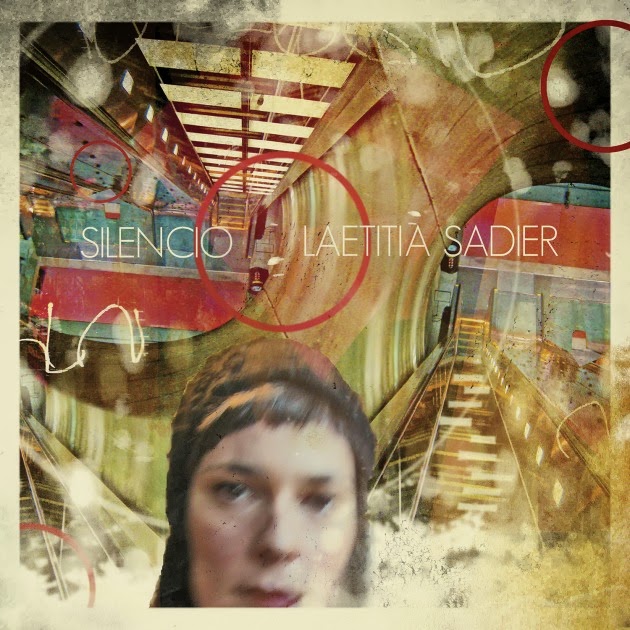
Laetitia Sadier at The Basement in York


Laetitia Sadier (and here I’m obliged to add the lead singer of the ex-Stereolab) played a solo set in The Basement below the City Screen in York on 18th September. It was a rather compact space, a windowless cavern which felt like it was sunk beneath the waters of the Ouse which flowed by outside. Candlelit tables created an intimate café ambience, and this intimacy was reflected in the fact that half the audience which filled the venue seemed to know the two support acts personally.

The first of these was Stuck Sunsets, the alias of singer-songwriter Patrick Atkinson. He lightly thumbed chords from his lovely white hollow-bodied guitar, providing barebones accompaniment to his charming and self-deprecating songs. They focussed on seemingly inconsequential details and feelings, and by doing so made the everyday of significant moment. The lyrics gave those of us who didn’t know him the sense that we were seeing snapshots of his inner life. Mildly confessional songwriting with enough self-awareness and humour to avoid moody navel-gazing, it was delivered with a winningly tentative looseness and mellow swing.

Alisia Casper had a stunning voice, pure and forceful. It was a striking blend of Judy Collins, Linda Perhacs and Josephine Foster, filled with a mesmerising strength which immediately commanded your attention. Her songs were largely anchored by single chords and hypnotically repetitive phrases on the guitar, over which her voice intoned incantations, lamentations and maledictions. They were filled with evocative nature imagery, and tended to dwell upon tormented emotions in the classic folk style. Unfortunately, the performance was all but ruined by her constant interruptions, breaking the flow of every song with throwaway comments about having got the chords wrong or forgotten the words, or suddenly deciding that she wanted to sing something different after all. This was particularly damaging given the dark romanticism of the music, which relied on casting a spell and drawing the listener into its world. This spell, once broken, was not easily spun again, and after a while was completely dissipated. The impression was given that she didn’t take her own material seriously, and if that was the case, then why should we be expected to? Of course, there may be extenuating circumstances which explain all of this erratic behaviour (she did tell us that she was ill). If she can get her act together, she could be something really special, though.


Laetitia also seemed to respond to the intimacy of the venue. She was relaxed and informal throughout, chatting to the audience between songs, each of which she introduced with a mixture of humour and seriousness. Her material was drawn mainly from her recent solo LP Silencio, her second under her own name. There was nothing from the first, The Trip, which was a very personal record, expressing feelings and states of mind particular to that time. Perhaps she didn’t want to revisit that transitional period, and the painful memories which the album dealt with, which belonged to another self. There were no Stereolab songs either. More surprisingly there were none of the French language numbers which make up a proportion of all her albums, which was a shame. She did incorporate several songs from her group Monade, however. This was her project outside of the ‘lab. The earliest of these, Becoming, from the A Few Steps More album, she held to be of enduring personal meaning. It’s one of a number of her songs which deal with personal growth and development, of the continual evolution of the human spirit.

There’s definitely a spiritual facet to Laetitia’s oeuvre, although it remains unconnected to any specific religion. The sense of connection with the cosmos which is a feature of so many of her songs, of the individual finding a sense of belonging within the infinite, is arrived at through the achievements of the human mind rather through any divine intervention. Hers is a humanist perspective on matters of the spirit. That said, the final track of Silencio, Invitation au Silence, finds a sense of the numinous in the coloured, murmuring silence of churches, incorporating a recording made in the St Blaise church in the south-west of France. The irresistible Find Me the Pulse of the Universe from the new album, which we heard on this night, conveys the sense of an unending, questing spirit, and was introduced as a piece of ‘cosmic’ music. Its optimistic launch out into the farther reaches of space was further propelled by the kind of Morricone-esque ‘shum shum’ chorus which has been a feature of her singing since the earliest Stereolab days duetting with Mary Hansen. It’s a music of the spheres rooted in the 60s, that white heat age when the future still invited dreams of endless possibility. Laetitia’s songs often seem to be trying to revive that spirit, to suggest that we can still make a brighter tomorrow.


Between Heaven and Earth verges on Pagan mysticism in its analogy of spiritual being with the growth of a tree, rooted in the earth and reaching half way to heaven. Laetitia’s idiosyncratic phrasing, which takes advantage of her French accent and veers towards a jazzy play with rhythm and emphasis at times, is particularly effective here. Nature metaphors also feature in the Monade song Invitation, from Monstre Cosmic. She introduced this with almost apologetic exaggeration, telling us it was about 15 minutes long and had something like 11 sections. The shifts of tempo, key and mood which it did encompass within its rolling flow reflected the analogy of a life and soul shared to the various stages of a river, which runs its course throughout. She played another song from the Monster Cosmic album, Change of Destination, which had a similar feel. This time, a solitary figure runs and hides before eventually swimming into the deep blue sea into which everything eventually flows. The call and response form of the lyrics, Laetitia answering her own questions, points to their self-reflective nature. Next Time You See Me is another song of spiritual growth, a hymn to the imagination and a warning of its potential stifling. It is also about the power of art to see and depict an infinity of possible worlds. The melody here is instantly and buoyantly infectious, and was co-written with her old Stereolab partner Tim Gane. More wordless vocalising expresses a feeling of effervescent optimism and gladness. The imagery of countless bubbles containing worlds of meaning brings to mind the wonderfully titled Stereolab song Jaunty Monty and the Bubbles of Silence, and perhaps also Tim’s new project Cavern of Anti-Matter.


Lightning Thunderbolt was introduced as a song about desire, as opposed to the ‘cosmic music’ which had been used to categorise other numbers. In fact, it is as much about the meeting of spirits as bodies. It ended with an effects pedal woosh of transfigured sound, and Laetitia looked up with a smile to follow the path of some imaginary spark of essence shooting up into the night sky. Her guitar playing consists of unshowy, solidly strummed rhythmic accompaniment. Referring back to the song Becoming, with its lyrics about the steady and continual process of developing as a person, she admitted that this could refer to her mastery of the guitar too. It was perfectly adequate to the task, however, and was strong enough not to suffer from the lack of an augmenting rhythm section. The output was tweaked here and there with effects pedals which gave a variety of textures to the sound palette.

There has always been a forthright political side to Laetitia’s writing too, stretching back to her contributions to McCarthy in the late 80s. She espouses an idealistic socialism which finds its voice in hymns to collective endeavour and the human spirit, but also in lyrics which analytically dissect the inequities of the late capitalist world. Such concerns are obviously of great urgency in the current climate. Her response to the economic crises, Auscultation to the Nation, comes across as a pointed manifesto, a simple spelling out of evident truths. Auscultation, we were told, is a medical term referring to the process of listening to the body’s organs in order to determine the general state of its health. So, by extension, this was a state of the nation (or a state of the global society) song. The words are clearly and crisply articulated, and are devoid of the poetic ambiguities and elisions which are more characteristic of her writing. It’s evident that she wants to get the message across as directly and unmistakably as possible. It’s to the song’s credit that at no time does it feel hectoring or tainted with bitterness. Blessed with a springy rhythmic drive and light melodicism, it is a light and palatable political address, which nonetheless makes its mark in denouncing the ‘tyranny of money’. It tells it like it is and asks why we should put up with it.

The final song of her set was dedicated to the late Trish Keenan from the group Broadcast, whom she described as her friend. Silent Spot is about someone passing away in their own time, and was thus obviously not written directly with Trish in mind, but the thought was still pertinent. It’s one of a series of songs produced over the years which contemplate mortality, and it arrives at a sense of acceptance, holding out the possibility of some kind of transformation or transfiguration. That sense of the spiritual essence of human being shines through once more. An encore rounded things off on a more upbeat note, and then it was all over. Laetitia retreated to the wings, re-emerging in the bar to sign any records which people might proffer or purchase, or just to say hello. It had been a relaxed and informal evening, and you sensed that she was quite at home in such a low-key setting. She certainly proved that she was a fine solo artist in her own right. The two new songs which she tried out on us (successfully) hopefully point to much more to come in the future.

Thursday, 5 September 2013

Jacques Demy's The Pied Piper (1972)


Jacques Demy’s 1972 film The Pied Piper is a countercultural take on the legend which in some ways comes a little after its time. Donovan’s fey troubadour is a figure from 1967 rather than the early 70s, when the zeitgeist already blew a little more harshly, the idyllic summer a memory eclipsed by subsequent unrest, fragmentation and narcotic drift. The dream of a medieval age of pageantry is thus as much a dream of the 60s ideals which were seeming ever more remote. The generational and ideological divide which marked the decade is here represented by the forces of the church, the armed state and the newly ascendant business class, who are ranged against the artists and philosophers (the peasantry don’t get much of a look in, here). These powerful Hamelin cliques are conveniently colour-coded (although not to the extent of having their faces painted blue or red, as Demy pigmented his servants and soldiery in his 1970 fairy tale Peau d’Ane, or Donkey Skin). The baron and his enforcers wear a mouldy green broken up by sloping military stripes. The cardinals and bishops are wrapped in scarlet, their perspiring faces peering beadily out from capacious hoods. The merchants wear black jerkins (or a more plush red for the higher amongst them) which give them a puffed-out, preening look. The travelling theatre troupe which comes to town have their own loose uniform of striped tunics, but the colours are varied and natural – sky blue, blossomy peach, earthy brown and mossy green. They are colours which reflect the landscape which they pass through, and in which they make their camp each night, and suggest that they are more at home here than in the cities and towns where they go to perform.

Church and state in the appropriate attire - Peter Vaughan and Donald Pleasance
The costumes of the Hamelin worthies are exaggerated and highly theatrical, and make it clear that Demy’s middle ages are defiantly non-naturalistic – a land of fable rather than historical verisimilitude. They are also buffoonish outfits, casting the figures of authority who wear them as grotesques, caricatures of their own warped desires and ambitions. The Burgermeister and his wife’s social aspirations are displayed in the absurd extravagance of the hats they struggle to keep aloft during the tactical marriage of their young daughter to the slimy Franz, the Baron’s son (a mercenary wedding of new money and bankrupt aristocracy). Diana Dors (as Frau Poppendick, the wife) in particular carries spectacularly over-the-top headgear throughout, which she manages to keep admirably well-balanced. The portable marquee which tents her features with such ostentatious modesty early on could be seen as a satire on Hollywood medievalism, with its queens and princesses in conical turret bonnets trailing wafty clouds of gauze. The Baron has a spritish, tapering cap which looks like it's been soaked in algae, or is some fungal growth sprouting from his pate. His bullying son Franz has rolls of green cloth layered in foppish folds atop his floppy, patrician mop. The bishop has his papal hood rising in a mitred, scarlet shield, but his face is also shrouded in a nunnish wimple. These fools’ caps are designed to conceal and disguise, or connote status, but only serve to emphasise the wearers’ vanity, pretension or madness. The players, on the other hand, have loose tunics which hide nothing, and Melius, the alchemist who is the town’s figure of learning and reason, dresses in a simple and noble robe.

At home with the Poppendicks - Roy Kinnear and Diana Dors
The prevalence of British character actors heightens the air of grotesquery. Roy Kinnear, as the Burgermeister Poppendick, brings his usual comic mannerisms into play. He is every inch the businessman who has made his pile through dodgy dealing, and is shifty, opportunistic and completely untrustworthy. He’s also utterly ineffectual as a public figure, and offers muttered asides as to the helplessness of it all. Diana Dors plays his domineering wife Frau Poppendick, one of the bellowing, comic shrews she specialised in during the 70s. She shifts with complete assurance between red-faced shrieking and saucy, winking lasciviousness, and its clear that she’s having a bit on the side with Franz. The thickly curling horns of her wedding bonnet, shaped like indulgent French pastries, seem to mock her cuckolded husband, whose gnomish, priapically extended fez is a pathetically overcompensatory response. Donald Pleasance’s Baron is a mad, muttering recluse, retreating to the shadowy spaces of his castle, and ultimately to the shuttered nook of his coffined bed. His dank lair is covered with morbid murals of devils and skeletons, promising diverse varieties of detailed torment. They are the outward projection of his clammy, twisted mind. Peter Vaughan’s Bishop is a guiltily perspiring serpent, desires as tightly constrained as his face-hugging costume. They are transformed into poisonous bile which his religious authority affords Papally sanctioned expression. John Hurt’s Franz, the privileged scion of the Baron, is poutingly sullen, lighting up only with the sadistic satisfaction he derives from the cruelty which his inherited power and its attendant aura of fear allows him to indulge. All of these exaggeratedly self-interested and power-hungry characters, with their various political ambitions, parallel the powers at play in Ken Russell’s The Devils, released a year earlier in 1971. Russell’s film is entirely dissimilar in tone, but does bear comparison in its use of stylised costume and set design and in its clear parallels with contemporary social, political and military conflicts. Both films are, in their own ways, intensely moral, and unafraid to declare their allegiances, even if this results in a certain schematic division into good and evil.

The Frau and her Franz - Diana Dors and John Hurt
The various powers in Hamelin all have their own schemes, put forward by their leaders. They conspire together in order to realise them, and to maintain their position. Burgermeister Poppendick and his wife wish to graft themselves onto an aristocratic family tree. To do this, they are prepared to marry off their daughter, still a child, to the slimily unappealing Franz. In this way, Frau Poppendick will also have her lover on hand, even if he would by then be her son-in-law. Franz’s aside to the Bishop during the wedding feast makes it clear that he too is fully aware of this, but chooses to tactically turn a blind eye. The sexual hypocrisy of the powerful, who put on ostentatious masks of piety and rectitude, is revealed in the end when Franz reaps his just reward and catches the plague whose proliferation he has enabled. The black circle which almost instantaneously appears on his cheek resembles the patches dotting the faces of the characters in Hogarth’s moral fables; patches which cover syphilitic scars.

Vainglorious dreams - the mad baron and the calculating bishop
The Baron is obsessed with building a new cathedral in Hamelin, facing his castle. This is not so much a monument to the glory of God as a further expression of his power and his preening ego. The Bishop is obviously keen to encourage this, as it would enhance his own prestige. But he is aware that the mad Baron has no practical idea of the costs involved, and the Burgermeister and his guild heads have already taxed every possible local resource. The half-built cathedral façade, with its idle workers and wooden winches and scaffolding, is like an unfinished set. It could perhaps be seen as an admission of budgetary limitations, or as a pointed rejection of Hollywood historical spectacle. The economic exhaustion which the extravagant fancies of the Baron has created has hints of the 70s downturn (although the ’73 OPEC oil hike had yet to make its devastating impact), with images of builders sitting disconsolately inactive about the site striking a resonant note. The rising towers of the cathedral could also be seen as a reflection on the greed of property speculators in the 60s and 70s, erecting grandiose buildings in prime locations and then letting them lie empty for years while they waited for rents to rise, and for sufficiently wealthy tenants to move in. The high-rise modernist office block Centre Point, in the heart of London, was one of the most notorious cases. It lay empty for some 5 years after its completion in 1967 at a time when unemployment and homelessness were rising steeply. The cathedral is only ever seen in the form of its architectural model, or as an elaborate cake produced for Franz’s wedding, another sign of its cynically political provenance. The cake’s delicately iced rose windows and arched doors are shattered by the rats which emerge from within, causing the whole structure to collapse in a symbolic rubble of crumbs and sugary dust.

A higher authority - toadying to the papal representative
A Papal envoy, carried into the town in a palanquin resembling a wooden coffin, is a representative of an echelon of power far surpassing the provincial concerns of the Hamelin elite. His demand for soldiers for the Pope’s expansionist campaigns makes it clear who is really in control, and prompts further scheming. There is no money to pay men to go to war, and not enough of them to spare anyway. Franz comes up with the idea of a children’s army. Their innocence can be exploited by offering them worthless fool’s gold, which he will force the alchemist to forge. Implicit contemporary parallels are drawn with Vietnam, and the young me drafted to fight there. With the arrival of the rats and the panic over the spread of the plague they bring in their wake, the cynicism and self-serving actions of the Hamelin authorities reaches a new, murderous pitch. Franz’s insistence that Melius, the alchemist and apothecary, devote his attentions to the creation of the fool’s gold for his children’s crusade rather than concoct a preventative medicine to protect against the plague shows a willed blindness. It’s a blindness which gives precedence to short-term capital gains over the management and care of the natural environment. Again , a concern very much in tune with the times, and the dawning awareness of impending ecological crises. The dark and unsparing representation of the hypocrisy and viciousness of power which lurks behind the grotesque surface of the film’s colour-coded villains reaches a climax with the burning of Melius at the stake. His heresy is the assertion that the plague is caused by natural means, and can thus be cured by natural methods. The Church claims it is a curse sent by God, and rests its authority on such a position. The Bishop is not about to have his authority challenged, and pronounces sentence with scarcely a moment of reflection. He is backed up by the Baron and Burgermeister, Church, State and Commerce uniting to serve their own interests. Demy displays a subdued sense of rage against his authority figures throughout, but it bubbles to the surface in the final scenes. His fairy tale certainly possesses a very adult subtext, engaged and angry. It has some of the spirit of Angela Carter’s worldly recasting of the old stories – sharp and wise.

On the borders of elsewhere - the magical storm
The cast of fairy tale villains, shaded in contemporary colours, are given particular prominence in Demy’s sombre fable. But we start with the wagon of a travelling troupe of players trundling across the countryside, the painted cloth backdrop of a beatific female martyr smiling in the flames like a bright sail helping them along the way. The painting is almost like a precognitive representation of Joan of Arc, who was burned at the stake in 1431, many decades after the mid-fourteenth century setting of the film (the post-credits historical screed informing us that the year is 1349). They pick up two further travellers as they approach Hamelin: a peddlar pilgrim, hawking relics and crusade souvenirs; and Donovan’s mysterious troubadour, the sharply pointed prow of his cap shading his gaze. The piper’s fey, otherworldly character is underlined by the magical storm which flashes around the encampment the night after he joins them. Theatrical lighting illuminates the stage set, its artificiality lending the scene an eerie charge, as if we were on the borders of some otherplace. This motley group are strongly reminiscent of the wandering players in Ingmar Bergman’s The Seventh Seal. They too are seen as innocents, free from the corruption of the world they move through and open and generous to those they meet. The pilgrim offers a more worldly perspective akin to that of the knight’s squire in Bergman’s film. They are a band of outsiders, whose lowly, vagabond status is made abundantly clear to them as soon as they arrive at the gates of Hamelin. The bawdy, knockabout popular entertainments they put on in front of their large Marian screen purvey a different, more honest and open vision of the sacred to that put forward by the Church. It’s a vision which finds the sacrosanct present in the common experiences of everyday life, in the pleasures which the Church would taint with sin.

Subversive art - the players' backdrop
There’s also a subversive element to the players, a mockery and peasant disregard for authority which anticipates non-conformist beliefs to come. The backdrop with the burning female saint has an enthroned king to the side gesturing his approval whilst a flunky does the hot and dirty work and fans the flames to enhance the spectacle. The woman’s sanctity is made evident by the golden headdress of her halo and the angel reaching down her hand in preparation to usher her into heaven. The king and the state he commands is thus portrayed as the villainous party, creating martyrs of holy innocents. In the show they put on outside the walls of the town, silent comedy angels suspended in the air (flying Keatons or Chaplins) deliver boots up the backside to prowling baddies who look suspiciously like castle guards. Again, there are parallels with The Seventh Seal. In Bergman’s film, the players’ life affirming farce is disrupted by a procession of self-flagellating penitents, who oppose it with their own theatrical spectacle of wailing and suffering. In Demy’s film, the players put on a show for the wedding feast which makes play with the story of Eve’s temptation of Adam. Here, a giant hopping apple and a frustrated serpent arrive too late to perform their assigned roles. Eve is beaming and caressing her rounded belly while Adam stands to the side, looking very pleased with himself. There’s no hint of sin or shame in this Garden, over which the painted figure of another female figure looks with an approving eye. The players and artists are associated with a more Marian worldview, heralds of a female future in which male power holds less sway. This is in marked contrast with the Bishop’s wedding ceremony, during which he venomously hisses about Eve’s curse and voices the Church’s abhorrence of female sexuality.

Songs for children - Donovan plays real good for free
The players remain essentially peripheral to the story, however, never becoming directly involved in its unfolding intrigues. Even the pied piper is a rather shadowy presence, a keenly observant onlooker from the wings who only takes centre stage to perform his three significant acts of musical enchantment: the waking of the Burgermeister’s daughter from her trance; the herding of the plague-carrying rats to the watery end; and the leading of the children in a merrily dancing parade to elsewhere. In a way, he is a little like Bob Dylan’s character in Pat Garrett and Billy the Kid (although a lot less twitchy) - the artist observer, taking in what he sees and storing it for future use. In the Pied Piper, however, Donovan’s songs are directly incorporated into the story rather than serving as its background soundtrack. Donovan’s piper is a figure from beyond time. Whilst the theatrical band take up hurdy-gurdy, cittern and tabor to play through a medieval estampie dance, he carries his psychedelically daubed acoustic guitar and sings songs which could have been taken from Donovan’s own albums for children, HMS Donovan and For Little Ones. Songs steeped in 60s Pre-Raphaelite medievalism like Guinevere and Celeste make him something of a natural for such a role, and he would go on to write songs for Franco Zeffirelli’s portrayal of St Francis as hippy saint, Brother Sun, Sister Moon.

The relaxed and industrious home - Melius and Gavin (Michael Hordern and Jack Wild)
The central characters outside the conglomerate circle of villainy, however, are Michael Hordern’s Melius, the Jewish alchemist, and his surrogate son Gavin, played by Jack Wild. Wild brings some of the urchinry he put to good use as the Artful Dodger in Oliver to the character. But here he has a settled home and a scholarly Jewish guardian with his best interests at heart. Melius’ laboratory cum library is a far more welcoming home than the Baron’s forbiddingly dark and labyrinthine castle. It’s filled with light, books, pots and bottles, alembics, bird cages and curios (preserved crocodiles and turtles) which suggest a lively curiosity about the wider world. Its busy but relaxed atmosphere is in complete contrast with the morbid interiority of the Baron’s gloomy surrounds, or the fussy quarters of the Burgermeister and his wife, where harried servants are constantly having orders shouted at them. Melius and Gavin offer an alternative vision of family life, one which doesn’t involve direct descent, but which does involve a great deal more love.

Morbid interiors - the Baron's decor reflects his mind
Where Baron and Burgermeister use their children as bargaining pieces to gain position or wealth, Melius seeks to guide Gavin towards the fulfilment of his nascent artistic talents, pointing him towards the Netherlands and the new schools of secular painting emerging there. This was the time leading up to the establishment of the Flemish School under the patronage of the Duke of Burgundy in the late 14th and early 15th centuries, which would reach a pinnacle with the paintings of Jan van Eyck and Rogier van der Weyden, and a little later the densely populated fantasias of heaven and hell by Hieronymous Bosch. Gavin makes a connection with the visiting players, recognising fellow spirits from whom he might learn. Demy depicts his artists as outsiders, looking in on society from a slight remove. There’s obviously a fair degree of self-portraiture here. These artists are either a part of a group, have the support of a sympathetic patron (Melius in Gavin’s case) or are loners who follow their own muse (Donovan’s piper) and who seem to be not just outside of society but from another world entirely. At the end of the film, Gavin return disconsolately to Melius’ room. It’s still filled with the objects which mirrored the contents of his mind, but its now empty of his spirit. He takes up the pipe and begins to play, and when the players turn up and invite him to join them, he agrees with scarcely a moment’s hesitation. He will travel to the Netherlands, explore new art forms and perhaps attain the almost supernatural power of the piper. A power which is achieved through art or music rather than sorcery, however.

Pleading with power - Melius and Franz
Gavin is also in love with Lisa, the Burgermeister’s daughter, and has secret meetings with her in the enclosed garden of her house, as if they were characters in an Arabian Nights tale. The scene in the garden is one of sun-dappled innocence, the two children finding a moment together in a private paradise before going back out into the fallen world. They are like a new Adam and Eve in this corrupt and plague-ridden land, offering the possibility of a new start. The contrast between innocent youth and debased maturity reflects the exaggerated generational divide of the 60s, a divide which was viewed by some in morally absolute terms. It is the elder Melius, however, who takes up the countercultural cry during his trial, holding out hope for an alternative to a deadening world of grubby power play, materialistic greed and oppressive religion. In what amounts to an explicit statement of Demy’s creed, he looks forward to a future in which we will have learned ‘to tolerate each other’s differences…and even to rejoice in them’. His words are met with snarls and sneering looks of contempt from his accusers. Melius is the outsider within the town walls. He is visibly different in dress and physical appearance, and also suspicious in his book-learning, independent of any institutional support and sanction as it is and thus betokening a dangerous freedom of thought and belief. His is potentially the rational voice of scholarly reason, free from the distorting gravity of power. But the pull of that power on weaker minds proves greater than the vital need for truth, and his fate is thereby written and sentence passed. At the same time, the Hamelin authorities’ willed ignorance condemns the greater part of their town to death.

The one that got away - the piper and the rat
Melius’ dawn execution forms the climax of the film. As he is led to the stake, the piper takes up his recorder once more and begins to draw the children from their early morning beds. It’s a symbolic awakening, leading them into a new dawn whilst their parents sleep or watch the execution, and is in contrast with his enchantment of the rats, which took place in darkness, with the powers that be looking on. Here, the gloomy, benighted world is being left behind even as its violent authority becomes more overt, made manifest in the daylit town square. Donovan’s piper leads the children away from Hamelin, from the sight of Melius’ burning, from the plague, from conscription into foreign wars, and from a future of political oppression and religious persecution. They dance out of the town and into the meadows beyond, singing and playing instruments. Gavin struggles to keep up with them, desperately calling out for Lisa, but to no avail. And then, in the blink of an eye or the splicing edit of a frame, they disappear in a solar flare of lens glare. The piper’s act is seen as one of salvation rather than of terrible revenge for the duplicity of the burghers in not paying him for ridding the town of the plague rats. This mercenary aspect to the old tale is not a significant factor in the film. When the payment initially agreed upon is refused, and the piper turns down a derisory alternate sum offered by the Burgermeister after the rats have been washed away in the river, his reaction is akin to a shrug. It’s as if this was no more than he expected all along. His salvation of the town from the plague is instantly forgotten, the onlookers drifting off with little more than awkward and muted thanks. He communes with a single rat which has been left behind, just as Gavin will be at the end. His otherness is further evinced by the genuine empathy he seems to exhibit towards this reviled creature. It’s an exchange which seems more genuine than those he’s had with the humans he’s encountered here. But his reaction is one of sadness rather than anger or disgust, and gives an insight into his motives for leading the children’s parade at the end.

The pied piper's parades - through the dark town with the rats...

...and out into the dawn meadows with the children
His enchantment of the children occurs as a direct reaction to Melius’ imminent immolation. We don’t see where they go; some fairyland equivalent of Gavin and Lisa’s garden, perhaps. But they go there full of joy, singing and dancing. And anywhere is better than this world, it is suggested. Franz, supervising the execution, hears the flute’s dancing pastoral melody drifting off in the distance, and feels an instinctive loathing for its light-hearted, optimistic airiness. He drowns it out with a music more in tune with the world which he intends to build with his commercial and ecclesiastical allies – the uniform, martial beat of his guards’ snare drums. The pre-final credits historical summary, setting the film in context in classical Hollywood style, looks forward to the atrocities of the religious persecutions and inquisitions to come, which Melius’ execution anticipates. With the statement that they would ‘remain without parallel until this century’ we are brought into the present, and the contemporary relevance of this fable is made plain. The bowl of the guards’ helmets has a stormtrooper curve, with horned metal spikes at the sides giving it an extra satanic embellishment. The execution of Melius’, the Jew, and the suspicion cast upon the players, who are referred to contemptuously as gypsies, bring to mind Nazi genocidal murder and the repeated demonising of outsiders and ethnic groups as a verminous ‘other’ throughout history. The chaos which descends on Hamelin at the end of the film, with people leaving on wagons piled high with their belongings, also brings to mind the mass displacement caused by warfare, ancient and modern. If the piper has led the children away from the world until it is a fit place for them to live in then, Demy suggests, that world has not yet come into being. In some ways, then, this is another 70s film about the failure of the 60s countercultural dream. It’s a sobering conclusion to this brightly coloured fable with a heavy and brooding heart.

Back to the garden and out of the world

Friday, 23 August 2013

Tales of Mystery and Horror


An interesting charity shop find in the traditional Gollancz yellow, grown a little less bright with the years. The utilitarian cover is fascinating in its insistence on ‘Amazing Value’, with story and page counts bracketing the price (7/6, that is a bargain!) as if inviting a bit of instant mental accounting. This pragmatic, no-nonsense design, appealing to parsimonious rather than aesthetic impulses, reflects the time of the book’s publication. In 1951, Britain was still in the depths of post-war austerity. Even the pages of this reasonably prestigious hardback are rough and pulpy, a little grey. 1951 was also the year of the Festival of Britain, however, which injected a little colour into the monochrome world of ration books and bombsites and pointed the way to a brighter future.


The cover also gives significant prominence to editor Dorothy L Sayers’ surname. She was firmly established as one of the queens of crime fiction, her Lord Peter Wimsey novels having first appeared in the 20s. She would perhaps have been less well known when the anthology was first published in 1928. Her selection includes names which remain familiar (M.R.James, Arthur Machen, J.S.Le Fanu, Bram Stoker) and others which are now all but forgotten (Morley Roberts, N.Royde-Smith, Violet Hunt and Barry Pain – a marvellous name for a hack horror writer). At the time that this edition was being published, Sayers was working on her translations and extensive annotations of Dante’s Divine Comedy, which would reach a wide readership when they appeared as Penguin Classic paperbacks: Inferno – or Hell, as she titled it - in 1949, Purgatorio in 1955 and Paradiso in 1962 - posthumously, appropriately enough. Her scholarly bent is apparent in the organisation of the contents of this volume, too. Divided into two major sections, with further subdivisions within, it offers what amounts to a taxonomy of horror literature which still bears deliberation today, even if the language in which it is couched is a little of its time (and all the better for it).

The two principal classifications divide the contents between the Macrocosmos, defined as stories of the supernatural, and the Microcosmos, which encompasses ‘stories of the human and inhuman’. Immediately, Sayers introduces a dualistic religious element as an underlying backbone to the whole panoply of generic variants. The Macrocosmos includes Tales of Ghosts and Haunting, with examples of the classic British ghost story. The Tales of Magic selection is further subdivided to delineate familiar themes: Witchcraft, Vampires, The Frankenstein Theme, Possession and the Dead Alive, and Tales of Doom and Destiny. This is where the Universal and Hammer family of gothic monsters shamble in. Our final Macrocosmic subsection is Tales of Nightmare and the Borderland of the Mind, a more subjective horror which is often more amenable to the literary writer chary of swimming too far into generic waters.

The Microcosmic portion of the anthology takes us into wholly human territory, where horrors aplenty can still be found. Sayers sorts these tales into two categories which effectively reflect the theological divide between the idea of free will and predestination, and again suggest that she feels the genre is rooted, consciously or unconsciously, in religious concerns. These stories present rationalised monsters, human devils who make literal the metaphorical fears embodied in the old supernatural ghosts and monsters. These are the monsters for the modern age. We have Tales of Disease and Madness (the progenitor of the ‘psycho’ genre); and Tales of Blood and Cruelty (a category notably fuller than the former, and comparable to the French contes cruels). It’s here that we find the eminently well-named Mr Pain with his story The End of a Show, a short, strange and subtly disturbing little story of moral ambiguity centred around the arrival of a fair in a Yorkshire village. Probably the greatest cruelty here is that which Pain inflicts upon the local dialect, as spoken by a ‘sad native’. Now that really is excruciating.

Tuesday, 20 August 2013

At the Moment of Being Heard at the South London Gallery


The exhibition At the Moment of Being Heard at the South London Gallery in Peckham includes a number of works of sound art in which the sounds are either heard, implied or prompted in the viewer’s imagination by visual cues and scores. John Cage is and abiding presence, both in his philosophical guise, exploring the nature of sound and the boundaries of the musical. And as a composer who employed elements of chance and the approximate navigational charts of graphic scores, which could also be seen as works of art in themselves.

In the main hall of the old Victorian arts and crafts building (the gallery originally opened in 1891), New York artist Eli Keszler’s sound sculpture NEUM stretches across the face of the west wall like some giant cat’s cradle. A web of resonant wires are tautly strung from floor to ceiling, resembling the cables flexibly anchoring radio masts or suspension bridges. This structure, impressive enough in itself, was silent when we first entered. It comes to life periodically, as if stirred by a sudden gust of wind. In fact, a small motor is set in motion, driving metal rods to saw against the cables, producing a metallic thrum akin to a stick being run across a long stretch of coiled wire fence, or a small chorus of croakily hocketing frogs in a cave. Different frequencies, produced by the varying lengths of cable, overlap and create resonant harmonies. The reverberations are spaced apart so that they don’t agglomerate into a clogged and indivisible mass of sound. They echo back and forth, filling all the corners of the space and sounding out this large room. Algorithmic patterns programmed into a computer, discretely hidden in a black box, vary the order in which the strings are played, resulting in a music in which randomness plays a part, but is contained within strict parameters. In this respect, it’s a little like Xenakis’ stochastic music, which also derived ‘approximate’ patterns of sound from mathematical bases. The nature of the sound produced also changes organically over time. It’s noticeable the small metallic bars which ‘bow’ the wires are deeply grooved with frictional wear. Presumably, the strength of attack correspondingly grows weaker, a built in reflection of natural decay which would mean that the initially strident playing of the sculpture gradually shifts to a more delicate, whispering touch. The notion of creating resonant sound from expansive stretches of wire brings to mind other composers such as Ellen Fullman, with her long string instrument, and Alvin Lucier, with his Music on a Long Thin Wire, and even Pythagoras’ notion of the divine monochord. They tend to create sustained drones, however. The music of Keszler’s sculpture is more fractured and pointillistic, producing a series of singular, echoing zings whose reverberations fill the ensuing pauses.

Other works in the hall produce small sounds which are inaudible until you bring your ears up close to the source. Combined with the periods of silence during which Keszler’s shivering web lies tautly still, this neatly solves the problem of noise leakage which is often a problem with sound art exhibitions. The artists here politely allow each other to be heard without any unseemly shouting for dominance.


Canadian artist crys cole (who seems to self-effacingly disdain capitalisation of her name or the titles of her work) hides her piece away in the interstitial spaces of the hall. filling a space with salt (in two parts) uses the air vents set into the parquet flooring in the corners towards the back. One is filled with salt, which rises to a white peak through the grille like a miniature Everest. Its form, made up of countless steadily poured grains, determines the limits of growth within this confined space. Any more and the structure would be destabilised, excess salt spilling out to spread across the floor and be walked through the rest of the galleries. The tip which we see here, peeking out into the gallery proper, is suggestive of a whole subterranean world, the air vent the entrance to some complex of hacked out salt mine tunnels, from which this might be an extracted heap. It leads us to re-imagine an empty, incidental space which we would normally have paid no attention to, locating art in areas on the edge of the official display boundaries (and a little beyond). A second vent has hidden speakers below which play a close-mic’d recording of the pouring of the salt. This obliges the listener to kneel down on the floor (or lie down if they feel like it) and press their ear to the grille. The sound is akin to trickling water, with a chaotic variance in the density of flow. There are abrasive rushes and interludes in which individual grains or droplets are distinguishable. It’s the sound of the salt mountain taking shape, order dictated by the physics of mass, volume and stable forms. But an alchemical transformation has taken place. From this driest of compound elements, liquid sounds have emanated. We are once again led to re-imagine spaces we would normally pass by (unless possessed with a particular fascination for Victorian iron grillwork). The air vent now becomes a drain beneath which we can hear the flow of underground streams or sewage systems.

German artist Reiner Ruthenbeck’s Geräuscharbeiten (Noise Works) from 1978 area a series of photographic images which try to capture particular sounds visually. No.3, Rolladen is the one on display here. It shows a woman scrolling metal shutters down over the entrance to what apparently is an art gallery (although the nature of the building is really incidental). There is a slight out-of-focus blur of motion which gives the action a sense of in-the-moment immediacy. Concomitant with this captured movement, there is also implied sound. The segmented metallic clattering of the steel shutters being pulled down from a rolling spindle is played out in the mind of the viewer.


German artist Rolf Julius’ Singing, conceived in 2000, is the first of several of his pieces scattered throughout the galleries. They act as something of a mini-retrospective following his death in 2011. His work generally involves low-level, unobtrusive noises which the listener has to crouch or kneel down near to the sound source to hear. They reflect on aspects of the natural world, both in the sculptural forms or assemblages built up around the tiny speaker cones he uses, and in the nature of the sounds which leak out of them. Singing is a relatively monumental work in Julius’ terms. An array of upturned speaker cones are strung like cradles from long wires attached to the ceiling, set gently swaying by the circulating draughts (or by the occasional clumsy listener who knocks them with head – ahem!) The speaker cones are set at a level such that you have to bend over at an awkward angle to listen them, literally forcing us out of our comfort zone. It’s a child’s ear level, and invites you to hear afresh from a new perspective. What we hear when we bend our ear is a rushing riverrine susurrus overlaid with bird song, insect chirrup and other sounds of forest chatter. Beneath it all runs a deep bass drone, the thrum and pulse of the lifeforce. Closing your eyes and concentrating on the sounds, a vivid and colourful picture is created in the mind, taking you away from Peckham and into the jungle. The suspended cones also act like censers, their bowls containing a fine dust of dark pigment, like a deposit of dried alluvial silt. This dust is shifted by the beating diaphragm of the speaker, and forms a pattern over time which in some sense gives shape to the sound waves pulsing outwards. It like an aural equivalent of the iron filings thrown onto a sheet of paper under which a rectangular magnet has been placed, which trace the lines of force radiating from the twin poles.


Some of the roughly circular forms thus produced have been transcribed and joined together in strips of paper which form the large painting Five Red from 2007. This is presented as a graphic score, of the kind drawn by John Cage, Morton Feldman and others in the 50s and 60s. The imperfect, rough hewn circle certainly recalls the Zen influences on Cage’s music (and indeed his visual art). The irregular, semi-natural forms of the silt circles, which are a reproduction of sound over time, are in turn used as a prompt to create sound. This in turn could potentially be recorded and played back through upturned speakers with a sprinkling of pigment on them, leading to an evolving, spiralling process. The visual cues are more psychological than notational, the circles forming a series of musical Rorschach blots. Most are in black, but there are five red blots interpolated at various intervals. These suggest both different tonal colours or dynamic levels, and a certain rhythmical emphasis. The way in which the ‘score’ is read is completely down to the performer. Having stared at it for a suitable length of time, they could even just close their eyes and play the phosphor dots drifting across their retinas. You can hear (and see) one response to it, from singer and composer Joan LaBarbara, over here.

Upstairs, Black Spot, another Julius piece, this one from 2009, goes almost unnoticed on the landing. A small and discretely placed speaker on the corridor wall emits a low level twitter of high-pitched bird song. It has a subliminal effect, providing a counterpoint to the exterior traffic noise drifting in from Peckham Road, allowing access to interior gardens or wilds. Another room contains two more Julius works. Four Stones comprises four small upright blocks of slate, a few inches high, surrounding the upturned bowl of a black speaker cone as if it were an altar stone. The connecting white wire trails back to the wall circuit like some ceremonial path. It’s like a mini megalithic site, and I struggle to dispel images of Spinal Tap’s Stonehenge from my mind. Leaning down over this site like some great Pagan deity, you hear tiny, high-pitched sounds on the edge of human audibility; Bat squeak, owl scratch and the skitter of rodent claws – the noises of the night. With a little imagination, you can picture a full moon hanging over the stones, illuminating them in its milky light. Volcanoes II from 2010 has three small computer screens placed on the floor, joined and folded out like a sacred triptych. If they depict an aspect of any divinity, however, it is a dormant god of fire. The upturned speaker cones which are at the centre of each screen are here likened to volcanic caldera. The absence of relative scale created by the frame of the screen means that the illusion is easy to maintain. They have the appearance of volcanoes as they might have appeared on Thunderbirds, models given the charmingly animated appearance of life. The three screen set up also suggests a modish 60s Woodstock-style split viewpoint. The cones are all covered with a deposit of ash, which disguises their true nature. The sounds are once more small and subliminal – flutterings and rustlings, which cause light belches in the ash. There’s a feeling that we’re waiting for a more dramatic eruption, a power chord or blast of digital feedback which will cause the ash to explode into a dense suspended cloud.


In the back room of the upper floor, the Belgian artist Baudouin Oosterlynck has created a series of works on paper under the general title Variations of Silence which are a combination of graphic scores, expressionistic sketches and diaristic evocations of place and emotional state. Again, any music to be ‘read’ from these scores will be more a matter of psychological, aesthetic and intuitive responses rather any logical following of fixed notation. Each drawing, outlined in variously coloured pencils, is a record of a particular location discovered during several journeys in search of moments of profound silence. Moulded relief maps on tables in the centre of the room are pinned with little marker flags which allow us to trace Oosterlynck’s wanderings, a bit like Richard Long’s maps, which act as a record of his walks. Oosterlynck, riding his bicycle, covers slightly wider territory, though. In order to find anything approaching silence in the modern world, he has to stray far from human habitation, peddling his way to woods, valleys, mountain paths, lakes, rice fields, gorges and pine forests. The ‘scores’ for these silences once more raise the spectre of John Cage. They are a mixture of descriptions and line drawings, both abstract and figurative. The descriptions can get a bit floridly poetic in a very French manner. ‘The silence is the sun’s favourite cloud’ could be one of Cantona’s old pearls of opaque wisdom. Perhaps it’s a problem of translation, particularly acute where poetry is concerned. The sketches are fantasias incorporating figures and landscapes. The sounds are in the lines and contours and in the feelings implied by the figurative distortion. The different colours are also coded in order to be ‘read’ in a particular way. One drawing looks like a diagram of the inner ear (Prelude du Silence no.11 op.89). Another resembles an inverted, coloured cone (resembling a dropped ice cream) suggesting an initial outburst of sound which narrows to the point where it finally dies out (Ouverture du Silence no.1 op.80). A purple mushroom forest is like an upright version of the sound baffles hanging from the roof of the Albert Hall (Prelude du Silence no.10, op.88). Images of confinement and burial (including one evoking the atmosphere of the Swedish cemetery at Haman suggest that the ultimate blanket of silence can only be experienced in death. The assignment of opus numbers to each piece puts forward the Cageian idea of silence as composition. The detailing of different shades of silence, each with their own particular texture, goes to show that there is in fact no such thing as absolute silence. There’s just the extraction of the elements (largely human) which obscure deeper, quieter layers. Whilst we’re alive, there’ll always be noise, as Cage discovered when he was left alone in an anechoic chamber. Life is always accompanied by the pulse or hum of sound.


There’s nothing quiet about Danish artist and musician Henning Christiansen’s Symphony Natura, op.170 from 1985. This is housed in a separate gallery building at the bottom of the Fox Garden (presumably a favourite with the urban variety). It’s an appropriate trek past the summer flower beds, since we then effectively a sound jungle. 8 speakers are set up around the room, which is filled with cacophonous cross-currents of animal calls recorded in Rome Zoo with the assistance of Lorenzo Mammi. These seem to emerge from a roaring wind, through which the crystalline tolling of a glass bell is buffeted. Singular elements of the overall soundstorm can be determined by moving close to separate speakers to isolate them. But for the full effect, it’s best to stand somewhere in the centre, in the eye of the storm, and let it rage around you. On the walls between the speakers, there are more painted graphic scores, although given that the sounds here are recorded, these are more impressionistic attempts to embody the nature of each sound track in terms of colour and form. Seascapes or fantastic palaces convey the idea of the imaginative landscapes to which the symphony might transport us. Multilingual titles, some in English, some Italian and one in German, give some sense of the species and their habitats (natural or surreal) which are amalgamated in this concentrated world of sound. We have a Gibbon in glass; Kakadua (cockatoos) in the North; Orso e foca a Villa d’Este (bears and seals at the Villa D’Este); Canzone di lupi con basso continuo (Song of wolves with basso continuo); Cervo e gibbone nella civiltà (Deer and gibbons in society); Il mare degli animali (The sea of animals); and Vogelorgel (Bird organ), which conjures up images of Paul Klee’s Twittering Machine.


Unconventional notational marks superimposed over the paintings are like worlds which in a foreign language, using a wholly alien alphabet. It’s the language of screaming monkeys, howling wolves, cackling birds and elemental forces. It’s a language which gleefully casts aside the constraints of civilisation, kicking over the barriers, tearing up the conventions and letting loose a wild blast of untrammelled chaos. This is a place to become engulfed in, allowing your senses to be overwhelmed by a ceaseless maelstrom. Your awareness of the outside world gradually fades away as this new environment becomes dominant, leading to a pleasurable state of disorientation. In an exhibition in which small and sparely employed sounds and variations on silence are predominant, Christiansen’s dense symphonic mass of noise makes for a startling contrast, a final cathartic blast which prepares you to walk back out into the rush and roar of traffic along the Peckham Road.

Crisis of Brilliance at the Dulwich Picture Gallery


Dulwich Picture Gallery is currently hosting the exhibition A Crisis of Brilliance in the elegantly formal side rooms of its Sir John Soane designed building. The selection of paintings, drawings and letters were chosen by David Boyd Haycock, and form an accompaniment to his book of the same title. This looks at the lives and work of five artists who attended the Slade School of Art in the immediate pre-war period: Mark Gertler, Dora Carrington, Christopher Richard Nevinson (who chose to go by his middle name), Stanley Spencer and Paul Nash. For this exhibition, Haycock has added another Slade attendee, David Bomberg. He wasn’t as closely entwined in the personal lives of this group, but his work displays a similar urge towards new forms of expression to reflect the rapid changes transforming the beginning of this turbulent new century. It’s Bomberg’s large, landmark painting In The Hold which confronts us outside the entrance to the exhibition proper, perhaps a pointer to his disconnection from the charmed (or cursed) circle. It also stands as an example of the end point of a certain branch of rigorous abstraction which some of the artists within will edge towards (although none will go this far). It also represents a total formalism which others will firmly reject, holding to the primacy and emotional impact of the subject matter of a painting or drawing. The Hold does have a subject – the work of dockers loading and unloading a ship in the East End docks. But any sense of human form or activity is splintered and reconfigured to the point of complete dissipation in the fragmenting compact lens of a prismatic grid, which regiments motion and colour into a rigorously formalised pattern – chaos contained.

The Slade School of Art had been set up with funds from the art collector Felix Slade in 1871, and soon became an alternative to the more traditional, conservative atmosphere prevailing in the Royal Academy. It looked to new developments which were taking place on the continent, and in particular in Paris. The artists here were all aware of the various forms of post-impressionism, which were given a prominent display in the exhibition organised by Roger Fry in the Grafton Galleries in London in 1910. Gertler and Nevinson started at the Slade in 1909, Nash and Carrington in the following 1910 term (Nash actually on staying for one year), and Bomberg in 1911. It was the Slade professor of drawing, Henry Tonks, who came up with the term ‘crisis of brilliance’ to describe their struggles. It was a crisis which encompassed artistic, personal and historical stresses and impetuses, all of them part of an inseparable whole. The seismic historical rupture which affected them all was, of course, the First World War, the advent of which proved to be a brutal coming of age for them, as for so many.

The six artists in the exhibition came from very different backgrounds, and the art school and the trenches were two of the few environments in which they might have been brought together at this time. Gertler and Bomberg were both the sons of poor Jewish immigrants who grew up in the East End; Gertler in Spitalfields and Bomberg in Whitechapel. They first met through their mutual use of the Whitechapel Art Gallery and Library. They would each draw on their experience of Jewish life in their early, pre-war work. Gertler’s The Rabbi and his Grandchild (1913) is a touching double portrait in which the black-clad, greybearded elder is contrasted with his young granddaughter, her full red lips emphasising the bloom of her youth. His cradling of her chin seems half tender caress, half proud display of this fresh new shoot of the ancestral tree. Bomberg’s Jewish Theatre (1913) directs its attention to the audience, as Sickert had done with his music hall paintings. But Bomberg turns his dimly lit figures, outlined like Sickert’s in shades of brown, into interlocking, semi-abstract forms – the indistinguishable mass of the crowd.

Carrington grew up in a comfortable middle class household in Bedford, but found the home environment, and her mother’s Victorian Puritanism in particular, unbearably stifling, and longed to break away. Nash’s father was a barrister, and he grew up in Kensington, before the family moved to a country house in Iver Heath in Buckinghamshire. He soon felt a natural affinity for this new home, and its surrounding landscape in a way that he never had for London. Nevinson’s parents were intellectuals, his father a writer and a foreign correspondent and his mother harbouring literary ambitions. They were both also active in pursuing progressive social causes, his mother becoming involved in the Suffragette movement. Both Nash’s and Nevinson’s mothers suffered from depression and anxiety, which sometimes became overwhelming (they both spent time in sanatariums). Their sons would inherit these temperamental tendencies, their moods periodically turning darkly inward. Spencer was the country boy, growing up in the village of Cookham in Berkshire, the son of successful music teacher and church organist, known to the family as ‘Par’. Cookham would remain his spiritual home and the ground for his visionary imagination throughout his life.

Richard Nevinson - Self-Portrait (1911)
These diverse characters would enjoy intense friendships and equally intense falling outs over the years. Carrington was often the catalyst. A woman of evident spirit and allure, she attracted the attentions of Nash, Nevinson and Gertler in turn. Only the pious and unworldly Spencer seemed immune to her charms. The first room in the exhibition begins with portraits and self-portraits they made of each other, captured in the full, romantic flush of fiery, enthusiastic youth. We can imagine these heads buzzing with inchoate ideas and artistic ambition, searching for inspiration and new distinct and personal means of expression. Nevinson’s sensual self-portrait in oils from 1911 sets his ruddy, full-lipped face against a black backround, his brown eyes looking appraisingly out at us from a half-profile position. With its cool insouciance, this portrait has an element of self-possession which borders on arrogance, Nevinson capturing the bullying side of his personality with disarming honesty. Stanley Spencer’s portrait in earthy red chalk from 1914 is face-on, earnest and intent. His eyes don’t look out at us like Nevinson’s, however, but seem rather to be directed elsewhere, an inwardly focussed gaze. A portrait of Nash done in pencil by Rupert Lee in 1913, which again features in the book but not the exhibition, shows off his noble profile, with its Roman nose, sloping forehead and neatly backcombed sweep of hair. Carrington’s self portrait in pencil remains unfinished, and she has a wistful look, gazing upwards as if looking out of a high window. It seems to express her self-doubts and lack of confidence in her artistic abilities. Her portrait of Gertler from 1912 has him sleepy-eyed and tousle-haired, as if he’d just woken up or was on the verge of drifting off. It has an air of relaxed intimacy about it. His portrait of her from the same year, in tempera, has a stillness and translucence which reflects the influence of the early Italian Renaissance painters which Nevinson and others looked back to for a brief period in their early development. This can also be seen in their friend John Currie’s frieze Some Later Primitives and Madame Tisceron, also painted in 1912. Here, Nevinson and Gertler (and their fellow Slade student Edward Wadsworth) are amongst the group re-imagined as Renaissance figures lined up against a landscape backdrop. Nevinson again looks out at us, meeting our gaze with a challenging fixity, whilst Gertler’s pale profile cuts its outline across his broad ochre cheek. This proximity expresses the close friendship the two shared in their first year at the Slade. It was a relationship which fell apart once they both became enamoured of Carrington, however.

Currie himself was an extreme embodiment of the turbulent emotional lives of these young artists, and their attempt to lead a bohemian existence for which their backgrounds had not prepared them, and to which their characters were generally ill-suited. Currie was a family man with a wife and son, but he became infatuated with one of the models from the Slade life classes, Dorothy Henry, known to all as Dolly. He embarked on an affair with her, which soon brought his marriage to an end. The relationship was stormy and unevenly balanced. Dolly had absolutely no interest in art or high-minded matters of culture. She was just a young girl, 17 when they met, who wanted a good time and a degree of social stability, and mistakenly believed that Currie was the man who might provide both. Currie was unable to see this, though, and couldn’t bring himself to bring things to a conclusion. That conclusion came instead on a violent night in October 1914 when, filled with jealousy and paranoid rage, he shot her and then himself.

Mark Gertler - Portrait of a Girl Wearing a Blue Jersey (1912)
Gertler’s portrait of Carrington from 1912, Portrait of a Girl Wearing a Blue Jersey, stands as the perfect expression of her looming presence in his life, which would dominate his world for years to come. The deep blue of the jumper, and the outline of Carrington’s body, fills the lower half of the painting, standing out in contrast to the lighter blues of the sky above. It forms a sweeping landscape horizon, from the hillside shoulders of which her head rises with the sculptural solidity and iconic clarity which would become characteristic of his human figures. The face is capped with a bobbed helmet of brown hair, which almost reaches the upper border of the picture, so that she fills up the entire frame. The cropped hair and loose, simple clothing which Carrington sported made for a striking look in the pre-war era, bold and modern and anticipating liberated 20s fashions by over a decade. It marked Carrington’s attempt to break away from the oppressive Victorian atmosphere of her upbringing. This reinvention of the self extended to her insistence on dropping the Dora and being referred to by her surname alone. She is definitely presented as something of a benevolent goddess in this painting, appearing monumental and blue eyed against the sky, a landscape in herself. Her relationship with Gertler was complex and long-lasting. She struggled to maintain a certain distance in the face of his eager, melodramatic and frequently desperate correspondence, and to hold off from any physical involvement, whilst encouraging his continued and undeniably flattering devotion. Letters from Carrington on display here show a mixture of childish playfulness, complete with charming sketches, and attempts at honest emotional articulacy. Gertler’s letters are much more intemperate, prone to wild declarations and dramatic ultimatums. Both, in their own ways, were struggling with almost constant self-doubt and the lingering legacy of the backgrounds from which they had tried to escape.

The portraits, particularly those in pencil or chalk, display the skills inculcated by the Slade’s emphasis on draughtsmanship, as overseen by Henry Tonks, an exacting and unsparingly critical taskmaster. This can be seen in Carrington’s richly detailed pen and ink drawing of Bedford Market (1912) which, with its crowded, bustling square has a multiplicity of glimpsed narratives reminiscent of Victorian paintings like William Powell Frith’s Derby Day. It suggests that she would have been a skilled book illustrator. Spencer’s pencil and ink drawing Fairy on a Water Lily (1909) also demonstrates the fine draughtsmanship honed at the Slade, and could be a plate taken from an Edwardian book of fairy tales or a George MacDonald style fantasy.

Dora Carrington - Female Figure Lying on Her Back (1912)
Life classes were also an important element of the Slade timetable, as we have learned through John Currie’s fateful dalliance with Dolly. These were segregated, men and women studying separately, a reminder that even in the supposedly bohemian environment of the art school, Victorian and Edwardian values held sway. The violent passions and all-consuming anxieties of the Slade artists and their confused romantic entanglements are better understood in the context of this pervasive moral climate. Carrington’s Female Figure Lying on Her Back (1912) is an example of such a life study, a frankly sensual portrait of a woman languorously stretched out on a bed. Her form is palely outlined against a dark background, into which her black hair blends. Her flushed face is turned away from us, her arm crooked back behind her neck, pulling her hair back to reveal a white expanse of throat. Her breast is prominently displayed, and it is this rather than her hidden face which becomes the focal point of the viewer’s gaze. It’s entirely surprising to learn that Carrington had a number of female lovers once her sexuality emerged from its fearful dormancy in the post-war period.

Dora Carrington - Lytton Strachey (1916)
Her true soulmate, however, was Lytton Strachey, the essayist and ascerbic lynchpin of the Bloomsbury set. They lived together in the large Mill House in Tidmarsh, Berkshire, which the great success of Strachey’s book of literary portraits Eminent Victorians had enabled him to buy. Carrington was utterly devoted to Strachey. As he was gay, she didn’t have to worry about the physical side of the relationship, which had proved such a cause of tension with Nevinson and Gertler. Their quiet, relaxed intimacy shines through in her portrait of Strachey from 1916, which remains her single best-known painting. He leans back, head and shoulders comfortably propped on the soft hump of a white cushion, which seems perfectly moulded to his contours. His long ginger bead lies flat and forms a continuum with the red blanket drawn around his midriff. The gently downward slope of his reclining body is interrupted by the angled, stiffly upright lines of his hands. With their long, delicate fingers, they hold open a small book, its red covers matching the colour of his coverlet. As Strachey reads his little volume, scanning eyes veiled by the round lenses of his glasses, we are invited to read him, engaged as he is in the activity which defines him as an aesthete and intellectual. It’s a portrait of a mind as much as a body, and as such stands as a perfect expression of her love for him as a person with whom she could endlessly converse and share confidences. When he died from cancer in 1932, she simply couldn’t imagine carrying on in the world without him, and shot herself a few months later.

The pre-war work of all the artists in the exhibition finds them searching for their own distinctive style, the form and subject matter which best expressed their newly coalescing worldview and artistic outlook. To reach this style, they tried on various more or less imitative guises, drawing on the new currents springing up in Paris. Nevinson concentrated on urban subjects, producing condensed industrial landscapes full of the angular blocks of warehouses and factories and the channels of canals which cut between them. Tow Path, Camden Town shows the influence of post-impressionism (via Roger Fry’s 1910 exhibition) and of the London Group of which he was briefly a member (and which emerged from the Camden Town Group). A black chalk outline picture of The Lock, Camden, with its arching footbridge instantly recognisable, moves towards the futurism and vorticism which he would enthusiastically adopt with its concern with geometrical, straight-edged form. Nevinson spent some time living in Paris in 1912, where he met a number of the artists then working there, absorbing a number of new influences. The Viadiuct, Issy-les-Moulineux is a formalised landscape parcelled out into distinct blocks of colour in the manner of Cezanne, the hero of Fry and his circle and model for their new artistic ideals. Racehorse from 1913 moves further towards the abstraction implied in that painting. In Le Vieux Port (1913) he subjects his dockyard scene to cubist diffraction, the inclusion of boldly inscribed typeface numbers making the emulation of Picasso and Braque plain. The grids of the crane frames add a distinctly vorticist element, however. Dance Hall Scene translates the energy of the crowded dance floor into abstract, vorticist arcs and angles, although it should be noted that Nevinson, due to his own tactlessness and tendency to act without prior consultation was never admitted into Wyndham Lewis’ official Vorticist gang. This painting bears some resemblance to William Roberts’ The Jazz Party, painted a decade or so later in 1923, and which can be found in the Leeds Art Gallery.

Spencer abiding concern was with discovering the sacred in the everyday, and his recognition of its presence in the Cookham lanes, fields and riversides he knew so well, and in the people who inhabited the village. This was at the heart of his painting from the outset. He seemed to arrive at the Slade with his artistic intentions already fully formulated. His very first surviving painting, Two Girls and a Beehive (1910), a portrait of two Cookham sisters, is already in the style for which he would become famous. Nativity was a prize-winning painting which set the birth of Christ on what appears to be the edge of a park in Cookham. The visionary depiction of John Donne Arriving in Heaven shows a more stylised English landscape, in which the poet and those who wait to greet him on the heavenly plain are planted like blocklike and monolithic giants, megaliths with crude human features. It was hung at Roger Fry’s second post-impressonist exhibition at the Grafton Galleries in London in 1912. By the time of the post-war picture Christ’s Entry into Jerusalem (1920), the pieces were all firmly in place: the keen sense of locality; the energetically peopled scene, with its exaggerated, slightly inflated figures; the subdued colour scheme, reminiscent of early Italian Renaissance painters (which also gives them the look of murals); and the pious but ungilded and non-ceremonial view of the divine made manifest in the ordinary.

Mark Gertler - Creation of Eve (1915)
Gertler concentrated largely on the human figure, initially painting local subjects drawn from the Jewish culture in which he’d grown up, and from the East End boxing clubs. A pastel study of a Seated Boxer from 1918 is included here. He also gained a reputation (and a steady income) for his portraits, whose solid presence and bold but sensitive colours gave them a strikingly distinctive appearance. Portrait of a Girl (1912) is one such, and gives an idea of why he was so much in demand, with its beautiful blend of autumnal tones set against a mossy green wallpaper background. He also painted more allegorical and religiously symbolic works. Fruit Sorters (1914) has a timeless and geographically non-specific feel; its orchard workers could be from biblical times, or from the current picking season in the garden of Kent. Along with Paul Nash’s Apple Pickers (1914) and Spencer’s The Apple Gatherers (1912), there’s a feel, perhaps gained with the added benefit of historical hindsight, of an immediately pre-lapsarian Eden, a place of easeful bounty which will soon be lost. Creation of Eve (1915) is a primal take on the Genesis tale, full of primitive violence. Eden here is a garden forested with oversized blue flowers. An earthily coloured Adam lies curled on the ground as if he were a part of it, a fertile seed bed. God pulls Eve from his side by her hair as if he were uprooting a fullgrown vegetable. Eve is a pale figure, separate from the brown-skinned God and Adam, who are joined together at arm and knee to form an undivided whole. Eve is torn between the human and divine, stretched thin and taut, aggressively held in a state of tension which looks akin to an assault. She is the female image as objectified by the male viewpoint, split between idealised purity and desired but reviled sexuality. It’s a powerful and at the time controversial composition which could be seen as being as much about the representation of the female in art as much as in religion (the two convergent for many centuries, of course). Consciously or otherwise, it also perhaps expresses Gertler’s own ambiguous feelings towards women, and his agonies over his love for Carrington, which left his desires eternally suspended.

Paul Nash - The Wood on the Hill (1912)
Nash’s early pen and ink works are clearly in the lineage of William Blake and Samuel Palmer. The Combat: Angel and Devil places giant figures astride a pastoral Palmeresque landscape, shining against the starry blackness. A hawk-headed birdman descends towards a sword-wielding angel until they are almost conjoined. It seems like a union of the spirits of heaven and earth as much as an archetypal conflict. The Cliff to the North is a mysterious moonlit scene with shooting star drawn from walks along the Norfolk coast. A simple shadowed outline of a figure rising at an approaching or receding angle from the bottom right of the frame is suggestive or more giants in the landscape, part of the jaggedly eroded geology of the sheared-off cliffs. The Wood on the Hill (1912) is one of Nash’s early depictions of the Wittenham Clumps, the twin beech-topped mounds which were to become the ultimate loci of his search for the numinous spirit of place. The stubbled and harvest stacked fields place the scene in a specific seasonal moment, whilst the rising swirl of black, pen-strophed crows implies an accompanying chorus of cawing complaint, perhaps set off by some intrusive presence among the trees. They are joined on this occasion by a dead fly, trapped behind the glass of the frame. It seems to have gained immortality on the postcard reproduction, too.

Mark Gertler - Gilbert Cannan and his Mill (1916)
Nash had found his first spiritual home at Iver Heath in Buckinghamshire, to which his family moved from Kensington. He was drawn to nature and the mystery of the English landscape from an early age, and was much more at ease away from the city. The urge to retreat to a personal rural paradise was also strongly felt by Gertler and Carrington (Spencer grew up in his blissful idyll and never truly left it). Gertler spent many weekends at Lady Ottoline Morrell’s manor house in Garsington near Oxford, which she had opened up to artists of all stripes. Pool at Garsington summons up the picturesque atmosphere of the place, its empty and still canvas a theatrical backdrop against which cultured debate, self-consciously extravagant gestures and personal intrigues could be staged. He also spent a good deal of time at Mill House at Cholesbury in Buckinghamshire, a converted windmill and its adjacent buildings in which his friend Gilbert Cannan, an aspiring writer, lived. It was here that he worked on his depiction of natural bounty The Fruit Sorters (1914). The simple, childlike forms of his portrait Gilbert Cannan and his Mill from 1916 (his wife seems to have disappeared from the equation), with its soppy, friendly dogs protectively enveloping his spindly but brightly alert figure evokes a true feeling of home, a safe retreat from the harshness of the world beyond. This is reinforced by the firmly rooted solidity of the tree beside the windmill, with its sheltering umbrella of foliage. As with so many characters in this story, Cannan’s life was not a contented one, however. His literary ambitions were realised by filleting Gertler’s confidences and casting him, along with Carrington and Nevinson, as the barely disguised protagonists of his novel Mendel. When it was published towards the end of 1916, Gertler naturally saw it as a massive betrayal of trust, and the friendship was effectively at an end. Cannan, affected by the ongoing slaughter on the continent, the failure of his marriage and the death of his beloved dogs (and perhaps also by his conscience) suffered a massive mental breakdown. He struggled for a long time to regain the urge to write or communicate in any meaningful way.

Gertler’s painting Near Swanage moves towards Nash territory, both stylistically and geographically. Nash and his wife Margaret periodically lived in an old farmhouse overlooking Swanage Bay from 1934-6, and he produced many paintings inspired by the area, including one of his best known, Landscape from a Dream, now owned by the Tate. Nash also used his familiarity with the Dorset coast and countryside to compile the Shell Guide to the county in 1935. Gertler’s landscape has the mysterious quality of Nash’s work, the sea and headlands glimpsed through borders of obscuring woodland which are both solid and oddly blurred and spectral. The painting has the quietly haunted stillness of a dream, its emptiness suggestive of some significant event which we are waiting for, a lurking presence which will soon make its entrance.

Carrington also found her blessed home counties idyll, a pocket paradise sheltered from the chaos of the twentieth century at Mill House in Tidmarsh, which she shared with Lytton Strachey. She’d met Strachey in 1915 at another such retreat, Asheham House in Sussex, Virginia and Leonard Woolf’s weekend cottage. Later, in 1924, she’d move with Strachey to a larger house near Hungerford in the Berkshire countryside. Her painting of The River Pang Above Tidmarsh (1918), lightly shaded by the trees lining the bank, evokes the spirit of summery tranquillity which she found here. It was a tranquillity which allowed her some respite from the personal devastation of war. Of her three brothers, all of whom had gone to the Western Front, one had died in the Somme, one suffered from shell shock, and one was badly wounded.

David Bomberg - Study for Sappers at Work (1918-9)
The war had an enormous impact on all the artists in the exhibition, whether they experienced it at first hand or not. Gertler was a conscientious objecter, and even when he was finally called up for the draft in the latter stages, he was declared unfit for service. The war served to further underline his feelings of isolation, the sense of being an outsider in the ‘cultured’ world he now inhabited, which was so far removed from his poverty stricken background and Jewish upbringing. Spencer and Bomberg both enlisted and went to the front, the former with the Royal Army Medical Corps, and the latter as a sapper (a combat engineer, which in this case would have involved building and maintaining trenches) with the King’s Royal Rifles. Spencer managed to stumble through in a daze, as much the innocent fool, conspicuously apart from his comrades, as he had been at the Slade. This innocence seemed almost to act as some sort of protection, sparing him while more experienced men of the world fell to either side. Bomberg eventually took a more direct and practical escape route from the horrors he faced; he shot himself in the foot in 1918. Neither of them would produce significant work reflecting their experiences in the trenches until after the war, when official commissions would result in large scale memorials. Bomberg’s Sappers At Work: A Canadian Tunnelling Company, Hll 60, St Eloi was painted at the best of the government Canadian War Memorials Fund. The first version, a large study of which dominates one wall of the final gallery, proved controversial. The forms of the sappers are semi-abstracted, reduced to lines of limbs and bent torsos. They seem on the verge of fusing with the geometries of the framework of props they’re constructing and the tools they’re using for the job. The colours are bright and non-naturalistic throughout, so there’s little tonal distinction between the human and the inanimate. Such an avant-garde transformation of what was supposed to be a celebration of heroic war work into an abstract pattern of motion, structure and colour was not exactly what the Canadian government had in mind, and Bomberg was obliged to produce something a little less radical, even though this was far less extreme than his earlier work.

It was Nevinson and Nash who produced the most significant work of the wartime period. Nevinson joined the Friends Ambulance Unit towards the start of the war, and was posted to the ‘Shambles’, a railway shed in Dunkirk which had been turned into a makeshift hospital in which the wounded and dying were dumped. Here, and in his ambulance trips to the front, Nevinson witnessed the terrible results of mechanised warfare. All the bombastic Futurist rhetoric thrilling to the noise and spectacle of modern warfare was exposed as grotesque and hollow in the face of its reality. Old habits died hard, however, and Nevinson couldn’t help indulging in a little more of it himself when he first came home. But he used the Futurist and Vorticist styles in a way which directly refuted such bluster. He gave it what it had never had before – a moral dimension. In the ironically titled La Patrie, his depiction of the dark interior of the hospital shed, he paints the recumbent rows of bodies with sharp angles and uncomfortably jutting elbows and knees. The faces are reduced to masks of open-mouthed pain. The dehumanisation of the Futurist figure here acts as a metaphor fro the way in which war and its concomitant agonies of pain and death reduces men to a deindividuated mass. This can also be seen in the row of stick-like figures, seemingly connected to one another to form a clumsy composite being, trudging along a bleak, featureless path to the front in the black chalk silhouettes of Return to the Trenches (1914).

Nash joined up near the start of the war in the Artists Rifles (he was the only artist in the regiment), but was initially posted on the home front. He was sent over to France with the Hampshire Regiment in 1917, but injured himself in a fall just before he was due to go over the top as part of the second battle of Ypres. He was back there in the winter of 1917 for the third battle of Ypres, better known as Passchendaele, this time as an Official War Artist, part of a scheme which had been set up by the government in June 1916. What he witnessed at Passchendaele prompted a now famous letter back home to his wife Margaret in which his anger and disgust was couched in almost biblically prophetic and revolutionary terms: ‘I am no longer an artist interested and curious’ he wrote to her. ‘I am a messenger who will bring back word from the men who are fighting to those who want the war to go on forever. Feeble, inarticulate, will be my message, but it will have a bitter truth, and may it burn their lousy souls’. Nash depicted the devastation of the war through its effect on the landscape. The bleak new vistas created by massive bombardment and entrenchment laid out onto the hellish, barren world created and maintained between 1914-18. Nash’s blasted landscapes rarely have any human figures in them. If they are present, they are tiny and insignificant outlines in the middle or far distance, hunched up against rain or falling shells. These are lifeless environments in which they are a fleeting, fugitive presence. Chaos Decoratif, a pen, ink and watercolour work from 1917, is like a prelude to the full-blown apocalypse. The woodland it depicts is still intact, green and alive, with only the splintered trunks of a couple of trees and the beginnings of a trench to suggest the proximity of destructive forces. The outline drawing Graves in a Ruined Orchard updates the pastoral and the gothic traditions to bitterly ironic effect. The ruined building is presumably a farmhouse, but might as well be the remains of an old church or abbey. The graves in front of it are new, bodies planted where the apple trees have been uprooted. This is a newly fashioned facsimile of the gothic, the pastoral despoiled. It could almost be seen as a dark wartime sequel to Nash’s pre-war painting The Apple Pickers. The Pill Box depicts the new wartime vernacular architecture, blocklike concrete forms planted incongruously in the landscape. They are the antithesis of natural form, and anticipate Nash’s introduction of surrealist elements into his landscapes in the 30s, as well as his fascination with megaliths.

Paul Nash - The Void (1918)
The Void (1918) is one of the major paintings in which Nash reveals the landscape of war in all its churned and blasted devastation, a morass of poisoned mud upon which human attempts to impose some kind of order seem pathetically provisional. Nash draws on some elements of Futurism and Vorticism to depict the zig-zagging boardwalk along which jagged stick figures trudge, and the angular shafts of rain, shell trails and explosive trajectories. Splintered tree stumps loosely rooted in the quagmire are a reminder of a landscape now erased. It is a ghost landscape from which all colour has been drained save for grey, mud browns, a mouldy khaki and the steely blue of the stormy skies. The only hints of brighter colour come in the form of bloodstains on the frosty ground and the patchwork of the camouflage cover on the van, which crashes out of the left hand side of the frame. This draws attention to it rather than disguising it, which may be why it is lying wrecked and useless. The whole scene is like some great dumping ground, with shells and shell-boxes, rifles, wire and broken lengths of duckboard scattered indiscriminately around. In the foreground, a ragged uniform lies splayed out on the ground like a collapsed scarecrow, its human frame gnawed and rotted away to leave this pitiful outline. The wheels of artillery guns provide the sole circular element to the composition. The guns themselves are half-embedded in the mud, making them resemble some new and malignant fungal growth. In the background, a tank crawls along like a steady and sturdy beetle. The outline of a plane against the white clouds of smoke resembles a double-winged dragonfly, a mechanical parody of life. It is seen here as a small element amongst (and contributing to) the general scene of ongoing destruction. As such, it differs from one of Nevinson’s 1917 paintings as an Official War Artist, Spiral Descent. This is a heroic picture of a divebombing biplane suspended in the endless blue, a celebration of aerial derring-do which partially reverts to the old Futurist tendency towards glorying in war and its machineries. Of course, the spiral descent may well be one which is beyond the pilot’s control, a death plunge rather than a daring swoop into a strafing run. The descent of Nash’s plane is silhouetted against a screen of dense smoke. Just above it is the upper arc of what appears to be a large moon. The world of the elements, of monthly and seasonal cycles abides, even if it is currently veiled or buried. Nash hints at its return once the orgy of destruction finally reaches the point of terminal exhaustion.

The war proved a harsh apotheosis for some of the artists in the exhibition, prompting a new intensity of expression which it was subsequently hard to recapture after its end. Nevinson travelled to America, to the Futurists’ dream city of New York, but his aggressively self-aggrandising rhetoric failed to win him any friends or converts there. Temples of New York (1919) shows how naturally the skyscraping cityscape conformed to his artistic vision. Here he could draw or paint pictures which were both Futurist or Vorticist in form, but also simple naturalistic representations of what he saw. The last of his paintings on display here, Studio in Montparnasse (1926), retreats from any trace of modernism, both in terms of style and subject matter. It shows a naked model at rest in front of a large studio window in a luxuriously appointed Parisian garret, and might as well have been painted in the mid to late 19th century. There’s a slight Vorticist element to the angular blocks of the rooftops beyond, but the heavy on either side of the window suggest that this is a scene upon which the curtain could fall at any moment, leaving us with the warmly coloured details of the interior and shutting out the past which to which the exterior alludes for once and all. What renown the painting has seems to lie as much in the fact that it was once owned by H.G.Wells, a plaque on the frame declaring that he donated it in 1927. Nevinson would continue in this conservative mode, even producing landscapes which owed something to the spirit of Paul Nash (as in Silver Estuary from 1925/7, which can be found in Leeds Art Gallery). By the time he died in 1946, 4 years after a debilitating stroke, he had become a somewhat isolated and bitter figure, raging against the state of the world. His work had long since fallen into obscurity. He is now remembered almost exclusively for his powerful wartime paintings, which gained such renown when they were first shown in one man shows at the Leicester Galleries in London in 1916 and 1918.

Bomberg also drew back from his high modernist style in the post-war period, partly due to a lack of recognition in what he saw as a provincial British art world. He lived for a time in Palestine and painted the arid, semi-desert landscapes in the region. He become involved in Zionist efforts to establish a Jewish homeland there, and his propagandistic work towards furthering that end necessitated a simplification of style in order to communicate more directly. Even if he retreated from experimentalism himself, and his work fell into obscurity, he became a dedicated and committed teacher of a new generation of painters when he returned to England. Amongst his pupils at Borough Polytechnic in London in the 40s and 50s were Frank Auerbach and Leon Kossoff who, as members of the so-called Euston Road school forged a new kind of semi-abstract art.

Nash’s painting The Sea Wall (1919) dates from the time he spent in Dymchurch after the war, essentially recovering from nervous collapse. It’s another depopulated landscape, half transformed by human agency. The fixed concrete geometries set against the flux of the cold, wintry sea have something of a mausoleum air about them. These are like the solidified and inverted forms of the trench spaces, as if Rachel Whiteread had gone back in time to create a monumental memorial. Nash would continue to seek out the spirit of place across the Southern counties, that uncanny quality hanging over certain sites. He would create a kind of English landscape surrealism which perfectly captured it. He was appointed an official war artist in the second world war as he had been in the first, and created memorable images of predatory bombers, tangled contrails and seas filled with the husks of dead German fighter planes (the well-known Totes Meer or Dead Sea). His ill-health caught up with him shortly after the war ended, a long standing asthmatic complaint leading to a final deterioration. His respiratory problems may have had their origins in, or at least been exacerbated by his time in the trenches. Gas, both chlorine and mustard, was first used in Ypres at the time that he was there. Shortly before his death, and in anticipation of it, he painted a series of views of the Wittenham Clumps, which he invested with his and his wife Margaret’s own cyclical solar and lunar symbolism. With these late paintings, he inscribed something of his own most inward and intimate being into the spirit of this place which had meant so much to him.


Spencer incorporated his war experiences into his visionary worldview with the murals he painted for the Sandham Memorial Chapel in Hampshire some years after the conflict had ended (they were created over a five year period between 1927 and 1932). He had also been appointed as an Official War Artist, one result of which was Travoys Arriving with Wounded at a Dressing-Station at Smol, Macedonia, September 1916 (1919). Here, as in the Sandham paintings, he tried to depict the compassionate side of human nature, the healing of human bodies rather than their destruction. The Sandham murals rather than the official work were his most heartfelt expression of this attempt to find humanity in the barbarous heart of war, and they were humbly hidden away from the general view of all but locals and dedicated pilgrims (religious or art-loving or both). He tried to remain true to his early Cookham visions throughout his life, striving to sustain the spirit in which they’d first come to him with such preternatural clarity. Even when a disastrous romantic liaison forced him to take up unwanted commissions and travel further afield to avoid financial ruin, he still kept coming back. He seemed to retain his owlish innocence in the face of all that life might throw at him, or all that that innocence and wilfully childlike credulity left him open to.

Carrington never fulfilled her artistic promise, having always been crippled by self-doubt. She did find fulfilment in the applied arts, however, rather like Vanessa Bell did during this period. She worked for Roger Fry’s Omega Workshop, decorated the homes she shared with Strachey, and painted signs for shops and pubs near her rural retreats. Gertler never quite gave up on her, although the brief consummation of their relationship, which he had dreamed of for so long, probably also marked the beginning of its end. After embarking on a completely fresh start, seeking out new directions after the war, his artistic confidence declined, and he struggled to regain the certainties and exploratory energy of his youth. Finally, depressed at the lukewarm reaction to his latest exhibition and by the news of the persecution of the Jews on the continent, he committed suiced on 23rd June 1939.


These six lives, tormented and frequently unhappy though they were, left a rich legacy which perfectly illustrates the different directions art was taking in England in the early years of the century, and the ways in which British artists responded to developments on the continent to produce something distinctively their own. Spencer’s reputation has remained firmly established over the years, as has Nash’s to a lesser extent. Their neo-romantic vision has been seen as a peculiarly British blend of modern and traditional values, and therefore acceptable in a country generally hostile to modernism and artistic experiment. Nevinson, Gertler, Carrington and Bomberg have all suffered from neglect, however, falling into obscurity during their lives and after their deaths. Carrington’s name still carries a certain amount of celebrity heft (enough to warrant a singularly titled movie biopic), but this is more to do with her Bloomsbury connections than her artistic achievements. Their attempts to create a modern British art for the new century have generally been judged as a pale shadow of the continental art of the time, part of a general assumption of inferiority and cultural provincialism. They are now being rediscovered and reassessed, however, finding an enthusiastically appreciative new audience (as the crowded Dulwich galleries attested). David Boyd Haycock’s book and this accompanying exhibition have done much to bring their considerable achievements back into the limelight.