
Last week I enjoyed two nights of Samuel Beckett plays at the Bike Shed Theatre in Exeter, part of a Beckett-centric season entitled, presumably with a certain amount of irony, Winter Warmed. The first evening brought together four works, two from the latter part of the 50s and one each from the 60s and 70s. Connections and common currents became readily apparent, and it was evident that the programme had been chosen with great care and well-informed consideration. The first half consisted of readings of or from two plays written for radio: All That Fall (first broadcast on 13th January 1957) and Embers (broadcast 24th June 1959). They were both performed by members of local company The Uncommon Players, who have brought their productions to all corners of Devon (and beyond) both inside and out for many years now.

The actors dressed in character but read from their scripts, so this fell somewhere between a stage performance and a recreation of the conditions of a radio recording. It was a rare opportunity to see these works on stage, and would have been all the more unusual (and unlikely) in Beckett’s lifetime. Always particular about the way in which his plays were interpreted (to the letter being his preference), he even turned down a request by Ingmar Bergman to produce theatrical versions of All That Fall and Embers in 1963. Bergman’s interest in them points to an intriguing connection between their work, and makes you wonder at the extent to which Beckett’s plays informed Bergman’s films at this time (Through A Glass Darkly, Winter Light and The Silence came out in 1961, 62 and 63), and influenced his progression towards a pared down, internally focussed modernism towards the end of the decade (Persona, Hour of the Wolf and especially The Rite).

Desmond Briscoe at the controlsThe sound mixer played a most important part from his little corner, hunched over in the steely glow of his laptop. He produced the soundworld which is so central to these works. All That Fall in particular was instrumental in providing the impetus behind the formation of the Radiophonic Workshop in 1958, the establishment of which Daphne Oram and others had been working so hard to achieve. Having been asked by BBC drama producer Donald McWhinnie to write a piece for radio, Beckett became enthusiastic about the possibilities of sound carefully and consciously employed as an integral part of the overall texture and meaning of the drama. Studio engineer Desmond Briscoe was brought in to realise the sonic directions in Beckett’s script. He was familiar with the work of Pierre Schaeffer and Pierre Henry at the RTF (the French national radio) studios in Paris, and their creation of what they termed musique concrète from the recorded sounds of the world (be they train whistles, human breaths, saucepan lids, spinning tops or any other of the sounds they used in early pieces). McWhinnie had even gone over to the studios to meet the two pioneering engineer/composers in preparation for the recording of Beckett’s play, and Douglas Cleverdon, another drama producer, had a particular interest in concrète sounds, having broadcast one of the earliest concerts of the new music, recorded at RTF, on the Third Programme in 1955. Briscoe’s subtle manipulation of the sound sources in All That Fall give them a slight unreal quality, giving them a sense of being at a remove from objective reality, sounds perceived through (or perhaps generated from) the mind of the play’s protagonist Mrs Rooney. All That Fall proved a big critical success, and the evident delight displayed by an artist of Beckett’s stature at the potential of the studio to bring new dimensions to his drama significantly furthered the case for an electronic music and sound effects department being established within the BBC. The Radiophonic Workshop would open a year later in 1958, with Desmond Briscoe soon becoming its head.

In the short extract of All That Fall performed at the Bike Shed, we didn’t get to hear some of the more startling effects, such as the long anticipated arrival of the train at Boghill Station. In the original broadcast, its hissing exhalations of steam and screeching of brakes were amplified and sculpted with echo, delay and feedback until it sounded like some great beast heralding approaching disaster. We did get to hear the establishing rural sounds of chickens and other farm animals. However, actual recordings were used in this case rather than the Percy Thrower-style human impersonations which began the original broadcast, again setting our perception of the world slightly askew. There was also a snatch of Schubert’s Death and the Maiden Quartet, one of Beckett’s favourite pieces of music, which emanates from a run-down house which Mrs Rooney passes. She also cues the sound of a dove (‘leave me, listening to the sound of the ring doves’) which have previously gone unheard, once more suggesting that we are perceiving the world through the filter of her sensorium, and her mind, which occasionally retracts to experience a more inward reality. Gillie Stoneham, the actress playing Mrs Rooney, provides the heavy shuffling of feet which marks out her weary via dolorosa towards the station to meet her blind husband. The sound of effortful steps, measuring out distance and steady progress, recur in Embers and become the rhythmic focus of his late piece Footfalls.
Mrs Rooney is one of Beckett’s reflexive chatterers or self-dramatisers, like the half-buried Winnie in Happy Days, the similarly immobile Hamm in Endgame, and Henry in Embers. The latter is told that his daughter once asked ‘why does daddy keep on talking all the time?’ Unlike the relentlessly, defiantly cheerful optimism of Winnie, however, Mrs Rooney emphasises the negative to the point of positively relishing it. Her voluble suffering takes on a comical aspect, brought out particularly well in Stoneham’s performance, through its repeated and emphatic articulation, and later on (beyond the span of this extract) through her loud declarations of wounded dignity as she is manhandled like a piece of baggage or believes herself ignored. The physicality of existence is brought to the fore, as is its ongoing processes of erosion and decay. Christy’s cart piled high with dung which Mrs Rooney passes at the start of the play presents pungently earthy evidence of the trail of waste mounded up in the course of a life. She suggests he perch on top, mount his own dung throne from which he can be king of his own shitheap and survey the surrounding territory. Mrs Rooney’s struggle with her declining and ungainly physical form is both comic and tragic. It resembles a slowed down version of the battles with the intransigent matter of the everyday world which the great silent film comedians (Chaplin, Keaton, Harold Lloyd and Laurel and Hardy) would intently engage in at every turn. Indeed, there’s something Oliver Hardyesque about her, albeit in a female Irish incarnation. Beckett would go on to a rather uneasy collaboration with Buster Keaton in his 1965 film, reductively entitled Film, which made clear his debt at the same time as it demonstrated the unlikelihood of Keaton ever comprehending it. Mr Tylor’s bike, with its flat back tyre, and Christy’s stubbornly stationary hinny (the offspring between a female donkey and a male horse) are the first examples of the slowing down and disintegration of the substance of the world. Mrs Rooney encounters along them along her way to the station, and they can all be regarded as an extension of her own state. In the end, she joins with her blind, austere and miserly husband to retrace her steps back home. They become another of Beckett’s complementary pairings, abrasive but interdependent. They seem destined to retreat further inward, shutting out the world beyond their narrow twin orbit (‘we shall draw the blinds’, Mr Rooney says at the end) like Clov and Hamm in Endgame.
Buster Keaton in FilmHaving had a mere morsel of All That Fall as a starter, we got to enjoy Embers in its entirety. This was another piece written for radio, once more produced by Donald McWhinnie for the BBC Third Programme and first broadcast on 24th June 1959, with Jack Macgowran in the principal role of Henry, and Patrick Magee providing the voice of the abusive music teacher. Macgowran and Magee were two of Beckett’s favourite actors and interpreters of his work. They appeared together in a 1964 production of Endgame, with Macgowran playing the servile Clov and Magee the dictatorial Hamm. Macgowran also played something of a Hamm-type character in Roman Polanski’s Cul de Sac, in itself a film greatly influenced by Beckett, Pinter and the theatre of the absurd, as the title makes clear. Macgowran’s 1966 LP of Beckett readings, which includes extracts from Embers and Endgame (and which I bought from the Exeter Oxfam music and art shop a couple of months ago) can be found on ubuweb. You can also hear his extraordinary performance in the original Embers there. It’s wrongly ascribed to Magee, and it’s true that Macgowran’s voice does indeed have the dolorous intonations of the Northern Irish actor here. Macgowran’s Henry speaks with an enervated whine, which makes it all the more shocking when he launches into a raw and full throated holler worthy of Captain Beefheart. The Uncommon Players’ Martin Reeve (who also directed both Embers and All That Fall) voiced Henry with a rather more forceful and bitter tone, his changes in register coming across as an amplification of his simmering resentment.

The sound in the original broadcast was again created by Desmond Briscoe, now as part of the Radiophonic Workshop a year after its opening. He gives the constant background susurration of the sea a burnished electronic aura. It sounds like the rising and falling hum and drone of electricity substations or pylon cables in the wind, producing an analogue imitation of human respiration. It gives an impression of a haunted half-world, a shore on the dividing line between life and somewhere beyond, the conscious and the unconscious mind. Henry feels compelled to tell the imagined shade of his dead father ‘that sound you hear is the sea’, going on to add ‘I mention it because the sound is so strange’. The Bike Shed engineer restricted himself to a more straightforward, unprocessed (unradiophonicised?) recording of waves breaking and receding along a pebbled shore. This continued throughout, occasionally asserting itself with a rise in volume before dying down into the background once more.
Footsteps here are lent a brittle reverb by crunch of shingle on the beach. In this production the sound was created live by Reeve, who shuffled his feet in a trayful of cat litter, or some such aggregate. This had the effect of pulling back the magician’s curtain and allowing us to see how the illusion was made. This literal disillusionment did offer an insight into the world of the foley artist, but, having noted it, it proved more effective to close one’s eyes after a while and recreate the original conditions of the radio (sounds coming out of the dark, as Beckett put it). Reeves’ Henry also followed his own barked out stage directions and stood or sat as ordered (‘down’ or ‘on’). The dramatic element was largely extraneous, although unavoidable in such a context.
The steady continuum of the waves’ inhalation and exhalation was contrasted by the odd intrusion of clattering hooves. These were cued by Henry, who raised his voice in a commanding, directorial manner. As with Mrs Rooney and her doves, this suggested a reality constructed within the mind as much as externally perceived. They sharply and unforgivingly delineated the passing moments with a succession of short, non-resonant sounds, Henry at one point wondering of a horse if it would be possible to ‘train it to mark time. Time and mortality is thus set against the eternal, the unceasing waves from which voices of the past emerge. From this ocean, both internal and external (the circulating tides of sea and blood) emerges Ada, Henry’s dead wife. She is voiced with distanced frailty by Gillie Stoneham, much palpably present than she was as Mrs Rooney in All That Fall. She sat at the back to the left, far apart from Henry, who was positioned slightly to the right of stage front centre, and the two never met each other’s abstracted gaze. Her voice was drained of all colour and tonal variation, sounding as if it were weakly tuned in from the aether, the signal likely to fade out at any moment. Beckett’s script specifies that she is to speak in a ‘low remote voice throughout’. She is one of the earlisst of a series of ghosts which inhabit Beckett’s twilight worlds. They are locked into repetitive actions and circumscribed orbits, raking over old memories indelibly stained with guilt. We were to encounter another such spectral figure, dressed in a nightshirt winding sheet, in A Piece of Monologue, and they also manifest themselves in late works like Footfall and Ghost Trio. The idea of souls trapped in purgatories or hells, inhabiting moments from the past in looped repetition is also found in Play (in which they are encased in large urns), which reflects Beckett’s lifelong love of Dante’s Divine Comedy.
Breath, from 1969, was originally written as ironic introit to Kenneth Tynan’s revue Oh Calcutta, his celebration of the decade’s sexual liberations which loudly promised plenty of onstage nudity. Beckett fell out with Tynan over what he saw as a failure to respect the integrity of his stage instructions. Since then, it has been seen (if at all) extracted from the specific context for which it was created. It bears some relation to the contemporaneous conceptual pranks of the Fluxus artists, or indeed of the Dadaists in the early decades of the century. In its paring down of the elements of theatre to their absolute bare essence, it is the most extreme of his works, and bears comparison with John Cage’s 4’33, the ‘silent’ piece which in fact comprises the sounds which fill silence and demonstrate its impossibility. It probably takes longer to read on the page than it does to witness. It begins with what Beckett describes as ‘an instant of recorded vagitus’. This means the cry of a newborn baby. The word derives from the Roman deity Vagitanus, the protector of the newborn who brings forth their first cry as they enter the world. The baby’s cry is immediately conjoined with a long indrawn breath and subsequent exhalation. It’s a concise encapsulation of the span of a life, a brief arc of birth, growth, decline and finally silence, and acts as a reductio ad absurdum of Beckett’s themes and preoccupations. Language is erased, completing the processes of editing and simplification to which he’d subjected in previous work, and expanding the pauses and silences which were a regular punctuation until they engulf everything else. The ‘miscellaneous rubbish’ scattered across the stage is a further instance of the material detritus which litters Beckett’s plays (and which Hamm discards at the conclusion of Endgame). The fading up and back down again of the theatre light (a naked bulb suspended above the audience in this case) reflects the importance of light and darkness in the plays. This is carried through into the next work, A Piece of Monologue, with its fading down of the light moments before the end, and also takes us back to the dying firelight of the dimly glowing coals in Embers. The birth cry morphing into the ascending inhalation of life and the declining exhalation leading to death also finds expression in the fist line of the Monologue, ‘birth was the death of him’.

The stage set up for this Breath followed Beckett’s instructions that there should be ‘no verticals’. This is the randomly accumulated junk of an unplanned life and should be inherently disordered (even the appearance of disorder requires conscious ordering). It looked like the kind of art installation which gets accidentally cleared away by the cleaners. Brown ribbons of magnetic tape were strewn around like drab or time-stained bunting. This was presumably a reference to Krapp’s Last Tape (which has been performed previously at the Bike Shed) and the medium through which its protagonist listens to his filed and indexed memories, recorded on spools which have here been unravelled and effectively erased. The silence following Breath was punctuated by a few disbelieving titters and tentative applause, which goes to show that it still has the power to provoke both ridicule and surprise. Its very brevity, and the greater amount of time which went into the preparation of its short span on the stage and its subsequent clearing away, made this a pointed and soberingly poignant 40 seconds or so.
A perhaps mildly disgruntled audience was obliged to file out after Breath had expired, having only just come into to hear its initial amplified filling of the lungs. When they returned (I’d sneakily remained lurking in the shadows at the back) the clutter was gone, replaced by a single dim globe of light in the centre of the stage. A man stood to the front left corner of the stage and began uttering the tattered sentences of his monologue. This was Les Read, a retired drama lecturer from Exeter University who was here putting his academic expertise to practical use. He took on the not inconsiderable challenge of performing the solo Piece of Monologue, which Beckett had first written for the English actor David Warrilow in 1979. The isolated narrator remains stock still throughout, the audience’s attention focussed directly upon him and away from the central globe of light which dimly casts its glow over him. He is a man who has retreated to the shadows at the margins, and that is the territory into which we are led.
The Monologue finds another spectral figure marking out the boundaries of a confined space, going through repetitive rituals involving the lighting and extinguishing of a wick-burning lamp. This unnamed character is a ghost fixed upon its unvarying track, and it’s possible that the grave he repeatedly recalls seeing is his own. The clearing away of Breath’s detritus can almost be seen as a thematic preparation for this piece. Our narrator talks of facing a blank wall from which pictures have gradually been torn to be left strewn over the floor in a shredded drift. They are memories stripped away to reveal the underlying blankness, and the complete isolation of the narrator’s ghostly half-life. As in Endgame, there is a window which looks out from the confined space of the room onto a world beyond. But it is an inaccessible world, mysterious and dark, ‘that black beyond’. The world has itself become immaterial, ghostly, and all is now compressed into this small room, life reduced to the habitual movements which are enacted within it. The concentration on the details of daily (or nightly) observances has a compulsive aspect to it which seems to be an attempt to block out painful recollection. Hence the repeated phrase ‘he all but said of his loved ones’, a drawing back from emotional articulation or specific memory. An intriguing extra element inadvertently introduced on this night was the intrusion of the prompter on the odd occasion when Reed came to a halt (and aside from these few instances, his performance was exemplary). This was understandable, given the dense, repetitive nature of the language, composed of short phrases with few definite articles and laid out on the page in a solid block of text. Whilst his presence was obviously a matter of practicality, the prompter became a voice from the outer darkness penetrating the narrator’s isolation, prodding him on to continue when he showed signs of fading. A semi-divine force or perhaps just an attempt at human contact, its gentle Devonian accent suggested a benevolent attempt to break through. This definitely positioned it as an invasive presence in Beckett’s universe, a sentimental element which he would never have allowed. With the dying of the light at the end, the evening came to a close.

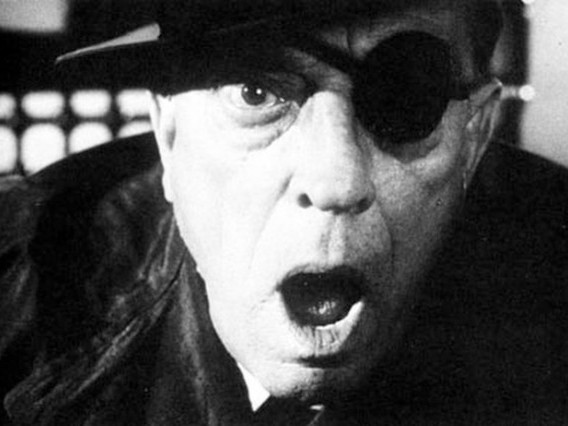
Endgame with Patrick MageeThe following night, the Uncommon Players returned under the directorship of Anthony Richards to perform Beckett’s 1957 play Endgame, one of the two works (alongside Waiting for Godot) for which he is best known. This takes place within another confined and circumscribed world, a featureless room with two windows at the back which might be a bunker sheltering its inhabitants from a post-apocalyptic world, or might be the cavern of a skull, with twin sockets gaping outwards. The attachment of specific meaning in terms of character, place or metaphorical meaning is not encouraged. At one point Hamm, one of the characters, tentatively enquires ‘we’re not beginning to…to…mean something?’, which raises a brief laugh from his companion (other half?) Clov, and a dismissive ‘ah that’s a good one’. Hamm also offers a few pieces of pre-emptive auto-criticism throughout, remarking that ‘this is deadly’, and later hopefully observing that ‘things are livening up’.
The main two characters, Clov and Hamm, are another of Beckett’s double acts, complementary foil who are also inseperable halves of a symbiotic whole. Clov is ostensibly the servile, active aspect, although his mobility is pained and effortful in the standard Beckett manner. His derivation from the old silent comedians is to be found in the repeated comic business which requires him constantly to shuffle back and forth, reaching his destination before having to return and retrieve forgotten stepladders or spyglasses. He was played by Philip Robinson with an end of tether edginess. But there was also an underlying pitifulness, a broken quality which suggested that his resentment at his servility would never be translated into actual rebellion, no matter how many times he might say ‘I’ll leave you’. Hamm is the intellectual aspect of this dual character, blind and immobile in his moveable chair (not moveable by him, however, as several attempts demonstrate). His is a dictatorial mentality (his chair a director’s seat) given to endless questioning and speculation. As played by David Watkins, he was curt and rude (often amusingly so) with an aristocratic assumption of superiority. But he also had a wheedling side which acknowledged his total dependency on Clov. His manner reminded me a little of Jim Broadbent in the films of Mike Leigh. In this production, he sat in an armchair mounted on a pallet, like a makeshift dais, which gives him an air of wasteland regality. Clov and Hamm are both stained with filth. Clov wears an extremely grubby white vest, and Hamm begins with blood and god knows what else stained handkerchief shrouding his face. Both have the look of decay about them.
Taking physical and mental decrepitude to an even greater extreme are the two other characters, initially hidden, Nag and Nell, Hamm’s ‘accursed progenitors’. They appear, faces dusted a deathly white, from two cylindrical rubbish bins (battered oil drums in this production) in which they mostly remain sedately ‘bottled’, resting on their stumps. Nag appears most often, and is reduced to a creature of simple appetite, calling for his ‘pap’. Their vagueness (reminiscent of Henry Crun and Minnie Bannister in The Goon Show) resolves into sharper focus only when familiar memories or oft told stories are rehearsed once again. As played by Jan Hookway and Eddie Holden, they were touchingly frail and half-present, more ghosts living in reiterated fragments of the past. Nell and Nagg’s confinement, stuffed into their bins with the lids screwed down, is similar to the fates suffered by other Beckett characters: Winnie buried up to her waste (and in the second half, her neck) in Happy Days, and the three protagonists of Play, stored in large urns from which only their heads protrude. Beckett’s love of Dante once more comes through in such purgatorial images of entrapment.

Nell and Nagg’s bins shrink the boundaries of the world to an even narrower circumference. The idea of confining cylinders or other hollow, imprisoning forms, is a recurrent one in Beckett’s work, and was evidently one which played on his imagination. Similar set ups can be found in his stories The Lost Ones, in which 200 people live in a cylindrical silo, Ping, in which one person lives a monadic existence in a small white cube, and All Strange Away, which features a white rotunda in which two people lie back to back. Rod Serling used a similar idea in the Twilight Zone episode Five Characters in Search of an Exit, whose title clearly alludes to the theatre of the absurd and Pirandello’s Six Characters in Search of an Author. Here, five archetypal characters – a ballerina, an army major, a clown, a tramp and a highland piper – awake to find themselves inside a towering cylinder with no doors. They have no memory of who they are or why they might be here. A fantasy rationale is provided in the end (not a very comforting one, however), but the atmosphere throughout is redolent of Beckett and the theatre of the absurd (as indeed are a good many other Twilight Zone episodes). Vincenzo Natali’s 1997 science fiction film Cube, in which 6 characters wake up to find themselves in a structure comprising interlocked cube-shaped rooms primed with a variety of deadly traps, is similarly Beckettian in its premise, and remains true to such influences by refusing to offer any concrete rationale which would place this netherworld within a fixed moral or political framework.
The room in Endgame is thoroughly explored, and the world beyond observed at regular intervals. Hamm insists that Clov takes him on a tour ‘right round the world’, and he is heaved from one wall to the other on his portable pallet before being parked back in exactly the same central spot from which they had set out. The windows look out onto a wider universe, one affording a view of the earth, and one of the ocean; one the realm of waking life, the other the depths of the unconscious. Such a clear division is open to any number of symbolic interpretations – or none at all. As Clov repeatedly explains, both are equally devoid of life or motion (no waves rippling the surface or winds blowing the dust), the world having sunk into an entropic flattening out of form in preparation for its final fading away. The Bike Shed proved the perfect place to stage Endgame. Its vaulted, underground space needed little adaptation to give it the feel of Hamm’s bunker, and a back wall with windows was there ready to use. Bright lights shone directly through them gave an impression of arid lifelessness beyond with the simplest of means. The fact that the small theatre was tightly packed with a capacity audience added to the sense of airless claustrophobia generated by the play – rather too effectively, in fact – I was glad to get out into the cold night air afterwards. It was a fine production by the Common Players, and it was great to see it attracting such a wide and appreciative audience. The Bike Shed continues to go from strength to strength. Long may it continue.


