
Blood On Satan's Claw is playing in a fantastic double bill with Ben Wheatley's A Field in England this Friday at the Black Swan in York, beginning at 7PM and with an introduction by writer Gavin Baddeley. Two great, great films put on by the estimable Fiendish Thingee. Come and enjoy the country air, but take care not to stray from the path. Following on from the notes on A Field in England, here are some circular thoughts on the other half of the bill.
A film with a title like Blood On Satan’s Claw, splashed on a poster and represented with blunt literalness by a fiendishly taloned paw dipped in gore, might not seem to promise anything from the more refined end of the arthouse cinematic spectrum. The words scream out in lurid red letters, letting you know in no uncertain terms that this will be a rough and ready piece of raw exploitation, a bubbling stew of sex and violence which takes full advantage of the new liberal censorship regime of the early 70s. Shocking in all senses of the word. This might indeed be the primary attraction for certain casual viewers, the poster enticing passersby into the cinema who are looking for precisely for these kinds of potent, slightly grubby thrills. It was certainly the impression that Soho movie hustler and old school East End character Tony Tenser, whose Tigon production company was behind the film, wanted to make. He was concerned with making money, and artistic considerations were not high on his priorities. Having said which, he was responsible for a small clutch of genuine classics in the 60s and early 70s, including Roman Polanski’s first two British features, Repulsion and Cul de Sac.
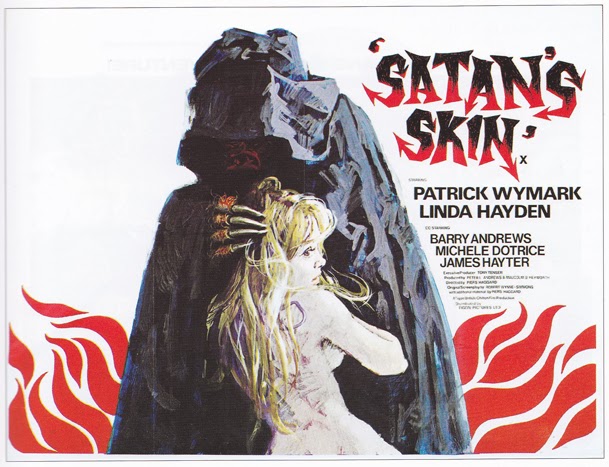
US poster under a different title (just to confuse things)If the film fails to live up to the expectations aroused by the grasping, bloody claws and the naked flesh which they are poised to rake, there may be a low chorus of disgruntled muttering in the lobby on the way out. We anticipate some lurid and titillating scenes from the offset, murkily and prosaically shot on cheap and hastily erected sets. So the opening scene comes as a considerable and, hopefully, pleasant surprise. It establishes the tone of the film, and immediately introduces some of its prevailing themes. And far from being lurid, shocking and contemptuously cheap, it’s poetic, expertly shot and quite ravishingly beautiful. But don’t worry. There will be disreputable pleasures too.
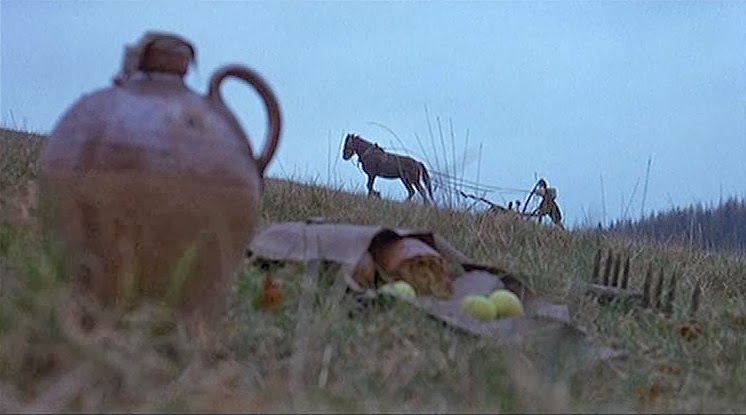
Pastoral and rustic still lifeThe opening shot is a highly formal blend of rural still life and agricultural landscape. An open, grassy slope, seen in close up from a low, ground level angle, takes up the majority of the screen’s space. Apples, a hunk of bread tucked into a leather pouch and an earthenware jug, presumably filled with cider, are neatly arrayed on the left of the frame – a ploughman’s lunch. And there’s the ploughman, a small figure in the middle distance moving across from the right of the frame. He treads out the horizon, outlined against the narrow strip of sky at the top of the screen. It’s a beautiful composition, almost painterly in its considered balance of elements and division of space. There are other compositions like this scattered through the film, including a lovely shot of a torchlit procession marching in the distance in evenly spaced rank across an evening field. We then get a close up of the soil being turned over by a horse-drawn wooden plough, again shot from ground level. This is a stylistic choice which director Piers Haggard and cameraman Dick Bush (both ex-BBC men) make throughout the film. Haggard is an avowed fan of Japanese cinema, and this may have had some influence in this respect. Yasujiro Ozu was known for his low-angle shots, and the camera in Japanese films often descends to a low angle to share the kneeling perspective of characters in domestic rooms, royal palaces or temples.

Torchlit processionThis ground-level view works on psychological and symbolic levels. It’s an unconventional and disorientating perspective to watch from, and sets the perceptions a little aslant. It also lends the impression that the surface of the world is provisional, a thin skin with deep, accreted layers, both geological and temporal, lying beneath. Forces long-buried and all-but forgotten spirits may worm their way to the surface and re-emerge, the genius loci of centuries past which never wholly dies but diffuses through the soil and reconstitutes itself when the climate is favourable. The low-angled shot is also used to good effect in the haunted attic scenes, creating a sense of incipient unease and suggesting that there is something lurking beneath the floorboards. The attic is the classic symbolic locus of the subconscious in gothic film and fiction, from Jane Eyre through The Owl Service to the Exorcist. It’s the dusty substratum of the mind, its hidden inhabitants, boarded up and kept from the light, waiting to burst through with all the violence built up through years of incarceration.

Ground level shots - the provisional surfaceBack to our ploughman; we first gain a proper view of him via his shoes, a rare close-up of period costume footwear. They look authentic enough to my inexpert eye, and are an immediate example of the attention to fine detail which is evident throughout. This can be seen in minor elements such as the use of rush lights, set down in bracket holders, the poignantly half-finished needlework circle left by the fire, and the wooden cage for a pet songbird hung from the ceiling. They all combine to create real depth to the 17th century atmosphere conjured by the set designer Arnold Chapkis. The film-makers were lucky enough to find a perfect period farmhouse in the Bix Bottom Valley for the exteriors of the principal locale in the first part of the film. But the set design for the interiors is equally impressive. It creates a solidly real, lived-in setting, which makes the fantastic and horrific events which are played out within it all the more disconcerting, a disturbing eruption of the irrational into the everyday.

Period fireside detailThis care in creating a believable sense of period extends to the dialogue. There is a real attempt to create a sense of rural speech, with many a ‘she’m’, ‘b’aint’ and ‘it be’ scattered throughout. The odd RADA or RSC vowel slips through, this not being a mode of speech actors are commonly called upon to essay. But it’s a refreshing change from the peasantry in Hammer films and their imitators. They are generally middle Europeans (nominally, at least), but the English character actors who portray them tend to slip at the drop of a hat into a disgruntled cockney shtick of the kind they might use in a BBC Dickens. This is perfectly alright in the context of Hammer’s fairytale worlds. Blood On Satan’s Claw is intent on building a more authentic environment, however. It also creates a sense of a village community defined through the divisions of labour evident throughout. The ploughman, Ralph (Barry Andrews), works for Mistress Banham (Avice Landon), who owns the large house and its surrounding farmland. She also employs Ellen Vespers (Charlotte Mitchell), another of the central adult characters in the film, who works as her domestic servant. The village authorities are represented by the temporarily resident judge (Patrick Wymark), the buffoonish squire (an amusing turn by James Hayter), the unworldly vicar (Anthony Ainley) and, to a lesser or more delimited extent, the ineffectual doctor (Howard Goorney). The peasants do share a general air of disgruntlement and a tendency to mob-handed violence with their Hammer brethren, however. This is treated with a certain amount of wryly self-aware humour by the film-makers. A member of a search party roused by the squire, setting out into the steady rain, mutters ‘silly old fool. Why don’t he go and search his bloody self’. And when the pitchfork and torch-wielding mob heads for the traditional climactic confrontation and conflagration, not a few of the stout locals decide to remain behind and look after the large kegs of ale which have been set up in the churchyard to steel the nerves.

Answer echoes answer - Cathy calls across the valleyThe work of Ralph the ploughman (to whom we once more return) is effortful. The soil yields reluctantly to the blunt blade guided by the straining figure who controls the machinery whilst also holding the reins of the horse which draws it forward. This is no sun-dappled eulogy to the purity of the agricultural life. It’s hard labour, carried out against a winter landscape whose predominant tones are dark brown. But there is a lyrical element of English pastoral romanticism here and throughout the film. Ralph pauses in his work to call back across the valley to his sweetheart Cathy (Wendy Padbury), and we see him from her perspective, a small, waving figure against the woods. Ralph and Cathy will remain the innocent heart of the film whilst all around them steadily succumb to devilish enchantment or the hysteria of fear, superstition and rumour. The call across the valley gives us a sense of the dimensions of this local space, and for a moment we seem to be in the territory of AE Houseman and A Shropshire Lad. But then Ralph ploughs up the devil, a head like a grotesque turnip inserted with a glistening eyeball, across which a wet worm inches. It’s the kind of picture which might have graced the cover of a Pan Book of Horror paperback at the time the film was made. I certainly can’t recall any such imagery turning up in any AE Houseman poem I’ve come across.

The devil's turnip - unearthing evilThe devil is gradually and methodically built up from various donated body parts throughout the film, gifted with varying degrees of willingness. We don’t actually get to see much of it, though. It’s no doubt a conscious choice on the part of the director, who’s well aware that what is suggested, or glimpsed in the peripheral shadows of vision, is liable to be more disturbing than what is revealed in the full glare of sun or firelight (particularly on a low budget). But his absence from the greater part of the story is also an indication that this is not the Devil of Revelations-riffling, Carl Orff-chorusing films of fundamentalist orthodoxy to come such as The Exorcist or The Omen. Nor is it the Hellfire Club Devil of salacious Satanists conjured up in Dennis Wheatley adaptations and variations. The offhand climactic unveiling of the near-wholly embodied demon is, in the end, a cursory observance of the required generic formula. But rather than a figure from the St James Bible, it’s a creature of deep folk memory, a product of the danker corners of the natural world, with the sort of half-formed, gurning features which might have emerged from the imagination of a medieval engraver or wood-carver. Indeed, you can find just such creatures in the shadows of Ashcombe church near Exeter in Devon. Its odd, hopping gait (it’s still waiting for that vital last limb to be supplied) adds to a general air of rank toadiness. Indeed, it’s not dissimilar to one of the devils depicted in Danish director Benjamin Christensen’s 1922 film Haxan: Witchcraft Through the Ages.

High priestess of the Dionysian cult - Angel Blake (Linda Hayden)The physical manifestation which is the source of the malignancy which spreads like a plague through the village is not particularly important. It is the youth cult which emerges and gathers strength and numbers through its guiding spirit, and under the beguiling leadership of its high priestess Angel Blake (Linda Hayden), which forms the central focus of the story. This cult is Dionysian rather than Satanic, a re-birth of old rites and revels, with their attendant sacrifices, which rise to the surface at periodic intervals. There are contemporary parallels with the children’s crusades of the 60s and early 70s, with their wholesale mistrust and rejection of the ‘straight’ adult world. Given that the intoxication of the children leads to cruel indifference of other’s suffering, an absolute us and them division, and orgiastic gatherings which climax in ritualistic murder, this could even be seen as a somewhat reactionary film, reacting with conservative revulsion to the ongoing upheavals stemming from the previous decade.

Jack in the GreenThe Dionysian cultists take to the woods for their rites. They appropriate a decorously ruined church (also to be found in Bix Bottom Valley), its remaining stonework held together by the binding roots of ivy, and reconsecrate it for their own heathen purposes. A direct parallel is drawn between this sacred grove and the village church, where attendance at Sunday school steadily dwindles to a stubbornly uncorruptable remnant. We cut from the vicar’s vexations at the empty benches facing his pulpit to the mist-shrouded pagan altar around which the children are gathered. The reversion to the old ways is also suggested by the two boys who become mischievious woodland sprites. We see them peering out through concealing branches and tangles of undergrowth, wicked grins permanently splitting their faces as they contemplate further gleeful pranks. One of them has sharp, elfin features and dresses in Lincoln green, a playfully murderous spirit of the greenwood waiting to lead the unwary astray. The other is a carrot-topped, freckle-faced boy, a Just William whose naughtiness and anarchic japes have crossed the line into active malevolence and evildoing.

May blossom frameThere are several scenes set on the borders of the woodland, with shots looking out from the trees into the fields, ‘innocent’ characters framed by dark winter branches or haloed by sprays of May blossom. The woodland path winding down the slope to Ellen’s cottage is trodden repeatedly, but becomes increasingly vulnerable to the lurking cultists. It forms a borderland between the two territories. The woodland is the wild place beyond the edge of the tamed natural environment of the agricultural landscape. It’s a potent symbol of the deeper, more tangled recesses of the human psyche.

Borderlands - The path through the woodsBack to the beginning again. We see the look of revulsion on Ralph’s face as he looks down at the unspeakable horror he has unwittingly excavated. It’s not so much a skull as it is a dessicated head, a bogman burial compressed and preserved from centuries packed beneath layers of soil until it is a thing of tilth and flint as much as flesh and bone. We get a worm’s eye view looking wetly back up at Ralph, the turnip-head’s eyeball staring him out with mesmeric fixity. A crow hopping on ploughed ridges amongst scattered feathers presages the discovery. Has it supplied the eyeball which it the first step towards the devil’s re-embodiment, granting it vision of the world once more? The crow (or a crow) turns up at various moments in the film, watching proceedings with beadily blinking vigilance from a variety of dark, gnarled branches. It is an emblem of the cruel indifference of nature, a carrion silhouette which seeks out the dead, and has often been taken for death’s uncanny harbinger.

The crow looks on from the edgelandsThe resurrection of the devil in the film can be seen as marking the return of nature in its more unrelentingly predatory aspect; a nature which is as much about death as it is about life, the one deriving from the other. The fey flower children of the 60s saw a return to nature as a reclamation of a state of innocence lost in the process of civilisation, industrialisation and the migration to ever-swelling cities. ‘We’ve got to get back to the garden’, as Joni sang in Woodstock. But the children of nature in Blood on Satan’s Claw are very far from being gentle hippies, at one with the birds and trees. The nature with which the cultists are in tune is the way of bloodsoaked predation, which relishes the luring, stalking and dispatch of the prey. Nature red in tooth and (Satanic) claw. This is ignoble rather than noble savagery, self-consciously delighting in its own pitiless viciousness.

All God's creatures - the vicar and the harmless serpentSex is part of this return to nature in the raw, too. Romantic love plays no part in it, it is purely and simply a procreative impulse towards the furtherance of one’s own kind – the devil’s kind, in this case. When Peter, the son of Mistress Banham, sees his betrothed led down the stairs from the attic in which she has encountered the reborn spirit of the field demon, she is no longer the coy bride to be of the previous day. She throws him a look of frank lasciviousness which makes it clear that she is now possessed of a carnal knowledge and hunger, and figuratively wants to eat him up. Angel Clare is similarly possessed. As the film progresses, she grows more and more to resemble a lupine creature of the old wilds. Her eyebrows grow dark and bushy and slope upwards with hungry animal alertness, and her cheeks become flushed with the arousal of the predatory carnivore sensing its kill. Close-ups of her blue-grey eyes also make for a very lycanthropic, wolfen look. In contrast, the vicar is a passive lamb, led off to the slaughter when Angel, putting on a mask of wounded innocence, accuses him of abuse and murder. He keeps nature tamed and domesticated in the form of his pet rabbit, tethered to his desk and hand fed. It’s a symbolic representation of his own carefully corralled nature. He is first encountered studying a slow worm he has discovered at the edge of the woodland (that borderland between states), declaring that all animal’s are God’s creatures. This writhing serpent is, contrary to appearances, a harmless beast. He is aware of this, and allows it to slither up his sleeve. Evil, or predatory and poisonous nature, is just as likely to take a pleasing form, as he will later discover.

One more time to the beginning. We move from the shot of Ralph looking down at the head, and the head staring back at him, and arrive at the title sequence. This is heralded by a full-beak close-up of the crow blinking its empty, black eyes, perched impassively on its branch. We are then introducued to the opening, stridulant strokes of Marc Wilkinson’s extraordinary score, which seem to echo the twitching movements of the bird. Wilkinson’s music brings together and entwines the different moods of the film. There is a lovely, sweeping theme in the strings, all Vaughan Williams pastoral romanticism, with hints of old folk tunes at its heart. Curling around it like a parasitic vine is a serpentine, descending theme with no definite tonal centre. It’s both intoxicatingly beautiful and disconcertingly off-kilter, the dying fall of a leaf spiralling to the ground. This theme is played on the Ondes Martenot, and early electronic keyboard instrument which was a favourite of the French composer Olivier Messiaen. There’s certainly something in Wilkinson’s score of the woozy, reeling Ondes Martenot love theme from Messiaen’s Turangalila Symphony, heard in the Chant D’Amour sections. The cimbalom is also used as a resonantly ringing shadow tinting the music at various points. The cimbalom is an Eastern European hammered dulcimer. It has often been used in soundtracks to indicate the incursion of something other, a shadowy presence from elsewhere stealing unnoticed into familiar surroundings. It was used as such in many a Cold War spy movie, to the point where it became something of a cliché.
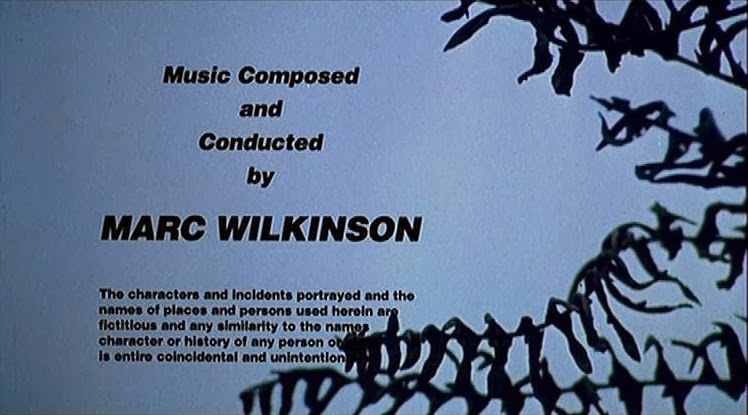
Wilkinson’s gorgeous score, which has happily been released on Trunk Records, accompanies a title sequence of great beauty. The credits are placed within framing curves and arcs of thorns and winter branches, furled ferns and spent seedheads. The separate shots resemble book plates or illuminated chapter headings in some exquisite folio edition, pages with decorated margins. The title sequence leads us to anticipate something quite special, an expectation which the title had singularly failed to raise.

Vermeer interiors - Margaret's taleThere are, naturally, some shortcomings attendant upon a film made on a very limited budget and timescale. The original plan had been for an omnibus film in the Amicus mould, with three stories taking place in different historical periods. Writer Robert Wynne-Simmons duly produced three separate tales, only for the producers to change their minds and decide that they wanted a single story set in the 17th century. Michael Reeves’ film Witchfinder General had been a big success for Tigon, and this was now considered to be a marketable period. Harshly realistic historical horror set in a pre-industrial rural England was, Tony Tenser and his partners decided, the new thing. The joins between the three patched-together stories still show to a certain degree, although the story still forms a coherent whole. In fact, it inadvertently displays the classic three act structure recommended by the gurus of formulaic Hollywood scriptwriting. Part one is the tale of Peter and his bride to be, and largely takes place in the farmhouse and its attic. Part two concerns the growth of the cult and its effect on Ellen and her children. It takes veers between her cottage, the woodland and its makeshift shrine and the village church. It’s also the tale of Cathy and the loss of innocence, of childhood’s end. Part three concerns the hunting down of the cult, and takes place in farmhouse and barn, village, woodland, lakeside and a chalk pit, against whose crumbling white cliffs Angel, in her soiled white shift, appears all the more like a desperate, fallen incarnation of her given name. It is also the pitiful tale of Margaret (Michelle Dotrice), who finds herself exiled from the cult and from Angel’s favours. Margaret is at the centre of the one scene which directly emulates the tone and subject matter of Witchfinder General. She is ‘ducked’ in a lake in the middle of a pine wood. This is a brief diversion to Black Park in Bucks, a home counties location familiar from dozens of Hammer films, in whose waters an unfamiliar victim is often found floating.

Angel as genius loci of the chalk pitsThe comparison with Witchfinder General is an interesting one. Blood on Satan’s Claw actually takes place at a later date than the Civil War period in which Reeves’ film was set, and a significant shift in attitudes has taken place. The days of hysterical accusations are over, and the persecution of ‘witches’ is seen as a historical aberration. The clothes of Mistress Banham’s husband, who we are told died 10 years ago, hang from the rafters in the attic gathering dust, and represent an era of history being packed away along with the culture and beliefs which went with it. These old-fashioned garments have the haunting quality of any clothes hung in storage, empty of the bodies which once inhabited them. The Judge, dwells at his leisure in Mistress Banham’s farmhouse, and it is made plain that they were intimate acquaintances in the past. He raises a glass to ‘his Catholic Majesty King James III in exile’, adding ‘may God keep him in France’. It’s an ambiguously phrased toast from a measured and enlightened man who chooses his words carefully, and it leaves us none the wiser as to whose side (if any) he’s on. It places the period as post the Glorious Revolution of 1688, which brought William of Orange and his wife to the throne of England, displacing the hugely unpopular Catholic monarch James II. James bore a son in the self-same year, and naturally enough called him James. When James II died in 1701 in France, his son became the exiled pretender to the throne, the James III in question. So Blood on Satan’s Claw can be considered to take place in the early 18th century. The last witches to be executed in England are generally thought to be the 3 ‘Bideford Biddies’, who were tried and found guilty in Exeter in 1682. The trial was a considerable embarrassment to the judiciary, who believed the charges to be superstitious nonsense but bowed to the strength of local opinion. The superstitions and folkloric hearsay which fuelled it were dying out even in such benighted corners of the country, however.

The Judge as Enlightenment scourgeThe Judge in Blood on Satan’s Claw is deeply sceptical about the return of what he terms the ‘old superstitions’, and is a man of the dawning age of enlightenment. When Peter suggests that ‘there’s evil in this house’, the Judge takes a firmly rationalist stance and advises him ‘you must cleanse your mind of such fancies’. Peter later visits him in London to inform him of the grim developments in the village, and tells him that ‘witchcraft has returned’, the implication being that it has been absent from people’s minds for some time. The Judge remains sceptical, however. When he does return to mete out justice, he declares ‘I mean to run this devil of yours to earth, if he exists’, and demands some form of evidence before he proceeds. Once he has that evidence, however, he becomes a terrible scourging angel, coming not to bring peace, but with a sword; and a huge ceremonial cruciform one at that. There is also a sense in which he is burning away the last remnants of the old magical thinking, making way for a new world of scientific rationalism which will disperse the shadows of the 17th century and the bedevilled medieval mindset in its clear, illuminating light.

Howard Goorney, Barry Andrews and Charlotte MitchellThe cast of Blood on Satan’s Claw has an interesting genre pedigree. Several had appeared in Hammer films. Barry Andrews worked in the archetypal Hammer tavern in Dracula Has Risen from the Grave, whilst Linda Hayden played one of the daughters of the trio of hypocritical Victorian patriarchs who were wooed over to the dark side by Christopher Lee’s Count in Taste the Blood of Dracula. Howard Goorney, who plays the very 1970s doctor, had made a very minor incursion into the world of Hammer, playing a drunk in the 1964 movie The Evil of Frankenstein. This was the film in which Hammer misguidedly tried to reappropriate the Jack Pierce Karloff look for the monster. Goorney was a graduate of Joan Littlewood’s Theatre Workshop, and went on to write an invaluable history, The Theatre Workshop Story, which drew on personal reminiscences as well as interviews with the actors he had worked with.

Wendy Padbury as CathyThere’s a double Dr Who connection. Wendy Padbury (Cathy) played the longstanding companion Zoe alongside Patrick Troughton’s Doctor in the 1960s, whilst Anthony Ainley would go on to play the re-incarnation of the Doctor’s nemesis The Master from the latter episodes of the Tom Baker era through to the very last ‘classic Who’ story Survival opposite Sylvester McCoy. Patrick Wymark was also in the running to play the regenerated Doctor in the 60s. Blood on Satan’s Claw was to be his last film, and he died before it was released in the cinemas. He gives a strong and characterful performance in defiance of his poor state of health. He’d appeared in Witchfinder General, and was also in Roman Polanski’s Repulsion, a Tony Tenser production from the pre-Tigon days of Compton Films. Michelle Dotrice plays Satan’s disciple a couple of years before she entered the nation’s hearts as Betty, the long-suffering wife of Frank Spencer in the immensely popular sitcom Some Mothers Do ‘Ave ‘Em. Her breathy invocation ‘hail Behemoth, spirit of the dark. Take thou my blood, my flesh, my skin and walk’ was sampled and used to great effect on the stirring track Scarlet Ceremony on the Ghost Box album The Owl’s Map by Belbury Poly, which gives an idea of the kind of territory in which the film has exerted a pervasive influence.

Milton Reid patiently waits his callMilton Reid, the Judge’s implacable enforcer, was an interesting character too. Born in India of an English father and Indian mother, he moved to England in his teens and became a professional wrestler after the war. He also took small parts in films, his imposing frame and bulldog head making for a striking onscreen presence. He invariably played stone-faced executioners, intimidating genies or other Arabian Nights heavies (and you can imagine him leaning on an unfeasibly large scimitar), or standard issue mute thugs. He was highly effective in these supporting roles, creating an immediate and lasting impression, and adopting a less is more approach to acting. He really just had to be there. He was in the splendid Hammer smuggling swashbuckler Captain Clegg, which featured Peter Cushing at his dashing, athletic peak (an English Errol Flynn in his day), and was later in Dr Phibes Rises Again and The People That Time Forgot, the Amicus follow-up to the Michael Moorcock-scripted Edgar Rice Burroughs adaptation The Land That Time Forgot. Robin Davies, who plays Cathy’s brother Mark, had just appeared in the TV series Catweazle, set on another farm. He played Carrot, the farmer’s son who befriends the tetchy wizard and introduces him to the bewildering magic of the modern world into which he has fallen. He also turned up earlier as one of the ‘scum’ knocking up a fry-up in the lower levels of the emblematic school in Lindsay Anderson’s If…

Robin DaviesDirector Piers Haggard never quite matched the strange and potent magic of Blood on Satan’s Claw in his subsequent work, although the 1979 Quatermass serial with John Mills again makes highly evocative use of the English rural landscape. He seems proud to have created a film which has built up such a lasting cult reputation over the years, though. It’s a reputation which is well deserved.


