Monday, 29 December 2014
Hunting The Demons of Ashcombe
It was on a sharp, blue-skied autumn day that I set out to hunt down the demons of Ashcombe. I’d seen pictures of the strange, distorted faces carved into the dark oak of 17th century bench ends in Todd Gray’s fine book on the subject, Devon’s Ancient Bench Ends. These were like nothing else I’d come across in my explorations of old Devon churches. They were emanations from the shadowy undergrowth of the rural imagination, monsters from the night side, the impenetrable gloom of the surrounding forest depths. They seemed to display no evident religious symbolism. Demons tended to be relegated to the exterior of churches, reminders of the evils from which the interior would provide sanctuary. But here they have invaded the space of the nave, settling themselves down right beside the congregation. This demanded closer inspection. But they proved frustratingly elusive. On my first visit I found the church locked, even though it was remote and unlikely to attract the attentions of all but the most dedicated and well-informed vandal. I returned on a Sunday, but discovered that services were few and far between, parcelled out between several other small churches in the parish. Perhaps this journey would prove more fruitful. There was a sense of anticipation in the air, a sense of immanence which augured well (or maybe ill).
The road to Ashcombe from Dawlish wound along the side of a valley, following the rippling contours of the gently folded hills. The hedgerows were rich with bright berries and late blooms. Bees sucked on pin-headed stamen clusters which looked like they were dipped in sugary sherbet. A fiery ball of robin’s pincushion tangled itself wirily around a pink-thorned rose bush, dewdrops caught in its threads and glinting with jewelled sunlight luminescence. A kestrel hovered over an open field, wings arched back in tense suspension, perfectly poised to plummet onto its pinpointed prey. Look out down below! Buzzards circle lazily on invisible currents, landing on bare, blasted branches and adding hunched, slightly sulky silhouettes to the tree’s skeletal outline. Raptor cries screech across the echoing valley. This is an edgeless landscape, defined by its curving horizons and sinuous roads. Woodland copses cresting undulant fields warp beneath contrasting cloud masses. Abstract compositions are drawn by tractors and harvesters, tramlines and long wavelengths etched through dry wheat. They are like energy patterns, circling in concentric ripples around the metal trees of pylons. Pylons, with their geometric grids, break up the non-linearity of the landscape. Only human constructs are linear here: Gates, greenhouses (there is a rose growing farm down by the river in the valley) and telegraph poles.
Arriving at the edge of the hamlet of Ashcombe, the prospect of the 12th century church tower, elevated by the rise of the slope on which it is planted, is framed by trees, chimneys and a telegraph pole. The pole sprouts a solid junction box and the brown ceramic discs of insulators, which are strung from the sky-raking wires like sleek mushroom caps. The Norman tower is ancient, but the telegraph technology it is juxtaposed with also looks outmoded, redolent of a redundant post-war moment. An old church filled with strange carvings and the crackling energies of 50s technology; this could be the setting for a Nigel Kneale TV drama in which the supernatural is confronted with the modern apparatus of scientific rationalism.
The church lies on the lower slopes of a steep hill which marks the southern end of the Haldon ridge. It’s a forested spine of land which extends a fair few miles, a rainshadow divider separating the Exe Valley from the Teign Valley and the rise of the moor beyond. Ashcombe is tucked into a fold in the lee of the range. It catches the sun on its path from the east, but the shadows can fall quickly and prematurely as the Haldons impose their looming gloom. It’s a short but sharply inclined trudge upwards from the trough of the bell-curve the road traces through the Ashcombe dell to the church’s hunched stone outline which broods above it. The graveyard is mounded up like the rounded back of a surfacing leviathan. Tilting crosses and gravestone arches stand out starkly against the sky, their dark contrast already beginning to dispel the brightness of the afternoon, to whisper intimations of a more chill atmosphere.
But there is brightness and life in the graveyard still. The efflorescing fruits of a tree produce vulgar, blushing pinks and glisteningly succulent oranges, nature’s vivid colour contrast to sombre grey stone. Violets cluster in the leaning shadow of granite slabs. Moss and lichen bloom across flat stone planes, forming their own expanding universes. Snails add their slimy script to etched lines, a spiral punctuation mark emphasising the letter or word where they take their fastened rest. Some find shelter in the sharp-angled armpit of a cross. Berries sprayed across a hardy shrub throw hard buttons of primary red against neutral granite, blood on fossilised bone.
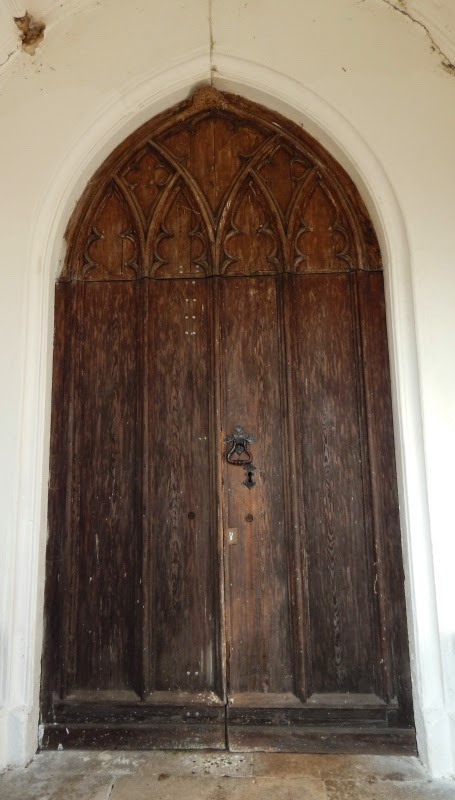
The church is locked. Frustrated, I rattle the door a few times, as if this will do any good. I walk back down to the lychgate, its paint peeling in flakes of dark green, harmonising with the shedding of autumn tumbling all around it. Looking at the notices for hints as to when the next service might find it open and filled with sound and light. A postcard with faded felt-tip writing, half-hidden by other pinned pieces of paper, is just about legible. It tells me that there is a key held in the yellow cottage at the bottom of the hill for any who wish to explore the church. A large black dog greets me there, letting me know that somebody is in, whilst not exactly encouraging me to make myself known to them. The woman who answers is friendly and trusting, however, handing me the key without hesitation. She apologises for the state of the interior. Renovation work is being carried out, and she inhaled some dust when she was last in there. As a result, she has not been well enough to clear away the harvest festival decorations and offerings. I sympathise but wonder if I will be similarly infected. How old is this ‘dust’? From what part of the church has it been excavated or disturbed? But I have come this far. I must not falter in my resolve.
Disappointingly, the key is an ordinary front door variety rather than the large black iron affair I had hoped for. It fitted into a small yale lock inserted above the large hole which would have required an object ten times its size. The latch lifts with a pleasingly firm clack when I turn the circular iron door handle, however, and the heavy door creaks open. I walk through into the hushed interior, the outside world immediately receding, distanced by the airlock of the porch. The first thing I notice is the font, whose wooden cover is woven with strands of corn, grass and hedgerow berries. All are now withered and dessicated, their decorative arrangement falling into desuetude and disrepair. A heady scent of apples fills the church, overripe and on the verge of rotting fermentation. A neglected harvest offering left to mark the passing of autumn’s fecund riches and the advent of winter’s barren scarcity.
A green man with an amiable, placid face, broad and flat and topped with pointed porcine ears, looks out on the font from a capital atop a pillar at the back of the nave. Over the altar rail a golden foliate head peers down on the apples, grain and vegetables presented on the border of the sacred space of the sacristy. It is at the conjunction of roof joists painted a vibrant black, green, red and gold; a strange echo of Jamaican national colours in this rural English church. The joists also connect with what looks like a lion’s head wrapped in a turban. The Lion of Judah? More lions jut nobly from the arm rests of an oak throne beside the altar, the nub of their manes designed for a palm to rest at ease on, to stroke the woody nap of the tamed beasts’ head. On the back of the chair, two pot-bellied cherubs stand atop piles of rock or coal and bend beneath baskets of the same strapped to their backs. It’s a heavy load for such diminutive creatures to bear – child labour, essentially. A perky lectern eagle looks brightly out to the nave, its alert gaze surveying the three ranks of benches filling the space. It dates from the time of Elizabeth I and its noble, benevolent visage, beak crinkling into a knowing smile, bears the wisdom of the centuries, just as its back has borne the weight of the Word, the opened book.
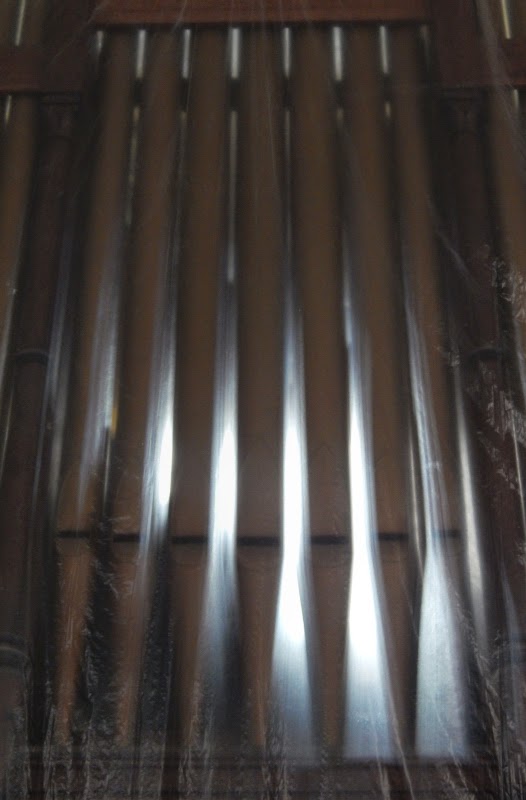
The restoration and repair work being carried out in the church is made evident by the scaffolding at the back of the north aisle. The organ by the entrance in the north aisle is shrouded in a curtain of smoky plastic. The pipes are visible as spectral formations, seen as if through a billowing fog. I imagine the music they would make, muffled and diffuse, sounds drifting through from a dimly perceived distance. The window in the south transept has been boarded over, the direct southerly sun streaming around the edges in sharp-edged, haloing spears of light.
That same low, dazzling late Autumn light lends mocking haloes to the St Nectan demons. They rest on the bench ends like wicked Chads, or wedge themselves into the corner angles. With their lolling tongues, sharp-edged grins, curving tusks and pointed ears, they are like anti-cherubs, exuding abandoned glee at their own grotesque natures. One has serpentine wings, its flapping lips parted in a rubbery, toothless groan. Hooded, sunken eyes stare out with blank, pupil-less depth. Its neckline is a ragged gouge, as if the head had been crudely torn off by a savage force. A close cousin of this creature retains two teeth, protruding loosely and squarely from its upper lip (which looks as if it has the jellied consistency of a rock pool anemone), inverted echoes of the tombstones outside. If anything, the teeth make it look even worse than its gummy kin. A moaning spectre wraps its thin, vaporous face around the scrolled top of a bench end. It is impaled on the spearheads of Gothic arches. An arc of tongue darts out of the gaping, downturned mouth. It looks a little like the ghostly alien which made a regular appearance in the final end title of the original Star Trek series.
A squashed head seems to labouring under dense local gravity, and gurns around its two prominent teeth. A squirrel and a lizard nuzzle against it, whether familiars or tormentors it’s not wholly clear. Almond-eyed serpents spiral up the side of the bench, living, writhing vines. The distinction between human and animal becomes blurred with many of the figures here. There is a head which is part human, part…cat? It certainly has a cat’s alert, radar ears and long, flat nose. And its tongue hangs in the way that cat’s tongues do when they get distracted in the middle of a preen. But it also has wings scrolling back behind it (feathered or scaled rather than furred). Flying cats? It doesn’t bear thinking about. A head with two arms emerging from its base appears to be crawling, advancing with a crablike scuttle. The upper face is like a chitinous mask fixed above mouth and chin. It resembles a devolved form of humanity, or a Moreauvian experiment in vivisected hybridisation. Halfway to the crablike creatures of HG Wells’ terminal beach in The Time Machine, it is retreating back to the ocean. It also brings to mind the spider-head from John Carpenter’s version of The Thing.
A goofy, big-nosed simpleton looks up with dull, sleepy eyes sunken in lazy folds of flesh, its face pockmarked by woodworm. Its mouth hangs vacantly open in a buck-toothed, slack-jawed yokel half-smile, thick ox’s tongue rolled out beneath three slab-like pegs. Two peasants lean out from opposite sides of a bench end, their soft craniums moulded, squeezed and straightened into corner points. Their chins rest in cupped hands. One leers lasciviously, the other seems to be yawning, or perhaps he is boorishly bellowing some choice insult. Or maybe he just has really bad toothache, and is yelling in pain.
Two more corner figures come in the form of toothless angels (angels of the angles). They are round-cheeked and bullet-headed, celestial beings of a very Earthly cast, incarnations of ordinary local folk. Their faces are the theatrical happy/sad masks with the upward and downward curve of the mouth reflecting the comic and tragic poles of experience. The ‘sad’ angel’s eyes bug out with worry, and a night cap hints at early hours anxiety and circling, sleepless thoughts. The ‘happy’ angel looks at ease beneath relaxed, thickset brows. Its smile looks a little self-satisfied, a little self-satisfied, a little secretive, wolfish. A little….evil. Between the two angels rests a swinish demon, not showing the least concern at their proximity. Indeed, it is the angels which appear the more affected by its presence; the one fearfully so, the other sensing the possibilities an alliance might offer, the potential for power and personal worldly influence.
Another demon roosts nearby. This one is a creature of appetite, omnivorous and ravenous. It is bat-winged and tusked, with four-clawed hands ready to clutch at unwary prey. Its cross-eyed gaze by no means suggests limited vision and its tongue lolls out with panting hunger. In the far corner of the church, another serpent winds up the side of a bench-end, its pointed head nearly reaching the top. It is lightly dusted with plaster, a white powder like ash or the finest fall of snow (or some of that bee sherbet).
My first instinct is to wipe it clean. But no. On no account must I touch any of these creatures. What manner of dreadful curse might be unleashed I fear even to contemplate (perhaps the holder of the key might enlighten me). I’ve read my M.R.James. I know that the curious must be cautious, lest their studies uncover things best left to the darkness of ignorance. I have no wish to share the experiences of Archdeacon Haynes in The Stalls of Barchester. He feels the oaken carving of a cat on a choir stall come to life beneath his hand (‘I was startled by what seemed a softness, a feeling as of rather rough and coarse fur, and a sudden movement, as if the creature were twisting round its head to bite me’), and that of a cowled, deathly monk changes so that ‘the wood seemed to become chilly and soft as if made of wet linen’. I have observed from a safe distance and made no contact whatsoever. I feel assured that no terrifying, malevolent spirits will be made manifest from the ancient wood, released to haunt and torment me like the unfortunate archdeacon. I leave the shadows of the church behind, along with whatever might inhabit them, the scent of autumn decay and damp, sifting plaster and walk out into the light, to the sound of birdsong in the graveyard.
I lock the door behind me. And that flicker of darkness flapping out from the tower? A trick of the light, an illusory spectre of the peripheral vision. The dry, snickering whisper in the air above my left shoulder? Nothing but a breath of wind through the leaves. I hasten my step and swiftly close the graveyard gate behind me, striding down the hill to return the key to its guardian in the cottage in the pit of the valley with a brisk word of thanks. And then I jump onto my bike and cycle out of Ashcombe with much haste before the light begins to fail. The demons recede behind me, remaining on their benches, locked into the time-polished wooden expressions and poses of the centuries. The chittering noises, the half-perceived feeling of shadowing presence, the sweet, rotting odour and the occasional brush of something flitting past – they are all in my head, I know. I must remain strong. I must.
Thursday, 11 December 2014
Nick Talbot of Gravenhurst
It was tremendously sad to learn of the passing of Nick Talbot, who died on 4th December at the desperately premature age of 37. Talbot had been the creative force behind the group Gravenhurst for 12 years, ever since their first LP Internal Travels, released in 2002. Indeed, Gravenhurst was, at various points, a veil for solo projects and performances. Talbot’s hushed voice, assured guitar fingerpicking and ear for affecting melody made the more intimate solo aspects of his work quietly compelling, drawing the listener into dark places and states of mind, but always tempered with compassion, pity and even empathetic identification. The more haunting and haunted aspects of the folk repertoire were an influence, as were the folk artists of the 60s and 70s. There are definite echoes of Nick Drake’s solid fingerstyle playing to the circling patterns of Circadian on the Ghost in Daylight album, for example, and his more dextrous accompaniments recall Bert Jansch and John Renbourne, in or out of Pentangle. There’s something of a folk air to the name, too. It’s an imaginary English place fashioned from a real village. Whilst Gravenhurst songs often have a contemporary urban setting, there’s always a hint of older patterns coming through the grubby surfaces, ancient and mysterious landscapes underlying the cracked concrete surfaces, thrice told tales recurring once more.
Gravenhurst could also create a driving sound as a trio or quartet, with the occasional guitar explosion providing the cathartic release of ecstatic noise. There was s subtle sound design applied to both the stark acoustic and fleshed out electric incarnations of Gravenhurst. Talbot had been inspired by the likes of Flying Saucer Attack and Third Eye Foundation when he moved to Bristol in the 90s, drawn to the richness and depth of their drone-based sounds. Many of his own productions surround the songs with shimmering haloes of organ drone and flickering spectres of electro-acoustic sound. They can be heard to great effect on Fitzrovia, which is backed by the moaning ghosts and echoing rush of the forgotten histories and buried rivers (‘Wandle, Falcon, Effra, Ravensbourne’) the song summons up. This, together with a feel for dynamic pacing which gives some of the longer numbers a sense of narrative development, lends his music a certain cinematic air. There were the occasional instrumental pieces, too. This seemed to be a direction he was moving in on the last album, The Ghost in Daylight. Carousel and Islands are particular lovely ambient miniatures, the latter dedicated to the Broadcast singer Trish Keenan. I first saw Gravenhurst when they supported Broadcast back in 2006.
Lyrically, Talbot was always attracted to dark matter. A recurrent theme was the seed of violence inherent in humanity, ‘the velvet cell within men’. In an early song from Flashlight Seasons, I Turn My Face to the Forest Floor, he wrote ‘you’re only a stone’s throw from all the violence you buried years ago’. It’s a line which forms the basis for a significant portion of his future output. This violence exists on a personal level, but also expands outwards into society and into the political arena. It reflects the balance of power at all levels. So, in Black Holes in the Sand, he sings ‘I held the hand that threw the stone that killed the bird that woke the city’. A circle of culpability and indirect agency which insists on a moral dimension to the most seemingly inconsequential of actions. The Foundry on the 2012 album The Ghost in Daylight makes the connection between violent impulses on a personal level and the violence of fascism and other political doctrines of forceful control explicit. ‘A uniform changes something inside’ Talbot writes, ‘and you won’t know when evil comes, evil looks just like anyone’. Anyone is capable of it, ‘the man with the match could be anybody’. This concern with violence also manifests itself in one aspect of Talbot’s writing which I find troubling: his portraits of murderers and serial killers. The serial killer as a modern day mythological figure and recurrent motif of horror and detective fiction is a cultural phenomenon which I find particularly depressing. Talbot’s disturbingly allusive songs are generally indirect and focus on the inner state of the characters he creates. In some respects, they are contemporary manifestations of old, death-haunted folk songs. Although Talbot’s approach is the opposite to the extrovert melodrama of Nick Cave’s murder ballads – his songs hint at hidden stories rather than explicitly relating them in an unfolding narrative. It’s significant that the only time he does do this it turns out to be a cover version – Husker Du’s Diane.
These songs also intersect with another abiding thematic concern, the distance between people and the retreat into states of disconnection and isolated inner solitude. Another early song from Flashlight Seasons, The Ice Tree, sets the mood: ‘we try to connect with the people outside, they pass through our slumber like trains in the night’. A feeling of numbness and emotional damage blurs the psyches of Talbot’s subjects. They stumble through the world like bewildered ghosts. In She Dances, the dancer thinks ‘I need new clothes, new skin; a mind I can bear to live in’. Another character (in Animals) reflects upon the revellers of an English Saturday night and muses ‘I wish I could be like them and I try/but I find it more rewarding to walk along the river/picturing my body discarded in the water’. Clearly there’s a good deal of self-loathing going on here, which can develop into an unhealthy way of defining identity, of creating confining prisons for the soul. This is fully expressed in the short lyric of the lengthy Song From Under the Arches: ‘I’ve seen bad things in bad places/What did I learn?/Wallow in grime/Tonight we’ll drink the sewers dry/We can’t function outside of these dreams of suicide’. Relationships are also seen as traps, with romance a self-deluding compulsion which causes people to keep dancing around one another when any feeling has long since dissipated.
Talbot’s view of love may have been jaundiced, but he remained a romantic, albeit a dark-hued one. ‘The universal dance/The black romance’ as he puts it in Nicole is one whose steps he rehearsed over and again. He rakes over the cold ashes of love rather than stoking its initial heat, dwelling on the sadness of its diminishment and the bitterness of its betrayal. Again, a shrinking into the cold cage of the disconnected self is often the cause of death for romance. As he writes in The Ice Tree ‘I caress where my lover once lay by my side before I turned inwards and forced her to fly’.
Talbot was also a romantic in his use of romantic language and mysterious imagery drawn from the natural world. Pine forests, rivers and seas, snow, ice and fire, stars and moon are all used to evocative symbolic effect. These depict real, figurative and inner landscapes, the latter suggested by the title of the first Gravenhurst album, Inner Traveller. Natural landscapes are contrasted with decaying cityscapes, the expansiveness of the former serving to highlight the claustrophobic confinement of the latter. In Grand Union Canal, for example, he writes ‘while you are waiting for me by a copper blue sea/I am fading away in this room’. He conjures city atmospheres with a beautiful economy of effect worth of his literary hero Iain Sinclair. I particularly like ‘black spine Northern Line, feeds on money and time’ from Hourglass. It seems to paint the city itself as a predatory beast, a devouring underground serpent. Seasons and their atmospheres are also invoked, winter and autumn in particular. The winter chill is the natural mood for a Gravenhurst song, and we find it in the opening lines of The Foundry in which ‘two wolves chase a whitetail through the snow’, as well as in songs such as Fog Round the Figurehead (a marvellously imagistic title), Winter Moon and The Ice Tree. The idea of buried or sunken ruins, artefacts or histories is also one which fascinated Talbot. There are the ‘cities beneath the sea/in deserted towns and burial mounds’ and ‘buried in sand/an ancient talisman touched by a thousand hands’, as well as the ‘lost event(s) consigned to history’ in Fitzrovia, the secret stories of the city. These lost worlds or frozen landscapes equate with the subterranean caverns of the unconscious, the unexplored territories of the self.
It might sound as if the tenor of Talbot’s music is relentlessly and oppressively downbeat. Whilst it’s difficult to deny this charge given the evidence cited above, there are counterbalancing forces. They lyrical quality of the language raises the tone above turgid misery-mongering. The sheer beauty of much of the music and the light delicacy of Talbot’s voice (like a less wavering Robert Wyatt), which is shot through with compassion, sympathy and even pity, makes the subject matter easier to bear, and casts it in a different light. A commensurately harsh musical setting would indeed make it oppressive, the kind of thing which would only appeal to people who feel that music should be harrowing and extreme, an aural endurance test. And there are chinks of light which shine through, too. They are all the more pronounced and precious for their scarcity. Talbot rejected shallow triumphs, glittering prizes and facile, baseless positivism. What hope does emerge is hard-earned and thereby genuine and strong.
There is a non-denominational religious aspect to all of this; a yearning for an authentic way of being free of the traps of violence, false emotion and material desire. Something beyond ‘the emptiness of the prize’. He is seeking ‘the Ghost of St Paul, still missing’, as he put in the song on The Ghost in Daylight. Perhaps there are hints of it in older forms, in the mysterious folk rituals which he summons up so well in songs like Flowers in Her Hair. The unmasking of the Spring Queen, the metamorphosis of veneration into abomination, marks a passing of something from the world, a desacralisation. ‘And when the flowers died they saw through the disguise/and all the townsfolk circled her/with prayers and tar and feathers/and fire’. And later, in The Ghost of St Paul, ‘slowly the smell of her fades/as blossoms wither away’. The sense of the world as sacred, and of that sacredness as being essentially feminine, incarnated in the form of the Goddess, is supplanted by a worldview dominated by the male violence Talbot dissects. A violent power which itself dissects (and murders) anything threatening its authority or potency. The eponymous authority figures in Hollow Men ensure that the status quo is maintained, and that there can be no rebirth of the Goddess, of sacrosanct female power: ‘her name is known, her name is known,/cut her up, cut her out,/crush her before she finds it’.
Talbots landscapes are haunted by the hunted. From the whitetails chased by two black wolves in The Foundry through the ‘dog loose in the woods’ where there’s ‘a fox tied to a tree’ in Flowers In Her Hair to the knowledge that ‘they will come for me/with searchlights streaming through the cedar trees’ in Song Among the Pine. But there’s still a hint of something which was once there, and may one day be rediscovered and resurrected. The key line in Ghost of St Paul dedicates the song to those who refuse to give up hope, who continue the quest and resist the controls of those who would corral their spirit: ‘here’s to the brave/to all those resisting’.
Some of Talbot’s influences were revealed through his choices of covers. He went back to the roots of the expansive, noisy drift of fellow Bristolians Flying Saucer Attack and Third Eye Foundation by taking the psych pop of The Kinks’ See My Friends and extending its two chord drone to the horizon. Husker Du have already been mentioned, but there is a general translation of the brutal realism and anti-romanticism of hardcore into a more melancholic English idiom. The cover of Fairport Convention’s Farewell, Farewell demonstrates a real affinity with Richard Thompson’s bleak but compassionate songwriting. The spectral winds ghosting around guitar and voice suggest final words of parting, perhaps delivered from somewhere beyond. It’s a truly haunting interpretation. A version of Tim Buckley’s Song to the Siren also captures the haunted, yearning quality of its briny drift with unadorned simplicity. Talbot also sang The Beatles’ Only A Northern Song on a Mojo collection of Yellow Submarine covers. It was a choice which indicated he might have shared George Harrison’s disdain for music biz practices. He also expressed a great admiration for Ian Curtis’ writing, his pared down but resonant phrasing.
Talbot was a writer as well as a musician, and literary influences show through in much of his work. Hollow Men alludes to TS Eliot, whose Waste Land also permeates Gravenhurst’s entropic landscapes. William Burroughs, an early inspiration, is acknowledged in the title of the LP The Western Lands. The cover itself has a rather bookish graphic design. Talbot also wrote for the online magazine The Quietus, and interviewed a number of writers for its pages. He was a keen student of philosophy, and his interview with John Gray makes fascinating and revealing reading. Gray opposed the rationalist/humanist fundamentalism of Richard Dawkins and AC Grayling in his books Straw Dogs and The Silence of Animals. He offered a different interpretation of religion which acknowledges its value and usefulness as a mythological template for understanding the complexities of human behaviour and experience. In his introduction to the interview, Talbot indicates his sympathy for Gray’s views and his dislike for the wholesale attacks on religious belief launched by Dawkins and Grayling, whilst declaring his own atheist standpoint. He wrote ‘to the many atheists who found the Dawkins camp’s rabid proselytising not only smug but tinged with an oddly religious fervour, the prospect of an intellectual heavyweight tearing up the very foundations of the rationalist position was a beautiful thing’. It shines a further light on, and adds more complex shading to the yearning for the sacred, for deeper connection in the Gravenhurst lyrics.
Talbot’s interview with Alan Moore reveals further literary influences: both Moore himself and the London writings of Iain Sinclair and Peter Ackroyd. Talbot published a few issues of a comic called Ultraskull, written by himself and a small coterie of collaborators. Avowedly amateurish, thoroughly cynical and deliberately offensive, it was an uncensored outpouring which recast Gravenhurst preoccupations in the form of deep black humour. It was occasionally funny, frequently sick, sometimes both – a nihilistic blast. Talbot was a particular admirer of Sinclair’s language, viewing its concentrated folding of word pictures, allusions and metaphors as something to aspire to. The conversation with Moore also turns to HP Lovecraft, which points to another inspiration, a source for those subterranean cities and ‘black holes in the sand’. Talbot was a horror fan in general, and ghosts and spectres flit through his work over the years. The luminous string arrangement at the end of The Prize is provided by the Algernon Blackwood Memorial Ensemble.
In fact, The Prize is a grand song to go out on. If the sentiments of the lyric insist upon the emptiness of the prize, be that romantic fulfilment or the promises of shiny consumer enticements, the glorious coda offers something far more uplifting. The strings swell and pulsate, building and building until the voice of the guitar explodes into roaring harmony, elevating everything with an ecstatic chordal riff. It’s such a celebratory sound, not empty at all. Perhaps that the message left for us. Music is where we find direct connection. In a cold world, this is the warm, beating heart of it all. The real Prize. God bless and may you find peace.
Labels:
Gravenhurst,
Iain Sinclair,
Nick Talbot
Saturday, 6 December 2014
Walk On: From Richard Long to Janet Cardiff - 40 Years of Art Walking
Walk On is a major exhibition loosely themed around the act of wandering and the art it has inspired over the past 5 or so decades. It is distributed around various venues in Plymouth, allowing the spectator to become a participant by tracing their own routes across the city. Indeed, the city itself can become a backdrop if you take part in one of the walks coinciding with the show, or if you borrow Janet Cardiff and George Bures Miller’s The Walk Book and follow their recorded instructions. The everyday can be transformed, the art prompting you to perceive familiar surroundings from a different angle, making them new and surprising or rendering them strange and alienating. The title Walk On suggests a continuum of work, a distinct path beaten through the tangled and tortuous landscape of modern art. It also suggests a certain indifference to contemporary trends, a lighting out for territories beyond, travelling along tracks branching off from the from the urban Artworld heartlands. The exhibitors here might not consciously be participating in a shared movement or drawing on each other’s work. But there’s evidently something inherently attractive to the artist about walking, getting out into the world. It’s an act which implies a broadening of perspective and an exposure to the unexpected, the unplanned. Walking pursued for its own end can also be a solitary endeavour and positions the artist as an observer, a stranger passing through and recording what she sees. Making the walk itself a subject questions the very basis of art. How does the artist represent what he sees? How to convey the many impressions which impinge upon the sensorium, how to map the totality of experience, or even the smallest part of it. Part of the fascination of the exhibition lies in the variety of means and modes used to translate direct observation into some kind of representational form.
The first two artists the visitor encounters in the part of the exhibition housed in the museum (the largest of the venues) are Hamish Fulton and Richard Long, who studied together at St Martin’s College of Art in London. It’s the perfect starting point, locating the origins of walking art in the 1960s, a decade which was defined artistically by a spirit of experimentalism and adventure; a wilful breaking away from established traditions. One obvious way of doing this was to move beyond the confines of the gallery space to create works in and from the landscape. Hamish Fulton conducted and early walk in 1967 with fellow students, shuffling along in a cluster from St Martin’s to their chosen destination a short distance away in Soho. It marked a conscious step away from premises where art was officially ‘done’, moving slowly into the chaos of the city and taking time to observe its passing parade. The route was retraced for the 40th anniversary of the event; walking as remembering and reflecting upon time and change. The representation of this walk takes the form of a poster advertising something which has already taken place. Details of time and place are laid out in a clear, bold graphic style, and there is a photo of the original walkers, which also acts as a snapshot of a London moment, with the styles and period details telling the story of the era. It could almost be a flyer for a band that’s recently passed through, yet to be torn down and pasted over with the latest thing.
From local beginnings, Fulton’s path radiated outwards, embracing the whole world. Investigations of the backyard expanded into epic explorations of far flung wilds. From college to the city, from the city to the country beyond its borders, and from that country to other countries, other continents. Just walk on. Eventually he attempted the ultimate ‘walk’: a climb up Everest. This is also presented in a bold graphic style, this time principally in the form of the bright, colourful Tibetan flag, which is placed centrally in the composition. It turns the walk into a political act, a crossing of boundaries and a refusal to recognise their invisible imperatives.
31 Walks is the first of the maps in the exhibition. They take many forms, artists playing with the idea of the map as a diagrammatic representation of landscape, and as a guide to navigating your way through the land; the map as a way of planning journeys or of making them in the imagination, mental travel through inner space. Fulton’s map shows the British and European landmasses as white blanks given shape by the sky blue of the surrounding seas. His walks over the decades are traced with thin, winding lines, intersecting capillaries with arrows indicating the direction of flow. The text compressed into the top right corner (over the unwalked Nordic countries) reads ‘walking coast to coast/coast to river/river to coast/river to river’. Britain in particular is condensed into a watery island, a land defined by what is not land. Imagistic word lists are another means to summon up the impressions of a journey. Fulton reverses the dictum that a picture is worth a thousand words. The repetition and varied placement of the two words ‘river’ and ‘coast’ with their accompanying associations with complex line and expansive border create their own rhythm of motion and connective pattern. The value of the work is in the direct experience as far as Fulton is concerned. ‘A walked line, unlike a drawn line, can never be erased’ he writes in one of the works here. And elsewhere, ‘the artwork cannot represent the experience of a walk’. It can only be alluded to through symbols – words, flags and maps. Beneath the 31 Walks map are printed the words ‘walking into the distance beyond imagination’. Fulton disappears into the all-encompassing haze of oceanic blue. We can only follow him so far, picking up on the traces he leaves behind him.
Fulton takes the art of walking into head-scratching metaphysical zones in which the nature of representation becomes an inseparable part of the work. We will never get to experience the walk, the work itself (although there is a chance to join one of his walks during the exhibition), only the attempt to express something of its essence. It’s a reflection upon the nature of art in general. Richard Long isn’t quite as reductive as his contemporary. Although an early work does pare down the tracks of his Dartmoor walks to a few minimal lines and circles, symbols charting his own territory with no co-ordinates provided to help give the outsider an idea of the topography covered. Long is also more inclined to make his mark on the landscape (and make a record of that marking) as is evinced by England 1968 and A Line In The Himalayas 1975. The linearity of the track ‘drawn’ across the field through walking repeatedly back and forth and the neatly arrayed, lightly coloured row of stones forming a runway to the distant mountain peak are clear indications of human presence and organising thought in the non-linear surroundings of the natural world.
Long uses maps as record and ‘proof’ of his walks as well as for the visual pleasure they afford. If a map is a two-dimensional diagram of a three dimensional space, then Long takes it to the next dimension as well. One of the works displayed here, A Square of Ground 1966, is a small tabletop landscape, a hilltop draining into a stream which traces folded contours as it runs down into the valley. This miniaturised topography, which resembles a geological model, implies a similar miniaturisation of any human figure (including Long himself) within it. It’s a pocket version of the sublime, with observers (us) peering down from above like towering gods.
Long also uses natural materials gathered on his walks, something which Fulton pointedly never does. In this exhibition, he has created two circles from blocks and wedges of stone, laid out on the gallery floor like fragmented wheels. This construction of a work composed of elemental materials in the centre of a ‘refined’ space creates a sense of dislocation, of worlds colliding. The congruent arrangement of raw materials redolent of stark, remote sites, circles which the visitor has to walk around as they make their way through the gallery, summons up a ritualistic atmosphere. It’s entirely appropriate that an exhibition in the neighbouring room displays materials recently found in a Bronze Age burial mound at Whitehorse Hill on Dartmoor.
A good many of the artists in the Walk On exhibition take their cues from Fulton and Long, adapting or updating them according to their own particular experience or intention. Maps are a recurrent feature. Chris Drury’s High Desert Wind superimposes a map of Ladakh on a cross-section of the human heart. It contrasts the spiritual with the corporeal, outer with inner landscapes. Symbolising the yearning for travel and adventure, self-discovery and enlightenment, it is a map of the human heart. Jeremy Wood’s White Horse Hill is a relief map made from cardboard which bursts out from the frame in ridges and contoured rosettes. Its protruding dimensions were drawn from GPS tracking signals. The ancient chalk downland landscape and the marks which man has made upon it (the Uffington White Horse) are thus contrasted with modern satellite technologies. These are technologies which create a distance from the landscapes and places which were once sacred, as the powerful lines of the chalk horse indicate.
Sarah Cullen displays several drawings whose abstract patterns were created using a simple yet ingenious low-tech home-made device. She carries a case on her walks within which a pencil is suspended and weighted over a sheet of paper. The swaying and jogging of the case beneath its handle is translated into the inscribing movement of the pencil. It becomes an index of the effort, changes of direction, ascents and descents involved in the walk, all recorded in the relative densities and vectors of the lines and curves made on the page, the areas which they fill more fully and those which are more sparsely shaded.
There are tabletop landscapes, miniature geological features or built-up maps. Brian Thompson, like Jeremy Wood, uses GPS technology to create layered sculptures whose shapes are determined by the tracked outlines of his walks. These outlines are incrementally enlarged, with the final form resembling a stalagmite mountain outcropping. These accretions equate with the formation of the landscape over time, but also with the intimate interconnection of landscape and memory. Again, the surface skimming devices of modern satellite technology are used to express something more ancient and deeply rooted.
Tracy Hanna’s Hill Walker shines a spotlight on pristine conical mountain of mounded plaster dust. Set within a dimly lit cubicle, it casts a sharp shadow in its wake. The mountain has a dark, penumbral side, the hidden reverse of its brightly illuminated face. Projected onto the slope we see the tiny silhouette of a figure trudging up its steep incline. It never quite reaches the top, fading away to reappear at the base again and begin the ascent once more. Tragi-comic, heroic and ridiculous, this mini-drama – a pocket-sized epic – reflects the British love of the noble failure, as enshrined in the mythologised stories of Scott and Mallory. It’s also a light-hearted embodiment of the human spirit for exploration and adventure or, in more nebulously spiritual terms, its constant aspiration towards some higher state. It’s also just great fun.
Some artists develop personal systems through which they visually codify the impressions gathered on their walks. James Hugonin’s Binary Rhythm takes the colours he has noted during this walks through the Northumbrian landscape and arranges them in grids of tiny squres. The result is a tiled wall, a sampler of the rich variety and infinite contrasts of nature’s palette. Rachel Clewlow records the landmarks passed on her urban walks in a small notebook. The information is laid out with obsessive neatness and symmetry on the page, the writing tiny but perfectly spaced. This information is translated onto the canvas, appearing as a visual analogue through the application of a codifying system. The results are reminiscent of spectral read-outs, Venn diagrams and bar charts (and the colour paintings of Bridget Riley) but have an abstract visual beauty all their own. It’s only through close inspection that you can see the framework they are built on – the artistic x & y axes for the visualised memory graph.
Some artists create a strong narrative structure to give form and meaning to their wandering. Sophie Calle’s photographs are intimate snapshots of her 1980 travels to Venice, capturing mysterious details which imply some personal significance hidden from us. These are put into context by the accompanying text, a first person narration which resembles the inner monologues of a Raymond Chandler PI. Calle decided to follow a stranger she had met briefly in Paris. Her attempts to track him down in Venice, where he had told her was going on a trip, build up a feeling of suspense, and the developing story of obsession and identity crisis resembles a Hitchcock film. The self-conscious manner of its telling is also like a Jean Luc Godard take on the detective genre – Calle as Anna Karina. Calle’s obsessive pursuit drives her to adapt different disguises, becoming a character in her own self-willed drama. Her random quest also makes her a stranger in an unknown city, and the story conveys a feeling of alienation, of being adrift in unknown territory. Maps are also supplied, attempts at providing evidence for way may very well be one big sustained work of fiction.
Walking also lends itself to game-playing, the setting of rules and limitations and the direction of human action and behaviour. Tim Knowles’ Kielder Forest Walk finds him rigorously following a straight line plotted through a dense coniferous plantation. It’s a fool’s journey through a dark land, pointless but not without aim. The unedited 8 hour HD film of his hapless endeavour is only ever likely to be seen in short extracts. A POV perspective of a man in a protective mask plunging relentlessly on through dim, uniform woodlands is only going to hold the attention of even the most determined viewer for a limited period. It’s the sheer single bloody mindedness with which the walk was carried out which makes it admirable in its own perverse way. The artist did it because he could and said he would, and that’s that.
There are others who walk the line, figuratively following in the footsteps of Richard Long. Carey Young directly quotes Long in one of her Body Techniques series of works. She created a line on the rubble strewn outskirts of Dubai, which she then walked along dressed in a grey business suit. She almost seems to merge with her surroundings, as if she had arisen from this wasteground. The glass towers clustering in ever-growing profusion behind her suggest that she is enacting a modern mythological drama, one which marks an ending as well the emergence of a new world. The mark made on this landscape won’t be subject to the gradual erosion of natural forces but will almost instantly be erased by the accelerated temporal demands of global finance.
Catherine Yass’ High Wire sets up a scenario in which walking the line is imperative, a matter of life and death. She filmed the high-wire walker Didier Pasquette crossing a line strung between high-rise blocks on the Red Road estate in Glasgow. The vertiginous experience of the walk is heightened by the use of a POV perspective gained by attaching a camera to Pasquette’s head. The tentative crossing, with long-distance shots taking in the estate and the horizon beyond, symbolises the post-war ideals of high-rise, high-density living, and the decline of the utopian dream which saw the Red Road monoliths erected. The wire-walker must sustain a concentrated balancing-act. If he succeeds, he walks amongst the clouds. If he fails, he falls fast and far onto the hard reality of the concrete world below. The towers have now been demolished, the dream reduced to rubble and then cleared away, dispelled as if it never existed.
Marina Abramovic walked the wavering and in parts semi-erased line of the Great Wall of China in 1988. She started at one end, her partner Ulay at the other. Their meeting in the middle marked the end of their collaboration and of their romantic involvement. It’s not as cold and clinical as it sounds. The original intention had been that they would marry upon meeting. But the complex arrangements and negotiations required to set up the walk took years, and personal circumstances changed in that time. The symbolic heart of the action was thereby turned on its head. An immense symbol of political power and dominance was also transformed into the backdrop for an epic personal drama. There are six photographs of the walk displayed here, each with small drawings of diagrammatic figures scribbled 6 years later placed beneath. These are star doodles from someone who has now attained art celebrity status. They resemble pieces of retrospective graffiti scrawled on the wall. A personal iconography spelling out the affirmation ‘Marina woz ere’.
Bruce Nauman walks the lines of a square in ‘Walking’, taking ungainly backward pigeon steps and making walking look like suspended falling. His video focuses on the most basic of movements, but sets them a little off kilter, making them seem effortful. The masking tape path laid out on the floor looks like a crude practice grid, the walker some alien being just learning how to inhabit a human body. It’s not quite got it right yet.
Francis Alys’ short film Guards records an event in which he created a set of rules for a troop of Coldstream Guards. They enter the square mile of the City of London singly from different directions. When they meet their comrades they begin forming into ranks and march in step. Groups gradually agglomerate and coalesce, the sound of their heavy, tramping shoes increasing in volume and intensity. The aim is to form an 8x8 square. When this is achieved, their instructions are to march to the nearest bridge over the Thames. The film acts as an exploration of the City’s empty weekend alleys and byways. They are sounded out by the explosive ricocheting of the soldiers’ one-two steps. The inherent oddity of the deserted streets is heightened by the anomalous presence of these anachronistically colourful troops. Individually, they appear lost, as if they had just woken up to find themselves in this unfamiliar setting. A battalion from an Imperial past teleported to a concrete future, left to wander dazedly through the maze of the Barbican. They seem touchingly human in these first stages of bewilderment, peering around corners or finding in comfort in sitting and combing their busbies. As soon as they encounter their fellows, however, stereotypical behaviours snap into place, and exaggerated marching steps turn them in to programmed components in a greater whole. There’s something almost lemming-like about their final passage to the river. When the square breaks up, its destination having been reached, the individual components of the marching machine once more disperse, as aimless and lost as they were at the beginning now that their purpose has been fulfilled. There are many dimensions to this playful but gripping work. On a purely visual level, the vivid red of the soldiers’s uniforms provides a pleasing contrast to the prevailing grey of the City buildings. There’s something here of the old Busby Berkeley routines, with their choreographed direction of bodies in synchronised motion shot from above. A stiff , deindividuated dance devoid of all personal expression. Guardsmen with strong nationalistic associations marching through the financial district can’t help but carry symbolic overtones. Are they here to restore order and impose control over a system which has descended into chaos? To drive out predatory jackals and instate a new set of values? The sight and sound of soldiers marching through the old streets of London makes us reflect upon how fortunate we have been not to have experienced such violent disruptions in the recent past. The martial rhythms drum up ghost echoes of alternative histories, time streams superimposed for a brief visionary instant.
Guards takes some of its footage from CCTV cameras, and this emblem of modern surveillance and paranoia features in a number of works. Alys uses it again in Nightwatch, another short film. We watch the nocturnal wanderings of a fox through the empty halls and corridors of the National Portrait Gallery via these remote viewing eyes. The fox sniffs at plinths, walks the length of benches, crawls under cabinets and leaps up onto a table where it curls up to go to sleep. All under the blank regard of the serried ranks of Tudor and Stuart worthies who hang lifelessly on the wall. Like Guards, Nightwatch gains much of its power from placing its subject in an alien environment. The contrast here is between a creature renowned, in an urban context, for scavenging (the ragamuffin urchin of the city’s fauna) and the refined setting it is set loose in. The figures it moves amongst are the kinds of people who would have hunted it down in their day. But they are now immobile, fixed in their immortal aspects. The fox is a brush-tailed blur of restless motion in the still hush of the museum after dark, following whatever trails it is picking up on the parquet flooring. There’s a certain tension as to whether it will knock a bust from its pedestal or piss on a portrait of the queen. The fox’s folkloric role as trickster and wily outsider gives an extra resonance to the film.
Some artists order the memories of their travels through the traditional holiday means of the slide show or the collection of mementoes. Atul Bhalla’s Yamuna Walk shows a series of pictures of a walk along the banks of a river which passes through New Delhi. This progression of images and the contrasts they throw up portrays the different aspects of the river, the co-existence of seemingly incompatible qualities. It is sacred, and industrial and agricultural resource, a workplace, a site of grandiose and politically charged engineering works, and a dumping ground. A list of words at the end are like captions which have floated free from the scenes they were intended to explain. This stream of words trigger recollections of the images which have passed before us. It’s an associative flow which sums up the bewildering chaos of the landscape Bhalla depicts in all its decay and fecundity.
Julian Opie's cover for Saint Etienne's How We Used to LiveJuian Opie’s Summer is based on a walk through the countryside in France. The artist took a regular series of photographs which became the basis for a slowly progressing slide show of paintings. Opie’s landscapes are characteristically simplified, reduced to outline forms filled with undifferentiated colour and with little distinguishing detail within. It is an edgeless Arcadia painted in shades of green, and with the images fading gently into one another, we glide through it with frictionless ease. The soft murmuration of ambient music accompanies our dreamy drift. Objects have a blurry lack of definition. We can recognise trees, but any finer species distinction is impossible. Rounded rectangles looming before us could be haystacks or they could be standing stones. It’s almost like a journey through a Batsford book cover. This is a landscape in which nothing can hurt, and everything is perceived through an anaesthetised veil. It also reminded me of some of the lovely covers Opie did for Saint Etienne at the time of their Sound of Water album.
Alex Finlay’s The Road North: The 53 Stations documents a journey through Scotland he made with his travelling companion Ken Cockburn. Their progress is memorialised by a collection of whisky miniatures, each a distillation of place and associated feeling. These feelings, records of a moment (the moment after knocking back the local malt) are expressed in the form of compact verses or epigrams, written on labels and attached to the bottles. They pay homage to the haiku written by Basho during his journey on the Narrow Road to the Deep North. One reads, for example, ‘approaching the bridge my fingers can’t help feeling for change’. The bottles may also be a nod to the many inns depicted in Hiroshige’s woodblock print series 53 Stations on the Tokaido Road, which often have landladies positioned outside almost forcibly dragging passing travellers into their establishments.
The lure of the northern wilds is felt by many artists. Richard Long and Hamish Fulton both headed for the Himalayas. Iceland is also a popular destination. Bryndís Snæbjörnsdóttir and Mark Wilson went on a ten-day walk through the north of the island. A series of pictures on a concertinaed length of card is like one of the fold-out postcards you used to be able to get if you had more to say than would fit on just the one side. The title, Home, suggests that it might indeed be something to send back from far flung regions. The pictures depict cairns, markers and also perhaps memorials. They could represent guiding posts, reassuring the traveller that they aer on the right track; or reminders of the lost, those who wandered from the path and never found it again. They are ambiguous and silent forms, tightly packed and self-contained, enshrouded in icy mist.
Dan Holdsworth also travelled to Iceland, and his lightbox image is like a huge projected slide. It is blown up to a scale intended to convey something of the sublime nature of the chill volcanic landscape. The eye is drawn into its mysterious depths, and you almost feel as if you could drift into it. The negative inversion of light and dark amplifies the uncanny spirit of the place, lending it an unworldly ambience. The soft illumination suffusing the glass plate from an obscure source behind serves to deepen the unfathomable shadows, radiating a dark light.
The words Walk On conjure the lyrical invocations of Rogers and Hammerstein and Neil Young in the songs You’ll Never Walk Alone and Walk On. The one anthemic and prayerful, the other resigned and dismissive of critical carping. They both confront the obstacles and disappointments of life, recognise the inevitability of change and determine to persist whatever happens. Walking is an act of hope, of openness to the unfolding of new experiences and encounters. The artists here embrace it in a variety of ways, displaying a great breadth imagination and vision. So walk on, walk on, with hope in your heart and you’ll never walk alone. You’ll never walk alone.
Labels:
Hamish Fulton,
Julian Opie,
Marina Abramovic,
Richard Long
Sunday, 30 November 2014
Bloody Homage: The Hammer of Dr Valentine, Terrors of the Théâtre Diabolique and the Enduring Appeal of Hammer and Amicus
The golden age of British horror movies continues to exert a fascination over successive generations of fans. The films of the late 50s through to the mid-70s belong to a distinct period of post-war popular culture, a pre-corporate era in which small companies could produce and market movies which were relatively small in scale but highly distinguished in quality. It was also a time in which maverick Soho producers at the lower end of the market could knock off cheap exploitation pictures which occasionally (very occasionally) resulted in the revelation of a fresh and exciting new talent, creating something which transcended the formula its backers were flagrantly trying to copy. The horror cinema of this era bears so little relation to contemporary manifestations of the genre, with their emphasis on prolonged physical pain and the dogged pursuit of new extremes, that they seem to come from a far more distant time, beyond living memory. Their values can seem impossibly outmoded, but in this marked difference lies part of their charm. The best of the pictures from this time offer a great deal more than the nostalgic appeal of period quaintness, however. They were made with great care and craftsmanship, featured actors of real class (the oft-twinned names of Peter Cushing and Christopher Lee being the stellar examples) and a wonderful array of character performers, and were often possessed of a full-blooded romanticism which formed a continuation of British traditions both cinematic (Powell and Pressburger and Gainsborough), literary and artistic. The Hammer and Amicus studios were the most notable homes from which they emerged. And they were homes, with a family feel to what they produced, a house style which you could depend upon. It’s a seemingly contradictory thing to say about the productions of a genre intended to inspire terror, but a real warmth and affection for their films and those involved in the making of them has developed over the years. Two new books pay homage to them in the form of reference-steeped fiction, and serve as testament to this enduring appeal.
The Hammer of Dr Valentine by John Llewellyn Probert, published by Spectral Press, is a sequel to The Nine Deaths of Dr Valentine, which won the British Fantasy Award for best novella at the 2013 World Fantasy Convention. That first encounter with the diabolically resourceful physician, bent on avenging the death of his daughter, drew very consciously on the films of Vincent Price. The models for the absurdly elaborate deaths meted out to the medical staff deemed responsible for allowing his daughter to die are lifted from Price’s films, Valentine adapting them according to circumstance. The narrative structure and blackly comic tone is lifted from Theatre of Blood and the Dr Phibes movies in particular. They were distinguished by lusciously contrived camp, the horror (and they were surprisingly vicious at times) alleviated by knowingly exaggerated and patently ridiculous excess. Dr Valentine emulates ham thesp Edward Lionheart in Theatre of Blood in his adoption of role-playing disguises, his propensity for gloating moral lectures and his relish for bad puns and mordant quips as agonising at the torments he inflicts upon his victims. These victims are invariably loathsome and wholly undeserving of sympathy, thus allowing us to enjoy the spectacle of their exquisitely plotted and executed demises.
The Hammer of Dr Valentine shifts the focus from Vincent Price and onto the extensive output of the Hammer studios. The Doctor is back and this time choosing as the subjects for his art of death the tabloid sleazemongers and hack bestseller writers who distorted the true nature of his previous escapades. As an aesthete of decadent derangement, this distortion of his carefully constructed narrative or revenge is unforgivable. Thus they are picked off one by one, eliminated by the monster they helped to foster and becoming fodder for more of their kind. Still sticking assiduously with the template of Theatre of Blood and Dr Phibes, even though nominally now on Hammer territory, the Doctor is provided with a young and loyal female assistant, his co-star and siren in the deadly skits he contrives. Also following the pattern, the forces of the law always plod a few paces behind. The returning DCI Jeffrey Longdon is left cursing impotently at his minions, the morbid chorus of DIs Martinus, Graves and Wentworth, as he comes across the latest implausible murder scene. He’s less the stoical Peter Jeffries of the Phibes movies, more the irascible, cynical and petulant Donald Pleasance in Death Line. There’s a less morally compromised character on the roster of potential victims, John Spalding, the equivalent of Joseph Cotton in The Abominable Dr Phibes or Ian Hendry in Theatre of Blood. If anyone is likely to survive and bring the Doctor’s murderous mystery play to a close it will be him. He is also effectively the ‘savant’ of the scenario, the character with the specialised knowledge necessary to defeat the monster. He is no Van Helsing, but his knowledge of the variety of Van Helsings on screen may prove of use. As a film critic he is acquainted with the whole range of Hammer films and thereby with the modus operandi of the supervillain he and the police force face. But will this cinephile learning arm them sufficiently to defeat such a mercurial, elusive foe.
Hammer fans will have a huge amount of fun spotting the films whose deaths Dr Valentine goes to such lengths to reproduce. They’re not necessarily the obvious ones, either. Probert digs deep into the Hammer back catalogue and comes up with some surprising and effective choices. He may just lead you to dust off films you’d put to one side as inessential. Fear In The Night or The Reptile, for instance. Valentine is in some ways a superfan himself, dressing the part and paying his own form of tribute with appropriate bucketloads of Kensington gore. Probert makes no bones about his own love of the studio’s output. Well, most of it anyway. He reserves a pronounced disdain for the 70s psycho Peter Pan drama Straight On ‘til Morning, with the new Hammer star of the time Shane Bryant and an uncomfortable Rita Tushingham (her unease palpable in the commentary she provides for the dvd release). His objects to what he perceives as its failed pretensions towards arthouse status. I find things of interest in it. It seems to be a swinging sixties film infected with the growing disillusionment of the seventies. The Knack or Smashing Time in which the bright pop art backdrops have faded to grey, the zany antics wound down into entropic stasis; the Peter Pan fantasy of carefree youth is no longer sustainable, and the attempt to prolong it induces psychotic breakdown. But no, it ultimately fails to deliver on the promise of such a scenario, and descends into another of Hammer’s tiresome psycho derivatives.
Prominent citation of sources during the opening credits for The House That Dripped BloodIn an extensive afterword, Probert provides a film by film key to the story’s cinematic reference points. There’s a lovely image in the book of the police incident room map, lines of red wool radiating out from the crime scenes to join with small reproductions of the relevant Hammer film posters. The afterword is Probert’s explanatory counterpart to this chart. It is charmingly autobiographical, and his remembrances of first encounters with various films will chime with many readers, prompting their own misty reminiscences. I particularly liked his recollection of watching Frankenstein Must Be Destroyed on HTV Cymru, unconvincingly dubbed into Welsh. Amicus gets a look in via the reference to Lotte Eisner’s The Haunted Screen, the classic study of German expressionist horror. It is prominently placed on a desk and lingered over by the camera at the start of The House That Dripped Blood.
We also get to visit Dr Terror’s Haunted Cornish Funfair, which combines Dr Terror’s House of Horror’s with the fairground setting of Torture Garden. A new entertainment venture for Peter Cushing’s tarot reader, perhaps. The rides include Dr Blood’s Coffin and Crucible of Terror, references to two Cornish set films of surpassing dullness (Zennor standing in for ‘Porthcarron’ and Perranporth for any Cornish folk out there). ‘These local things were never up to much’, one character muses, ‘so they could give the Crucible of Terror a miss’. It’s an amusingly offhand critical dismissal. Probert’s story is full of such pleasing details and, like its illustrious sources, serves up shudders of fear and laughter in equal and well-balance measures. We also get to visit one of the ultimate locations for 60s and 70s British horror: Oakley Court, a neo-gothic mansion by the Thames in Berkshire (conveniently close to Hammer’s Bray Studios). It provided the backdrop to several Hammer films, transported to Cornwall for The Reptile and Plague of Zombies and middle Europe for Brides of Dracula. Amicus used it for one of their few all-out gothics, And Now The Screaming Starts, and it was put to atmospheric use in Vampyres. Intriguingly, a parting reference to Don’t Look Now suggests that the demented Dr V may yet return – but moving into the arthouse and using Nic Roeg films as his sick source material. We can only wait with fearful anticipation.
Terrors of the Théâtre Diabolique is an anthology edited by Dan Barratt and John Davies. It is graced with an urbane introduction by David Warner, who played an unfortunate character in the Amicus film From Beyond the Grave, a devilish cover by Simon A.Brett and illustrations by Paul Griffin. Profits from the sales of the book, whether in physical form or as a downloadable pdf, are going to MIND, a particularly worthy charity. Not least amongst the services it offers is enlightening the public about the nature of mental illness, thus dispelling the bogies summoned up in Amicus’ film Asylum; an absurdly melodramatic view of the ‘mad’ as devious and dangerously unpredictable which is still surprisingly prevalent. The inspiration here is the series of portmanteau horror films made by Amicus from the mid 60s through through to the mid 70s. Or the early 80s if you care to include The Monster Club, which I rather think I do, largely out of blurry nostalgia. Alright, so Amicus had folded by then, but it was produced by Milton Subotsky and is an Amicus film in all but name. It was the first horror film I saw in the cinema. I was thrilled at the prospect of watching an Amicus picture on the big screen, having become familiar with the likes of Dr Terror’s House of Horrors, From Beyond the Grave and Asylum via Saturday night horror double bills on the BBC.
Dan Barratt shares my affection for the Amicus portmanteau films and has fashioned a contemporary version in the form of a short story collection. He supplies the framing narrative himself, inviting others to provide the creepy vignettes he sets up. The opening scenes are written with a cinematic sweep, taking the point of view of a swallow gliding down towards a seaside town. This affords us long and medium distance establishing shots, followed up by exterior close-ups of the Victorian gothic details of a crumbling theatre of dark varieties. Following a near escape from a local cat, the swallow conducts a swift (sic) aerial survey of the interior before coming to a rest at a high vantage point, from which it can watch events unfolding below. The choice of a swallow might be a little nod to Oscar Wilde’s The Happy Prince. The swallow as symbol of selfless sacrifice provides an ironic contrast to the self-absorbed outlooks of the characters who people the stories in the collection.
You're all dead already - end of storyThe protagonists in Amicus films are by and large unsympathetic: selfish, mean-spirited, venal, cold-hearted and frequently coldly murderous. They tend to find themselves gathered together in some unwelcoming venue (a crypt, a vault) or linked by a common locale they all visit (a strange shop, a house which changes hands with suspicious regularity). There is a guide or host who welcomes them, generally with a highly portentous, sepulchral air. He then proceeds to tell them their secret stories, reading their fates, which invariably involve a distinct element of finality. Having pronounced their collective doom, he then reveals the shocking truth, which brings the film to an end. This tends to be a reminder that they’re all dead already and will be, or have for some time been spending an eternity in hell.
Peter Cushing's mild-mannered shopkeeper in From Beyond the Grave - just don't shortchange himThere’s certainly a strong current of judgement contained within the stories of the Amicus portmanteaus. Poetic justice is meted out with cackling relish, often rounded off with a summary quip from our guide. I always loved Peter Cushing’s parting words to Ian Carmichael in From Beyond the Grave. Carmichael had just surreptitiously swapped price tags on two antique snuff boxes, buying the more expensive one for a considerably reduced price as a result. In this uncanny shop, hidden away in a forgotten city alleyway in which the Victorian era seems to live on, it is, however, extremely, indeed fatally unwise to cheat the proprietor. ‘I hope you enjoy snuffing it sir’, he says, a pitiless note underlying his amiable, mild-mannered demeanour. He clamps his pipe in his mouth, turns and shuffles off with a certain air of weary disappointment at being confronted yet again with human weakness and greed. The moral comeuppance visited upon richly deserving characters betrays the influence of the notorious EC comics of the 50s. These had a notably satirical undercurrent, drawing (and inking) a picture of contemporary America as a moral vacuum which belied the comfortable self-satisfaction of the Eisenhower era. Vengeance was often carried out at the clawed, earth-encrusted hands of rotting revenants, leering corpses returning from the grave to right wrongs with much rending and tearing of flesh. They were anti-superheroes of a sort, emerging from the earth rather than descending from the skies, draped in ragged shrouds rather than colourful capes. A suppurating Justice League of America for the downtrodden and betrayed. Needless to say, they failed to win the approval of the moral majority. The Amicus films didn’t really share the barbed satirical element of the EC comics, although there was a certain undermining of 70s consumerism and class divisions, the relentless pursuit of wealth and the idealisation of the spotless suburban household. There weren’t many rotting corpses clawing their way out of the grave either. One memorable exception was the tale of Arthur Grimsdyke, a highly effective episode featuring a performance of heartrending pathos from Peter Cushing. We cheer him on when he returns from the dead to make literal the figurative heartlessness of his proto-yuppie tormentor. That story was told in Tales from the Crypt, one of two films directly adapted from EC comics.
Grimsdyke returns in Tales From The CryptThere’s definitely a strong element of moral comeuppance to the tales told in the Théâtre Diabolique as well. We have our guide here, too. A cowled figure who ushers his ‘guests’ through a tour of the dilapidated Victorian house of varieties, leading them into the subterranean vaults lying beneath the stage. There are conscious echoes of Amicus films throughout, as you would expect from a homage. The touring party pass various dusty objects in storage rooms which hint at stories untold, or perhaps ones we’ve seen before: an ‘ornate mirror’ reminds us of the possessed glass in From Beyond the Grave; ‘a child’s doll’ the toy which Christopher Lee snatches from the hand of the little girl he believes to be a witch in The House That Dripped Blood; ‘some scattered illustrated pages’ are perhaps drawn by Tom Baker’s artist in Vault of Horror, whose portrait subjects suffered damage commensurate with that inflicted upon their images. Others are less familiar, although ‘a large, ominous pendulum blade’ and ‘a human sized ape suit’ might have strayed in from the Roger Corman/Vincent Price Poe pictures The Pit and the Pendulum and The Masque of the Red Death. Similarly, a ‘spiralling metal staircase’ which ‘groaned and swayed alarmingly’ may have been relocated from Shirley Jackson’s Hill House, as memorably visualised in Robert Wise’s The Haunting.
Ingrid Pitt in a publicity still for The House That Dripped BloodAs for the stories themselves, they fit the Amicus mould in that they share a contemporary setting. No moonlit gothic castles wreathed in mist here. Amicus briskly dispensed with the gothic staples in their first portmanteau picture, Dr Terror’s House of Horrors, which featured werewolves, vampires, a crawling hand (the beast with five fingers), voodoo curses and, er, a swiftly spreading variety of intelligent, carnivorous weed (menacing poor old Alan ‘Fluff’ Freeman). They turned up from time to time, but in a joky context. Vampires bared their teeth with an accompanying nod and wink in Vault of Horror (tucking into rare or medium clots in an exclusive restaurant) and in The House That Dripped Blood (supplying a splendid and much reproduced still of Ingrid Pitt hissing through elongated incisors if nothing else). They no doubt realised that they couldn’t beat Hammer at their own game, and so set their cruel tales in 70s living rooms, bedrooms and lounges (and basements). The horrors often extended to the décor.
JR Southall’s House Sitting is a variant of the malevolent house tale. A building which feeds off the fears and painful buried memories of those who stray into its field of baleful influence. Ghosts of the mind are awakened, personal hauntings set into spectral motion. Southall’s tale harks back to The House That Dripped Blood, with its desirable Victorian detached house from which tenants are despatched with disdainful frequency. It also echoes the evil architecture of Shirley Jackson’s Hill House, with its uncanny feel for the hidden weaknesses of its inhabitants. The Day Martin Anderson Lost It is a latterday tale of Walter Mitty daydreaming. This is extreme Mitty, however, with fantasies of psychotic violence directed against a hated call-centre boss superceding the whimsical escapism of Thurber’s character. In railing against corporate workplaces with their empty managerial mantras, it voices frustrations which we can all identify with to some extent.
David Warner looking decidedly unwell in From Beyond the GraveTony Eccles’ The Finding is a haunted house tale whose supernatural manifestations centre upon a mirror with uncanny properties. It’s the kind of mirror whose depths contain a little more than a simple inverted reflection presented to those standing in front of it. It brings to mind the David Warner episode in From Beyond the Grave, one of the more disturbing of the Amicus stories, not least because of Warner’s quietly intense performance. It follows its protagonist into the depths of a psychotic breakdown, his murderous actions prompted and directed by a figure in the mirror he bought from Peter Cushing’s shadowy emporium. He didn’t pay enough cash, either. A haunted mirror also appears in the honourable ancestor of the Amicus portmanteaus, the 1945 Ealing picture Dead of Night. Eccles’ story also plays with the confusion of the real and the imaginary, the border between rational perception and emotionally clouded hallucination. This ambiguity provided the basis for a few Amicus stories. There was the ‘Dominick’ episode of The House That Dripped Blood, in which a murderous character from writer Denholm Elliott’s novel seems to have come to life. And in Asylum, Charlotte Rampling dreams up an imaginary friend (Britt Ekland) who indulges in all the wild things she is far too timid and anxious to do herself.
Simon A Brett’s The Artist’s Medium concerns a very special pen which, when mixed with bodily fluids (their specific provenance doesn’t seem overly important) becomes imbued with the power to alter in reality that which it draws on the blank page. Used unwittingly in a state of post-coital reflection or in a fit of drunken rage in the wake of a bitter break-up, the results prove grimly ironic. They are punning deaths in the Amicus mould, figures of speech or symbolic representations rendered literal, with liberal splashes of gore to bring it up to date. The Vault of Horror story with Tom Baker as an artist who discovers his power to affect reality through his painted representations is a classic reference point here. Tom misuses his powers, but comes a cropper when a workman knocks over a bottle of white spirit onto his self-portrait, causing features to blur and run – a Francis Bacon meat face for real.
Lee Rawlings’ By Rook or By Crook (the agonising Amicus pun contained in the title) is kitchen sink psycho horror combined with the Freudian supernatural of The Birds. The dynastic rivalry between father and son is also a clash between the pragmatic Yorkshireman’s bluntly fiscal worldview and the more aesthetic outlook of his adopted offspring. The age old imperative to displace the father, enshrined in the modern age by Freud, is given a nicely ritualistic air by the stark, ancient landscape in which the story takes place. Jon Arnold’s The Golden Ghouls (another painful pun) draws on the new extreme strands of cinema, and on the body horror which has been a significant generic strand since the 80s. His story is simplicity itself. Two lively old ladies in an old people’s home who still entertain libidinous thoughts are charmed into drinking an elixir of youth. It’s a homeopathic remedy whose sub-microscopic elements are demons from hell. They are duly possessed and their puppeteered bodies are made to dance to the devil’s tune in a strict modern tempo. Arnold takes the satire of the EC comics and some of the Amicus stories to delirious new levels (or depths). His story seems driven by a pervasive disgust at and cynicism about the modern world, and exhibits a visceral horror of old age. The wholesale assault on venality, consumerism and the empty, possessive carnality which accompanies it is unbalanced and more than a little hysterical. Arnold certainly holds nothing back in his detailing of the ladies’ orgiastic rampage. It’s like a mini-Salo, portraying contemporary society in terms of readymade circles of hell. The in your face unpleasantness could almost be construed as rude riposte to the relatively refined horrors of Amicus and Hammer, a mark of how far we have come (or fallen). Milton Subotsky, an old school horror aficionado (as witness the books displayed at the start of The House That Dripped Blood, borrowed from his own collection) would not have countenanced its like. I certainly don’t have the stomach for it, which is why I tend to avoid most modern manifestations of horror. A matter of taste (and age), I suppose.
Who's next? Could it be YOU?The finale, bringing us out of the theatre once more, creates an explosive eruption of Lovecraftian delirium which Amicus could never have dreamed of staging on their meagre budgets. They tried consigning a soul to a fiery pit of damnation at the end of Vault of Horror, but their ambition outstripped their means, and the effect was frankly embarrassing. Dan Barratt gives a grandiose climax which encompasses and then surpasses the default Hammer way of ending things by bringing the house down, and usually burning it the ground as well. A quiet coda offers a version of the typical Amicus ending in which the guide or proprietor turns to the new visitors, customers or lost souls. Who will be next to enter my domain – could it be you? Here we are introduced to a modern incarnation of the popularly loathed social type, the sort who many would gladly see receiving their just dues. For our age, it is a banker. It rounds things of with a pleasing circularity, ending on the kind of wryly humorous note which characterised the Amicus films. A reminder not to take any of it too seriously. The curtain falls. But which side are you left on? Who is that cackling dryly in the shadows? Why has it all gone so dark? Where has everybody gone? Hallo?
Labels:
Amicus,
Hammer Films,
Peter Cushing,
Spectral Press
Subscribe to:
Posts (Atom)