

May Day is one of the turning points of the year, the moment when the transformations of the seasons’ cycles are ritually observed and celebrated. The Eve of May displays an obverse face to Halloween’s soot-blackened mask, fixed on the diametrically opposite arc of the slowly-spinning annular globe. Both have origins in the Celtic pastoral (or livestock farming) year and the solar festivals which lent it formal division. Samhain marked its end (and the end of the year as a whole) on the last day of October; Beltane its new May beginning. Samhain heralded the months of darkness, Beltane opened the door to summer. Fires were lit on both occasions, to invoke the sun and anticipate or celebrate its return. After Samhain, the fires would retreat inside, much diminished, to be tended in the hearth. Beltane saw them coming outdoors again, stoked into blazing conflagrations to reflect the solar rising. Samhain saw cattle being led into winter shelter. Beltane was the time for them to be led back out to pasture. On both occasions, they would be driven through twin bonfires. This fiery passage offered protection against the supernatural forces whose power surged at these interzonal periods, when corporeal and spirit worlds were in close proximity, like the Earth and Moon at perigee.

Oberon and Titania, king and queen of the fairies, from Arthur Rackham's illustrations for A Midsummer Night's DreamShakespeare’s A Midsummer Night’s Dream dramatises this interpenetration of parallel worlds, blending fantasies of antiquity and British otherworld folklore with the formal dance of Tudor pageantry. At the same time, it allegorises the confusing intoxication of love and desire, the awakening of which is another key element of May Day revels. Whilst the title would seem to fix the date, there are various references to May Day which suggest that the play’s nocturnal entanglements take place on May Eve, and that May Day ritual, revel and romance is on everybody’s mind. Lysander speaks of ‘the wood, a league without the town – where I did meet once with Helena to do observance to a morn of May’. The enraged Hermia spits out ‘How am I, thou painted maypole? Speak! I am not so low but that my nails can reach unto thine eyes’. And Theseus speculates ‘no doubt they rose up early to observe the rite of May’. The interaction of human and faerie worlds, with the appearance of Shakespeare’s versions of Puck (also referred to as Robin Goodfellow and Hobgoblin) and the King and Queen of the fairies, Oberon and Titania, certainly points to May Eve as the more appropriate frame for the night’s dramas. This unanchored calendrical vagueness creates a moondappled superimposition of festive periods which blurs and transcends the rigidly linear grid of time; a grid which is dissolved and dispersed like drifting fog in the eternal lands of dream.

Arthur Rackham illustration for A Midsummer Night's DreamHuman beings also sought immunisation from devilry or the wicked caprices of the fairy folk by jumping through the sacred flames they had driven their cattle between. The pungent woodsmoke purged them of whatever pheremones attracted the attentions of hungry spirit world denizens. Sacrifices of cattle or sheep considered less prime stock would be offered as propitiation. The word Beltane comprises two separate elements forged into one festive name. Bel means shining or lucky, and tane fire. So, Beltane offered the talismanic blessing of fire and the promise of the sun’s renewed beneficence, the return of the light.
Superstitions surrounding May Eve, May Day and the ensuing days at the start of the month persisted well into the medieval period, and even into the post-Reformation era. Fairies might steal or sour milk, or witches spell maleficent harm on the herd. In Northern Europe, May Eve was Walpurgisnacht, the Eve of the sanctified Saxon abbess Walpurga. It was a night when witches were thought to swarm in the skies, flying across the fields and heading to the high places such as the Brocken peak in the Harz Mountains for their Sabbat communion with the Devil, and creating opportunistic mischief and malevolent damage in their wake. Something of the dread attending this night on the continent was translated into the British idiom. The belief The beginning of May was associated with bad luck, and it was considered an unwise act of generosity to pass on fire from the home hearth on May Eve or May Day. The fire was analogous to the kindly donor’s spirit, and could be used to gain mastery over it. Thus, anyone requesting a flame to spark their own fire on or around the first of May might find themselves accused of intent towards witchery. Better to remain shivering by the cold grate than arouse such suspicions. Hares caught in pasture fields on May Day, darting between the hooves of the cattle, would be hunted and killed. They might be witches in transmuted form (werehares?), milksnatchers or livestock blighters. Rowan or elder boughs would offer some protection against supernatural forces, and fairies could be charmed or at least distracted for a vital moment by tying colourful ribbons to hawthorn branches.
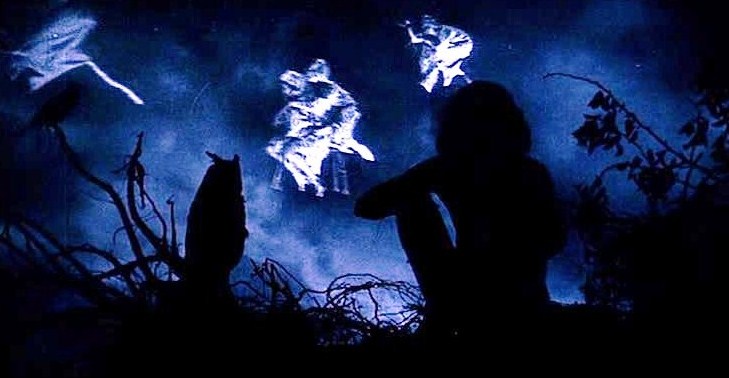
Walpurgisnacht flight from Danish director Benjamin Christensen's 1922 film Haxan:Witchcraft Through the AgesEchoes of Beltane fire rituals can be detected in various May Day games and customs. The sun’s radiance is condensed in the spirit-raising glow of yellow primroses and marsh marigolds (‘the herb of Beltane’) woven into garlands to be hung about the village or town. In parts of Scotland, bannock cakes were cooked in May Day fires, buns with knob-knuckled crowns like a boulder-strewn moorland landscape. One of the cakes would be divided and a piece smudged with charcoal from the fire. The unfortunate who drew this tainted treat from basket or bonnet would be execrated as the ‘carline’ or scapegoat for the following year, spurned and made mock of. A distant memory of human sacrifice on the bone-fire? Probably not. There’s no evidence for such specific seasonal practices beyond Roman anti-Celtic propaganda. It could be a deeply uncomfortable social and psychological experience for the victim, nevertheless, a form of licensed bullying which united the rest of the community. At some point a presumably intoxicated individual noticed, as he bounded after it, how well his fumbled cake bounced down a hillside, and the tradition of bannock rolling was born; a pointless, vaguely idiotic pastime devoid of any symbolic, sacred or ritualistic import which was largely an excuse to pelt down a grassy slope. Like many pointless, vaguely idiotic pastimes it was, and still is hugely enjoyable.

May Day festivities are above all about getting out of doors and inhaling the first breath of summer; throwing the early morning windows wide and heading for the woodlands and meadows with a light skip in the step. The opening lines of many a folk song attest to this spirit: ‘O as I rose up one May morning/One May morning so early (Seventeen Come Sunday); ‘One morning in the month of May/As from my cot I strayed/Just at the dawning of the day’ (The Spotted Cow); ‘As I walked out one midsummer’s morning/To a-view the fields and to take the air’ (Banks of Sweet Primroses); When I was a-walking one morning in May/To hear the birds whistle and nightingales play (Green Bushes); ‘Now it was on a summer’s day in the merry month of May/I was strolling around my grandfather’s farm’ (The Ball of Yarn). Etc. etc.

These opening lines are usually followed by an encounter with a charming maid, or by the lament of a maid waylaid by a charming rogue – essentially two conflicting perspectives on the same subject, conquest and defeat. For May was a time when the sap was rising and the first steps of the summer courtship dances were tripped. The comic romantic complications of A Midsummer Night’s Dream make formal play with such lusty woodland assignations. May folk songs are full of bawdy, nudge nudge innuendos and euphemisms, designed to raise gusts of knowingly ribald if not outright filthy laughter down at the local village inn. Analogies are drawn between seasonal farming labours and the fulfilment of desire, connecting the natural cycles of the year with those of the human heart. So Cupid the Pretty Ploughboy is observed by an enamoured maid ‘ploughing his furrow deep and low/Breaking the clods to pieces, some barley for to sow’; the search for a ‘charming maid’s’ Spotted Cow provides an excuse for a day of sport and play ‘down in yonder bourne’, a pleasurable encounter with the promise of further hunts for the straying and in all-probability non-existant creature heralded by the coded cry ‘ye gentle swain I’ve lost my spotted cow’; The Ball of Yarn plays lascivious metaphorical variations on the farmboy’s desire to wind up a country maid’s ‘little ball of yarn’. The Sussex-dwelling Copper Family song Pleasant Month of May (collected in Bob Copper’s book A Song for Every Season) depicts the sweaty labour of haymaking before the arrival of a travelling piper at sundown and the commencement of festive merriment. The final verse conjures images of bucolic bliss and pastoral amours inseparable from the lay of the land and its tending:
‘We called for a dance and we tripp-ed it along,/We danced all round the haycocks till the rising of the sun./When the sun did shine such a glorious light and the harmless birds did sing,/Each lad took his lass in his hand and went back to his haymaking’.

Sometimes traditional May songs are simply evocations of the early summer ambience, with no double-meanings attached. Such is By the Green Grove, another Copper song, which is a simple and affecting paean to the heartswelling beauty of birdsong in the Sussex countryside. ‘No music, no songster can with them compare’. There are darker presentiments of harvests to come to be found in the memoirs of Bob Copper, too. In his reminiscences of May haymaking, he recalls that ‘the quiet of the field would by invaded by a gang of six or eight men arriving carrying their scythes across their shoulders’. The shadow of the reaper is present even in the merry morning of May, the time of renewal and rebirth. Et in Arcadia ego.

The license associated with May Day inevitably roused the ire of Protestant critics, constant complaint against the state of things inherent in their very name. The Puritan John Stubbes is highly amusing to read for the intense passages of fevered ranting his broiling indignation stews. With variable statistics plucked from the overheated undercroft of his brain, he rages in his 1583 screed The Anatomie of Abuses that ‘I have heard it credibly reported…by men of great gravity, credit, and reputation, that of forty, threescore, or a hundred maids, going to the wood overnight, there have scarcely the third part of them return home undefiled. These be the fruits which these cursed pastimes bring forth’. He would no doubt also have disapproved of the vanity of a later tradition, that of bathing the face in May morning dew to lend the complexion a magical glow for the rest of the month and banish troublesome freckles. Samuel Pepys records in his diary that his wife indulged in this hopeful custom, and he rather touchingly worries about her safety being abroad in the early hours.
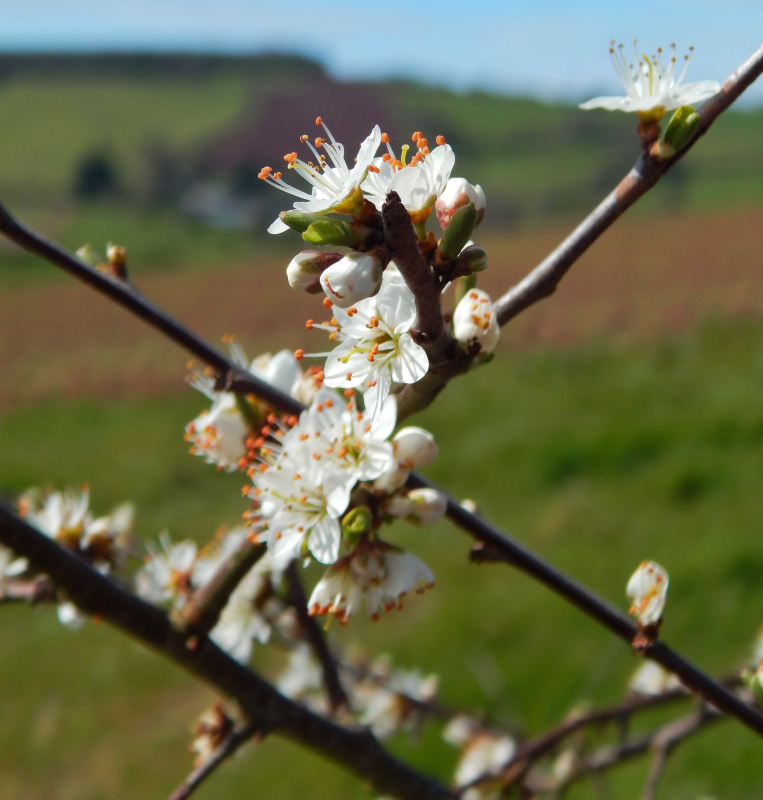


Bringing in the May to the streets of PadstowThe custom most widely associated with May Day was the bringing in of the May. Boughs of blossoming hawthorn would be cut down and brought back from meadow’s edge and woodland and strewn or hung about town or village, some woven into garlands, others left as they were found. The spiritually refreshing experience of going out into the fields and communing with the natural world in the renewal of its blossoming and unfurling was an integral and profound part of this seasonal ritual. Hawthorn was generally favoured, but there were regional variations. The Cornish tended towards sycamore, whilst the Welsh often opted for birch. Whatever the arboreal species, however, it was given the designation ‘May’. The Elizabethan tailor turned writer John Stow describes the bringing in of the May with beautiful simplicity and clarity in his 1598 book Survey of London: ‘On May Day in the morning, every man, except impediment, would walk into the greenwoods, there to rejoice their spirit with the beauty and savour of sweet flowers, and with the harmony of the birds’. Bringing in the May, or going-a-maying, was a way of connecting the settled, built environment or human habitation with the cyclical patterns of growth beyond its bounds. Wild nature in all its bounteous flowering was brought into the heart of the ordered domain of civilisation where it had been tamed or banished altogether. Something of the spirit felt by those who had gone out into the fields on a May morning was thereby given emblematic form. Some kind of symbolic exchange was effected. Man ventured out into Nature, and Nature entered into the habitations of Man.


The Padstow maypoleMaypoles were also erected in villages, towns and cities. Young trees were cut down from neighbouring woodlands (not always with the permission of the landowner) and hauled by teams of men and oxen into the appointed green or square where they were heaved up and made fast. The towering wooden columns would be painted with colourful stripes or other patterns and hung about with ribbons, boughs and garlands. It became the focal point for local festivities, for dancing, whether in a wheeling, handlocked circle or in more abandoned, weaving approaches and evasions. A maypole could remain in place for many years until it began to rot away at its base and require replacement. Sometimes it would crash to the ground before such removals were effected. There were maypoles of great longevity and renown in London. In the early 17th century, an immense one stood for a good few years at Cornhill in front of the church of St Andrew, whose spire it exceeded in height. The church became known as St Andrew Undershaft as a result. Another stood in The Strand in Elizabethan times before being felled in 1644, the victim of a Puritan ban on maypoles instigated in that year. A giant 134 foot pole was resurrected on the same spot in 1661, the Royal Crest at its tip marking it as a prominent celebratory symbol of the Restoration. It stood on the site of St Mary le-Bow into the early years of the 18th century. A substitute pole, taken down in 1718, was purchased by Sir Isaac Newton. He used it to prop up the great 123 foot telescope which had been installed in Wanstead Park in Essex the previous year. A perfect amalgam of folkloric traditions, possibly reaching back into the ancient past, and the new science, with its distant optic gaze focussed on the future. Nigel Kneale would have made something out of such a richly symbolic conjunction. It reminds me of his placement of a radio telescope besides a stone circle in his 1979 Quatermass series.

Jo and the Doctor join in the Maypole revels at the end of the 1971 Doctor Who serial The Daemons. Yates and the Brigadier retire for a pint

The reliably rancorous Philip Stubbes looked upon such practises with seething horror, of course, voiced in his unceasingly virulent strain of invective. ‘They go some into the woods and groves, some to another, where they spend all night in pleasant pastimes, and in the morning they return bringing with them birch boughs, and branches of trees, to deck their assemblies withal. And no marvel, for there is a great Lord present amongst them, as superintendant and lord over their pastimes and sports: namely, Satan Prince of Hell. But the chiefest jewel they bring from thence is the may-pole, which they bring home with great veneration…twenty, or forty yoke of oxen…draw home this may-pole (this stinking idol rather)’. Stubbes describes how, once the villagers or townspeople have reared up and decorated the pole, ‘then fall they to banquet and feast, to leap and dance about it, as the heathen people did, at the dedication of their idols, whereof this is a perfect pattern, or rather the thing itself’. Escalating his hyperbolic disgust to a climactic pitch, he damns the May merrymakers utterly: ‘Assuredly, I think neither Jews nor Turks, Saracens, nor Pagans, nor any other people how wicked, or barbarous soever, have ever used such devilish exercises as these: nay, they would have been ashamed once to have named them, much less to have used them’.

The May Day revels of late medieval and Tudor England which Stubbes so vocally despised incorporated all manner of May games. Morris dancing (‘the devil’s dance withal’ – Stubbes) featured frequently during its 16th century craze and for a period thereafter, and there might be pipers and harpers, drummers and fools to fuel the festivities with music, capers and general jollity. Mummers plays were sometimes staged, the performers disguised, which gave them a certain license to mock the high and mighty. Parades were peopled by stock figures of British folklore, religious devotion and popular legend: George and the Dragon, regional saints, Jack-in-the-Greens, Giants, Devils and St Michael, also with dragon in tow (the Devil in final Revelation battle form, ready for the slaying). Robin Hood and his greenwood band of righteous outsiders were particularly popular, and would often go around from door to door raising money (not necessarily for the Parish poor, either). Plays relating the familiar tales of daring feats and defiant gestures became widespread in the later medieval period. The first recorded example took place in Exeter in 1427, but they became and integral part of Tudor May Day celebrations in the years leading up to the cultural and historical earthquake of the Reformation. Maid Marian was a relatively late addition to the canon, appearing in the 15th century, possibly imported from French Romances and ballads such as Adam de la Halle’s late 13th century musical play Jeu de Robin et Marion (recorded in the 1970s by David Munrow and his Early Music Consort). Robin has been interpreted at various times as a spirit of the greenwood, a green or wild man figure symbolic of vegetal death and resurrection, a seasonal king whose sacrifice would ensure the return of the sun and the fertility of the crops (a favoured theme of JG Frazier put forward in The Golden Bough, his capacious survey of comparitive myth and religion), the high priest of a coven or a historically-based, rebellious anti-hero fighting the power. Marian and Robin are also sometimes seen as the Queen and King of May; Marian the embodiment of Spring, a Persephone or Flora figure, Robin her knightly green consort. Like all figures who slip out of the mundane world and into the mutable realm of myth he was, in other words, all things to all men.

Robin and Marian’s assumption of the roles of King and Queen are indicative of a more general play with inversion and transformation within the context of May Games. In a variation of the Christmas tradition of electing Lords of Misrule, mock-kings or lords were often crowned or ennobled for the day and presided over the celebrations. In the Scottish districts of Borthwick, Haddington, Peebles and Linlithgow an Abbot of Unreason was ordinated to give his anti-clerical blessing to the wild indulgences of the day. There was a strong element of mischief making, and echo of the licensed knavery of Hallow’s Eve, and of the Puckish trickery of fairy world denizens so active at these intersticial times. Guisers, cocky chancers (latterly geezers) in disguise, prowled the streets planning and enacting pranks on the suspecting victim who, on this day, was powerless to seek recourse. The 19th century Lancastrian radical Samuel Bamford recalls the occurrence of ‘mischeif-neet’ on May 1st in Early Days, his 1849 memoir of his early life in Middleton, Manchester and Salford. Tokens from the fields would be left by young men on the doorsteps of neighbours (mainly female) as symbolic assessments of character, whether cruel and spiteful or complimentary and amorous: ‘a gorse bush indicated a woman notoriously immodest; and a holly bush, one loved in secret; a tup’s horn intimated that man or woman was faithless to marriage; a branch of sapling, truth in love; and a sprig of birch, a pretty girl’. A similarly laddish blend of horniness and spite was enacted across the country in the Cambridge fenlands. Here, sloe blossom was for the favoured and blackthorn for those considered loose, elder for those judged insufficiently well turned out and nettles for those the boys thought had a sharp tongue (no doubt directed at their clumsy advances).

Masks and costumes provided the opportunity for the wearer to get away with all manner of mischief, taking on new identities which allowed for a distancing from the everyday social self. Transvestism was rife, men seizing the chance to put on dresses and wigs and paint their bearded faces. There were Morris ‘Mollies’, and May Marians in Robin Hood plays generally embodied by men in drag presenting their exaggerated, grotesque versions of femininity. Taking hybrid human and animal form was also prevalent on this day of transformations. Stag, bull or ram horns or heads might be borne. But such cross-species mummery and guising was most widely manifested in the migration of the hobby horse across the country. It was a costume which came in a variety of shapes and sizes, from draped frames which entirely enveloped the human occupant to ‘Hooden Horses’ from which the upper torso of the ‘rider’ emerged, to poles with clacking heads (and in some cases stripped and garlanded horse skulls) affixed to their upheld tips.

The most renowned hobby horse (or Obby Oss as it is idiomatically known) is undoubtedly the one which is led out of its paddock in the back of the Golden Lion inn and onto the streets of Padstow every year. It comprises a large hoop tightly covered with shiny black oilkskin which drapes around in a loose circling skirt. The disc is like a black anti-sun, glistening with photo-negative inversion; or an occult moon, a remnant of the dark days goaded through the summer-garlanded streets one more time before being shut away for the year. Stylised features on the flat plane of its broad face (intriguingly reminiscent of the designs found on traditional African ceremonial masks) heighten its disconcertingly alien quality. It is more like the product of a sleek biomechanical future than a horse, a 1970s Dr Who monster in swaying, revolving motion. It is guided, led and driven by ‘Teasers’ who try to keep its attention by drawing it into a ducking and swirling dance. The unpredictability of its movements might find it suddenly swivelling to turn its blank-eyed disc-visage on nervous onlooker, however, throwing back a distorted shadow reflection, seen as through a glass darkly. Its inky depths are akin to the Elizabethan alchemist and occult philosopher Dr Dee’s obsidian shewstone, the spirit mirror whose polished black surface he tried to see through to communicate with angels (or demons?) in another dimension. Who knows what one might see if one gazes too long into the depthless yet potentially bottomless void of the Oss’s ‘face’, especially with the intoxicating effect of the freely-flowing ale and the pounding beats and hypnotically repeated refrains of the Padstow Obby Oss song deranging the senses. But it passes swiftly on before anyone can get truly lost. The black, flashing form glints against the blue (with any luck) of the sky and the white and red of the Padstonians’ costumes.


The ceremony and its preparations were captured by folklorist and recorder Alan Lomax and cameraman George Pickow in their 1953 film Oss Oss Wee Oss (the cajoling cry of the onlooking townsfolk), included on the BFI collection of folkloric footage Here’s a Health to the Barley Mow. They preface their dramatised document with the assertion that ‘this strange dance is a modern remnant of an ancient springtime rite in which primitive man rejoiced in the renewed fertility of the land’, adopting the romantic fancies of the mid-century which actively sought to unearth ancient Pagan roots in any and all seasonal observances. Traditions are open to, and indeed require re-interpretation, remodelling and above all reinvigoration, otherwise they eventually ossify (if you’ll pardon the pun in this instance) and crumble into dust, to be blown away by the forgetful winds of the progressing years. So let’s join Lomax and Pickow in this fulfilling fancy, so long as we don’t mistake supposition for historical fact – no matter how intuitively ‘right’ it feels.


Helston May Morris dancersYou’ll also come across The Flora Faddy Furry Dance Day in the BFI collection, Richard Philpott’s impressionistic record of another famous Cornish May Day festival, the Helston Furry Dance. Furry here could be a corruption of the Cornish feur, meaning holy day. The Floral Dance could be in honour of Flora, the Roman Goddess of flowers, or her local equivalent. The town is certainly resplendently decked out with green boughs and flowered garlands, and the Helston Town Band heroically plays the Floral Dance throughout the day as an accompaniment to a rather sedate series of parading, genteely pirhouetting dances which wend their way through the narrow nexus of the town centre’s winding streets. Philpott’s 1989 film (which feels more like it was made in the 70s) uses cross-editing, montage and intercut woodcuts and silhouettes of labyrinths, dragons and maypoles in an attempt to convey a sense of continuity with older traditions, sacred processions and universal archetypes. Like Lomax and Pickow, he claims the Furry Dance for ‘an ancient pre-Christian spring ritual’. Or perhaps he is simply trying to exorcise the twinkling spectre of Terry Wogan and his dispiritingly popular 1978 version.

George Cruickshank's cartoon of a London May Day parade

The Milkmaid's ParadeEP Thompson, in his classic 1963 history The Making of the English Working Class, notes that the rapidly expanding urbanisation brought about by the industrial revolution did not mean the dying out of old seasonal rituals and customs. Just as new towns grew over old rural settlements and villages were absorbed by the spreading boundaries of cities to become suburbs, so there was a continuity of celebratory tradition. May rituals brought the rhythms of the now-distanced natural world into the smog-darkened centres of the industrialised cities. In London, urban milkmaids who delivered supplies of the whitestuff danced through the streets, initially with a milk pail balanced on their head like an inverted metal bonnet. This basic set-up was steadily elaborated over the seasons, an element of competition undoubtedly coming into play. In the end, piled helmets of polished silver were precariously balanced on platters garlanded with flowers, the whole ensemble thrillingly threatening to tumble to the pavement in a clattering disaster if perfect deportment was not maintained. It was a celebration of the first significant milk yield, and a reminder that even in the crawling heart of the metropolis, from which nature was increasingly smoke-blotted and walled out, people were still reliant on the turning seasons and the bounty they produced. To such an end, garlands were thrown into the Thames to acknowledge the watery conduit along which this bounty was carried into the city.

As if to mock the new-found ostentation of the milkmaids, ‘bunters’ dressed in rags would follow in their wake, parodying a now-established tradition. These women were of a lesser social standing, rag pickers or, as some whispered, ladies of ill repute. Class distinctions and their attendant snobberies infected even these celebratory occasions, noticeably more so once they had migrated to the city. What would once have been inter-village rivalries were now concentrated into more condensed and divisive centres of population. Sweeps also joined in the parades, whose money-raising opportunities were invaluable to them at this time. Whilst everyone else was greeting the lengthening days and warming sun with joy in their hearts, the sweeps were fretting at the upcoming loss of trade as hearth fires were gradually extinguished. Their presence became more and more prominent, and they introduced the startling figure of the Jack-in-the-Green to proceedings. Again, this was a prideful and competitive elaboration of initially simple leaf and blossom garlanded bonnets. As if the Jacks were undergoing a gradual vegetal growth, they got annually more expansive. Eventually, the sweep disappeared beneath a huge conical frame covered in greenery and flowers, and giant Jack was seen to walk with a swaying gait through the streets of London, guided by his ‘bogies’. These attendants were often the children whose chimney crawling labours were ended by progressive legislation in the late 19th century.

May Day traditions have always been subject to appropriations, revivals and revisionism. Many of the customs we associate with it are largely Victorian fabrications, attempts to escape from the pressures and inequities of industry and empire into a Merrie England fantasy of a simple, gilded past when everyone knew their place and all was pageantry, chivalry and happily purposeful agricultural labour. The term merry England was popularised in the early nineteenth century by the essayist William Hazlitt (who referred to its ‘rustic gambols’) and in particular by Walter Scott, whose 1808 poem Marmion referred to a time when ‘England was merry England’. Scott’s immense popularity in the 19th century did much to fuel the Victorian passion for medieval revivalism. Victorian worthies refashioned the old May Day rites, flensing them of their carnality and wild, celebratory communal spirit and reducing them to children’s games and carefully staged worker’s pastimes. They bequeathed us the much-diminished maypole with its trailing, coloured ribbons grasped by glumly skipping boys and girls, and the election of young May Queens for the year, condemned to sit shivering on floats for an interminable duration. Their resurrection of Morris Dancing, which had long since fallen out of fashion, was a singularly pallid ghost of its formerly rambunctious self. Even our old friend Philip Stubbes would have found it hard to work up a head of indignation over their polite village fete prancing.


The manufacturing and manipulation of a dream of England’s glory was not new, however. Both Henry VIII and Elizabeth I had participated in May Games which evoked visions of a medieval golden age. Elizabeth attended formal May celebrations at Greenwich Palace in 1558, the first year of her reign, and witnessed a pageant whose no doubt trembling and fearful cast included Morris Dancers, St George and the Dragon, a giant, drummers, the ‘nine worthies of Christendom’, Robin Hood, Little John, Maid Marian and Friar Tuck. John Stow, in his A Survey of London, is one of several writers who record Henry VIII’s May Daying outing (on this occasion setting out from Greenwich Palace) with Catherine of Aragon to the woods on Shooters Hill. Here they picnicked beneath the trees and were entertained by their host, Robyn Hood, with displays of archery. Both monarchs made conscious use of the popular May Day customs, associating themselves with the golden age neverland such pageantry summoned up. In a sense they became magical king and queen of May, roles as chimerical as the mock monarchs they displaced with self-mythologised projections of the authentic article. Alan Moore recognises this Tudor version of Merrie England dreaming as a Disney construct in The Unearthing, his psychogeographical Shooters Hill reverie of history, myth and place and their interaction with an individual human consciousness, spiralling outward from an intimate portrait of his friend Steve Moore, the late comic strip writer. He writes ‘out a-maying with one of his Catherines, Henry VIII attends a Robin Hood fair, Shooters Hill as Medieval theme park, and meets players dressed as Robin, Friar Tuck, Will Scarlet, Bashful, Goofy’.

Thankful Sturdee's 1906 photograph of Fowler's Deptford Troop with attendant Jack-in-the-GreenTraditions have been re-invented for the modern age too, with the resurgence of a composite Paganism patched together in the latter half of the twentieth century playing a vital role. The London Jack-in-the-Green walks again, bringing a shimmying rustle of spring greenery and floral colourflash to the grey steel and glass canyons of the city. Its rebirth came about through the discovery of a 1906 photo of the old Jack by Thankful Sturdee (a strong and blessed name if ever there was one), its faded black and white image brought to vibrantly technicolored life. The milkmaids balance their silverware again, and the sweeps have returned to Rochester with a 7 foot Jack in tow. Beltane is now marked in the city, too, with a Pagan Pride parade making its way through Bloomsbury, an aptly named district to beat the bounds of. The spirit of Virginia Woolf looks down on them with amused benediction, I’m sure. Her final novel, Between the Acts, is all about the staging of a village pageant of British history and culture, and the continuity, renewal and convergence between the universal and the individual which it represents. Woolf’s story is partly about how there is no real distinction between the pageant and the incidental activities and incidents which take place around it – between the acts or during them. It’s all part of the great human parade. Issues of ‘authenticity’ or authorship seem beside the point in the light of this great communal connection, the sense of history’s vast acreage encompassed within an afternoon, or a flickering instant of flashing consciousness. The Pagan parade, with its inventive costumes and joyful sense of celebration, partakes of this spirit.

May Day rituals have repeatedly been the object of suppression and political appropriation over the centuries. A 1555 Act in Scotland banned the appointment of mock bishops and the participation in May Games. A political act which perhaps betokened a fear of mocking satire undermining authority. May Games were also banned in Kent in the wake of the 1554 rebellion led by Sir Thomas Wyatt, whose ragtag Kentish troops had reached as far as Southwark. The Puritans banned maypoles and the revels which took place around them, and their erection became an act of anti-Parliamentarian defiance. The restored Stuart monarchy lost no time in allying themselves to a renewal of the May Games, as we have seen from the royal crowning of the Strand maypole. May revels were even shifted to the end of the month to mark Charles II’s birthday on the 29th May, which was conveniently also the day on which he rode into London in 1660, restoring monarchical rule to the land. Oak boughs replaced May blossom as the dominant symbol of the day, memorialising the instantly storied occasion on which the king had hidden in an oak tree to evade Parliamentarian troops. It was a calculated act of propagandistic self-mythologisation, an equation of the king with the national tree, and with the renewal and rebirth of the spirit of the greenwood (although if JG Frazer’s theories are to be given credence, this could of course be an unfortunate analogy). Royal Oak Day became an officially decreed holiday for a while, although observance of it rapidly tailed off as the Stuart monarchs squandered the public’s affections. There are echoes of it still in Oak Apple Day in Wiltshire and Garland Day in Castleton, and indeed in the Bank Holiday which comes towards the end of May.

May Blossom and Oak Leaf - Opposing symbols at the poles of the monthThis is at the other end of the month from May Day Bank Holiday, and if the link with Charles II and the restored monarchy is granted, at the opposite end of the political spectrum. With elections of mock monarchs, bishops of unreason and the welcoming of Robin Hood to preside over the festivities, May Day always had a strongly anti-authoritarian side. This was why the authorities felt the need periodically to exert their control over it. In 1890, the International Socialist movement (the Second International) chose May Day as the occasion for an international strike in support of the struggle in America to establish an 8 hour working day. It was subsequently formally declared as International Workers Day, an annual celebration of solidarity and united purpose. The romantic Merrie England associations of English utopian socialists in the William Morris, Arts and Crafts mould can be seen in Walter Crane’s poster The Worker’s May-Pole, his ‘offering for May-Day 1894’. The may-pole is given female embodiment, arms held out like spreading branches, a circling garland of flowers below. She loosely bears a ribbon in the open palms of her hands as if it had been draped across her statuesque form by one of the surrounding celebrants. On it is blazoned the ideological trinity Socialization, Solidarity, Humanity. The ribbons extending from the may-pole Goddess’ dress are grasped by happy and healthy Arts and Crafts peasants who dance around this figure of bounty and utopian promise. The ribbons are also imprinted with slogans and ideals such as ‘Eight Hours’, ‘Leisure for All’, ‘Abolition of Privilege’, ‘The Land for the People’, and ‘No Starving Children in the Board Schools’ (echoes of Dickens’ Dotheboys Hall). Further banners held aloft in the background read ‘The Hope of Labour is the Welfare of the World’ and ‘Neither Riches nor Poverty’. The next year, Crane produced A Garland for May Day 1895, held up by a bare-footed Arts and Crafts Goddess, and would about with further slogans, including one which reads ‘The Land for the People – Merrie England’.

Walter Crane's Workers' MaypoleThis politicisation of May Day has proved a recurrent irritant over the years. During the Cold War, the International Workers Day descended into a grim opportunity for the Soviet Union and its cowed Eastern Bloc dominions to roll out their latest armaments for a rumbling, earthshaking parade, missiles and tank snouts cocked at the sky like half-erected maypoles. Robin Hood and his merry greenwood band were replaced by Khruschev and his Red iron generals. In Britain, the Conservatives are always grumbling about May Day, latterday Stubbeses whose focus has shifted from moral indignation to the raising of the shibboleths of a quiescent socialism which still rankles with them even as it fades into a historical memory. Proposals to impose a Margaret Thatcher Day on the late August Bank Holiday proved as divisive as the Royal Oak Day celebrating the Restoration soon became.

May Day is ours, even as seasonal patterns and political power bases shift around us. It is to be decorated with boughs and garlands not flags of allegiance; an anticipation of haymaking not a commemoration of Thatcher; a day for dancing around the maypole, nor for marching in ranks behind sky-pointing missiles; rejoicing in the restoration of the sun, not of the monarchy. So let us all come together in merrie communion, feast, drink and dance, and sing the old Padstow song once more:
Unite and unite and let us all unite,
For summer is a-come unto day
And whither we are going we will all unite,
In the merry morning of May.


Bibliography:
Clifford, Sue & King, Angela (eds.) England in Particular
Steve Roud – The English Year; A Month-by-Month Guide to The Nation’s Customs and Festivals from May Day to Mischief Night
Nick Groom – The Seasons
Sara Hannant – Mummers, Maypoles and Milkmaids: A Journey Through the English Ritual Year
Roland Hutton - Pagan Britain
Roland Hutton – The Stations of the Sun: A History of the Ritual Year in Britain
Roland Hutton – The Rise and Fall of Merrie England: The Ritual Year 1400-1700
Asa Briggs – A Social History of England
E.P.Thompson – The Making of the English Working Classes
Rodney Castleden – The Element Encyclopedia of the Celts
Iain Sinclair (ed.) – London: City of Disappearances (inc.Alan Moore – Unearthing)
Steve Roud & Julia Bishop (eds) – The New Penguin Book of English Folk Songs
Alexandra Harris – Romantic Moderns: English Writers, Artists and the Imagination from Virginia Woolf to John Piper
Brewer’s Dictionary of Phrase and Fable (14th Edition)
Bob Copper – A Song for Every Season
William Shakespeare – A Midsummer Night’s Dream
BFI DVD – Here’s A Health to the Barley Mow


.jpg)




_01.JPG)


.jpg)


