Showing posts with label Alan Moore. Show all posts

Wednesday, 11 February 2015

Terror and Wonder: The Gothic Imagination at the British Library

PART TWO


Charles Dickens is the perfect figure to usher us into the Victorian world, and into the dark, narrow and crowded streets of the rapidly expanding, noisily industrial capital. A clip of the recent BBC adaptation of Bleak House, with Gillian Anderson as a ghostly Lady Dedlock, shows us the scene in which Jo the crossing sweeper takes her to the gates of the paupers’ cemetery. The bones lie on the surface in some parts, and Jo remarks of the man she is searching for (known only as ‘Nemo’ at this point) that ‘they put him wery nigh the top. They was obliged to stamp upon it to get it in. I could unkiver it, with my broom, if the gate was open’. He then excitedly points out a rat, which runs into the ground to feast. This depiction of the bodies of the dead protruding from their shallow graves, seen through the eyes of a streetchild for whom it is wholly unremarkable, is a grim Gothic touch which Dickens drew from factual observation. Victorian London was, for many, a Gothic city, but one marked by poverty and squalor rather than elegantly decaying castles and crypts. A staggered pile of booklets on display were a reminder of the part published format of the book, episodically issued in 1852. The public would devour the story in monthly instalments, eager to discover what happened next.

Woman in Black - Gillian Anderson as Lady Dedlock in the BBC adaptation of Bleak House
Gothic had become a flavour or shade which could be added to the kind of multilayered work of which Dickens was a master. It might be associated with a a particular character, plot strand or setting. It was a transferable style which could be employed in a variety of contexts. Dickens wrote a number of ghost stories as well, including The Signalman, an enduring classic of the subgenre, and the collaborative collection The Haunted House, whose framing story (written by Dickens) introducing separate tales anticipates the Amicus portmanteau films of the 1960s and 70s. It was a form which would become increasingly popular as the Victorian period progressed. It was an era much preoccupied with mortality and the memorialisation of the dead. The great necropolises which were built on the outskirts of the rapidly expanding urban centres were themselves like miniature cities of the dead. They would prove ideal Gothic locations, particularly as the years added attractive layers of gentle ruination and ivy entanglement. For Dickens, the Gothic could also encompass an element of social comment or psychological portraiture. The graveyard in Bleak House is disturbing for its exposure of appalling poverty as much as the rat-gnawed bones of the dead. Lady Dedlock drifting blankly through Chesney Wold and Miss Havisham presiding over the cobweb-strewn Satis House in Great Expectations are both spectres prematurely haunting their decaying homes. They are portraits of mental and moral paralysis.


For Dickens, the true Gothic locale was not a remote, ruined abbey or centuries old castle but the dark alleys and dilapidated houses of London. Its gaslit Gothic atmosphere is perfectly captured in the engravings Gustav Doré produced for the book London, A Pilgrimage, a journalistic record of travels through the city which highlighted the huge gulf between the rich and poor. Plates depicting the rookery of Bluegate Fields, the night-time pavement sellers of Harrow Alley in Houndsditch, the ragged wraiths working in the Lambeth gasworks and the mazes of back to back terraces in the sooty shadow of arcing railway viaducts are densely shaded with an almost palpable darkness.


The Gothic followed in the wake of mass migrations from field to factory and relocated to the city. Urban Gothic was formed in the choking fogs of London; fogs like those described in the opening scenes of Bleak House, in which Dickens imagined the possibility of encountering ‘a Megalosaurus, forty feet long or so, waddling like an elephantine lizard up Holborn Hill’. The primeval swamp seeps through into the streets of the modern city. Urban Gothic bred its own monsters and mythologies which were promulgated in the rough pages of the Penny Dreadfuls and Penny Bloods. These episodic works featured sensational cover illustrations which dramatically depicted scenes of horror and bloodshed. Precursors of the EC comics of the 50s, their potential effect on the minds of the masses who read them occasionally troubled the moral guardians of Victoria’s realm. But they generally fell so far below the literary lighthouse beam that they escaped any real censure. The dreadfuls introduced the likes of Varney the Vampire, with his impulsive thirst for blood; Sweeney Todd, the demon barber and fresh meat merchant; and Spring Heeled Jack, a proto-supervillain who could effortlessly leap over the rooftops of London, and who gradually morphed into an enigmatic superhero in the Batman mould. A copy of The Mysteries of London by George WM Reynolds was also on display, explicitly inviting the reader imagine their city as a labyrinth of hidden terrors, lurking and ready to spring. The prolific Reynolds also wrote an early werewolf tale with his 1846-7 series Wagner the Were-Wolf. Some of Dave McKean’s original full-colour illustrations for the Batman story Arkham Asylum were displayed as an example of a modern version of the urban Gothic of the Penny Dreadfuls.

Harry Clarke's illustration for Poe's William Wilson
Edgar Allan Poe was a central (perhaps THE central) figure in mid-19th century Gothic literature, and his morbid sensibility spread like an enervating virus, distilling fever dreams from the unconscious underworld of a motley spectrum of writers and artists, from French Decadents through Edwardian illustrators of children’s books to subversive Surrealists. One of Poe’s letters was on display, allowing us to inspect his neat handwriting and feel a sense of communion with the man who wrote it. Truth to tell, it doesn’t provide a very edifying portrait. Addressed to Fanny Osgood, one of a series of women with whom he became obsessed in his short lifetime, and whose patronage and hospitality he frequently called upon, its fulsome and fawning praise of her literary efforts is embarrassingly transparent in its bid for her favour. Poe’s influence on the late Victorian and Edwardian imagination is clearly visible in the illustrations from various editions of his work. On display here were Edmund Dulac’s plate for The Raven, Harry Clarke’s for William Wilson, Arthur Rackham’s for The Oval Portrait and John Buckland Wright’s woodcut for The Tell-Tale Heart. Presiding over this gloomy Poe corner was the magisterial voice of James Mason, narrating the expressionistic 1953 animated interpretation of The Tell-Tale Heart, with designs by Warner Bros. background artist Paul Julian, who would, appropriately enough, go on to work with Roger Corman. Mason explains his actions in a patient and scrupulously rational manner: ‘it was his eye, yes, that eye. His eye, staring, milky white film. The eye, everywhere in everything. Of course I had to get rid of the eye’.

Aubrey Beardsley's illustration for The Masque of the Red Death
Poe’s work certainly informed the Yellow Book Decadance of the fin de siecle period, the dying days of the Victorian period. A copy of the Yellow Book was on display here. And indeed its cover was an exquisite shade of yellow, an instantly distinctive object to be seen with tucked under your arm, connoting an all-embracing aesthetic worldview. One of Aubrey Beardsley’s Poe illustrations was also on display, a depiction of a scene from The Masque of the Red Death, full of leering, deformed grotesques and limp, opiated beauties. Oscar Wilde’s Picture of Dorian Gray was presented as the emblematic story from this movement, a self-reflexive myth for, and about, its participants. It’s a mythic encapsulation of the cost of the pursuit of excess and all-consuming sensual indulgence cast in Gothic form. The figurative is made manifest and hidden away in the attic. Wilde was the public spokesman for the Aesthetic movement (French-style Decadence in all but name). His elegant dandyism and elevation of the passing witticism into an exquisitely crafted artform promoted the idea of art as an all-encompassing worldview, affecting mannerisms and modes of dress as much as any actual creative artefact which might be produced in time remaining. This was a philosophy which would resonate throughout the 20th century, finding expression in the theatricality of latter day Goths as well as the self-reflective (or obsessed) art of the likes of Gilbert and George and a number of the YBAs. Indeed, there were some works by the Chapman Brothers later in the exhibition. Wilde’s own penchant for the Gothic, as well as his conflation of life and art, were displayed in the calling cards he had printed after he emerged from Reading Gaol. He cloaked himself in the pseudonym Sebastian Melmoth, adopted from Charles Maturin’s 1820 novel Melmoth the Wanderer. Wilde thereby cast himself as the cursed exile who had made an ill-advised pact with the Devil and is now fated to tread a lonely, immortal path through the world.

Richard Mansfield as Jekyll...and Hyde
Another key work of the late Victorian period was Robert Louis Stevenson’s Strange Case of Dr Jekyll and Mr Hyde, originally published in 1886 as a Shilling Shocker (a complete work as opposed to the Penny Dreadful’s serialisations – hence the slightly inflated price and altered alliteration). Stevenson’s story is a subtly suggestive study of the duality inherent in the human psyche, its terrors remaining relatively subdued. It was the hugely successful theatrical production of 1887, written by JR Sullivan and starring Richard Mansfield in the twinned title role(s), which changed the tone of the story, and set the pattern for future adaptations. The bifurcation into ‘good’ and ‘evil’ selves, or rather selves which suppressed the desire for sensual pleasure and gave it full, destructive reign. Jekyll and Hyde became another myth of fin-de-siecle Decadence, a companion piece to The Picture of Dorian Gray. Richard Mansfield’s performance was particularly noted for its remarkable transformation scene, aided by theatrical lighting and make-up. A photograph displayed here gives us an idea of the thrills which the Victorian theatregoers would have experienced. Using the developing room magic or double exposure, we see the upright Dr Jekyll, face a saintly picture of benevolent intentions, transformed into the hunched, bestial figure of Hyde, hands clawed and poised to grab whatever they can grab a hold of. Hyde really does appear to be a shadow self in this photograph, a parthenogenetic homunculus tearing itself free from its noble progenitor.


The theatrical production of Jekyll and Hyde, which Stevenson professed to hate, was running at the time that the Jack the Ripper murders began to impinge on the public consciousness in 1888. The two became superimposed in the minds of many, Jack and Edward Hyde becoming mirrored selves. Theatrical fiction and factual speculation percolated together to form the beginnings of the potent myth which distilled the dark essence of late Victorian London. The city of terrible night, its narrow Whitechapel streets filled with the stench of poverty and despair. One of the most startling exhibits was a work of fiction purporting to be fact; another example of the fakery which seems to play such a prominent part in the history of Gothic (and which lives on in ‘found footage’ horror movies). A letter written in red ink boasting of murderous exploits and promising more horrors to come is signed Yours Truly Jack the Ripper (‘Don’t mind me giving the trade name’). Undoubtedly a hoax, it has nevertheless accumulated a certain amount of legendary cachet, being the first of a welter of such fevered missives, stoked by sensationalist newspaper reportage. Alan Moore, in his kaleidoscopic Ripper epic From Hell, has two journalists from the Daily Star compose the letter in a Wapping flat, giving the public a fiend whose luridly outlined exploits they can gorge themselves on (in the page of The Star, of course).


Robert Bloch’s story Yours Truly, Jack the Ripper draws on the letter’s signature, and imagines Jack as an immortal who surfaces in various eras to commit his ritualistic killings, which serve to keep him alive. The subsequent pairing in Harlan Ellison’s 1967 Dangerous Visions anthology of Bloch’s A Toy for Juliette and Ellison’s own A Prowler In the City At the Edge of the World takes as its basis the way in which ‘Jack’ was transformed into an almost supernatural figure, an elusive trickster constantly eluding his pursuers with mocking ease. He was an inheritor of the powers of Spring Heeled Jack, and a precursor of the regrettable archetype of the superhuman serial killer in modern culture. Harlan Ellison reduces him to a pathetic puppet of greater, more debased forces at the end of his story, a conclusion which has considerable moral and allegorical force, and once more addresses the role of the media in creating and feeding an appetite for such atrocities.

Laird Cregar in the 1944 version of The Lodger
The Ripper murders, as filtered through Jekyll and Hyde and proto-tabloid journalism, gave rise to Belloc Lowndes’ 1911 novel The Lodger. The entrance of Ivor Novello’s titular character in Alfred Hitchcock’s 1926 film version, face disguised beneath the mummifying wrap of a scarf , ragged wisps of illuminated fog dissipating behind him, is an electrifying expressionistic rendering of the mystery and fear fuelling the ever-expanding Ripper mythos. Actually, the 1944 version of The Lodger, with a mesmerising performance by Laird Cregar at its heart, better evokes the social gulfs within Victorian society which the Ripper murders so horrifically exposed. It’s also interesting to note the narrowing gap between literary source and cinematic adaptation. Only 38 years separate The Lodger from the Ripper murders and Richard Mansfield’s theatrical transformation into Hyde (and 32 from the 1920 John Barrymore film), the cinema from the music hall, the gas lamp from the electric light, the horse drawn Hackney cab from the motor car. They really do seem worlds apart.
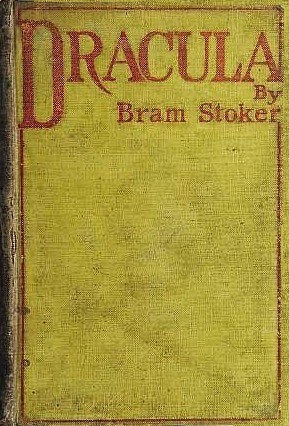
First edition of Dracula in fin-de-siecle yellow book covers
The final work from the late Victorian period explored here is of such moment that it merited a whole room to itself. The visitor was obliged to make a detour from their natural winding progression through the exhibition’s dimly lit corridors, turning into this sealed off sepulchre which immediately felt like a sacred space. Indeed, so caught up was I in the cultural current leading me eagerly on from one thematic display to another that it wasn’t until I’d reached the end and exited into the light of the British Library’s lofty atrium that I paused and thought ‘hang on, there was something missing there’. Retracing my steps, I discovered the hidden sanctum which I’d initially passed by. The book in question is, of course, Bram Stoker’s Dracula, first published in 1897. Its influence on the horror genre and on popular culture in general is pervasive and profound, and anything in this compacted space could offer a partial survey at best. The literary exhibits were particularly fascinating. There was a pleasing congruity to the inclusion of some of the books which Stoker consulted in the British Library whilst researching the background of his story. Perhaps some of them were even the same copies.

Of particular significance was a book written by William Wilkinson, Esq., ‘Late British Consul Resident at Bukarest’, which blended colonial memoir, history lesson and traveller’s tales, and was given the fustily prosaic title An Account of the Principalities of Wallachia and Moldovia: With Various Political Observations Relating to Them. Stoker initially read this not at the British Library but in the subscription library in Whitby, the seaside town on the Yorkshire coast where he was staying for his summer holidays in 1890. The historical passages make reference to King Ladislas of Hungary forming an alliance with the Wallachian Voivode Dracula in 1444 to fight the Turks. It was in Whitby, therefore, that Stoker found the name for his vampire lord, although he would transform him from a prince (voivode) into a count. There was no such noble rank in Wallachia in the 15th century, but the baleful influence of Lord Byron together with the antics of his acolytes on the European continent had created an indelible impression. Vampires and Gothic villains in general had become strongly associated with dissipated Western European aristocrats.

The illustration included in the 1901 edition of Dracula
Stoker followed the established convention by ennobling his title character, even though he envisaged him as a stout military figure with a thick Central Eastern European moustache. This explicitly described appearance (roughly reproduced in the illustration in 1901 edition) would seldom be acknowledged in subsequent adaptations. Wilkinson also notes that Dracula in the Wallachian language means Devil. This could connote evil, although it could also use refer to the folk devil as a trickster figure. As such, it could be used in a complimentary sense as a badge of bravery or ingenuity in warfare or matters of state. Wallachia was also entirely separate from Transylvania, but such cavils are irrelevant. Dracula is not a historical novel, and the local colour and geographical detail Stoker derived from Wilkinson’s book and other accounts of the area provided a richly mysterious and haunted backdrop for Jonathan Harker’s arduous journey to Dracula’s castle and the final pursuit through the Transylvanian landscape. The mountainous and thickly forested world which he conjured up from his reading room travels was shrouded in fogs of superstition and venerable custom. Journeying there was akin to falling back in time to a pre-industrial era, leaving behind the nascent modernity of the late Victorian period in which electric lighting was already beginning to banish the shadows and returning to the Middle Ages. It was a reiteration of the Gothic’s abiding delight in resurrecting the spectres of primitive (and imaginary) histories which contrasted with the comforts of the present.


The demons of Lewtrenchard
Another book which Stoker consulted, Charles Boner’s Transylvania: Its Products and its People, contained fold-out maps (one of which was spread out here) which facilitated imaginary exploration, mental expeditions into the Carpathian Mountains via the Borgo Pass. Also on display was the Reverend Sabine Baring-Gould’s The Book of Were-Wolves, a collection of legend and lore which provided the inspiration for the wolves Dracula heralds as ‘the children of night’, and for his own transformation into a great hound which leaps onto the shore of Whitby from the deck of the wrecked Demeter. Baring-Gould was the parson of Lewtrenchard church, nestled in the shady valleys west of Dartmoor. In addition to collecting local folklore and folk music, he was a dedicated antiquarian, endeavouring to save the church furnishings and decorations of the Gothic period which other Victorian clergymen were busy discarding and destroying. His small church is a treasure house packed with objects rescued from diverse parts, restored and refitted. And hidden on the side of the pulpit facing the east wall are a pair of grinning demons carved from wood by the Pinwill sisters, Esther and Violet, in imitation of medieval originals. They would certainly not have looked out of place in Dracula’s castle.


More demons lodging in Lewtrenchard - call for the Rev. Sabine-Gould, demon hunter
Also included here was a manuscript Stoker wrote for a theatrical version of his novel. Scrappily assembled, with passages cut and pasted from the printed page, this was evidently dashed off with great haste. It was an exercise to establish theatrical copyright and prevent others from hijacking his ideas, distorting them and profiting from the thinly veiled results. Perhaps he had the success of JR Sullivan and Richard Mansfield’s Jekyll and Hyde in mind. It also suggested that Stoker was highly conscious of the fact that Dracula was a work which had the potential for broad popular appeal. The script formed the basis for a theatrical reading at the Lyceum Theatre in 1897, staged concurrently with the novel’s publication. Present in the select audience was Henry Irving, the actor-manager for whom Stoker acted as personal assistant and factotum in all things. Irving was an imposing figure, an archetypally demanding and egotistic theatrical, and a dominant force in Stoker’s life, source of both reverence and fear. Some have claimed him as a model for Dracula. Its certainly likely that some of his characteristics found there way into the portrayal of the commanding count. His approval or even mild encouragement was vital for Stoker; but all he received after the show was brusque brush-off. The self-absorbed Irving had no time to dispense the words of praise he demanded and required for himself.


Projected onto the back room of the Dracula room were scenes from the finale of FW Murnau’s 1922 film Nosferatu, expressionist shadows taking on a life of their own, extending grasping claws ahead of the rodent-toothed creature casting them. Stoker’s worries about the unauthorised appropriation of his material seems to have been justified, since the German company who produced the picture, Prana Films, had made no effort to seek approval for their adaptation. The widowed Florence Stoker’s attempts to gain recompense merely resulted in the company going bust. In order to discourage further such incidences, she managed to get a court order requiring all copies to be destroyed. Fortunately, this celluloid auto-da-fé wasn’t altogether thorough in its execution, and surviving prints resurfaced in later years. As a result, we can still enjoy what has become established as an enduring classic of German expressionism and cinematic Gothic. Stoker’s character and vampiric lore would soon spread with the exponential infectiousness of a blood-borne virus, putting it well beyond any possibility of containment.

The exhibits here briefly sampled the cultural shadow cast by Dracula over the long decades of the 20th century. His looming presence was in some ways a counter-reaction to the forces of modernism and rapid technological progress; a renewed example of the Gothic finding inspiration and escape in a time of social transformation through the resurrection of the past. The character as Stoker envisaged him was eager to embrace the possibilities afforded by new technologies and economic channels. That was the reason for his move to England. But this is one of a number of the novel’s aspects (including his Eastern European military bearing) which have been abandoned in successive cinematic incarnations. Christopher Lee’s repeated pleas to the Hammer hierarchy to return to the book as a direct source fell on deaf ears.

Vampire - Edvard Munch
The female vampire had already found its way into the broader European literary and artistic stream as a symbolic character. In Baudelaire’s poem The Vampire it stands as a very French metaphor for the destructive nature of love, and the fear of the devouring woman. It was also a stock pre-Freudian fever dream figure in Symbolist art, an image to set alongside the many personifications of Death in chill Nordic and Baltic landscapes. Edvard Munch’s Vampire, aka Love and Pain (1894), could almost be an illustration for Baudelaire’s bitterly misogynistic poem. Rudyard Kipling’s poem The Vampire was a rather surprising inclusion in the exhibition, serving as a representation of these literary adoptions, and another version of the vampire as belle dame sans merci. Appropriately enough, it was written in 1897, the year of Dracula’s publication. He’s certainly not somebody you’d associate with such Decadent company. But then he’s a writer to whom many misconceptions have become attached over the years. The printed poem was accompanied by an illustration by Philip ‘son of Sir Edward’ Burne-Jones, an explicitly erotic tableau which bears some relation to Fuseli’s Nightmare. It was this image which gave birth to the poem in Kipling’s imagination, an example of visual art exerting a direct influence upon literature.


Edward Gorey’s Dracula toy theatre brought his mordant drawings to marvellous pop-up life, and demonstrated the broadening appeal of the whole mythos. The sets are actually models for the stage designs he produced for the 1977 Broadway production of Dracula. His lugubriously amusing figures prove eminently suitable to the novel’s characters and scenarios. A slight element of mockery is appropriate given their familiarity at this stage, but is obviated by the beauty and care with which they are drawn. And his Dracula has a moustache! A lovely artefact for Gothic children to exercise their morbid imaginations upon – the cardboard Lucy Westenra’s head can easily be stuck back on with sellotape.


It’s but a few short steps from here to Sesame Street’s delightfully numerate Count, the vegetarian vampire duck of Cosgrove-Hall’s Count Duckula and the vampire grandpas and uncles-next-door of The Munsters and Alan Moore’s Bojeffries Saga The latter features the wonderfully weird Uncle Festus Zlüdotny, whose spluttered speech-bubble utterances are rendered in the undecipherable symbols of a mysterious yet somehow inherently violent alphabet. A vampire slaying kit, with tools and substances covering most recommended means of undead extermination, was on display in its own standalone cabinet, its components housed in a neatly portable valise whose compartments concertinaed out with ingenious pragmatism. It had no apparent provenance, and its presence was therefore rather anomalous, but fun nevertheless.

Christopher Lee endures the Scars of Dracula
A design for Frank Langella’s Count in John Badham’s 1979 film of Dracula suggested future developments of the character, and of the vampire in general, as a romantic figure. The animalistic bloodsucking and viral furtherance of the undead plague were increasingly relegated to the background, incidental details eclipsed by the old fashioned seductions of the irresistible Heathcliff anti-hero. Alas, there was nothing here to match the display of Christopher Lee’s Dracula: Prince of Darkness costume in the BFI’s Gothic display a couple of years ago. Hammer was represented (and represented it simply HAD to be, of course) by more of Scott MacGregor’s set designs, this time for Scars of Dracula. Indisputably the nadir of Hammer’s Dracula cycle, and quite possibly of its Gothic output at large, the designs indicate just how far the studio (and director Roy Ward Baker) was prepared to go in its determination to keep up with contemporary trends and add new elements of explicit gore. In the bedroom set, a bloody corpse sprawls across the four-poster, severed body parts scattered to the side along with the saws and knives which have been used in this clumsy dissection. The echoes of the grim finale of Witchfinder General are all too evident. Perhaps thankfully, this scenario was never realised in the completed film. Christopher Lee’s Dracula merely leaps into the chamber and stabs Anoushka Hempel’s vampire seductress with a knife whose rubbery flexibility is all too plain. It’s a gratuitous scene which is as risible as it is illogical and inexplicable. MacGregor’s set for the castle roof is an atmospheric Gothic arena, a stage for dramatic confrontations. Sadly, the final realisation fell far short of his vision, the greatly reduced budgets of the 60s and 70s more than usually evident.

As with Frankenstein, Dracula made it through to the vinyl age too. Displayed here was the cover of the Studio2Stereo LP Dracula with Christopher Lee, a compilation of Hammer soundtracks. A real treat, this one, with James Bernard’s stirring score for the original Hammer Dracula set in context by Lee’s narration. It also features cues from Bernard’s score for She, as well as contemporary composer John McCabe’s music for the 1972 psycho-thriller Fear in the Night, Harry Robinson’s lushly romantic themes from The Vampire Lovers and extracts from David Whittaker’s score for the stylish Dr Jekyll and Sister Hyde, wittily scripted by the late Brian Clemens. The 70s provenance of the LP was clear from its use of a promo still from Dracula AD 1972 on the cover, Christopher Lee tucking into the jugular of poor old Caroline Munro.

Leaving the Dracula room, we also take our leave of the 19th century, and enter a new era in which the medium of cinema, with its large, darkened palaces, would prove a perfect site for the expansion of the shadow worlds of the Gothic. But those shadows often originated and drew their raw sustenance from the archetypal monsters, human and otherwise, which emerged from the gaslight illuminated fogs of the Victorian imagination.

Monday, 1 August 2011

I'll Be Your Mirror at Alexandra Palace

PART TWO - SUNDAY


Sunday began in darkness at (just after) noon with Godspeed You Black Emperor, who played a nearly 2 hour long unbroken set. I initially waited in the Great Hall, before the penny finally dropped that the fact that I was almost entirely alone in this large space probably indicated that the action was elsewhere. The Great Hall wouldn’t have suited their music anyway; it requires suitably shadowy and relatively intimate surroundings in which to achieve its fullest effect. The group sat and stood in a communal circle, unconcerned with facing the audience. But this didn’t feel like a rejection or a gesture of aloof indifference, rather an invitation to join in this communality. The music is all about dynamics shifting over time, with a slow build up to a thundering crescendo followed by a subsequent ebb and flattening into alluvial dissipation. The piece Gathering Storm is paradigmatic in this sense, both in terms of its title and its form, with a gradual massing of instrumental forces rising higher and higher until they burst forth in an ecstatic melody. This was accompanied in performance by a series of images of their Canadian homeland; wooden homes were lingered over, both intact and derelict, before we rushed through the landscape, often seen through the windows of cars and trains. This evocation of home and belonging fulfilled the promise of the word ‘hope’, which flickered in scratched scrawl across the screen at the beginning of the set. This tentative grafitto had provided a subliminal visual plant behind the opening number, which hovered around a single chord for about 15, incrementally increasing the mass and volume until it was an all-encompassing torrent of glorious noise.

Godspeed You Black Emperor
In between Hope and the Storm, the images darkened, and hope seemed far distant (but with that initial burning word still echoing in retinal after flash on the mind’s eye). Official document or desperately typed pages swiftly scrolled by, interspersed with disturbing pictures hinting at the hidden agendas and secret processes of the war on terror, the subliminal flash of a scrawled ‘fuck America’ the response (and the dark antithesis to the original ‘hope’). The cover of Robert Burton’s 17th century philosophical treatise The Anatomy of Melancholy is followed by contemporary woodcuts of demons, scourging clerics and conquistadors, the roots and early symbolism of modern empire. These began to deliquesce in the manner of igniting or chemically disintegrating film, a visual representation of the sinking spirit of melancholia inflecting much of the music. After the Gathering Storm had broken and passed, the set ended with a triumphal piece in which the final explosive clarion chords were accompanied by aerial and ground level shots of anti-war protestors filling the streets of New York (or it could have been Montreal, not sure) – hope realised, if only for a day. It’s paradoxical in a sense that Godspeed You Black Emperor, an instrumental group in which the only vocal elements are provided by samples, should be one of the most unequivocally political acts producing protest music of recent years. The lack of lyrics allows a certain flexibility in the interpretation of just what the nature of that protestation is. The live back projections bring this sense of resistance firmly into focus, however. As the music passed the apogee of its final explosion, the members of the group got up and quietly left one by one, just as they had first entered, and the reverberating sound diminished until it had dwindled to a looping singularity – and then it was over, the end of a quite overwhelming experience. Time to go out and breathe the air of the bright North London afternoon, spirits raised high.

The Passion of Joan of Arc
Liars in the Great Hall delivered their usual pummelling post punk thrash, all distortion, ritualistic drum pounding and muttered or shouted vocals of a vaguely (or explicitly) threatening nature. It all blurred into an indistinguishable continuum for me, and with the lyrics being unintelligible to my ear, it proved a little wearying in its relentlessness, with no discernible purpose behind the attack (the LPs have much more cohesion to them). A large hall wasn’t the most appropriate setting, maybe, with some of the intensity of their performance dissipated, particularly from the vantage point of the back of the crowd. I headed off to claim a prime position for the screening of The Passion of Joan of Arc in the West Hall. Portishead’s Adrian Uttley and Will Gregory, Goldfrapp’s musical partner, had composed a live score sometime ago for Bristol’s Colston Hall, and this was played again here, with both participating. Uttley was one of several guitarists, and also occasionally picked up his mandolin for minstrel moments. Gregory crouched studiously behind his KORG synthesiser, but also managed to coax plangent and sacred sounds out of that most humble of instruments, the kazoo. The ensemble also included kettle drums, three gradations of medieval harp and a chamber choir. The whole was unobtrusively conducted by Charles Hazelwood, who had an exceedingly busy weekend, given that he had conducted the Human Planet Prom at the Albert Hall the previous evening and again the following morning, before dashing across town to conduct again in another grand Victorian building. He gave a cheeky Kenneth Williams moue in reaction to the audience’s applause as he took to the podium – acknowledging that this was no place for classical formality. The film itself remains a hugely affecting masterpiece of the silent era, an unflinching depiction of suffering and of a soul preparing itself for death, as well as a timeless study of heroic political resistance in the face of seemingly unassailable power. The harrowing pictures of Joan’s body burning and toppling forward as if in prayer at the end of the film are reminiscent of the footage of self-immolating Vietnamese monks in the 60s, and are intercut with scenes of violent rebellion which have the immediacy of contemporary news footage even though they take place against a medieval backdrop.

Joan's tears
The concentration on the actual recorded transcript of the trial meant that a lot of the drama was conveyed through close-ups, and there are some remarkable faces here: Maria Falconetti, in the title role, who gives one of the most remarkable and fearless performances in the history of cinema (and whose tears are mirrored by those of Anna Karina as she watches the film in Jean-Luc Godard’s Vivre Sa Vie); a relatively youthful Michel Simon, an iconic, beautifully ugly figure of French cinema, also present in such classics as L’Atalante, Boudu Saved From Drowning and Quai des Brumes, and whose 1968 swansong, Ce Grand Pere featured a soundtrack by Serge Gainsbourg and Michel Colombier (including a songs, L’Herbe Tendre, on which Gainsbourg and Simon, fellow spirits in many ways, collaborated); and the legendary Antonin Artaud, surrealist, experimental film maker and proponent of a confrontational performance style (the ‘theatre of cruelty’) who could be said to be one of the presiding spirits of the weekend. The music blended the sacred and elevated with industrial and noise elements. The choir produced ‘angelic’ interpolations at key moments which bordered on the clichéd but were archetypically affecting for all that. They also passed around ‘hocketed’ syllables to suggest the conspiratorial muttering of the ecclesiastical jury. The clamour and clank accompanying the torture chamber sequence conveyed the physical terror of pain and suffering experienced by Joan upon seeing these appalling devices demonstrated. The nauseating roll of the spiked wheel upon whose crushing revolutions the camera focuses was particularly well evoked by the metallic rumble and fingernail scrape of guitar and synth, anticipating the industrialised instruments of death from centuries to come. The final burning at the stake and subsequent revolt of the onlooking peasantry, a sequence which still has an almost unbearable intensity even to this day, was made even more powerful by the conjoined forces of the ensemble, with clangourous, tolling guitars heralding the uprising (and also echoing the climax of the Godspeed set). It was wonderful to see this deeply affecting film further elevated by such a finely attuned and adventurous soundtrack.

It took me a while to see the latter half of the Acoustic Ladyland set in the Panorama Room as I had to negotiate the frustrating contraflow system which sought to reconfigure the everyday relationships of space and distance according to some arcane and evidently incommunicable logic. If you crossed a particular threshold between the corridors and halls of the Palace, you could not then step back, as an imposingly built orange-jacketed security person would tell you with implacable finality. A complete circumambulation of the building would then be necessary in order to return to the spot which you had just left. It was like passing through the mirror in Cocteau’s Orphee and entering a world which operated according to its own laws. There also seemed to be a problem with the room having reached its capacity, although there seemed no shortage of space when I was finally granted access. This was the group’s last performance and they went out in blazing style. They played a scorched-earth punk jazz, with short tenor sax phrases in a ripe Albert Ayler-ish tone occasionally exploding into frantic squeal and skronk, backed by guitar thrash and scrabble, and drum hurricane and coal chute tumble. It took jazz back to its party roots (with the audience batting large black and white balloons about), a music to dance to, as it had been in the hot 20s, the swing band 40s, and the hard bop 60s, although now the moves were of a more primal pogoing variety.

Having had a delicious crayfish confection from the Banh-mi Vietnamese food stall, I returned to the West Hall to await Alan Moore and Stephen O’Malley’s performance, and watched timidly through the open door into the Great Hall as Swans completed their set. Michael Gira was thrashing around as if in a self-induced fit, or in the throes of divine or demonic possession. The doomy song they were playing was lent further funereal dolour by the tolling of tubular bells. Having already arced a sputum of spit into the audience, he stood up to the mic, the music dying around him, held his arms out wide with fists clenched in a gesture half of crucifixion, half of grim triumph and just roared at full capacity, several times. It was an act which had to be carried through with absolute conviction, otherwise it risked teetering over the edge into absurdity. But from my somewhat distance perspective, he seemed to pull it off (it certainly made the security guards at the door pass a few comments between themselves). This was music which acted as a sort of communal purgation, a purification of sorts, and its excavation of the dark places of the soul was the demonic shadow side of a yearning, religious sensibility, reaching for the light. This comes through in the titles of some of the songs (Children of God, The Apostate, Eden Prison) and in the name of Gira’s post-Swans group, Angels of Light. At the end of the show, he told the audience that he loved them, and it seemed like he really meant it, and that the feeling was mutual.

Alan Moore and Stephen O’Malley (of bracket abusing drone metal group Sunn (((O)))) were due to perform a words and music accompaniment to the 1957/62 Harry Smith (not to be confused with fellow experimental film-maker Jack Smith) animated film, which is often known as Heaven and Earth Magic. O’Malley seemed to take an age to set up his guitar, with engineers also fiddling, leaving the scene, and then coming back to fiddle some more. The resultant delay was particularly damaging in that it meant that a good number of people left when Grinderman began (on time) next door. Alan Moore took to the stage in a very striking long wizard coat, a shimmering sky blue with added glittery sparkles, worn over a dark shirt with white tie. Very elegant. You had to make a conscious effort to shift your attention from his imposing figure as he read in his distinctive Northampton tones and concentrate on the film being projected on the screen, which was, after all, what he was talking about. O’Malley, meanwhile, was another in the line of guitarists who took to their seats over the weekend. He scraped, knocked and bowed the strings to produce sounds which emphasised the electronic rather than the guitaristic component of his electric guitar. Moore had already fitted Smith into his pantheon of counter-cultural heroes, including him in the ‘collectors cards’ series Great Hipster of History in his latter day underground magazine Dodgem Logic. Smith was card number 8 (an early selection, then) and appeared in the third issue, where it was noted that he was hailed as ‘an authentic American magus’ by Allen Ginsberg and that his extensive paper aeroplane collection was eventually bought up by NASA.

Moore’s text, read in conjunction with the quieter passages of O’Malley’s music, attempted to align Smith with his own theories equating alchemy and magic with the transforming power of art upon human consciousness. Smith’s remarkable collage animation sets out his own personal symbology and set of magical arcane, and sets them dancing in an archetypal series of tableaux. It bears some resemblance to the work of Terry Gilliam in its use of cut-outs from old catalogues and text books for surreal and disruptive ends. There were lengthy periods during which we were left with just O’Malley’s guitar, which was particularly effective in the sequence in which a series of cog wheels are turning, as if we are in the engine room of the universe. He provided appropriate clanking, scurrying, rattling, busy, machine-like and metallic sounds, the music of the hidden mechanisms of the spheres revealed. Moore’s poetic prose took Harry Smith from his Oregon birthplace in 1932 to the ‘Beat’ Chelsea Hotel in New York where he died in 1991, and interpreted the images on the screen in terms of his inner and outer life, and the artistic transformations through which he set out to express his visionary ideas and explorations. His reading acted both as a personal interpretation of the imagery of Smith’s film, and as an invocation of his spirit and purpose. It demanded concentration (and didn’t always receive it, as witnessed by a couple of idiots standing near the front who raised their voices so that they could hear each other’s conversation, and be heard by everyone else in the vicinity, over Moore’s voice) and perhaps also a little prior knowledge, as this was undeniably esoteric matter. But for those who made the effort, it was an insightful and involving introduction to the surpassingly curious mind of Harry Smith and his strange and compelling film.

Nick Cave and pals’ reductio ad absurdum rock group Grinderman were in full flow by the time I made it to the Great Hall. They were, of course, incredibly loud, and I fumbled for my ear plugs to protect my ears. You could physically feel the waves of sound as they streamed past and shuddered up through the floor. In Grinderman, Nick Cave and fellow bandmates Warren Ellis, Martyn Casey and Jim Sclavunos go into ‘character’, expressing the base principles of male lust, greed and violence expressed in primal rock noise. They were all immaculately tailored in suits and shirts, as befitting their age, and leapt around the stage with demented adolescent energy, as very much didn’t befit their age. Cave himself planted himself front stage, striking wide-legged cock rock poses, occasionally rushing back to wrench a few distorted chords out of his organ (supply your own Carry On response here…). He also jumped down to sing directly at the audience, indulging in the old holding the mike out for the crowd to sing into cliché, and harassing them in close-up (aggressively demanding of one poor soul ‘give me your money’ several times). The male characters on display in the songs are far from attractive (they are represented on the front of the first LP by a screaming capuchin monkey). The protagonist of No Pussy Blues comments on how he sucked in his gut and combed his hair over his head – hardly a typical example of priapic rock god self-mythologising. It’s all staged with knowing assurance, with the players fully aware of their own absurdity, but enjoying themselves immensely anyway. When it’s all over, they can put away the masks and return, fully refreshed, to their other artistic personae in the Bad Seeds and the Dirty Three.

Walking back through the West Hall on my way to the cinema, I listened to a few songs by The Telescopes. All were loud, hazy aurorae of shimmering noise produced by overdriven and fx pedal moulded guitars and a violin played vertically like a cello for extra drone layers, with largely incidental vocals buried somewhere beneath. The unvarying nature of the initial songs suggested that a sample effectively represented the whole. I went to the cinema to watch Peter Whitehead’s Tonite Let’s All Make Love in London, a portrait of the swinging 60s capital which took its title from a line in an Allen Ginsberg poem, intoned towards the end. Whitehead had made a film about the 1965 international poetry gathering in the Albert Hall in which Ginsberg had prominently featured. This documentary was rather pretentiously subtitled a ‘pop concerto’, a rather transparent attempt to disguise the fact that its disparate elements completely fail to cohere. It’s a mix of talking head interviews, concert and recording studio footage and roving observations of the London of the time. There was plenty of inadvertent comedy, as the giggles emanating from the audience indicated. Vanessa Redgrave exhibited her painfully earnest militancy, expressing solidarity with the Cuban revolution (which had, I’m sure, just been waiting for validation from the British luvvie branch) in an odd received pronunciation attempt at Spanish. The spectre of Stella Street was never far away as Mick Jagger offered his opinions on the social issues of the day and the correct way to conduct a revolution (well alright, yeah). He revealed that in the leisure society of the future, which was surely just around the corner, we would not be ‘jumping around and swimming’ as everyone believed (?). Michael Caine had begun to outline his views on nation’s loss of ‘moral fibre’ as reflected in the length of women’s skirts when the dvd, perhaps mercifully, stuck. This left us with a bifurcated Caine visage for a while, the upper half of his face grotesquely distended and perched over a diminutive mouth and chin. Skipping on to the next scene meant that we missed David Hockney and Lee Marvin, unfortunately. Julie Christie gave the most interesting interview, which she prefaced with the plea to Whitehead ‘you will be kind, won’t you?’ She was much less full of the certitude displayed by the other interviewees, and more reflective in her self-interrogation, attempting an honest response to the more personal questions put to her. Quite the opposite was the cockily self-assured Andrew Loog Oldham, a proto 80s figure who embodied the way in which the ethos of that decade was embedded in disguised form in the 60s. He talked about the artists whom he produced as if they were his puppets (something about which I’m sure Marianne Faithfull, seen here wandering amongst the roses in a fey daze, might have a few words to say). We see footage of a couple of these artists recording in the studio, one of whom is none other than Vashti Bunyan. If only we could have heard less of Oldham’s self-important prattling and heard something of her voice. Or at least more of the song which she was singing, Winter Is Blue, which, of her Oldham productions, most resembles the songs which would later make up the Just Another Diamond Day LP. She would soon be free of his baleful influence, anyway, and begin her journey through the British Isles in her horse drawn wagon. The film ends up in Alexandra Palace, the building in which it was being projected, for the 1967 14 Hour Technicolor Dream (claims for 24 hours are exaggerated). But Whitehead muffs what could have been a significant document of the event by attempting to create a subjective impression of what it was like to be there (or perhaps just making the best of some poor quality footage), sequencing a series of blurred colour stills to create a stroboscopic semi-animation. It’s far from being a great film, but the few snapshots of the London of the time now have an intrinsic value as a visual record of an era more usually recollected through an obscuring veil of intoxicated hyperbole.

Back in the Great Hall, I enjoyed a second viewing of the latter half of Portishead’s headlining set, which was well worth seeing again. They messed up the new Neu-ish song this time, stumbling over the opening several times before finally deciding to give it up as a bad job. A shame, since it sounded really good on the first night. The crowd were in a forgiving mood, however, and encouraged the band at every slip. Beth claimed that the mishaps were Portishead’s attempt at comedy, and it did indeed provide an unintended interlude of relief from the otherwise intense and inward material. They ended up issuing thanks to all involved in the weekend, and there was a sense of fulfilment, of months of planning having come to fruition and events having concluded in a satisfying manner. They seemed happy, which is not something you can generally say when talking about a Portishead concert.

Minor (or medium-sized) gripes about the weekend on my part included a certain feeling of having been herded around like depersonalised cattle at various points. The porter from the local Redemption Brewery was gorgeous, but they proved wholly inadequate to the task of supplying the festival, running out completely halfway through the first day and failing to deliver any further barrels (surely that was one of the reasons for using a local supplier). A missed opportunity for them, I would have thought. This left us with nothing but cans of San Miguel and Gaymers cider on offer, at £4 each!) Worst of all, no-one was allowed to bring in bottles of water, all of which were confiscated at the door and thrown into a large bin placed just for that purpose. I discovered on the second day that this extended to bottles without any water in them; my protestations that I was not in fact bringing in any food or drink, as stipulated, fell on disinterested ears. In crowded rooms and halls on a hot weekend, this risked being seriously deleterious to people’s health. Evidently they were expected to but the small bottles of water on sale at £2 each inside. The result was that there was a queue in the Gents for the one water fountain on site, at which people refilled whatever receptacle they had to hand (I clutched my teacup throughout). Such deliberate creation of scarcity in a market sector over which you have complete control represented capitalism at its shabbiest, and hardly lived up to the ATP festivals’ claims to ‘alternative’ status. A certain creeping corporatism also seems to be suggested by their insistence on turning everything into an acronymic brand (ATP, IBYM etc). Of course, they have to make money, but there are ways and means. Anyway, I managed to sneak in an orange and a couple of bananas, so take that, The Man.

But let’s not leave on such a negative note. There are not many other places you can go to see such an eclectic and bold mix of diverse music and film. There was also a great art installation created by David Wilson, who set up three ranks of praxinoscopes, early illusionistic moving image viewers. These use a central column of faceted mirrors which reflect pictures painted on encircling strips which are spun around, in this case on turntables, with the result that the images move in an animated loop. Wilson focussed on the natural world, creating flying owls, a deer into the black reflective lens of whose eye our perspective zoomed, wolves whose devouring maws loomed into close-up (last second) view, and turning and twisting leaves which shaded from spring greens into autumnal browns. All this was backed by the atmospheric sounds of Blanck Mass (whose debut LP is excellent). It was hypnotic and enchanting, and exerted that kind of primitive yet potent magic which such mechanically contrived illusions still cast. Walking out into the warm night air after Portishead had finished, a similar atmosphere of enchantment hung over the illuminated prospect of London, from this elevated perspective a city of tiny lights. The vista stretched from Highgate Hill to Crystal Palace tower, from Shooters Hill to Barking. The magic city and beyond. It was a great view to stand and contemplate for a few minutes, recollecting the events of the weekend.

Monday, 12 April 2010

Beautiful Buttons and Camden Town Nights

Girl at a Window, Little Rachel 1907

We took a day trip to Cambridge during our Easter visit to the in-laws, and went to see a couple of exhibitions at the Fitzwilliam Museum. The first was a selection of paintings by Stanley Spencer, John Singer Sargent and Walter Sickert. The first two don’t really interest me much, but I find Sickert’s offhand glimpses of interior London lives more engaging. These paintings could be seen as a kind of post-impressionism. Sickert was much influenced by Degas, whom he went to Paris to meet. Like him, he painted scenes of the Parisian stage, although he characteristically chose to focus on more popular entertainments like the music hall and the circus rather than Degas’ more decorous back-stage ballet subjects. If Sickert’s late nineteenth century music hall paintings and Edwardian Camden Town interiors are in any way post-impressionist, then it is in a peculiarly English fashion. Rather than the warm colours of the French painters, we are in a world of dull and muted tones. Light comes in weakly through grimy windows and faces are lit by gaslight or the harsher glare of theatrical limelight. It’s an urban impressionism for an island with a predominantly overcast climate, the momentary effects of light merely serving to further illuminate the surrounding drabness. These paintings are certainly impressionist in the sense of capturing a moment of lived life, however. Hints of colour take on an exaggerated importance, life asserting itself amidst the dull drudgery of poverty. The sun catching the red hair of the young girl Rachel Siderman whom Sickert painted several times in 1907 seems to illuminate her inner world in these contemplative portraits. The painting in the exhibition was actually Little Rachel at the Mirror rather than the picture above, and seemed to capture a bellow of smoke from a train passing by outside Sickert’s Mornington Crescent house, in this area enmeshed by railway lines.

The ghost of Marie Lloyd sings


The Old Bedford, 1894-5


Up in the gallery


Noctes Ambrosianae, 1906
James Mason returns to this area in 1967 in his role as the guide in the film The London Nobody Knows, based on Geoffrey Fletcher’s book. After an introductory glide past construction sites and half or freshly built high-rise office blocks, which indicates the new London which was being erected upon the ruins of the old, we first encounter the urbane Mason as he descends the steps of the Bedford Theatre. He reminisces about how this used to be the favourite venue of probably the greatest music hall star, Marie Lloyd. ‘Now it’s just a mess’, he observes, glancing at the crumbling cupids and drooping plaster rosettes around him. We hear a ghostly echo of ‘The Boy I Love is up in the Gallery’ as the camera dwells on the pitiful ruins which remain. It’s not even a good shelter for pigeons and tramps, Mason adds, because ‘there’s a bloody great hole in the roof’. This was the theatre where Sickert came to sketch scenes which he later turned into his paintings of performers isolated on the stage or audiences up in the galleries stretching over the balconies to get a better view. Mason relates with a certain grim relish how one Belle Elmore also sang here, before later becoming the victim of Dr Crippen, whom she had the misfortune to marry. Sickert himself became posthumously mired in one of the more implausible tributaries of the ever-widening catchment of Jack the Ripper conspiracy theories when Patricia Cornwell put him forward as a new suspect. He plays a small role in Alan Moore’s panaroma of Victorian society which centres around the Ripper murders, From Hell, but Moore (who is not interested in identifying the murderer, anyway) clearly has no truck with such tenuous speculations. Sickert’s paintings of the Bedford are largely of the theatre as it existed before it suffered extensive fire damage and was opened again as The New Bedford in 1899. The atmosphere of the ruins through which Mason ruefully picks, occasionally casting aside a bit of debris with his umbrella, must have been largely the same, though. Like much of the Victorian London whose last traces this film lovingly lingers over, it’s now gone. The bright lights of the White Heat of modernity banished the shadowy interiors of Sickert’s London.

Ashinaga and Tenaga
Also in the Fitzwilliam, there was an exhibition of Japanese Netsuke. These are tiny carvings which served the functional purpose of holding up the sashes from which pouches, boxes or personal items were suspended in traditional Japanese dress, which didn’t incorporate pockets. These grew from initially utilitarian designs into fantastic and beautifully carved items, works of art deriving from mere sartorially necessity. They were also a means of self-expression (and an indicator of prestige) within a dress code constrained by the dictates of the government bureaucracy (or Bakufu) of the Edo period, rather like a businessman or male newsreader wearing a colourful or extravagantly patterned tie. The contained explosion of the creative imagination which these objects embody gives the impression of an art which is almost surreptitious and furtive in its tiny scale. For those who sported them, it perhaps felt like a small act of rebellion against the overbearing strictures of a heavily formalised society; Something akin to wearing a brightly coloured badge on your school uniform.

Tenaga catches an octopus - comic business to ensue
Netsuke were generally carved from ivory, wood or antler and they embody a wide range of subjects, from animals and insects, through religious figures and noh masks, to mythical beasts, demons and gods. It’s lovely to see how funny and rambunctiously whimsical a lot of them are. One of my favourites was the twinned figures of Ashinaga, or long legs, and Tenaga, or long arms. These were two mythical characters, fishermen who lived by the shore, and combined their curious anatomical features to good, symbiotic effect. Ashinaga would wade out to sea with his long, spindly legs whilst Tenaga would ride on his back and reach down with his long arms to scoop up fish. They seemed to have regular problems with octopuses, though (ok, octopi, if you want to get picky), which, as Captain Beefheart observed (talking about squids, but the principle is the same) are fast and bulbous (even when not in a polyethylene bag). Such antics once more demonstrate the universal delight which people have always taken in simple and effective slapstick.

Giving a ride to a witch
Another of the netsuke on display depicted the warrior Omori Hikoshichi carrying what he believed to be a beautiful young woman across a river. On seeing her reflection in the water, however, he realises that he’s saddled himself in a rather literal sense with an evil witch. A strikingly similar scenario is played, but in reverse, in the 1967 Russian film Viy, which takes its story from a Ukrainian folk tale. Here, the feckless monk who is the film’s central character finds himself being ridden across the sky (with effects courtesy of Alexsandr Ptushko) by an ancient witch, only to find her transformed into a beautiful woman when he wakes from his trance upon landing. There is evidently a certain underlying universality which unites folk tales from widely differing cultures.

Drunken wasp
The observation of nature found in many of these netsuke is also astonishing. These are pieces which would rival the finest Victorian botanical illustrator or wildlife artist. Carvers seemed to take a particular interest in odd sea creatures such as turtles and octopuses (octopi!); natural enough for an island race surrounded by the ocean. Insects also seem a popular subject, their intricate form perhaps presenting a challenge to the artist. Or maybe just giving the opportunity to work to scale. The netsuke of a wasp eating a pear, which we can see is soft and overripe, is wonderful, and maybe plays to the Japanese love of evoking the atmosphere of a particular seasonal moment. These tiny carvings, whose details you have to lean close to take in, are a great example of how beauty can arise from the most mundanely utilitarian origins. The imagination really does take root and flower in some of the most unusual and unpromising places.