
There have been some interesting things on the radio over the past few days. On the BBC Radio 3 programme Night Waves on Monday Michael Chabon joined presenter Matthew Sweet to discuss his new novel Telegraph Avenue (it’s about seven minutes in). A reading from the book focussed on the character of Mr Nostalgia, a peddler of collectible ephemera, bubblegum cards in particular, selling people encapsulated fragments of their past. This led to a discussion about nostalgia and retromania, and the power of certain artefacts or pieces of popular art (songs or movies) to briefly bring about a sense of completely inhabiting a recollected past. As Mr Nostalgia reflects, the reverently preserved relics of throwaway culture, the bubble gum cards, model kits and spin-off boardgames he casts his slightly worldweary eye over, whilst they have no intrinsic value other than what people are prepared to pay for them, offer the possibility that what has been lost (a past which has acquired an Edenic aura in the mind) can be restored, if only for a briefly ignited moment. Chabon likens the powerful talismanic artefacts and mantric sounds which Mr Nostalgia and his Telegraph Avenue record shop proprietors seek out and sell to drugs, allowing the individual to access a layer of consciousness beyond the day to day awareness of the temporal instant, to defy the conveyor belt of linear time. As with any drug, it can prove addictive, its effects dangerously alluring. Sweet points out that nostalgia used to be classified as a medical condition up until the 1870s or 80s, the ‘algia’ part having its Greek roots in the word ‘algos’, or pain.

Chabon confesses that his own perspective on collecting and pop cultural obsessiveness is one of ‘helpless approval’, not to mention active participation. He goes on to discuss Doctor Who with Sweet, and the two immediately hit it off, sharing their in-depth knowledge of the series in the very manner which Chabon celebrates in his essay The Amateur Family, included in his recent collection Manhood For Amateurs. The word geek is avoided, as Chabon notes its negative connotations and contemptuous usage in his essay, and he’s not comfortable with the way ‘fan’ suggests an indiscriminate and narrowly uncritical focus, so he settles instead on the notion of enthusiastic amateurs. The essay also charts his Doctor Who obsession, which sprang from his love of the new series and his inherent need to then go on and discover the entire history of its fictional universe, watching stories all the way back to William Hartnell’s first appearance in 1963. He shares his extensive explorations of this expansive world with his children, who are soon sporting Dalek and Cybermen t-shirts, and they all enthusiastically engage in a conversation with a fellow fan in a museum, cued by his question ‘is that a Dalek?’ Reflecting on the way that fandom allows this intense and detailed enjoyment of a popular artwork (as he refers to it) to be shared with others, he comes to see the link between it and family life. Both are the domain of the passionate amateur, in which a shared world is explored and discussed, its limits tested and its familiarity alternately cherished and challenged. They provide a model through which the wider world can be better understood.

Holmesian Who - Tom Baker in The Talons of Weng-ChiangSweet asks Chabon who is his favourite Who from the past, and he opts for Tom Baker, apologising for the obviousness of the choice. Baker was the actor who most notably impinged on the American consciousness, and appeared with the greatest regularity on their screens, so he is partly drawing on youthful recollection. Harlan Ellison provides a good American perspective on the series in his 1979 introduction to the US editions of the paperback novelisations, noting that ‘we’re only now being treated to the wonderful universes of Who here in the States’. He remembers being introduced to it in 1975 by Michael Moorcock, the first year in which Baker took on the role, so he could even have begun with the classic Genesis of the Daleks story (than which he could have had no finer introduction). He testifies to his wholehearted conversion, calling the show ‘the apex, the pinnacle, the tops, the Louvre Museum, the tops, the Coliseum, and other etcetera’, and praising it as being ‘sunk to the hips in humanism, decency, solid adventure and simple good reading’. The Doctor, he suggests, has the same universal appeal as Sherlock Holmes, Tarzan and Superman. Chabon holds up the Baker era as the one in which the greatest balance between between whimsy and pleasurable terror was struck. He specifically expresses his enjoyment of a Sherlock Holmesian adventure set in Victorian London, which Matthew Sweet immediately and enthusiastically identifies as The Talons of Weng-Chiang. Sweet too has come out as a Who fan, and provided a witty and well-informed documentary for the Invasion of the Dinosaurs dvd, a 1974 Jon Pertwee adventure which he puts into its wider political and cultural context (the birth of modern environmentalism and the fear of right-wing coups by private armies). ‘We’re on the same wavelength, Matthew’, Chabon remarks, ‘a nightwave’.

Night Terrors - Oh Whistle and I'll Come to You, My LadThey also discover a shared interest in the ghost stories of MR James (who is also mentioned in the previous article, about the worrying plight of the ash tree). Chabon has written an essay on James, included in his collection Maps and Legends: Reading and Writing Along the Borderlands, and taking into account his enthusiasm for Sherlock Holmes (who is the subject of another essay in the collection), there appears to be a definite Anglophone tendency to his literary tastes. Sweet suggests that Chabon’s record collectors and dealers in ephemera are like James’ antiquaries, with a similarly single-minded absorption in their quest, which leaves them vulnerable to attendant dangers, whether psychological or supernatural. Chabon insists upon the blamelessness of James’ scholarly protagonists, suggesting that part of the horror of the stories lies in their moral arbitrariness. These harmless dabblers (more enthusiastic amateurs) do nothing to deserve the terrible fates which befall them. Sweet mischievously points out that Professor Parkins, the amateur archaeologist of Chabon’s favourite James story, ‘Oh, Whistle and I’ll Come to You, My Lad’, does earn the terrifying visitation of the spectre which forms itself from his bedclothes, since he mistranslates the Latin inscription on the bronze whistle which he unearths from an old Templar site on the bleak East Anglian shore. Or rather, it is an omission of scholarly thorougness. As ST Joshi points out in his annotated Penguin Classics edition of James, the inscription Quis Est Iste Qui Venit is adapted from Biblical verse (Isaiah 63:1 to be precise) and is correctly interpreted by Professor Parkin as meaning ‘who is this who is coming’. But he neglects to decipher the further marks etched into the ancient metal, Fur Fla Bis Fle, before impulsively blowing the whistle, producing a sound with ‘a quality of infinite distance in it’. Joshi alludes to the varying interpretations of the word fragments by literary scholars before opting for the Latin phrase ‘Fur, flabis, flebis’ as the most apposite. Translated, it means ‘Thief, you will blow, you will weep’. Undue haste and overeager carelessness in drawing conclusions are certainly academic sins, but the mind-cracking supernatural encounter which Parking suffers as a result certainly seems incommensurate with the original infraction.

Sweet and Chabon also discuss the notion of crossover characters, fictional creations who migrate from one story world into another. Science fiction and fantasy seem particularly adept at such wholesale import and export of established figures. Chabon continues to use Doctor Who as an exemplar, citing Captain Jack’s appearances in the new series, after having been established in Torchwood, and the Doctor’s in the Sarah Jane Adventures. He also proposes that Barack Obama is essentially a fictional character in the manner he and others have constructed his persona and presented itself to the American public, and that his appearance in Telegraph Avenue is therefore in the nature of a crossover. The grey parrot who crops up in Telegraph Avenue has also crossed over from Chabon’s short novel The Final Solution. This is a subtly devastating story which (as the title cryptically hints) conflates a portrait of an elderly Sherlock Holmes (never actually named, but readily identifiable to anyone who knows the Holmesian oeuvre) coping with physical and mental decline and the terrible, bureaucratic logic of the European death camps, whose spectre places him in a very different world from the Victorian and Edwardian environs he once surveyed with an all-encompassing eye. The new Moriarties have come aboveground, developed a political philosophy and taken control. The grey parrot, chattering out seemingly random sequences of numbers, holds the key to the mystery, one last case for the great detective to solve – a solution which will swallow up the last vestiges of his old world in a dark moral abyss. Sweet points to the fact that Chabon’s literary universe now contains both Sherlock Holmes and Barack Obama. Chabon makes the intriguing observation that the two have some affinity, a reference perhaps to the president’s perceived cool intellectual aloofness which has not proved popular with the portion of America which expects a more bullish assertiveness from its leaders. Who knows where this interest in crossover characters within his fictional worlds will take him. It’s started with a parrot, maybe it will develop into the kind of vast, teeming multiverse of Michael Moorcock’s fictional worlds, with their increasing retrospective ordering of an initially chaotic profligacy of genre-migrating characters, and the occasional appearance of ‘real’ people. Chabon can also be heard talking to Alex Fitch down a slightly distorted phone line on the Resonance FM Book List programme, the conversation starting about 40 minutes in.

Delphine Seyrig - Daughter of DarknessOn Tuesday, Reece Shearsmith presented the Radio 4 programme Scream Queens, looking at the role of women in horror films over the decades, but particularly in the golden age of British horror from the 50s through to the early 70s. The League of Gentlemen writer and performer isn’t the only one to have paid homage to his love of classic horror. Mark Gatiss made an excellent, very personal three part history of British horror films for BBC4 a couple of years age, and is soon to present its follow up, which will focus on the European horror film tradition. This single 90 minute film, called Horror Europa, is being previewed at the bfi on 28th October, with Gatiss present for a Q&A session afterwards. The bfi programme summary promises that the documentary will range from ‘the nightmare visions of German Expressionism to the black-gloved killers of Italian Giallo movies, from Belgian lesbian vampires to the ghosts of the Spanish Civil War’. So it sounds like we can expect a lineage tracing Murnau and Dreyer (Nosferatu and Vampyr) to Mario Bavo and Dario Argento, Harry Kumel’s deliciously decadent Daughters of Darkness (and possibly also his wonderfully surreal and dreamlike Malpertuis) to Guillermo del Toro’s The Devil’s Backbone and Pan’s Labyrinth. Shearsmith’s approach is a little more flippant than Gatiss’, the latter managing to combine an evident affection for the films with an essentially serious approach to the material (which doesn’t preclude him having a bit of fun with some of the film’s more preposterous elements).

Barbara Shelley - Dracula Prince of DarknessShearsmith’s documentary, light and a little frivolous though it may be, does offer the pleasure of gathering together several actresses from British horror films of the 60s and 70s, Hammer and otherwise. It was particularly good to hear from Barbara Shelley, who recalls that her unpretentious desire upon becoming an actress was to entertain and amuse. She was initially wary of the horror roles she was offered, before coming to realise that these films achieved precisely that aim. She seems proud of her status as a Hammer icon, and claims that horror roles were in many ways more demanding than ‘normal’ ones. She recalls doing more research (in this case being into Greek mythology) for her role as Carla/Megaera in the Gorgon (one of her finest performances and a rare leading part) than for any other. Questioned about her dual role in Dracula Prince of Darkness, in which she is transformed by the Count’s infectious kiss from a primly repressed Victorian lady into a sensual vampiric temptress, she admits that she actually preferred the more ‘starchy’ parts, since they required a more restrained form of acting. But it’s this very restraint, the subtly conveyed air of a character holding some part of herself in, which makes her transitions into wild abandonment so compelling. Her wailing levitation under the influence of the pulsating force of the awakening Martian pod in Quatermass and the Pit is absolutely electrifying. These transitions can be equally powerful in reverse, too. She cites her death scene in Dracula Prince of Darkness as the moment in her film career of which she is most proud, her wild, hissing, animalistic ferocity instantly receding into peaceful repose as the stake is forcefully hammered in (an uncomfortable scene which has often been likened to a sexual assault).

Innocence and Experience - Madeleine Smith and Ingrid PittShearsmith also talks to Madeleine Smith, who came to Hammer quite late and featured in such films as Taste the Blood of Dracula, The Vampire Lovers and Frankenstein and the Monster from Hell. She talks, with the amused tolerance of someone remembering water which has passed under and well beyond the bridge, about the indignities she was obliged to put up with in an era in which Hammer was beginning to expose more flesh, and to make a sexuality which had been left largely implicit emphatically explicit (although not as emphatically as some of its seedier rivals, it has to be said). She puts this new emphasis on sex down to co-financing of The Vampire Lovers by AIP (American International Pictures) and the arrival of producers Michael Style and Harry Fine, who she says followed her around everywhere in order to ensure that they were getting the kind of film they envisaged. The BBFC (British Board of Film Classification) head John Trevelyan was sufficiently bothered about the script’s lesbian content that he contacted Sir James Carreras, the well-connected father figure of the Hammer ‘family’, asking him if he could try to temper the excesses of these upstart newcomers and ‘keep this film within reasonable grounds’. Carreras played the literary adaptation card, pointing out that the lesbianism was present in Le Fanu’s source story Carmilla (who lent the central character her name, if nothing else), which Trevelyan seemed to accept. A reading from Le Fanu’s story in the programme reveals that it does indeed possess a heady, narcotised atmosphere of decadent eroticism, remarkably so for the time of its writing (1872). Madeleine Smith professes to have been completely naive at the time the film was made, which helped to see her through, and her obliviousness to what was going on, and the nature of the parts she was required to play, gives her characters an authentic and affecting appearance of innocence. There was no such reticence or naivety about Ingrid Pitt, whose rich Eastern European accent is heard in an archive interview (hearing it makes you wonder why on earth her lines were overdubbed in Countess Dracula). She had no problem with nudity since, as she proudly proclaimed, ‘I had a wonderful body’.

The cult of Linda - Blood On Satan's ClawLinda Hayden, who had to do a nude scene in Blood on Satan’s Claw in which she attempts to seduce the village vicar (as played by Anthony Ainley, later to exchange the cloth for the villain’s black of The Master in Doctor Who) in his church, also professes to have been unabashed at such a requirement, partly due to her respect for director Piers Haggard, whose work on the film she unreservedly praises. Despite its lurid title, Blood On Satan’s Claw is a haunting, beautifully shot evocation of a pastoral England infected with a malign spirit which seems to distil the cruel and vicious elements of the natural world. Hayden is chillingly effective as the leader of a rural cult in an isolated woodland village, her possession by a devil churned up piecemeal from the ploughed over earth signified by a wolfish thickening of her dark eyebrows Hayden is also very good in the 1969 Hammer film Taste The Blood Of Dracula as the daughter of one of a trio of Victorian ‘gentlemen’, seduced to the dark side by Christopher Lee’s Count in a story which exposes the hollow hypocrisy of their moral authority. Hayden embraces her vampiric nature with wholehearted abandon, fully conveying the sense of liberation from Victorian strictures which it brings.
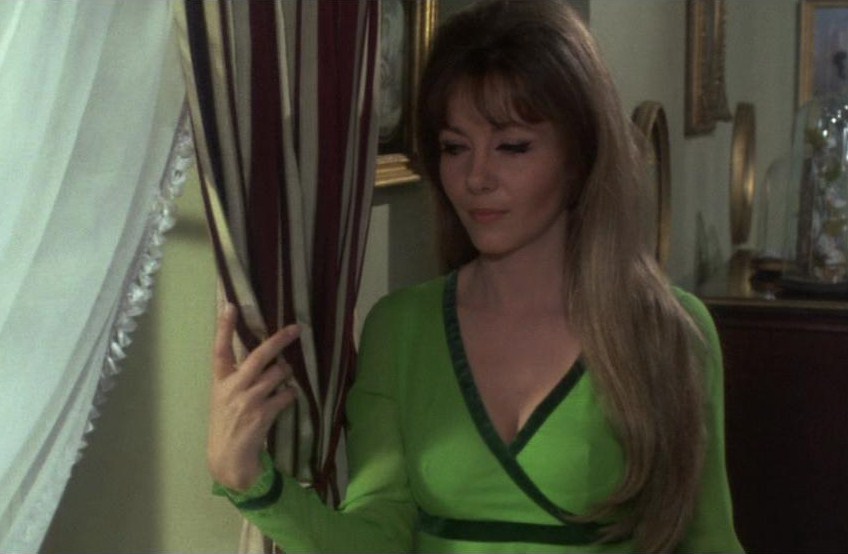
Ingrid as Le Fanu's Carmilla - The Vampire LoversMadeleine Smith and Pauline Moran, who played the Woman in Black in Nigel Kneale’s 1989 TV adaptation of Susan Hill’s short novel, both decry the lack of leading roles for women both in horror and in the acting profession in general. Moran works for the actor’s union Equity, who have recently been working to redress this imbalance. Horror, whilst it frequently reduces women to the role of sacrificial victim or predatory vamp, has also provided some excellent opportunities for female actors. The Vampire Lovers and Countess Dracula may have been born out of Hammer’s attempt to compete with the exploitation market, but Ingrid Pitt puts in towering performances in both, bringing a touch of pathos and longing to her monstrous characters which earns them a degree of sympathy. She reflects that she was probably best suited to horror films, and that if she somehow strayed into a romantic comedy ‘I would probably kill him’. Leading female characters such as Irena in Val Lewton’s Cat People (played by Simone Simon) and Miss Giddens, the governess in The Innocents (played by Deborah Kerr), trailers or excerpts from both of which are heard in the programme, are richly ambiguous and psychologically complex, offering challenging and demanding roles for the actor (and both Simon and Kerr give fine performances).

Gloria Holden - Dracula's DaughterGloria Holden in Dracula’s Daughter (a neglected minor gem in the Universal canon) and Elsa Lanchester in Bride of Frankenstein are also held up as exemplars of women who have created memorable female characters in horror films. Lanchester’s bride may be onscreen for only a few moments, and she doesn’t so much scream as hiss and spit, but her impact is unforgettable. Holden brings an unworldly, deeply melancholic quality to her cursed character, bringing a tragic dimension to the story. It’s interesting that both she and Irena in Cat People are subject to the interrogations of a psychiatrist looking to find the true subconscious origins of their afflictions – the underlying metaphor of their monstrous natures laid bare for a few moments. Irena ends up killing her psychiatrist in leopard form, however, which clears up that case. As a more modern example of a complex female protagonist, neither victim nor one-dimensionally feisty and all-competent heroine, Shearsmith mentions The Awakening, in which Rebecca Hall plays Florence, a sceptical ghost hunter. Shearsmith offers the intriguing insight that an early draft of Stephen Volk’s script revealed this character to be Flora, the little girl from The Innocents, all grown up but still working through the trauma of her experiences.

The Woman In Black - Pauline MoranPauline Moran’s performance as the hateful spirit of The Woman In Black, a revenant bent on revenge, was extremely effective. As she points out, she is only seen five times in the course of the film, but each appearance makes an indelible impression. She recalls the scene, which Shearsmith remembers as being possibly the most terrifying he has seen on any television programme, in which the woman in black descends on the hapless solicitor, marooned on his sick bed. She floats impossibly through his window and approaches him in a glide which seems to bring her looming endlessly forward without ever quite arriving. Moran reveals the mechanics of the filming of this spectral visitation, and the effect her appearance had on the normally fairly hardbitten crew; they all instinctively leaned away from her as she was pulled towards them on the dolly tracks, the wind machine blowing her hair and black cloak back behind her. She produced her bloodcurdling scream not as a full-throated bellow, but as a long-drawn out ‘eeeeeeee’ from the front of her mouth, held in a rigid rictus; a terrifying sound which seemed to draw on ancestral Celtic memories of banshee death wails in the dead of night. It was still utterly hair-raising even just coming out of the radio. Moran, Madeleine Smith and Barbara Shelley were united in their dislike for modern developments in the genre, which they see as having becoming coarser and more explicitly violent. Moran sees no reason why classic period horror shouldn’t find a place in the modern cinema landscape, however. The recent success of the revived Hammer’s version of The Woman In Black, for all its flaws (and they are, to my mind, manifold) shows that there is an appetite for such fare. And perhaps Hammer is the studio to provide it once more.

Scream Queens is part of the Gothic Imagination series of programmes on Radio 4. This week also saw the start of a new adaptation of Bram Stoker’s hugely influential novel Dracula. There is an immediate sense of redundancy to such an undertaking. The story has been told so many times before, and by now there’s a definite sense of strain in the search for a new way in which it can be approached. This is actually a fairly straight ‘classic’ interpretation, acted with period drama correctness, and offering little that is new. A degree of familiarity is almost assumed here, and the narrative appears at times to be unfolding with a retrospective air. The limitations of radio are exposed at times, or rather are not sufficiently overcome. Parts of the action are awkwardly conveyed by characters pointing them out: Lucy commenting on the Demeter’s dramatic storm-tossed beaching n Whitby Harbour (‘look, there’s a man on deck – he’s lashed to the wheel’, etc.) and Dr Seward’s ‘Ah, you’ve cut me’ in reaction to a knife attack from Renfield. Dracula is obviously a difficult role to take on, with the temptation to fall into the mannerisms of renowned Counts from the past hard to resist. He is presented here as an old man with a long white moustache, a welcoming, slightly creaky East European who seems disarmingly ordinary. The sexual nature of his predation on Lucy, which is brought out by lines such as ‘you must ask me to enter you’, and by the breathy moans which accompany his supping of blood, is rather undermined by this initial image of an ageing, slightly avuncular figure, full of mild complaint. It makes this Dracula seem more of a dirty old man than a dark seducer of the Christopher Lee variety (or even a stage mesmerist in the Lugosi mould). The sound design for the scenes of blood drinking is also decidedly odd, with an exaggerated ripping sound followed by a loud, stickily fluid bubbling. Perhaps it is intended as an expressionistic effect, but it verges on the inadvertently ridiculous, Dracula sounding like a loud and messy eater. Similarly, Renfield’s lapping up of blood from the floor is done with such an emphatic slurp that it sounds like he has produced a handy straw from about his person to hoover it all up. The action so far has reached Lucy’s death. Again, overfamiliarity has rendered the repeated attempts at reviving her through blood transfusions a little tedious. We know she’s not going to survive, so the whole process seems a little drawn out. Don’t let me put you off entirely though. There are also things to enjoy here. The performances are solid and the script a clear and faithful rendering of Stoker’s story (Christopher Lee would approve). The interjection of moments of interior monologue give depth to characters who can appear a little one-dimensional on the page, and make them more sympathetic. Dracula will be followed by an adaptation of Mary Shelly’s Frankenstein. Given that her novel is far less familiar to the modern reader, this may prove more fruitful material for adaptation. Perhaps, for now, it’s time to put the Count to bed. He’s earned a long, long sleep.


