Showing posts with label Stephen Volk. Show all posts

Tuesday, 16 October 2018

The Dark Masters Trilogy by Stephen Volk


Three of Stephen Volk’s recent novellas, portrait stories of significant figures in the fields of horror and the macabre, have been lovingly and lavishly repackaged and conjoined as the ‘Dark Masters Trilogy’. Here we meet, in youth, middle age and premature old age, ‘Fred’ Hitchcock, Dennis Wheatley and Peter Cushing in the environs of Leytonstone, Netherwood and Whitstable. It’s a resonant overarching title. The real characters embedded in these tales of psychological suspense, uneasy horror and occult powerplay were all masters of the dark arts. But the darkness is also the existential void, the crisis of the soul with which Volk confronts them. Peter Cushing’s sense of desolation after the death of his beloved wife Helen; ‘Fred’ Hitchock’s childhood bewilderment at the strange machinations of the adult world; and the sense of inadequacy and social inferiority which bedevils Dennis Wheatley.

There is a thematic coherence which fully warrants the use of the word ‘trilogy’, and subtle links are included which connect the worlds of the three focal characters. In Whitstable, a waitress is referred to as ‘a Kentish Kim Novak’; Both Hitch and Aleister Crowley are likened to Buddha; Alesteir Crowley recalls an encounter with a young and enthusiastic Christopher Lee, who professes to be an ‘enormous fan’ of Dennis Wheatley (a gentle dig at Sir Christopher’s tendency to name drop); and Dennis Wheatley recalls his friendship with Hitch and Alma. But is this testing, this drawing out through the psychic scouring of adversity and terror, which draws the three portraits together and provides us with such a rich, ambiguous and ultimately loving depiction of legendary figures made human, revered icons rendered vulnerable. The stories, inflected with biographical detail but straying far from the straight path of fact, nevertheless feel true. Volk’s investment in the lives and the work stamps them with the hallmark of authenticity.

Novellas they may be, but Whitstable, Leytonstone and Netherwood are highly concentrated, multi-layered works which encompass a complex array of themes. As the titles suggest, they are partly evocations of place. The East End London of Leytonstone, where Fred’s father owned a grocer’s at 517 The High Road; The Kentish fishing town of Whitstable where Peter Cushing became such a well known resident; and the Hastings guest-house where Alesteir Crowley lived out his declining years. But these are also places rooted in particular historical moments, hence the appending of dates to the titles in the contents pages. Leytonstone is set in 1906, the pre-First World War twilight of Empire; Netherwood takes place amidst the post-war ruination and austerity of 1947 – ‘the blighted land’ as Dennis Wheatley thinks of it whilst gazing out of the train window; And Whitstable is situated in 1971, at the beginning of the steady decline of the decade following the euphoria of the 60s.

Together, they offer a kaleidoscopic portrait of England (more particularly, South Eastern England) across the twentieth century. Volk has a way of nailing time and place with a keen, haiku-like phrase. An ‘airfix blue sky’ is the perfect simile for a clear 70s day. And the use of the word ‘malachite’ to describe the particular shade of green livery employed by southern railway carriages somehow immediately fixes them to the 40s world, to British Transport Film colour. Indeed, the very fact that Dennis Wheatley, a writer at the height of his bestselling renown with the wealth attendant upon it, travels by train says much about the nature of post-war, pre-Beeching Britain. Small details are also used like cuttings in a nostalgic scrapbook to summon the particularities of an era. In the case of the 1971 of Whitstable, songs on the radio (Grandad and My Sweet Lord), Pan Books of Horror and a Doctor Who Radio Times cover heralding the first appearance of Roger Delgado’s Master.

This national portraiture also encompasses a keen sense of class division, which Volk delineates with great subtlety. The ‘monster’ of Whitstable is a working class character, and Peter Cushing’s entrance into his ‘lair’ and encounter with a working class mother is a finely observed distillation of the bristling class conflicts boiling to the surface at the time. It’s a measure of the novella’s loving tribute to Cushing (it was first published in his centenary year) that he is shown as being entirely understanding of her verbal hostility towards his refined accent and bearing, even though he feels each ‘fuck’ thrown at him as a blow. The class distinctions of the East End Edwardian milieu are exemplified by the division of the local into saloon and public bar areas. Even within the fairly narrow economic range of this neighbourhood, there seems some inherent need to put up barriers to make the stratifications of social position visible, to ensure they are correctly observed. The tensions created by the maintenance of such appearances are one of the barely understood influences which go towards forming the character of young Fred, and thereby, of course, his subsequent art.

Dennis Wheatley is plagued by a sense of social inferiority, of the hollowness of his achievements. Joan, his wife, is from an aristocratic background and he never feels a part of her circle; ‘they were Joan’s people, not his’, as his inner chorus comments during a recollection of a grilling at a particularly awful party. Like Hitch, the persona put on by the adult Fred, he feels the obligation to put on a front, an affable, clubbable façade. Peter Cushing, feeling utterly hollow in his grieving for Helen, also finds himself compelled to don his outward cloak of charm and gentile courtesy when all he really wants to do is hide from the bright life and expectations of the world. Pedro Marques’ cover art captures this aspect of the trilogy perfectly. The sense that we are glimpsing a series of authentic, troubled selves behind a carefully fashioned masquerade. This is not to say that we are offered the kind of one-dimensional ‘dark-side’ portraits of well-loved characters which have been a staple of TV biopics for some time now. These three stories are an attempt to create rounded, human characters by taking biographical details and fleshing them out with themes and preoccupations distilled from the work.

It’s an interesting fictional form, a blend of tribute, biographical meditation and auto-commentary on the subjects’ work. All three masters are caught within refractions and inversions of their own archetypal tales. Peter Cushing’s confrontation with a monster whose ‘evil’ seems inherent and ineradicable; Fred’s early reification of the ‘fair-haired girl’ icon, his manufacture of a suspense narrative whose ultimate, ever-receding aim is self-discovery; and Dennis Wheatley’s reluctant involvement in an occult thriller with the model for one of his own villainous magi, Alesteir Crowley - A scenario which complicates his own need for a world in which the forces of darkness and light are clearly defined, as they had seemed to be during the war.

These all work magnificently as tales of terror, unease and suspense in and of themselves. But the moulding of the fictional narratives around psychological portraits of actual artists (whether their artistry comprised of writing, film directing or acting), the splicing together of art and biography, results in a reflection on the extent to which authors, auteurs and actors invest truthful elements of their own being into their work (to whatever degree of self-consciousness or fanciful disguise). This also becomes a comment, particularly pertinent in an age of rampant celebrity, on the way that readers or viewers can mine books, films or performances for seams of the creator’s authentic inner life, which may be hidden by the cultivated public persona presented to the prying world. Dennis Wheatley’s experiences at Netherwood, his co-option and testing by the arch manipulator Alesteir Crowley, leads him to contemplate the theme for his next novel, the book which will free him form a debilitating period of writer’s block, a crisis of self-belief. He comes up with the title and the character sketch of the protagonist: The Haunting of Toby Jugg. With its portrayal of an airman physically and psychologically traumatised by the experience of war, it’s generally considered his most substantive and personally nuanced achievement.

Oddly enough, I have recently come across two further pieces of writing which have directly reflected upon the Dark Masters Trilogy. Earlier this year, I saw the film The Ballad of Shirley Collins and later read Shirley’s excellent autobiographical memoirs All In The Downs. Collins was a young girl growing up in Hastings during the post-war period. Her mother was a member of the local Communist party and would send Shirley and her sister Dolly out into the town to sell the party magazine the Daily Worker. Dennis Wheatley would have been horrified to see it. In the film, Shirley is seen watching the revived Jack In the Green ceremony in her old home town. More Pagan rituals in Hastings. She was aware of Crowley’s presence at Netherwood at the time. She notes that she and Dolly first sang in public at Oakhurst Hotel on The Ridge as part of a Hastings Communist Party social weekend. Netherwood was just nearby. Crowley ‘had a reputation as a person to keep clear of – and I know that when Dolly and I were walking along The Ridge to The Harrow where our Uncle Wally and Aunt Nell in their Tudor farmhouse, we’d always cross to the other side of the road and creep by. Then run!’ This is no doubt an anecdote which she has regaled to her good friend David Tibet, who was instrumental in encouraging her back to singing once more. Tibet creates powerful music of an incantatory, recitative nature with Current 93, constructing his own occult mythologies in which the forces of good and evil battle struggle for ascendancy in scenarios of Gnostic apocalypse. He was also one of the authors of Netherwood: The Last Resort of Alesteir Crowley, by a ‘Gentleman of Hastings’, a book which Volk found in a bookshop in the Old Town (an area which Shirley’s mum considered ‘rough’) and which proved indispensable for the writing of his own Netherwood tale. The introduction of All In the Downs is written by Stewart Lee, a great fan and supporter of Collins. Lee is one of the writers appearing in an anthology of horror stories written by comedians and edited by Johnny Mains and Robin Ince, Dead Funny (and its follow up, Dead Funny Encore). Volk dedicates the Dark Masters Trilogy to Johnny.

Another comedian with a story appearing in Dead Funny is Matthew Holness. His story Possum, about a tormented puppeteer, is the basis for a forthcoming film of the same name (with a very, very disturbing poster, particularly if you are an arachnaphobe). Holness was interviewed by the Guardian about it. He talked about his childhood in Whitstable, and his early obsession with the horror genre. He met with Peter Cushing in town, of course. Cushing ‘expressed concern that the six-year old asking for an autograph knew so much about Hammer’. Did young Matthew have a copy of Dennis Gifford’s Monsters In The Movies, I wonder. When he passed his 11-plus, Cushing gave him a copy of his autobiography with a lengthy inscription (yes, he really was a lovely man). Connections, connections.

In telling tales whose focal characters are key figures in the literature and cinema of horror and the macabre and incorporating them within contemporary variations of their own archetypal narratives, Volk also interrogates the nature of the genre. He suggests the insights into human nature, the understanding of the moral struggles constantly at work in the world and, strangely enough, the comforts which it can afford. Dennis Wheatley, in being granted a glimpse of his eventual obscurity, comes to the conclusion that there is a certain nobility and honour, an essential usefulness in providing people with imaginatively diverting and luridly exciting entertainments in a post-war era which has left people in a state of psychological shock. The names of Dachau, Buchenwald and Belsen are recited like an appalling dark litany in both Netherwood and Whitstable. In Leytonstone, the celebration of Empire Day, a tableau which is built around the famous photo of young Fred, clad in military attire, sat upon a pony outside his dad’s grocers in a street bedecked with Union Jacks, anticipates the clash of Imperial powers in the First World War, and the disastrous fractures of world politics and economics which ensued. What can a literature of terror do to encompass (or even to attempt to exclude) such terrible knowledge of the depths to which humanity can sink? How can the old Romantic and Gothic traditions continue to provide their sublime terrors, their subtle frissons in the face of the numbing extremity of the horrors starkly presented in newpaper photos or on the TV screen throughout the 20th century. Peter Cushing perhaps speaks for Volk in his self-defence of the genre for which he had unwittingly become such a defining figure. Answering a no-doubt oft-voiced question as to why he made such ‘horrible films’, he explains ‘I think the best so called “horror” shows us our worst fears in symbolic form and tries to tell us in dramatic form how we can overcome them’.

For Volk, a romantic humanist, the answer is connection, always connection. It is Hitch’s tragedy that he never truly seems to find it. There is always a hollow chamber within, a cell inhabited for life by the confused and frightened boy who must keep the world at bay with ordered systems (from train and tramspotting to the plotting of perfect cinematic thrill rides) and a bluffly remote façade of macabre joviality. The damage sustained in childhood and carried through into adulthood, and the threat to children from the damaged or simply monstrous is a theme which recurs in Volk’s fiction, from Afterlife to Ghost Watch and The Awakening. It is present throughout this trilogy too.

Both Cushing and Wheatley are firm believers in a benevolent Christian God, a force for good in the world. Their worldview is strongly moral, with an underpinning commitment to confronting evil wherever it might be encountered. For Wheatley, as for so many others, the Second World War was a fight against the encroachment of an evil ideological poison in the world. The ritual battle he takes part in with Crowley as an unlikely ally is a struggle against a kind of occult fascism, an attempt to use magic potency attained through pitiless cruelty and brutish bullying to exert a violent, self-aggrandising power. The dark magus whom they oppose is the antithesis to Wheatley’s values and it turns out, surprisingly, Crowley’s. His utter disconnection from all human connection, fellow-feeling and compassion are what makes him truly monstrous. The same is true for the monster whom Cushing confronts in Whitstable. He talks of life being about satisfying ones appetites, and talks of developing the taste for the once prevalent local delicacy of oysters (a scene with uncomfortable echoes of Laurence Olivier’s seduction of Tony Curtis in Spartacus). This is stated as if it were a self-evident truth. Cushing quietly offers an alternative credo in his mind. Life is given meaning through love. Peter’s love for Helen, and Dennis’ love for Joan. This is the redemptive force. Whether it derives from a benevolent God or from the shining heart of the Human spirit.

Friday, 24 March 2017

The Little Gift by Stephen Volk

I’ve attempted to avoid mentioning one of the central incidents in the story, but surrounding allusions will inevitably give a good deal of the game away. So to avoid disappointment and irritation I will hereby issue a SEMI-SPOILER alert.


Stephen Volk’s novella The Little Gift may be a relatively short work, but it contains volumes within its carefully constructed narrative. It comments upon the aridity of corporate clone culture, the subtle but everpresent divisions of class, the vital import of art and spiritual nourishment in an aggressively materialistic world, the coarsening effect of tabloid journalism and the philosophical distinction between instinctive and morally conscious action. As a story written by an author generally working within the horror genre (and I think that, with its exploration of the dark corners of the human psyche, this qualifies as a horror story) it is also strident in its rejection of the prurient allure of one of the modern avatars of the monstrous, the serial killer. A brutally realist monster for materialist times, stripped of all supernatural mystery and ripped from the lurid headlines of the real world. They are driven only by debased appetites, playing on fears of physical pain and torturous death rather than any threat to the soul, inviting the lurch of nausea in place of the vertigo felt in the presence of the uncanny.

Above all, however, The Little Gift is a terribly human story filled with an empathetic awareness of the frangibility of the emotional self, the fragility of bodies – bodies and souls. Its cruel ironies and correspondences (and I shall endeavour not to reveal the central irony, which is embodied in the title) act as harsh lessons, stunning blows leading to damaged self-awareness. It begins with our first person narrator in the midst of night terrors, the existential dread given form by sleeplessness. They obviously have a subconscious source beyond their ostensible cause, the little gifts of dead mice and birds left by the cat. Something fundamental is exposed in the vulnerable hours before dawn.

The little gift left by the pitiless pet at the start of the novella seems like some physical manifestation of these night fears. The mauled, near-dead bird is a token of feline fellow-feeling, a sharing of the kill with the pride, allowing the privilege of the final death-blow to lie with the chief provider. The link between human and animal is established at the outset and is reiterated throughout the story. The narrator sees the cat’s actions as instinctive, engineered by ‘millions of years of evolution’. His own actions, the impulsive affair he falls into, are seen in similarly materialistic terms, animalistic drives followed at a time when his sense of self has been reduced to a dulled nullity. He fantasises about sex in the toilet, the ultimate reduction of passion to basic physical need and fears that some pheremonal musk might betray him to his wife, as if she could sniff him out. The first kiss, the peremptory prelude, takes place in the gardens of the grand house in which the corporate away day is taking place, the failed competitors for the prize mate aimlessly shuffling around the topiary like statuesque figures in a demystified version of Last Year in Marienbad. Later, on a trip with his family, the narrator pulls in at a location called Heaven’s Gate which offers a prospect over Longleat Park and the animals living in the safari park there. It’s a different view of the animal kingdom akin to the anodyne paintings of lions settling down with the lambs in the summery fields of the Lord found on the covers of the Jehovah’s Witness circular Watchtower. If this offers a converse metaphor for family life, then it is a fantasy, a forcefully willed ideal which bears no relation to true nature. Even emotions and psychological problems are spoken of in materialistic terms, with talk of Neuro Linguistic Programming and the Kübler-Ross stages of grief. All along, the narrator is aware of ‘the little man inside me, my soul’.

The scattered detritus of torn-out feathers are described discovered by the narrator’s wife at the beginning of the story are described as ‘dark commas’ spread across the room, their radius indicative of a fluttering struggle, agonies prolonged by the playful predator. It’s a powerfully poetic image, the comma marking a pause before an ensuing clause, the crux upon which a sentence turns; an interlude in the continuity of a life. But their provenance as the dismembered remains of a dying creature is also suggestive of a full stop, an ending in a parallel sentence. The image of a dark, feathered comma is used as a demarcation of significant moments of change in the narrative. Laid horizontally between certain paragraphs, it underlines temporal shifts or decisive alterations of intention or perception; the drift of time and mind. These symbolic punctuation marks are part of the visual schema for the book created by Pedro Marques which add a significant element to the overall impact. The exquisite surrealist corpse of the cover illustration, the dismembered doll angel with its bird head and plucked wings, is a disturbing yet strangely beautiful image.

The comma in the life of the protagonist is the banal disruption of a mid-life crisis. Volk depicts this with all the confused immediacy and panicked lack of perspective a first-person narrative affords. The very specificity of the details with which the narrator sums up his life – the Range Rover Evoque, the ‘gorgeous’ Kawasaki and the half-timbered cottage in All Cannings in Devizes – along with the contemptuously mocking self-awareness accompanying their listing, point to the falsity of such materialist aspirations as indicators of success and happiness. Tellingly, his ‘beautiful’ wife and ‘two gorgeous, healthy children’ (gorgeous like a Kawasaki) are tagged onto the end of the list as an afterthought, unnamed additions to the tokens of boastful achievement. You can almost hear David Byrne’s semi-hysterical vocal asking ‘well, how did I get here?’

What’s in a name? Naming or the withholding of names is important in The Little Gift. The narrator remains unnamed throughout and thus maintains the anonymity of the nameless. Although we are privy to the intimacies of his inner life at a time of personal crisis we see little beyond the borders of his brief and vividly real liaison. He remains essentially ill-defined, the primacy of family to his sense of self asserted rather than depicted. He also denies the serial killer his name, refusing to add to his mythologisation, his transformation into a folk demon. I’m reminded here of the ending of Guillermo del Toro’s Pan’s Labyrinth in which the brutal fascist captain is told in the moments before his execution that his name as a father will be denied him, never mentioned to the son that the woman who is about to take his life is cradling. He will be erased from his family tree. The shared namelessness adds to the sense that killer and narrator are connected however, both remotely touching one another on the spectrum of blank disconnection. ‘He always seemed part of me, attached by some dark umbilical’, our protagonist admits at the end. ‘The little man inside me’, perhaps, his dark soul. Or the ineradicable infection passed on by debased acts (again, don’t mythologise them by using the word evil, as if there were some inverted transcendence or any kind of active anti-morality at play), the tainting of the soul through contact, propagated through the grubbily ink-stained vector of the tabloids.

Part of Volk’s purpose here is to regain the humanity of the victims, to force us to empathise with them in their darkest moment, to be with them in the terror of their final loneliness without for one moment using their experience for the most despicable kind of prurient onlooking. It is something which has to be done with the utmost sensitivity, because we are approaching real and enduring suffering here. Volk is no stranger to addressing the darkest areas of human experience however, notably in the series After Life, which was fearless in its confrontation of the most distressing of scenarios (and which featured an episode which once more demythologised the serial killer archetype, exposing the blankness at the core of such characters). He always retains a humanist outlook which makes us feel for his characters, never revelling in or unnecessarily dwelling upon physical pain. And it is the humanity of the killer’s victims which is of the essence here, the acts themselves revealed only indirectly through the flashgun snapshots of tabloid reports. It’s a similar approach to that taken by Phil Rickman in his Merrily Watkins novel The Lamp of the Wicked, which also deals with the poisonous legacy of the Gloucester murders. Merrily has the ultimate nightmare in which she dreams that of daughter Jane (a character with whom we have become intimate over previous novels) being bundled into the back of the builders van. It’s a humanisation of the victim at the most intimate level, and allows her to empathise all the more with those who lost the people they loved in such a terrible way and who have to endure such dark imaginings over and over again. Such a shared humanist perspective suggests an affinity between the work of Rickman and Volk; an affinity which was obviously picked up by whoever commissioned Volk to adapt Rickman’s second Merrily Watkins novel Midwinter of the Spirit.

His wife and children are initially unnamed too, merely referred to in terms of their family connection. It is only after he meets his lover that they take on names and become more clearly defined as individuals, just as he feels himself waking up into a sense of an authentic self once more. His rehumanisation humanises them. Their names feel like they have an allegorical ring to them: Trudy, the true one and his daughters Verity (more truth) and Amber (the precious, the catcher of warm, hearthglow light). His lover’s name blends hints of the exotic with counterbalancing mundanity, the romantic with the drab everyday. Ghislaine is a French name which could have come from an old troubadour romance, whilst the surname Hammond is rooted in the English heartland in which this anti-romance takes place. The element of Frenchness may also be a nod to the British films of the grey 50s in which any element of illicit love (a fairly broad definition back then) tended to involve French actresses such as Simone Signoret (see Room At the Top) or other continentals who were more prone to that sort of thing. She has a hidden middle name too, of Italian provenance this time. Lenzi, which temporarily transports her out of the landscapes of motorway service stations and conference centres into the genuinely romantic dream of villages in the Tuscan hills.

Volk is brilliant at building up anti-romantic detail, with the precise location of a rendezvous at a services on the M5 between junctions 11a and 12 exposing its crushingly dispiriting nature whilst enabling us to locate it on our maps and explore its ambience for ourselves should we so wish. But he also finds beauty in imperfection, in the vulnerability and tenderness of those struggling to find happiness or fulfilment in a disconnected, corporate world but refusing to give up on themselves or others. We are defined by our imperfections as much as anything, he suggests. And it is those imperfections, the departures from an airbrushed presentation of the self to the world which make Ghislaine so plausibly real, and which makes her so attractive to our narrator. They catch onto one another as they drift aimlessly by, spinning closely around in a temporary dance of mutual recognition.

There is also a subtly portrayed class barrier between them. Not a gulf, but the kind of fine gradation which still creates instinctive divisions in the stratified society of Britain. Ghislaine is from Birmingham, we are initially led to believe. This misapprehension (she is actually from Wolverhampton, we later discover) is indicative of the generalised stereotype into which people are instantly assigned at first encounter, the reduction of the individual to a set of crude assumptions. Birmingham is a place synonymous with dour, brutalist pragmatism and an absence of romance, of any spark of the visionary. For me, as the home of the bands Broadcast, Pram and their various associates, it’s a major locus of magic and strange enchantment, an indication that rich interior landscapes and constellations of the imagination can be discovered and flourish in any environment. It contrasts markedly with the Wiltshire idyll in which the narrator lives, however. Ghislaine’s relatives may have come from the Tuscan countryside, Lenzis filling the graveyards there, but it is a place that her family have long since left behind for the built-up, motorway-bound terrain of the midlands. Our narrator, meanwhile, is able to take advantage of a ‘gite with a swimming pool near Brignoles, a former olive press’ which belongs to a company director. It may very well say something about my position within the British class spectrum that I had to look up what a gite was. Ghislaine has the contrasting prospect of a hen night in Barcelona, travelling by Easyjet and staying at a place called the Hotel Derby. Again, Volk is spot on when it comes to providing the telling anti-romantic detail. He could no doubt write a fine romantic comedy full of such wry observation if he had the mind to. I strongly suspect he doesn’t. Ghislaine’s one taste of upper crust living comes during the away day weekend, which takes place at a stately home converted into a conference centre. It hardly counts.

In a way, the class divide makes the passionate interlude all the more urgent and affecting. They both see each other for who they really are, with all trappings of status stripped away. As is always the case, however, it is far easier for our narrator to retreat back into the protective compound of his wealth, the stability of family. He is required to make the decisive move, but his default setting is drift. He simply doesn’t have the killer instinct. That has to be provided by someone else. An actual killer, perhaps. There is something peculiarly, poignantly English about his struggle to express his desires, to even articulate his feelings to himself. A verbal dance of self-deprecation skips lightly away from direct statement and it is down to Ghislaine to direct the affair, to read the all-too obvious signs. This disconnection from desire and clogged up communication is embodied in the fact that he finds it easier to make contact via the remote, truncated means of text messages. Printed out in bold type, these are disturbingly echoed in the lurid tabloid headlines and flashes of pruriently detailed reportage which are also printed in bold. Both condense, coarsen and elide truth, weakening the empathy which comes from true human connection.

These equivalences and correspondences create a sense of interconnected patterns spanning all manner of divides. Ultimately, they link a ‘respectable’, hard-working family man with an indolent, despicable killer, an unreadable void whose humanity has, at some point, been wholly erased. Or was he merely, like the housecat whose impulses are indulged, merely doing what he was programmed to do by nature. Are we more than a collective mess of amalgamated instincts? What makes us different from animals? Are we moral beings or are we just kidding ourselves? Mention of ISIS headlines on the news taking over once the killer’s tale is done raise the stakes and places such questions on a global scale. We have been offered the possibility of a religious work of art by Matisse, inspired by the kindness of a Catholic nurse who subsequently became a nun, as some kind of redemptive embodiment of the spiritual nobility inherent in the human soul. The description of the glass, its vivid colours and living light (‘the intense blue of the Mediterranean and the Madonna’ – beautiful writing here) gives an almost catechistic pagan sense of the immediacy of being. The equivalences which are so much a part of this intricately structured novella once more provide ironic counterparts however. And it would take a particularly intense moment of Blakean visionary transport to experience a similar flooding of divine light in the Gloucester services off the M5. The final image could have taken place in those services (thus echoing filmic images of dissolving or bubbling liquids stared at by James Mason in Odd Man Out and Robert de Niro in Taxi Driver, both characters suffering crises of identity and hovering on the edge of death and violence). I’ve always been fascinated by the way in which sugar cubes absorb and draw up the tea or coffee into which they’re dipped until they’re entirely consumed by it and I’m clearly not alone. Here, such an effect acts as a complex and ambiguous piece of symbolism. The sugarcube soul, absorbing that to which it is exposed? A metaphor for the transient nature of all things, the vital importance of making the most of our short span? Of not allowing ourselves to drift into the dissipation of the unexamined life, slowly reduced to the sludge of base, instinctual existence? Or of the way in which the lonely, monadic self can find indivisible commonality with another if it is prepared to open itself up and communicate with complete honesty? Our narrator used to take two sugars. He ends up taking one, which he watches darkening with the stain of his black coffee. Perhaps he still has some distance to go.

These are profound issues, questions which address the fundamentals of who we are as individuals, as political and social beings; as humans in fact. No easy resolution is arrived at, no closure comfortably attained. In the insidious, dangerous manner in which expert storytellers operate, we are invited to think for ourselves, to think about ourselves. It is Stephen Volk’s Little Gift to us. I for one am thankful for it.

Saturday, 22 November 2014

Stephen Volk's Leytonstone and the Secret Heart of Hitchcock


Stephen Volk’s new novella (novelette? I never did work out the fine distinctions) Leytonstone is a tangential follow up to Whitstable, his acclaimed 2013 book, also published by Spectral Press. He once more fashions a story around a particular time, place and a real person inhabiting them. Whitstable offered a heartfelt portrait of the aged Peter Cushing wandering through the sleepy Kent seaside town in which he had settled with his beloved wife Helen and made his home. It reflected upon both Cushing’s gentlemanly manner, old world kindliness and Christian worldview and the moral rectitude and certainty of the more upright, crusading characters he played onscreen. These qualities were set against the backdrop of the harsh, increasingly desensitised world of the 70s in which such moral and spiritual convictions had begun to dissipate, and to which the fantasy world of Hammer with which Cushing was so indelibly associated was struggling to adjust. New fears and terrors, allied with the uncertainties attendant upon a declining economy, were arising to eclipse the gothic staples of the Hammer universe with monsters of a more grimly realistic tenor – monsters with a human face. Cushing’s personal crisis of faith and hope in the wake of his wife’s death becomes paradigmatic of the crisis of the country at large. In the manner of Boris Karloff at the climax of Peter Bogdanovich’s 1968 film Targets, Cushing has to face a contemporary monster imbued with all the ambiguous complexities of human nature. In that film, Karloff confronted a sniper who had turned his sights on the audience at a drive-in where one of his old cobwebbed gothics was screening. In Whitstable, Cushing intervenes in order to protect a young boy who has turned to him, or rather to Dr Van Helsing, for help in driving out the father whom he believes to be a vampire. In doing so, the actor has to face his own fears of redundancy and helplessness in a world he no longer understands, and feels he has no real place in anymore. It is a deeply moving portrait, full of the compassion and psychological insight Volk brought to difficult and upsetting subject matter in his supernatural TV series Afterlife. This was a fictional iteration of Cushing, but it spoke about the man and his work with great eloquence, revealing much about the enormous respect, admiration, and indeed love with which he is still regarded by so many (myself included).


Volk treads a parallel path in Leytonstone. Whereas Whitstable viewed the compensatory imaginative world of a child from the perspective of an adult, Leytonstone invites us to see things from a young child’s point of view. That child is Fred, or ‘Cocky’ to his schoolmates. We know him better as Alfred Hitchcock, or perhaps as ‘Hitch’, the nickname which he preferred as an adult to the crude name-calling of the playground or childhood streets. At this stage in his life he is a 6 year old boy living in the east end London borough of Leytonstone, in a house attached to the successful greengrocer’s business of his father, William Hitchcock.

Volk adopts a cinematic style appropriate to his subject, setting the scene with the acute eye of the accomplished screenwriter. There is some quick cross-editing in the first few pages, with Fred’s recitation of potato varieties intercut with close-up details of the street, indicating someone approaching (‘dark legs stride in mirror-black shoes’). The imaginary camera eye then pulls out to give us an interior and exterior view of the Hitchcock greengrocer’s. Later, there are expressionist shadows which turn a policeman walking the gaslit streets into a skull-faced ghoul: a nod to the German films from which the young Hitchcock learned so much in the formative years of his career. We get a foretaste of some of Hitchcock’s own cinematic devices too. Windows and peepholes provide voyeuristic screens within the screen, iris ovals which make the audience complicit in what they watch. Fred clears the misted pane of his bedroom window to look out onto the evening street below. Volk observes that ‘it’s black and white out there, like a film’. A view at a safe distance from the pick-up he half-comprehendingly watches take place. Later, he spies on a prototype Hitchcock blonde through a hole in a matchbox he had customised for a practical joke (played upon said blonde). This tiny matchbox is a miniature model of the prying lens of the movie camera. Echoes of Rear Window resonate down the years. The fact that the matches are of the England’s Glory make provides the potential for a crude joke (the glory hole) which Fred would have no understanding of, but which the adult Hitch most certainly would. His love of bawdy toilet humour is anticipated in Fred’s nervous inscribing of a cock and balls, copied from a piece of graffiti he has seen, onto the wall of the toilets at his Jesuit school.


Other well-recorded aspects of Hitch’s character and behaviour are also anticipated, lent dramatic context and provided with psychological insight: his compulsive comfort eating, his yearning for easeful luxury, his enactment of elaborate and cruel practical jokes, and his placid remoteness and emotionally distant demeanour. His iconic image is pictured at the end of the book seated onstage at the American Film Institute’s celebration of his life and work. It is an image of someone who is aloof and at a remove from ordinary human motivations, which he observes and sums up with a few dramatically weighted words of mordant wit. Volk describes him as ‘a vast Buddha as recognisable as any of the actors whose name he put up in lights’. It’s a description which could be applied to the giant sculpture of his head which rests, heavy-lidded and rustily bronze, in the centre of a complex of offices and flats built on the site of the Islington studios where his film directing career took flight. But this is a Buddha, Volk’s story suggests, who never achieved enlightenment; who remained in the dark, alone and filled with a paralysing fear which could only find release through his art. Behind the Buddha’s serene gaze lies a void.

Hitchcock and Truffaut
The first half of the story centres around an event which became a well-worn anecdote reeled off time and again by the mature and feted Hitch. His father took him to the local police station when he was a small boy (‘about six’, as Hitch told it). He had arranged for the policeman in charge to lock him in a cell for a short period of time (‘five minutes’ was the general estimate). ‘This is what we do to naughty boys’ the PC in charge told him by way of explanation. Hitch told this well-rehearsed tale, along with many others, as a way of deflecting any attempts at soliciting personal information. It offered a tidbit of prefabricated insight into the genesis of the ‘wrong man’ theme running through his work, along with the notion of transferable or latent guilt which attends it. The anecdote was duly brought out for the 1962 interview with Francois Truffaut which formed the basis for his 1967 book on Hitchcock. This was the only window on his early childhood he allowed his admiring interrogator, aside from a remark that, rather than being strict, his father was ‘a rather nervous man’. The only other glimpse we can get of Hitch’s childhood is the photograph of him posing next to his father, perched comfortably on a stout pony, in front of the luscious cornucopia of fruit and veg (including pineapples strung upside down like gamebirds) displayed in front of the shopfront with its proudly prominent sign reading W.Hitchcock – Fruit Salesman. William and Fred are both dressed in tropical khaki, the windows draped with flags to celebrate Empire Day (a celebration which the exotic fruits also implicitly play their part in). The photograph is incorporated into Volk’s story, which gives us some idea as to what might be going on behind the distant, detached gazes of father and son.

Volk takes the police station story and transforms it from the inflexible anecdotal shield it had become into a raw and pivotal moment in young Fred’s emotional and psychological development. The constant reiteration of the experience in the form of an amusing tale becomes a double-bluff; a piece of genuine self-revelation coated in the polished veneer of a light, carefully crafted recollection. It’s a pointer to the nature of Hitch’s films, the way in which he embedded his own deeply personal fears and desires beneath their immaculately contrived surfaces whilst never, ever admitting to any such dimension in public. In Volk’s story, the punishment meted out in the police station is a great deal more traumatic than the mild admonishment of the anecdote, the incarceration much lengthier than the brief incarceration Hitch outlined. Fred is left there overnight, bullied and tormented by a sadistic policeman who delights in telling him that Jack the Ripper is lodged in the adjacent cell. He has only a piss-stained bed with an indeterminately sticky blanket to curl up on, his lullaby sinister nonsense songs bellowed by the neighbouring drunk. It’s related with a Kafkaesque sense of existential terror. Fred feels utterly abandoned, and betrayed by his parents (his mother who let him go with a promise of his favourite steak and kidney pie upon his return). But most of all, he doesn’t understand. If he’s being subjected to this terrible punishment, he must be guilty of something. But what? Some latent sin he has yet to manifest? A universal guilt lodged within every human heart? It’s almost as if he is being guided to discover that guilt. At this juncture, he might as well be called Fred K.

The shadows of films to come are glimpsed throughout the story. There’s a certain game-like element to these allusions. They are partly speculative excavations, searching for the psychological strata underlying the stories Hitch chose to tell. But they are also offered with a nod and a wink, an enjoyable bit of movie spotting for terminal film buffs. The Ripper reference looks forward to The Lodger; the stuffed bird in the Jesuit father’s office, the transvestite and the police officer’s taunting ‘bit of a mummy’s boy, are we?’ to Pyscho; the ‘fluttering and scratching’ pigeons filling the upstairs room of a ruined house to The Birds’; the idea of hiding a body in a sack of potatoes to Frenzy….and so on.

Shadow selves - Guy and Bruno in Strangers on a Train
Other abiding themes running through Hitchcock’s films are also alluded to. The idea of disguised or hidden selves is present from the start in the form of metaphorical architecture – the division between the immaculate and bright streetfront display of the Hitchcock greengrocer’s and the dark interior behind in which the family lives. One of the bullying policeman’s methods of playing on young Fred’s imagination is to act as if he believes that his thorough knowledge of transport timetables and routes points to his being a potential spy. He turns something innocent, a source of intellectual pride, into something secret and despicable. Spies are key characters in a significant number of Hitchcock films: The Man Who Knew Too Much, The 39 Steps, Secret Agent, Sabotage, The Lady Vanishes, Foreign Correspondent, Saboteur, North by Northwest, Torn Curtain and Topaz. Volk has Fred ask his father what a spy is. His answer sheds light on their role within these pictures. His dad also inadvertently describes himself and all adults who aren’t unblemished saints (ie all adults), and presents his son with a sketch of his future self. A spy, William explains, is ‘a person who keeps secrets. Somebody who says he’s one thing but he’s really another’. The spy theme and the idea of the self hidden behind a carefully maintained surface extends to the doubled characters which cast mirroring reflections across Hitchcock’s filmography. Cary Grant and James Mason (Roger Thornhill – or ‘Mr Kaplan’ - and Phillip Vandamm) circling each other in North by Northwest is the example that most vividly springs to mind. But there are also the pairings of Cary Grant and Claude Rains in Notorious, Farley Granger and Robert Walker (Guy and Bruno) swapping murders in Strangers on a Train, James Stewart scripting Raymond Burr’s murder of his wife to alleviate his boredom in Rear Window, deadbeat Jon Finch and his psychopathic mate Barry Foster (Richard Blaney and Bob Rush) in Frenzy and many others. In Leytonstone, Fred’s father William is doubled with the monstrous, bullying policeman. The latter is a bluff brute who lives to feed his appetites, without any moral compunctions which might curb them. William is far more uncertain of himself (the ‘rather nervous man’ of Hitchcock’s recollection), filling his life with labour to allay the fear that it might all be ultimately without purpose. Or rather, that he might never discover that sense of purpose which those around him seem intuitively to possess. The doubling theme finds interesting form in Johan Grimonprez’s 2009 film Double Take, in which footage taken from introductions to the Alfred Hitchcock Presents TV series is contrasted with interviews with and footage of a contemporary Hitchcock impersonator.

Villain as victim
There’s an often ambiguous borderline separating hero from villain in Hitchcock’s films. They are, to varying degrees, different aspects of a divided self. The hero is sometimes bland and rather weak, as with Guy in Strangers on a Train or Richard in Frenzy. The villain is contrastingly smooth, decisive and charismatic. In other cases, Psycho being the prime example, the heroes are little more than bullies, the villains damaged, fearful and misunderstood (save by the director and, perhaps, their victims). Fred exhibits sympathy towards the ‘villain’ as he appears at the beginning of Dickens’ Great Expectations. ‘I like him’, he says of Magwich after his mother has called him ‘a terrible man’.

The wrong man as Christ-like martyr - The Lodger
The doubled self also links in with the ‘wrong man’ theme. If there is a wrong man then there must also be a right man, or a man who bears the genuine burden of guilt. Fred is the wrong man (or boy) in Leytonstone. But in a sense he is also the right man. his imprisonment is a premonitory punishment (akin to the delayed punishments meted out by the Jesuit teachers at the hour of the pupil’s choosing). The notion of overwhelming and all-pervasive personal guilt, prevalent also in his Catholic upbringing and schooling, almost invites action to provide a palpably solid basis for its nebulous presence, an identifiable source for its oppressive weight. Volk suggests a religious dimension to the wrong man theme (a dimension explicitly evident in Hitchcock’s I Confess) by having Fred ask of the Jesuit schoolfather ‘but Jesus was crucified as a criminal. For a crime he didn’t commit. What was the crime they though he committed?’ So Christ was, from a certain viewpoint, and example of the ‘wrong man’ – the lamb taken for a lion. Or of the right man, taking on the guilt and sins of others, something only possible by virtue of a shared humanity. The wrong man takes on the sins of the ‘villain’ with whom he becomes inextricably linked. The guilt is, to all appearances, removed from the ‘sinner’, for the time being anyway. What happens to that guilt? Does it correspond to something that was always present in the ‘wrong’ man? Of course, it’s the nature of the plot’s progression that he tries to return it to its original owner. The analogies with Christ only stretch so far. As Father Mullins, the Jesuit teacher, states, desperately trying to evade the issue, ‘it’s complicated’.

Of course, there has to be a Hitchcock blonde. The prototype here is a girl called Olga from the local convent school. Fred is fascinated by her coolness in the face of his friends’ base schoolboy pranks. His confusion over his feelings towards her leads to the dramatic tension at the heart of the second half of the novella. A tension which mirrors that of the first, but with Fred now putting himself in a position of power. Taking up the director’s chair. It provides a psychological basis for Hitch’s treatment of the ice blondes in his mid-period classics (Grace, Kim, Eva, Janet and Tippi) which is directly linked to his experience in the police cell. The production of exquisitely manufactured scenarios of suspense and release as a means of subsuming personal, inexpressible fears, art as a means of controlling that which eludes you in real life. It is also, as the parallel events of the story make clear, an indirect way of trying to connect with someone, to create an intimacy based on shared fear. This perverse melding of romance and terror would characterise many of his films. It also suggests that if Hitchcock has his doubles onscreen, the characters which truly express the secret spaces of his heart, then they are not the suavely collected Jimmy Stewarts, Cary Grants or Sean Conneries, but the fearful, haunted Tippi Hedrens, Kim Novaks and Eva Marie-Saints.

Volk takes a certain amount of license with the facts in Leytonstone. The police cell incident took place when Hitch was about 6, and that is Fred’s stated age in the story. He attends St Ignatius Jesuit School, although Hitchcock didn’t go here until 1910, when he was 11 years old, by which time the family had moved from Leytonstone to Stepney (via Poplar). His precocious 6 year old self is already familiar with the work of Edgar Allan Poe, whereas Hitch spoke in interviews about having discovered him when he was 16. There is also no mention of his older brother and sister, William jr. and Nellie, who would presumably have been living at home at this time. But this is mythography, not biography. Volk is creating a fictional portrait based on aspects of a well-known public persona and body of work, drawing on elements from a whole lifespan. Hitchock’s version of his own life was as much fiction as fact (the same could no doubt be said of us all). Volk’s story, with its compression and folding outward of time, its collision of the real with the invented, reflects on Hitch’s fundamental, Kane-like inscrutability.


There have been many attempts to psychoanalyse Hitchcock, generally undertaken in an amateurish and highly speculative manner. They seem to take their cues from the psychology for simpletons lecture at the end of Psycho. Hitch was a master of misdirection and manipulation, both in his films and as regarded his private life. It’s tempting to reach for facile simplifications when trying to penetrate his implacable exterior, to draw on particular events to neatly summarise the complex contradictions of his character. Donald Spoto’s controversial biography, whilst admirably frank and honest in some respects, is all to ready to reach instant psychological conclusions. Volk’s book is partly a response to these versions of Hitchcock, which have reached their apogee in two recent films (Hitchcock and The Girl) which cast him in a deeply unflattering light. By portraying Hitch as the young Fred, a frightened and confused boy, Volk is able to examine the roots of his art and its universal appeal from a neutral distance.

Hitch’s films have affected an enormous number of people over the year, attracting an audience way beyond the coterie of cinephiles who continue (in the wake of Truffaut and the Cahiers du Cinema boys) to revere him. Vertigo has now displaced Citizen Kane as the greatest film of all time in the weighty estimation of Sight and Sound readers and critics. Volk’s Hitchcock is ultimately a mystery to himself, just as his father is depicted as being. He’s not a monster. He remains that frightened boy, bewildered by the betrayals and machinations of the adult world; torn between adoration of his father, respect for his father’s authority and a rejection of both; and disconnected from the turbulent swell of his own emotions, and thereby from real communion with others. He is a tragic figure.

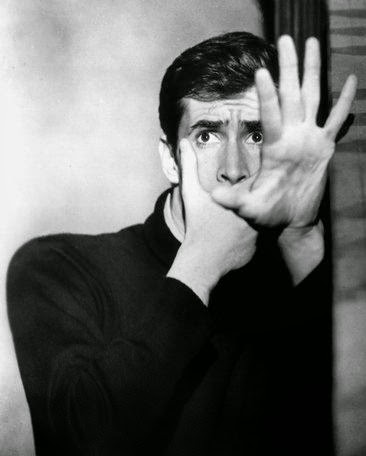
Reaching out for contact (see also the Anthony Perkins photo above)
Towards the end of the book, we encounter him in the form we know at the American Film Institute’s celebration of his life and work held in 1979, not long before his death the following year. The lost little boy is still there, unable to apprehend the love and professional respect being directed towards him. He remains adrift, the world never having truly made sense to him since that night in the police cells when he was confronted with such overwhelming fear and guilt arising from an unknown place, from no identifiable source. The films are phantom emanations, attempts to reach that emotion, to create a sense of commonality through fear and suspense. The adulatory response of the AFI audience is proof that he achieved that. The tragedy is that he is unable to share in that commonality. The depth of his films lies in the perception of the tragedy lying beneath their exciting colourful surfaces (and the nearness of that tragedy to the surface of Vertigo is perhaps why it is so critically revered). Hitch also persisted in asking the questions which Volk has his Jesuit teacher Father Mullins so definitively to answer. In a strange way, he was a religious director.


Volk’s book brilliantly and movingly gives an origin myth to bring light to the ambiguous depths and tragic dimensions of the films, and to restore to Hitchcock his humanity, the wounded and confused pain and compassion at the heart of his work. The critic and playwright David Rudkin wrote, in his TV play Artemis 81, of Hitchcock’s camera being a ‘consecrating eye’, detecting the sacred aspect of his work, the yearning for a transcendent sense of connection, of profound love. This sense of the sacred, of shared fears and desires, is at the heart of Hitchcock’s great post-war work. It’s what has earned him his immortality, and has made such a profound impact on so many people over the years. We can all empathise with these feelings at some level, learn to fall together and find release from our fears. Hitch, forever Fred deep inside, remains outside, watching us with an impassive, unreadable regard, that famous profile a serenely blank mask. Perhaps he’s Buddha after all.

Monday, 25 August 2014

The Spectral Book of Horror


The Spectral Book of Horror is an instantly attractive volume. The cover is graced by a gorgeous painting by Vincent Chong showing two boys and a girl standing against a cracked and peeling wall, illuminated by a sickly yellow light. The girl clutches a standard issue creepy, porcelain-faced doll to her chest, whilst a large, bloodied knife hangs loosely from the hand of one of the boys. They wear animal, skull and Cthulhoid masks, and cast monstrous and devilish shadows, projections of their dark animas. It looks as if they are preparing to enact some ritual invocation, or are taking a break from one which is in progress. An invocation designed to raise those shadowy outlines in bodily form. Can we judge the book by this cover? To a certain extent, yes. It suggests that the terrors within will be of a largely domestic variety, and that whatever supernatural elements are present won’t be made overtly manifest. Rather they will be half-glimpsed, distorted shapes momentarily caught in the periphery of vision, or wraiths suggestively coalescing from the darkness in the farthest corner of the room. There may also be hauntings from the spectres of the intense childhood imagination which are never wholly exorcised, even if they are eclipsed by adult preoccupations. Both of these presumptions prove to be accurate.

The introduction by the collection’s editor, Mark Morris, recalls the days of the Pan, Fontana and Armada paperbacks of the 70s; a halcyon period of plenty for the short story in all the genres of the fantastic. These collections, the Pan Books of Horror Stories in particular, mixed old classics of terror and the supernatural with modern nasties, contes crueles which were sometimes little more than set-ups for gruesome fates, described with lingering relish. The Pan series was edited by Herbert van Thal, a man with a name eminently suited for the task. It looked great on the covers, and conjured an image of a Peter Cushing Van Helsing type, a smoking-jacketed connoisseur of the grim and ghoulish commenting urbanely from his walnut-panelled, book-lined study whilst drawing on an ornately curving pipe. Morris fondly summons up a childhood picture of reading torchlight under the covers on stormy winter nights, a memory which invites smiling nods of collective recognition. It envelops these anthologies in a warm, blurry haze of period nostalgia, and posits them as a strange form of comfort literature. My experience was rather different. The bleached photographic covers disturbed me, particularly the one with the half-buried head the colour of a swede, half-human, half-root vegetable. There were a couple of nasty stories which gave me bad dreams for a good many nights, and which I tried vainly to cleanse from my mind.


Morris seems to have the long-running Pan Books of Horror in mind when voices the hope that the Spectral Book of Horror may be the first in a regular series. Times have changed since van Thal churned out his increasingly tawdry selections, however. Newsagents no longer have revolving wire racks of mass-market paperbacks for people to pick up as casually as the daily paper. The market for short stories has shrunk drastically, spurious notions of value for money leading to ever-more bloated mega-novels, the increased wordage designed chiefly to expand the breadth of the spine and occupy a more prominent proportion of the display shelf. Concision is a largely lost novelistic art, and the short story is an increasingly rarefied and endangered species, protected by a few dedicated conservationists. Gene Wolfe wryly commented on the situation back in 1989 when he actually entitled his latest short story collection Endangered Species. A regular anthology from Spectral Press would by hugely welcome, then.

I think the first Spectral Book of Horror is a bit classier than the Pan books, however. Firstly, there’s that nightmarishly beautiful cover of everyday Lovecraftian terror. True, there are a few stories within which might have taken their festering place within the musty Pan covers. Anecdotal squibs like Tom Fletcher’s Slape, Michael Marshall Smith’s Stolen Kisses and the initial stages of Brian Hodge’s Cures for a Sickened World, which are essentially set-ups for gross pay-offs. All they need is an afterword from a cackling, corpse-faced crypt keeper cracking off-colour quips to complete the feel of an EC comics vignette. The other stories are far more substantial, however, with a refreshing lack of hastily scrawled tableaux of intricately agonising death (or worse). These stories are, dare I say it, more literary. They veer towards what was once defined as dark fantasy in an attempt to distinguish it from the splatter of the more visceral body horror emerging in the 1980s.


The majority of the writers are British, and the settings of their stories largely portray a determinedly de-romanticised view of the country. The stories of M.John Harrison and Robert Aickman, set in the dank, dilapidated no-spaces of unglamorous provincial towns and cities, are a touchpoint here; Harrison’s Egnaro, A Young Man’s Guide to Viriconium, The Incalling and his novel The Course of the Heart in particular. So too is the clammily creepy episode from the Amicus portmanteau film From Beyond the Grave in which Ian Bannern’s frustrated city commuter visits the drab home of ex-serviceman Donald Pleasance, from whom he has been buying matches, and meets his eerie, ghostly daughter (played by Pleasance’s actual daughter, Angela). This certainly came to my mind when reading Helen Marshall’s Funeral Rites, in which a Canadian post-grad student comes to lodge at the dingy Oxford house of the morose Mrs Moreland and her two palled, hostile nieces.


The Spectral Book of Horror is bookended by two well-known and highly respected genre writers, Ramsey Campbell and Stephen Volk. Volk’s novelette Whitstable, an affecting tribute to Peter Cushing in the form of a fictional portrait of the actor in his later years, some time after the death of his beloved wife Helen, was published by Spectral Press to great acclaim last year. There is a judicious mix of well-established writers and new voices (new to me, at least) throughout. I was particularly pleased to read something new by Lisa Tuttle, a writer familiar to me from her superb 1986 collection A Nest of Nightmares, along with subsequent novels and stories. Other familiar names include Robert Shearman (who re-introduced the Daleks to the revamped Doctor Who, and is a particularly fine exponent of the short story), Steve Rasnic Tem, Nicholas Royle (forming a connection with the early days of Interzone, and thereby indirectly with New Worlds, whose experimentalism it initially carried on), Conrad Williams, Michael Marshall Smith and Stephen Laws. But newer or less established writers provide material of equal power and accomplishment here. The Spectral Book of Horror serves a vital (and increasingly rare) function in this respect, providing new stories from familiar names, which will attract the attention of the discerning genre reader, whilst also building a nurturing environment in which a fresh generation of talent can be fostered.

Ramsey Campbell’s story On The Tour opens the collection and to a great extent sets the tone. Its portrait of Stu Stewart, former drummer of Merseybeat also-rans The Scousers, finds Campbell back on home, Liverpudlian territory. Stewart’s is a life eked out on the thin, dusty sustenance of worn and threadbare dreams, confined within the grooves of the record stacked amongst the seldom-browsed LPs of Vin’s Vintage Vinyl, the shop where he works. The mirthless humour of the exchanges he has with his boss Vin, dialogue underscored by indirect power play, together with the sense of a life staged as an increasingly desperate performance for an imaginary audience (the rock nostalgia tour bus which purportedly includes his house on its programmed route) puts this in the absurdist territory of Pinter and Beckett. The horror here is of mental breakdown, of sustaining illusions being dispelled. We are caught unsparingly within the subjective viewpoint of a life and a mind unravelling, following Stu’s steadily accelerating descent. The ironic juxtaposition of this narrative perspective with our comprehension of its increasing illogic and delusory disconnection from the real is reminiscent of the psychological sketches of the inner life Katherine Mansfield drew in her short stories. Campbell’s subtle direction of events towards a point where they go very badly out of control is what pushes this in the realm of horror, although the terrain is not established with any obvious generic markers. The suggestive final paragraph is a classic case of allowing the reader’s imagination to fill in detail, creating manifold horrors from the shadowy substance of their own fears.


Further excursions into the absurd can be found in John Llewellyn Probert’s The Life Inspector, in which the right to continued existence is weighed up according to the hermetic illogic of a relentless and briskly efficient bureaucrat. Nicholas Royle’s This Video Does Not Exist is a self-interrogating story, pitching a surrealist piece of absurdism involving a man who wakes up to find his head is no longer visible in any reflections against real world horrors read about in the papers and seen online and in the news in which people genuinely lose their heads. National and international events mirror each other, and the whole world seems to have descended into absurd drama, staged for a ready audience plugged into diverse media. In the face of this new, terrifying reality in which globalised, digital technology goes hand in hand with barbarous savagery, the main character’s personal crisis of identity comes to seem like an indulgence, and the story ends abruptly with his inner narrative being abandoned. The existential headless man scenario might be seen as typical of Royle’s thematic and stylistic territory, and as such there’s an element of auto-criticism here. I can imagine the story’s initial conceit being inspired by a Magritte painting, just as his novel Saxophone Dreams was inspired by the surrealist paintings of Paul Delvaux. Indeed, Magritte’s painting La Reproduction Interdite (Not to be Reproduced), depicting a man looking in a mirror which reflects the perspective we see of the back of his head, is described in the story, suggesting a probable point of inspiration. It was also used in the 1974 film Un Homme Que Dort (A Man Asleep), based on a short novel by absurdist writer Georges Perec, who also worked on the adaptation. This tale of existential drift and disappearance in Paris has definite affinities with Royle’s work (as well as dovetailing with his cinephile side), and I wouldn’t be surprised if he was familiar with it.

Magritte - La Reproduction Interdite
One of the pleasures of an anthology which has no explicit linking theme or subject lies in creating your own connections. Certain similarities or correspondences reveal themselves, and conspicuous differences in style and approach also become apparent. The subjective realism which Campbell establishes is further explored by a number of writers here. The fear of aging, and the attendant sense of life’s possibilities diminishing - of watching your life slide out of view, as Jarvis Cocker put it – is present in Michael Marshall Smith’s Stolen Kisses, Angela Slatter’s The October Widow, Conrad Williams’ The Devil’s Interval, Nicholas Royle’s This Video Does Not Exist and Steve Rasnic Tem’s The Night Doctor. A number of stories also feature lonely characters who are disconnected from society, for whom the prospect of mental disintegration is an everpresent and very real terror. Nora Higgins, the socially withdrawn protagonist of Helen Marshall’s Funeral Rites, conspires in her own fate, almost welcoming the oblivion of its cold embrace. Cecil Davis, in Angela Slatter’s The October Widow, is an aging, isolated character leading an enervated, bare bones life dedicated with van Helsing purity of purpose to the pursuit of a Pagan seasonal spirit, one of whose sacrificial victims was his son. The central relationship of the protagonist of Conrad Williams’ The Devil’s Interval, an aimless office drifter, is with his guitar, which becomes a dangerously uncontrolled channel for his suppressed emotions and banked up anger. And Ramsey Campbell’s Stu Stewart, trapped in a moment of eternally recycled nostalgia, is another aging loner cut adrift from the here and now.

Family life is another common thread, but few comforts are offered to counterbalance the hollow loneliness and mentally fraying isolation found elsewhere. Instead, it is shown at its most claustrophobic and controlling, swallowing up and absorbing individual identity and endeavour. This is the family of knotty Freudian entanglements, the unspoken subterranean roots dug up and exposed to the withering light. In Gary McMahon’s Dull Fire, the couple tentatively beginning a relationship carry the ghosts of their abusive mother and father with them on their rootless travels. The story contains a sentence which encompasses the generally downbeat tone of the collection, a Philip Marlowe-esque observation that a rundown hotel room is ‘the kind of place lonely suicides might come to end their miserable days’. It is, instead, the place where the protagonists try to start something which will ease their loneliness and misery. Robert Shearman’s Carry Within Some Sliver of Me (a poetic title with echoes of Ray Bradbury and Harlan Ellison) is full-on Freudian horror, describing a monstrous, devouring mother with repulsive literalness. As with McMahon’s story (with its equally monstrous father), the fear (or dull acceptance) of inheritance, of growing into the monstrous parent, is foremost. Monstrous fathers also turn up in Rio Youers’ Outside Heavenly and (to a lesser extent) Stephen Volks’ Newspaper Heart, while Helen Marshall’s Funeral Rites has a monstrous mother-in-law by proxy.

South coast modernism - the De La Warr Pavilion, Bexhill
Alison Moore’s Eastmouth is about being absorbed into someone else’s close-knit family, and the anxiety of the isolated individual over loss of self-identity. The protagonist, Sonia, sees her dreams of a showbiz life wither and fade, reduced to the antediluvian end of the pier attractions of a southern seaside town caught forever in a mid-century stasis. The description of a ‘modernist pre-war building’ suggests that Moore may have had Bexhill in mind. The amazing De la Warr Pavillion, built on the seafront in 1935, is one of England’s finest buildings in the modernist International Style. It’s actually been recently restored to its former glory in a 2005 refurbishment and hosts a fine programme of art exhibitions and concerts. But I know what Moore has in mind – the tattered, dilapidated remains of pre-war utopian dreams. The story contains a sentence which perhaps contains the purest distillation of horror in the whole collection, when the man whom Sonia seems fated to marry boldly declares that Cannon and Ball, who are appearing at the theatre, are his favourite act of all time. She should have run screaming at that point. Moore’s evocation of out of season melancholy and grubby memories of childhood excursions to the seaside exemplify the seedy scenarios of a good many of the stories in the collection. It’s a place where ‘nothing changes’, where you are stared at by ‘dead-eyed gulls’ and the front is weakly illuminated by ‘sunlight the colour of weak urine’. An entropic environment redolent of personal and national inertia and decay. The view of the family as an oppressive, constraining force is here extended to the whole town; a closed community monomind, just a few shambling steps away from agglomerating to become a gesticulating zombie horde. There’s something a little reminiscent of an English variant on Shirley Jackson’s classic short story The Lottery here.

Ironically, the only positive take on the family as a supportive, encouraging unit is offered in Stephen Laws’ Slista; and the family here is monstrous, murderous and possibly not even human. Alison Littlewood’s story The Dog’s Home plays on the reluctant obligations and financial wheedling attendant upon relations with more indirect, spiky branches of the family tree. It’s also one of a number of stories whose first person narrative voice gives a misleading initial impression of balance and reason. Scary Aunt Rose is the dragon of the family, whose thorny harshness is tolerated and indulged in the hope of charming or inheriting a share of her hoarded wealth from her. Her hardness in the face of the family’s penury is contrasted with the unconditional love and loyalty of her dog. This dog becomes the emotional focus in a tale of betrayal and cruelty. Again, it is madness, the loss of rational control, which is seen as the ultimate horror here.


The family stories culminate in Stephen Volk’s Newspaper Heart, the Spectral Book of Horror’s final tale, a powerful piece firmly rooted in a specific time and place (October 1970 in the Welsh Valleys). As he did in his intense scripts for the Afterlife series, Volk unearths the fears inherent in family life, bringing them to life and examining them unflinchingly but with great compassion and empathy. The story is partly a variant on the creepy ventriloquist’s dummy tale, the dummy in this case being a baby-faced bonfire night guy rather than a tux-clad wooden-head with fixed grin and ruddy cheeks. It’s also a descendant of the old changeling folk tales, an acknowledgement of the ancient roots of late October and early November fire festivals. The horror elements here are a way of exploring any number of emotional and psychological subcurrents within the family. Parental anxiety over the child’s safety; the effect of economic depression on a marriage, and of marital drift on a child’s mental stability; the slowly corrosive effects of class-selfconsciousness and division; the thin boundaries between childhood and adulthood, with the marital home compared with the school playground; and a mother’s guilt at the unutterable suspicion that they might not love their child as much as they’re supposed to – or even that they might wish that they’d never had them. The familiar litany of period TV favourites are intoned (Blue Peter with Val, John and Peter, the Vision On gallery music), along with the more conservative end of the pop spectrum (Elvis, Mary Hopkins and Smokey Robinson). But rather than a prompt for nostalgia, these are used more to suggest stultifying routine and narrow limitations. This counter-nostalgia is re-enforced by the simultaneous citation of news stories about Vietnam, Biafra and Northern Ireland. The mention of the Mexico 70 World Cup also summons up retrospective feelings of disappointment, an ‘end of the 60s’ come down. Newspaper Heart demonstrates just how multi-layered and complex the short story form can be, with a dense pattern of allusion, metaphor and symbolism combining to crate potently suggestive and multivalent meanings. Importantly for a horror story, it’s also very scary, with a few of those moments of chill frisson which masters of the supernatural expertly engender. This is undoubtedly one of the highlights of the collection, and I can see why it was chosen as the closing story.

Two authors provide variations on the theme of the performer becoming confused with their signature stage or screen role, either in their own minds or that of their fans. Brian Hodge’s Cures for a Sickened World is a third story of warped and delusory rock dreaming, of the spurious power which its self-mythologisation confers, to add to Ramsey Campbell’s On the Tour and Conrad Williams’ The Devil’s Interval. It begins as a sick revenge on the critic tale, with a snide, destructively negative online reviewer’s hyperbolic figures of speech, used comparatively to delineate what he’d prefer to do rather than listen to the music of a costumed shock metal band called Balrog, taken at face value by its lead singer, Ghast (aka Tomas Lundvall). Cue Saw-like punishments designed s morally corrective lessons. The story develops beyond such limited, mechanical parameters, however, going on to explore notions of moral culpability, the relative nature of evil, the delicate balance between a performer’s stage persona and his or her real self, and the corrupting effect of the urge to use shock-tactics to gain attention in a media-saturated world.

The disjuncture between real and media selves is also the subject of Lisa Tuttle’s alliteratively titled Something Sinister in Sunlight. It features an English actor, Anson, who has become shackled to the role of a serial killer called Cassius Crittender, a character who has become increasingly charismatic as his popularity flourishes, gradually completing the transformation from cold-blooded psychopath to agonised romantic. It’s a moral metamorphosis which many fictional monsters undergo as they become familiar to the point of becoming de-fanged and -clawed. Now it’s the turn of the mythologised serial killer, that very modern monster, to be romanticised, as we have seen in the later Hannibal films and the TV series Dexter; the good serial killer thwarting the bad. Tuttle’s story plays upon this romanticisation and all that it implies – the old connection between sex and death familiar from Freud and French decadent writers and poets. The fact that Cassius’ attraction is mainly felt by women whereas Anson is gay adds another level of play-acting complication between performer, role and obsessive viewer. When Anson accepts an invitation to dinner at a female fan’s house, the tensions which these layers of illusion create come to the surface, with alarming results. Tuttle’s stranding of an English actor in LA in this role is a wry comment on the way that British stage gravitas translates into villainy in Hollywood. There’s another allusion to the weakness of the English sun. But whilst it was a symbol of provincial dullness in Alison Moore’s story Eastmouth, a dim spot from which the main character dreamed of escaping, heading for the bright lights of America, for Anson the opposite is the case. He yearns to return home to his partner, to fly away from limiting fame and from the bleached out light of California to get back to the grey, rain-heavy skies of Blighty. It’s a neat reversal of the more common location of Hollywood as the locus of dreams of escape.

Two stories make play with language to create narrative perspectives removed from the norm. The first person narrative of The Slista by Stephen Laws is written in a phonetic language whose stunted words suggest a devolved version of our world. The basement dwelling family hints at first at a post-apocalyptic scenario, with the simplified spelling similar to that in Russell Hoban’s novel Riddley Walker. But is soon becomes apparent that whoever is speaking in this strange, slurred tongue is part of a group of shadowy wainscot dwellers looking out on the contemporary world from the spaces in between. The Book and the Ring by Reggie Oliver is written in formal Elizabethan English, the language conveying historical antiquity with first person immediacy. It reminded me of the 16th century narrative of David I Masson’s 1965 tale A Two Timer, first published in New Worlds. The Book and the Ring is an M.R.Jamesian tale of ancient books uncovered during scholastic researches in ecclesiastical surrounds which bring to light strange and troubling stories of long-buried occult encounters. The devil which is summoned by the Elizabethan composer Jeremiah Starcky from the usual tome of dangerous lore acquired from a local witch takes the standard passive aggressive Satanic approach of giving human greed, lust and attendant paranoia space to fashion their own irrevocable damnation. It’s a tale told with great gusto, taking particular delight in period cursing and swearing. With its full panoply of witches, devils, books of the damned and souls in mortal supernatural peril, this is one of the most purely pleasurable stories in the collection.

Oliver’s story is atypical in its traditionalism. The Spectral Book of Horror withholds many of the traditional pleasures of the genre. The classic gothic bestiary is extinct here, perhaps because it currently thrives in terrain purists disdain. There are few manifestations of the supernatural or intrusions of the exobiological (ghosts and monsters). And what devils do appear are at least partly demons of the mind. The writers mine the dark caverns of the human spirit for their fears and terrors. Newborn monsters are present at the edges of some tales, however. The torturous, vampiric relationship between rock star and journalistic parasite in Cures for a Sickened World gives birth to a new breed of demon, waiting in the shadows to be fully defined by human appetites. And the title creature of Steve Rasnic Tem’s The Night Doctor is a spectral figure with an inhuman, faceless head and a dark, leathery bag who appears when you are sleeping to offer dubious cures which may ultimately be worse than the illness itself. It’s an embodiment of fears of aging, physical decline and death, either of oneself or of those one loves.

Older forces are summoned up in Angela Slatter’s The October Widow and Rio Youers’ Outside Heavenly. Slatter’s tale is a piece of modern Pagan horror, bringing sesasonal sacrifices into the contemporary world. Inevitably, there are some echoes of The Wicker Man here. Very faint ones, though, perhaps more from its endless citation as a point of comparison. Outside Heavenly is a piece of Midwestern gothic which also incorporates elements of the police procedural. Police Chief John Peck is an inadvertent occult cop, as opposed to the more traditional occult detectives such as Algernon Blackwood’s John Silence and William Hope Hodgson’s Thomas Carnacki. Demonic energies have destroyed a monstrous father with grim thoroughness. The devil here is a wish fulfilling avenger, but one which also represents the psychological (or even spiritual) damage the abused offspring inherits from the abuser, even (or especially) after they are caught and punished. It’s to Youers’ credit that he doesn’t pander to the easy release of the revenge fantasy here. The evidence which the Police Chief eventually uncovers is akin to the folktales of Lucifer over Lancashire – burning hoofprints left in a huge striding trail across the landscape.

This is a fine start for the Spectral Book of Horror. The stories tend towards the darker end of the spectrum, and the moral certainties of older gothic horror forms have totally disappeared. It makes for an uneasy read at times, perhaps even connecting with personal anxieties to disconcerting effect. This is not horror as escapist fantasy, but horror facing the fears and uncertainties of the modern age, and of the modern, embattled psyche. By thus confronting them, we can go some way towards dispelling, or at least controlling them. Let us hope that Mark Morris’ and Spectral’s plans for further volumes come to fruition, and that we are offered further caustic, homeopathic balms for our unconscious terrors.

Friday, 16 December 2011

The Awakening


WARNING: contains spoilers
The Awakening, written by Stephen Volk and Nick Murphy, who also directs, is an English ghost story set in the aftermath of the First World War. Florence Cathcart (Rebecca Hall), a strong-willed and independent modern woman, has taken it upon herself to be the scourge of occult charlatanry and fake spiritualism, exposing the methods of mystification, the table-tapping trickery through which people are fooled into believing that they are once more connected with people who have passed from their lives. She has become something of a minor celebrity, having written a book detailing her investigations which was a great popular success. Having thus gained a widespread reputation as a ghost hunter and demystifying detective, she is hired by a teacher, Robert Mallory (Dominic West), to employ her methods at Rookford, an isolated boys’ boarding school in the north in which he works. The spectral apparition of a boy has been appearing in a succession of school photographs and haunts the night corridors, its presence seemingly leading to the death of one pupil. Florence expects to discover some elaborate schoolboy prank, or sceptic-baiting hoax, and Mallory, in calling upon her services, is also apparently seeking a rational explanation. There are complex currents of repressed emotion running through the school, and she soon finds herself being pulled into their undertow, and finds it difficult to leave or find easy answers to the mystery. When the school breaks up for the holidays, she is left in the great, empty mansion in which the school is housed, with only Mallory, Judd the groundsman (Joseph Mawle), Maud the nurse and housekeeper (played with typical quiet restraint by Imelda Staunton) and one pupil, Tom, for company. As well as whatever else may be present.

The Awakening is a ghost story of self-conscious classicism, with many of the traditional and familiar elements intact. There is an isolated manor house, cheerlessly grey and labyrinthine, with a full compliment of locked rooms and concealed passages and basements; a still, stagnant pool with an old and disused boathouse offering a shadowy, secluded space at its edge; dark woods and twisted rhododhendron thickets bordering the grounds, forbidding places even before night begins to fall; and a journey across bleak and sparsely populated moorland to arrive at the school. It is just the kind of setting in which Florence would expect a supernatural drama to be played out. When we first meet her, she is anonymously taking part in a séance, which unfolds with all the stagy spookiness of old-fashioned cinematic illusion. There is carefully masked illumination to highlight certain actions and direct attention away from others, sepulchral set dressing to evoke a supernatural mood, simple special effects and atmospheric sound, mechanical stage props, and transformative make-up and key lighting to create a suitably cadaverous pallor on the faces of the actors. Florence contemptuously tears open the curtains to throw daylight across the shadowy room, dispelling the otherworldly aura and laying the mechanics of the performance bare. It is as if someone were to slash the cinema screen and stand in front of the projector making mocking hand shadows.

When Florence is invited to Rookford, she anticipates coming across a similarly elaborate theatrical set up, played out on a larger stage. Part of the sense of narrative anticipation lies in the question of how her disbelief will be challenged, and whether it will be worn down. Volk’s script and Murphy’s direction also makes play with the classic ghost story elements, with allusions to various scenes from the relatively few notable cinematic examples of the form. The ball bouncing down the stairs has echoes of similar children’s balls thrown by an invisible hand in Mario Bava’s Kill Baby Kill, Peter Medak’s The Changeling and Nigel Kneale’s TV adaptation of Susan Hill’s The Woman in Black. Pale faces pressed to the windowpane also make an appearance in Charles Gordon Clark’s adaptation of MR James’ Lost Hearts in the Ghost Stories for Christmas sequence, in Jack Clayton’s The Innocents, and again in Kill Baby Kill. A figure suddenly turning to reveal hideously deformed features is something of a horror film staple, and is used (on a regular basis) in John Irvin’s Ghost Story and in The Others. Two minor characters, a couple with the surname of Vandermeer, would also appear to tip the hat to contemporary curators of the weird in literature and other forms, Ann and Jeff Vandermeer. The all-pervasive sense of knowingness, whilst never spilling over into empty parody or pastiche, is given a rationale in the final revelation that the genuine hauntings also have their theatrical aspect. Its part of the humanisation of the spirit world that its inhabitants are allowed to have a playful side, as much as the children who participate in the original ‘fake’ haunting. The smeared, open-mawed and gaping socketed visage which has caused so much terror is in fact the ghostly boy pulling faces. He is playing a role as much as anyone else.

Stephen Volk’s script is in some respects a period version of his TV series Afterlife with the roles reversed. In Afterlife, Alison is a troubled medium who receives messages from the dead and is sometimes able to see them. She becomes an object of study for Robert, a lecturer in psychology, whose treatment of her as an academic case implies a distanced standpoint of objective non-belief, which begins to shade into active hostility as he becomes more personally involved. He is interested in mediumship as a social and psychological phenomenon rather than in any possibility of a spiritual dimension. Florence is like Robert but is more actively hostile to spiritualism and the paranormal, wanting to expose rather than merely document the practices of mediums, and dispel the superstitious belief in hauntings to which they claim to be sensitive. Believing that they are inherently fraudulent and self-serving, she sees them as purveyors of emotionally manipulative exploitation (the view of many censorious souls towards cinema over the years). Not all of those who are saved from such exploitation are necessarily grateful for her interventions. The woman who was the client at the séance subsequently strikes her. The solace offered by the medium, the hope of renewed contact with someone whom she loved, has been abruptly torn away, leaving her with emptiness once more. The film has a prefaratory text explaining the rise in interest and participation in spiritualism in the wake of the huge loss of life in the war, and through the flu pandemic which coincided with its ending. People cling to necessary illusions in order to make life bearable. ‘Humankind cannot bear very much reality’ as TS Eliot put it in The Four Quartets.

The Awakening also resembles Afterlife in its humanisation of the supernatural, of the ghosts which it manifests. Afterlife, in the course of its two series, used its supernatural premise to unflinchingly explore some of the most traumatic and emotionally shattering experiences of life, confronting fundamental fears and universal anxieties, with death in its varied guises being the ultimate unspoken reality underpinning them all. Need, desire, jealousy, hatred, longing and loneliness – the whole panoply of human emotion – are common on both sides of the spiritual divide. The hauntings in Afterlife and The Awakening give form to feelings which are too overwhelming to bear ordinary expression. In The Awakening, this is at least partly the national trauma and benumbed daze of the war’s aftershock. There is an element of the ghost story which dovetails, to a greater or lesser extent, with the detective story. The nature of a haunting, its origins in a particular event or feeling which has yet to find resolution, has to be discovered. When this discovery has been acted upon, the haunting can be brought to an end, the case closed. Both Florence and Alison are psychic detectives in their own way, and both are ultimately working towards a resolution of unspoken traumas in their own childhoods. The confrontation of initially terrifying intrusions into the rational world allows them to face their fears and find an empathic connection with the inhabitants of the world beyond. Fear is dispelled through understanding and compassion. Alison lays ghosts to rest, helping them to move beyond the material world in which they have become temporarily trapped. Florence is dedicated to laying more material spirits to rest, figuratively whipping away the white sheet to reveal the prankster beneath. Both ultimately face their own ghosts in the form of monstrous parents – Alison her terrifyingly manipulative mother, the manner of whose death is designed to create an unbreakable bond; and Florence her murderous father. Human psychology as much as supernatural emanation is at the heart of these hauntings.

Caravaggio's Judith Beheading Holofornes
The 1920s setting allows for an examination of the way in which notions of masculinity and femininity, and the roles of men and women, were changing (at some levels of society, anyway). Florence is very much the embodiment of the new woman, self-confident and assertive in pursuing her own ends. She dresses in mannish clothes, is curt and to the point, unconcerned with any need to appear demure and retiring in speech and manner. She smokes cigarettes, not waiting for someone else to light them, and doesn’t even use a holder! She is the primary protagonist of the story in an active way, not in the passive sense of female characters up until this juncture. With her scepticism and sardonic manner, she exhibits traditionally male traits which complement her dress, and go against the idea of women being more ‘sensitive’, ‘open’, and ‘understanding’ (all of which could be qualities ascribed to Alison in Afterlife). She attracts opprobrium from some people she encounters, just as women were viewed with resentment if they tried to maintain their position in the workforce into which they’d been welcomed during the war. The fear of women’s growing independence is dramatically expressed in the huge painting which hangs above the stairs at Rookford: Caravaggio’s Judith Beheading Holofornes, in which the Jewish heroine is in the process of effortfully cutting off the head of the Assyrian leader, whom she has first seduced. A castration image, Freud would no doubt hastily have concluded. It’s a choice of picture that suggests that the single sex school and the household which preceded it is a hotbed of repressed feeling and sexual anxiety. The groundsman at Rookford, Judd, is portrayed as a weaselly man, impotent and cowardly, an anti-Mellors (the groundskeeper in DH Lawrence’s Lady Chatterley’s Lover). His only way to display his manhood in the face of Florence’s open disdain is to attempt to rape her. Mallory looks like the standard rugged, heroic figure, handsome and a little distant. But he is also vulnerable, his stutter giving him a hesitancy suggestive of a lack of self-assurance. He becomes the object of her gaze when she finds the peephole bored into the wall of the bathroom, and it is only later on that she willingly offers herself to what she believes to be his regard before the same hole. He prises open his old war wounds until they bleed, a modern day fisher king figure whose unhealing wound is connected with the surrounding malaise.

The war is itself seen as a crisis in Victorian and Edwardian ideals of masculinity. Mallory may take his name from the explorer George Mallory, the mountaineer who died during an ascent of Everest – a heroic man who also shared the open sexuality of the Bloomsbury group, having affairs with both men and women. Then again, it could also refer to Enid Blyton’s Mallory Towers books, set in a girls’ boarding school. Judd is a troubling figure. On the one hand, the war is seen as being a prolonged and horrific nightmare, a slaughterground upon which men’s lives were meaninglessly thrown away. It created a new mistrust of the establishment and their motivations and fomented revolution on the continent. On the other hand, Judd, who is cast in an unsympathetic light throughout, is seen as despicable coward (by Florence as much as by anyone else) for having faked injury to escape his fate as expendable cannon fodder. Judd is like Mallory’s shadow self, a manifestation of his fear and loathing, and of his attitude to the war and its aftermath, which remains unspoken. He is representative of the psychological rupture of war, its explosion of meaning and purpose, which are left to lie in rubble and ruin. Judd is always seen outdoors, often in dark, liminal places such as the moorland, the woods or the rhododendron thickets, whereas Mallory is generally to be found within the school building. Mallory’s evident dislike of Judd is first made manifest when the latter is seen up a ladder leaning against the side of the building. It as if he has come to close, pushing up to the boundaries of Mallory’s world. When Judd assaults Florence in the woods, Mallory finds himself mysteriously locked into his room, from which he can only escape to the roof to impotently look out. It’s as if his ignoble, bestial self has been let loose. There’s also a class element to the Mallory/Judd dualism. Judd, like Lawrence’s Mellors, is a working class figure with a pronounced northern accent, and Mallory’s disease with him is partially a reflection of this fact. Mallory’s wartime suffering, horrific through it is, is given a certain noble cast. It’s the suffering immortalised in verse by the likes of Wilfred Owen and Siegfried Sassoon – the sensitive officer class. Judd was supposed to be one of the foot soldiers who died namelessly in the mud, their bodies never to be recovered. That he evades this anonymous fate results in his being held in contempt, not least by Florence, his survival regarded as a negation of his manhood. The malaise of violent masculine authority is traced back to the paternal atrocity which is the singular event lying at the heart of the Rookford hauntings. The roots of this individual tragedy, which has scarred Florence’s life and which she has suppressed for years, are thus linked with the wider international tragedy of war, which has affected her as it has affected everyone, directly or indirectly. Mallory is trying to suppress his memories of the war; his fellow teacher Malcolm McNair, a man with a bitter aspect, may also be haunted by it, his persistent hacking cough perhaps a constant physical reminder of a trench gas attack.

Haunted houses are often repositories of repressed emotion, physical edifices built from unconscious materials. Shirley Jackson’s novel The Haunting of Hill House, and Robert Wise’s adaptation of it as The Haunting is a classic example, with the house itself seeming to possess a malign persona which amplifies and absorbs Eleanor’s self-negating, unassertive character until she is a spectral aspect of its unnatural architecture, a lonely ghost walking its corridors. Similarly, in Nigel Kneale’s TV play The Stone Tape, the bricks of an old building act as a kind of receptor for violent emotion, a storage battery for terror and nameless dread. In The Awakening, the house becomes a metaphorical locale for the attempt to strip Florence of her self-assurance and wordliness, to return her to a pre-war notion of female domestication. Like Eleanor, Florence is confronted with her own underlying anxieties and nagging sense of self-doubt. Her boyfriend, whose offer of marriage, made from the front, she rejected, has died in the war. Her choice of independence is thus shaded with guilt, as if she was somehow, through her rejection, responsible for his death.

A large doll’s house takes on a sinister import as the film progresses, with Florence reluctant to approach too closely and see what’s inside. When she does, she has the ontologically vertiginous experience of seeing a direct representation of what she has experienced, including a figure of a woman peering into a small doll’s house. It seems as if some godgame is being played out, the demiurge of the house toying with her sense of self and her perception of the nature of reality. This vertigo, of the world as she knows it receding rapidly before her eyes, is also experienced by the lakeside, where she loses the keepsake given to her by her dead boyfriend. Gazing into the water, she impulsively rolls in, sinking below the surface. Is it a suicide attempt, or has she been drawn in by some mesmeric force? The metaphor of the doll’s house as representing women’s imprisonment within the domestic sphere was most famously explored by Henrik Ibsen in his play The Doll’s House. Here, it serves a similar purpose, Florence being slowly led towards permanent entrapment within Rookford’s walls. It is partly her discover of an old doll containing a musical box which triggers her memories of what had happened to her as a child in this house. The sounding of the box’s chimes had been what alerted her father, in the midst of a murderous psychotic breakdown, to her hiding place. For him, she was his fragile doll, and with the disruption of his perfect domestic set up, occasioned by his own philandering, he intends to smash everything that was a part of it. The housekeeper, Maud, who was also there in the house during Florence’s childhood, desires to have her two spirit children with her forever, and attempts to poison Florence as she has poisoned herself, so that they will be a spectral family, a permanent aspect of the house. She is expressing, in extreme form, the idea that the woman’s place is in the home. A letter in the January 2012 Sight and Sound, responding to the previous month’s review, pointed to the ambiguity of the film’s ending, in which no-one seems to see Florence as she walks through the school, term now reconvened and the corridors full of bustling activity. We never actually see whether Mallory succeeds in rescuing her, and for a moment wander whether she is actually dead. But there seem to be definite indications to the contrary. For a start, she has regained her confident air, striding in a self-assured way with a smile upon her face. The chaplain, who talks about her without acknowledging her presence, has treated her with distanced disapproval from the start. She leaves the building and gets a cigarette from Mallory, which he lights for her, an acknowledgement of a degree of comfortable dependence. Her indulgence in a material pleasure such as smoking gives us firm assurance that she is still in the land of the living. And her independence is confirmed when she calls for a car to take her away from Rookford – awakened and out in the wide world again.