Showing posts with label Christopher Lee. Show all posts

Wednesday, 11 February 2015

Terror and Wonder: The Gothic Imagination at the British Library

PART TWO


Charles Dickens is the perfect figure to usher us into the Victorian world, and into the dark, narrow and crowded streets of the rapidly expanding, noisily industrial capital. A clip of the recent BBC adaptation of Bleak House, with Gillian Anderson as a ghostly Lady Dedlock, shows us the scene in which Jo the crossing sweeper takes her to the gates of the paupers’ cemetery. The bones lie on the surface in some parts, and Jo remarks of the man she is searching for (known only as ‘Nemo’ at this point) that ‘they put him wery nigh the top. They was obliged to stamp upon it to get it in. I could unkiver it, with my broom, if the gate was open’. He then excitedly points out a rat, which runs into the ground to feast. This depiction of the bodies of the dead protruding from their shallow graves, seen through the eyes of a streetchild for whom it is wholly unremarkable, is a grim Gothic touch which Dickens drew from factual observation. Victorian London was, for many, a Gothic city, but one marked by poverty and squalor rather than elegantly decaying castles and crypts. A staggered pile of booklets on display were a reminder of the part published format of the book, episodically issued in 1852. The public would devour the story in monthly instalments, eager to discover what happened next.

Woman in Black - Gillian Anderson as Lady Dedlock in the BBC adaptation of Bleak House
Gothic had become a flavour or shade which could be added to the kind of multilayered work of which Dickens was a master. It might be associated with a a particular character, plot strand or setting. It was a transferable style which could be employed in a variety of contexts. Dickens wrote a number of ghost stories as well, including The Signalman, an enduring classic of the subgenre, and the collaborative collection The Haunted House, whose framing story (written by Dickens) introducing separate tales anticipates the Amicus portmanteau films of the 1960s and 70s. It was a form which would become increasingly popular as the Victorian period progressed. It was an era much preoccupied with mortality and the memorialisation of the dead. The great necropolises which were built on the outskirts of the rapidly expanding urban centres were themselves like miniature cities of the dead. They would prove ideal Gothic locations, particularly as the years added attractive layers of gentle ruination and ivy entanglement. For Dickens, the Gothic could also encompass an element of social comment or psychological portraiture. The graveyard in Bleak House is disturbing for its exposure of appalling poverty as much as the rat-gnawed bones of the dead. Lady Dedlock drifting blankly through Chesney Wold and Miss Havisham presiding over the cobweb-strewn Satis House in Great Expectations are both spectres prematurely haunting their decaying homes. They are portraits of mental and moral paralysis.


For Dickens, the true Gothic locale was not a remote, ruined abbey or centuries old castle but the dark alleys and dilapidated houses of London. Its gaslit Gothic atmosphere is perfectly captured in the engravings Gustav Doré produced for the book London, A Pilgrimage, a journalistic record of travels through the city which highlighted the huge gulf between the rich and poor. Plates depicting the rookery of Bluegate Fields, the night-time pavement sellers of Harrow Alley in Houndsditch, the ragged wraiths working in the Lambeth gasworks and the mazes of back to back terraces in the sooty shadow of arcing railway viaducts are densely shaded with an almost palpable darkness.


The Gothic followed in the wake of mass migrations from field to factory and relocated to the city. Urban Gothic was formed in the choking fogs of London; fogs like those described in the opening scenes of Bleak House, in which Dickens imagined the possibility of encountering ‘a Megalosaurus, forty feet long or so, waddling like an elephantine lizard up Holborn Hill’. The primeval swamp seeps through into the streets of the modern city. Urban Gothic bred its own monsters and mythologies which were promulgated in the rough pages of the Penny Dreadfuls and Penny Bloods. These episodic works featured sensational cover illustrations which dramatically depicted scenes of horror and bloodshed. Precursors of the EC comics of the 50s, their potential effect on the minds of the masses who read them occasionally troubled the moral guardians of Victoria’s realm. But they generally fell so far below the literary lighthouse beam that they escaped any real censure. The dreadfuls introduced the likes of Varney the Vampire, with his impulsive thirst for blood; Sweeney Todd, the demon barber and fresh meat merchant; and Spring Heeled Jack, a proto-supervillain who could effortlessly leap over the rooftops of London, and who gradually morphed into an enigmatic superhero in the Batman mould. A copy of The Mysteries of London by George WM Reynolds was also on display, explicitly inviting the reader imagine their city as a labyrinth of hidden terrors, lurking and ready to spring. The prolific Reynolds also wrote an early werewolf tale with his 1846-7 series Wagner the Were-Wolf. Some of Dave McKean’s original full-colour illustrations for the Batman story Arkham Asylum were displayed as an example of a modern version of the urban Gothic of the Penny Dreadfuls.

Harry Clarke's illustration for Poe's William Wilson
Edgar Allan Poe was a central (perhaps THE central) figure in mid-19th century Gothic literature, and his morbid sensibility spread like an enervating virus, distilling fever dreams from the unconscious underworld of a motley spectrum of writers and artists, from French Decadents through Edwardian illustrators of children’s books to subversive Surrealists. One of Poe’s letters was on display, allowing us to inspect his neat handwriting and feel a sense of communion with the man who wrote it. Truth to tell, it doesn’t provide a very edifying portrait. Addressed to Fanny Osgood, one of a series of women with whom he became obsessed in his short lifetime, and whose patronage and hospitality he frequently called upon, its fulsome and fawning praise of her literary efforts is embarrassingly transparent in its bid for her favour. Poe’s influence on the late Victorian and Edwardian imagination is clearly visible in the illustrations from various editions of his work. On display here were Edmund Dulac’s plate for The Raven, Harry Clarke’s for William Wilson, Arthur Rackham’s for The Oval Portrait and John Buckland Wright’s woodcut for The Tell-Tale Heart. Presiding over this gloomy Poe corner was the magisterial voice of James Mason, narrating the expressionistic 1953 animated interpretation of The Tell-Tale Heart, with designs by Warner Bros. background artist Paul Julian, who would, appropriately enough, go on to work with Roger Corman. Mason explains his actions in a patient and scrupulously rational manner: ‘it was his eye, yes, that eye. His eye, staring, milky white film. The eye, everywhere in everything. Of course I had to get rid of the eye’.

Aubrey Beardsley's illustration for The Masque of the Red Death
Poe’s work certainly informed the Yellow Book Decadance of the fin de siecle period, the dying days of the Victorian period. A copy of the Yellow Book was on display here. And indeed its cover was an exquisite shade of yellow, an instantly distinctive object to be seen with tucked under your arm, connoting an all-embracing aesthetic worldview. One of Aubrey Beardsley’s Poe illustrations was also on display, a depiction of a scene from The Masque of the Red Death, full of leering, deformed grotesques and limp, opiated beauties. Oscar Wilde’s Picture of Dorian Gray was presented as the emblematic story from this movement, a self-reflexive myth for, and about, its participants. It’s a mythic encapsulation of the cost of the pursuit of excess and all-consuming sensual indulgence cast in Gothic form. The figurative is made manifest and hidden away in the attic. Wilde was the public spokesman for the Aesthetic movement (French-style Decadence in all but name). His elegant dandyism and elevation of the passing witticism into an exquisitely crafted artform promoted the idea of art as an all-encompassing worldview, affecting mannerisms and modes of dress as much as any actual creative artefact which might be produced in time remaining. This was a philosophy which would resonate throughout the 20th century, finding expression in the theatricality of latter day Goths as well as the self-reflective (or obsessed) art of the likes of Gilbert and George and a number of the YBAs. Indeed, there were some works by the Chapman Brothers later in the exhibition. Wilde’s own penchant for the Gothic, as well as his conflation of life and art, were displayed in the calling cards he had printed after he emerged from Reading Gaol. He cloaked himself in the pseudonym Sebastian Melmoth, adopted from Charles Maturin’s 1820 novel Melmoth the Wanderer. Wilde thereby cast himself as the cursed exile who had made an ill-advised pact with the Devil and is now fated to tread a lonely, immortal path through the world.

Richard Mansfield as Jekyll...and Hyde
Another key work of the late Victorian period was Robert Louis Stevenson’s Strange Case of Dr Jekyll and Mr Hyde, originally published in 1886 as a Shilling Shocker (a complete work as opposed to the Penny Dreadful’s serialisations – hence the slightly inflated price and altered alliteration). Stevenson’s story is a subtly suggestive study of the duality inherent in the human psyche, its terrors remaining relatively subdued. It was the hugely successful theatrical production of 1887, written by JR Sullivan and starring Richard Mansfield in the twinned title role(s), which changed the tone of the story, and set the pattern for future adaptations. The bifurcation into ‘good’ and ‘evil’ selves, or rather selves which suppressed the desire for sensual pleasure and gave it full, destructive reign. Jekyll and Hyde became another myth of fin-de-siecle Decadence, a companion piece to The Picture of Dorian Gray. Richard Mansfield’s performance was particularly noted for its remarkable transformation scene, aided by theatrical lighting and make-up. A photograph displayed here gives us an idea of the thrills which the Victorian theatregoers would have experienced. Using the developing room magic or double exposure, we see the upright Dr Jekyll, face a saintly picture of benevolent intentions, transformed into the hunched, bestial figure of Hyde, hands clawed and poised to grab whatever they can grab a hold of. Hyde really does appear to be a shadow self in this photograph, a parthenogenetic homunculus tearing itself free from its noble progenitor.


The theatrical production of Jekyll and Hyde, which Stevenson professed to hate, was running at the time that the Jack the Ripper murders began to impinge on the public consciousness in 1888. The two became superimposed in the minds of many, Jack and Edward Hyde becoming mirrored selves. Theatrical fiction and factual speculation percolated together to form the beginnings of the potent myth which distilled the dark essence of late Victorian London. The city of terrible night, its narrow Whitechapel streets filled with the stench of poverty and despair. One of the most startling exhibits was a work of fiction purporting to be fact; another example of the fakery which seems to play such a prominent part in the history of Gothic (and which lives on in ‘found footage’ horror movies). A letter written in red ink boasting of murderous exploits and promising more horrors to come is signed Yours Truly Jack the Ripper (‘Don’t mind me giving the trade name’). Undoubtedly a hoax, it has nevertheless accumulated a certain amount of legendary cachet, being the first of a welter of such fevered missives, stoked by sensationalist newspaper reportage. Alan Moore, in his kaleidoscopic Ripper epic From Hell, has two journalists from the Daily Star compose the letter in a Wapping flat, giving the public a fiend whose luridly outlined exploits they can gorge themselves on (in the page of The Star, of course).


Robert Bloch’s story Yours Truly, Jack the Ripper draws on the letter’s signature, and imagines Jack as an immortal who surfaces in various eras to commit his ritualistic killings, which serve to keep him alive. The subsequent pairing in Harlan Ellison’s 1967 Dangerous Visions anthology of Bloch’s A Toy for Juliette and Ellison’s own A Prowler In the City At the Edge of the World takes as its basis the way in which ‘Jack’ was transformed into an almost supernatural figure, an elusive trickster constantly eluding his pursuers with mocking ease. He was an inheritor of the powers of Spring Heeled Jack, and a precursor of the regrettable archetype of the superhuman serial killer in modern culture. Harlan Ellison reduces him to a pathetic puppet of greater, more debased forces at the end of his story, a conclusion which has considerable moral and allegorical force, and once more addresses the role of the media in creating and feeding an appetite for such atrocities.

Laird Cregar in the 1944 version of The Lodger
The Ripper murders, as filtered through Jekyll and Hyde and proto-tabloid journalism, gave rise to Belloc Lowndes’ 1911 novel The Lodger. The entrance of Ivor Novello’s titular character in Alfred Hitchcock’s 1926 film version, face disguised beneath the mummifying wrap of a scarf , ragged wisps of illuminated fog dissipating behind him, is an electrifying expressionistic rendering of the mystery and fear fuelling the ever-expanding Ripper mythos. Actually, the 1944 version of The Lodger, with a mesmerising performance by Laird Cregar at its heart, better evokes the social gulfs within Victorian society which the Ripper murders so horrifically exposed. It’s also interesting to note the narrowing gap between literary source and cinematic adaptation. Only 38 years separate The Lodger from the Ripper murders and Richard Mansfield’s theatrical transformation into Hyde (and 32 from the 1920 John Barrymore film), the cinema from the music hall, the gas lamp from the electric light, the horse drawn Hackney cab from the motor car. They really do seem worlds apart.
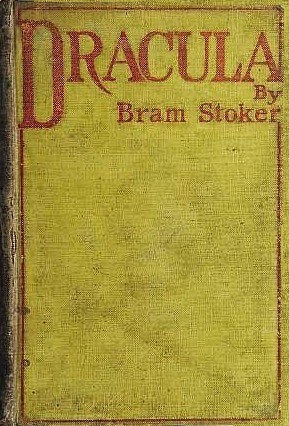
First edition of Dracula in fin-de-siecle yellow book covers
The final work from the late Victorian period explored here is of such moment that it merited a whole room to itself. The visitor was obliged to make a detour from their natural winding progression through the exhibition’s dimly lit corridors, turning into this sealed off sepulchre which immediately felt like a sacred space. Indeed, so caught up was I in the cultural current leading me eagerly on from one thematic display to another that it wasn’t until I’d reached the end and exited into the light of the British Library’s lofty atrium that I paused and thought ‘hang on, there was something missing there’. Retracing my steps, I discovered the hidden sanctum which I’d initially passed by. The book in question is, of course, Bram Stoker’s Dracula, first published in 1897. Its influence on the horror genre and on popular culture in general is pervasive and profound, and anything in this compacted space could offer a partial survey at best. The literary exhibits were particularly fascinating. There was a pleasing congruity to the inclusion of some of the books which Stoker consulted in the British Library whilst researching the background of his story. Perhaps some of them were even the same copies.

Of particular significance was a book written by William Wilkinson, Esq., ‘Late British Consul Resident at Bukarest’, which blended colonial memoir, history lesson and traveller’s tales, and was given the fustily prosaic title An Account of the Principalities of Wallachia and Moldovia: With Various Political Observations Relating to Them. Stoker initially read this not at the British Library but in the subscription library in Whitby, the seaside town on the Yorkshire coast where he was staying for his summer holidays in 1890. The historical passages make reference to King Ladislas of Hungary forming an alliance with the Wallachian Voivode Dracula in 1444 to fight the Turks. It was in Whitby, therefore, that Stoker found the name for his vampire lord, although he would transform him from a prince (voivode) into a count. There was no such noble rank in Wallachia in the 15th century, but the baleful influence of Lord Byron together with the antics of his acolytes on the European continent had created an indelible impression. Vampires and Gothic villains in general had become strongly associated with dissipated Western European aristocrats.

The illustration included in the 1901 edition of Dracula
Stoker followed the established convention by ennobling his title character, even though he envisaged him as a stout military figure with a thick Central Eastern European moustache. This explicitly described appearance (roughly reproduced in the illustration in 1901 edition) would seldom be acknowledged in subsequent adaptations. Wilkinson also notes that Dracula in the Wallachian language means Devil. This could connote evil, although it could also use refer to the folk devil as a trickster figure. As such, it could be used in a complimentary sense as a badge of bravery or ingenuity in warfare or matters of state. Wallachia was also entirely separate from Transylvania, but such cavils are irrelevant. Dracula is not a historical novel, and the local colour and geographical detail Stoker derived from Wilkinson’s book and other accounts of the area provided a richly mysterious and haunted backdrop for Jonathan Harker’s arduous journey to Dracula’s castle and the final pursuit through the Transylvanian landscape. The mountainous and thickly forested world which he conjured up from his reading room travels was shrouded in fogs of superstition and venerable custom. Journeying there was akin to falling back in time to a pre-industrial era, leaving behind the nascent modernity of the late Victorian period in which electric lighting was already beginning to banish the shadows and returning to the Middle Ages. It was a reiteration of the Gothic’s abiding delight in resurrecting the spectres of primitive (and imaginary) histories which contrasted with the comforts of the present.


The demons of Lewtrenchard
Another book which Stoker consulted, Charles Boner’s Transylvania: Its Products and its People, contained fold-out maps (one of which was spread out here) which facilitated imaginary exploration, mental expeditions into the Carpathian Mountains via the Borgo Pass. Also on display was the Reverend Sabine Baring-Gould’s The Book of Were-Wolves, a collection of legend and lore which provided the inspiration for the wolves Dracula heralds as ‘the children of night’, and for his own transformation into a great hound which leaps onto the shore of Whitby from the deck of the wrecked Demeter. Baring-Gould was the parson of Lewtrenchard church, nestled in the shady valleys west of Dartmoor. In addition to collecting local folklore and folk music, he was a dedicated antiquarian, endeavouring to save the church furnishings and decorations of the Gothic period which other Victorian clergymen were busy discarding and destroying. His small church is a treasure house packed with objects rescued from diverse parts, restored and refitted. And hidden on the side of the pulpit facing the east wall are a pair of grinning demons carved from wood by the Pinwill sisters, Esther and Violet, in imitation of medieval originals. They would certainly not have looked out of place in Dracula’s castle.


More demons lodging in Lewtrenchard - call for the Rev. Sabine-Gould, demon hunter
Also included here was a manuscript Stoker wrote for a theatrical version of his novel. Scrappily assembled, with passages cut and pasted from the printed page, this was evidently dashed off with great haste. It was an exercise to establish theatrical copyright and prevent others from hijacking his ideas, distorting them and profiting from the thinly veiled results. Perhaps he had the success of JR Sullivan and Richard Mansfield’s Jekyll and Hyde in mind. It also suggested that Stoker was highly conscious of the fact that Dracula was a work which had the potential for broad popular appeal. The script formed the basis for a theatrical reading at the Lyceum Theatre in 1897, staged concurrently with the novel’s publication. Present in the select audience was Henry Irving, the actor-manager for whom Stoker acted as personal assistant and factotum in all things. Irving was an imposing figure, an archetypally demanding and egotistic theatrical, and a dominant force in Stoker’s life, source of both reverence and fear. Some have claimed him as a model for Dracula. Its certainly likely that some of his characteristics found there way into the portrayal of the commanding count. His approval or even mild encouragement was vital for Stoker; but all he received after the show was brusque brush-off. The self-absorbed Irving had no time to dispense the words of praise he demanded and required for himself.


Projected onto the back room of the Dracula room were scenes from the finale of FW Murnau’s 1922 film Nosferatu, expressionist shadows taking on a life of their own, extending grasping claws ahead of the rodent-toothed creature casting them. Stoker’s worries about the unauthorised appropriation of his material seems to have been justified, since the German company who produced the picture, Prana Films, had made no effort to seek approval for their adaptation. The widowed Florence Stoker’s attempts to gain recompense merely resulted in the company going bust. In order to discourage further such incidences, she managed to get a court order requiring all copies to be destroyed. Fortunately, this celluloid auto-da-fé wasn’t altogether thorough in its execution, and surviving prints resurfaced in later years. As a result, we can still enjoy what has become established as an enduring classic of German expressionism and cinematic Gothic. Stoker’s character and vampiric lore would soon spread with the exponential infectiousness of a blood-borne virus, putting it well beyond any possibility of containment.

The exhibits here briefly sampled the cultural shadow cast by Dracula over the long decades of the 20th century. His looming presence was in some ways a counter-reaction to the forces of modernism and rapid technological progress; a renewed example of the Gothic finding inspiration and escape in a time of social transformation through the resurrection of the past. The character as Stoker envisaged him was eager to embrace the possibilities afforded by new technologies and economic channels. That was the reason for his move to England. But this is one of a number of the novel’s aspects (including his Eastern European military bearing) which have been abandoned in successive cinematic incarnations. Christopher Lee’s repeated pleas to the Hammer hierarchy to return to the book as a direct source fell on deaf ears.

Vampire - Edvard Munch
The female vampire had already found its way into the broader European literary and artistic stream as a symbolic character. In Baudelaire’s poem The Vampire it stands as a very French metaphor for the destructive nature of love, and the fear of the devouring woman. It was also a stock pre-Freudian fever dream figure in Symbolist art, an image to set alongside the many personifications of Death in chill Nordic and Baltic landscapes. Edvard Munch’s Vampire, aka Love and Pain (1894), could almost be an illustration for Baudelaire’s bitterly misogynistic poem. Rudyard Kipling’s poem The Vampire was a rather surprising inclusion in the exhibition, serving as a representation of these literary adoptions, and another version of the vampire as belle dame sans merci. Appropriately enough, it was written in 1897, the year of Dracula’s publication. He’s certainly not somebody you’d associate with such Decadent company. But then he’s a writer to whom many misconceptions have become attached over the years. The printed poem was accompanied by an illustration by Philip ‘son of Sir Edward’ Burne-Jones, an explicitly erotic tableau which bears some relation to Fuseli’s Nightmare. It was this image which gave birth to the poem in Kipling’s imagination, an example of visual art exerting a direct influence upon literature.


Edward Gorey’s Dracula toy theatre brought his mordant drawings to marvellous pop-up life, and demonstrated the broadening appeal of the whole mythos. The sets are actually models for the stage designs he produced for the 1977 Broadway production of Dracula. His lugubriously amusing figures prove eminently suitable to the novel’s characters and scenarios. A slight element of mockery is appropriate given their familiarity at this stage, but is obviated by the beauty and care with which they are drawn. And his Dracula has a moustache! A lovely artefact for Gothic children to exercise their morbid imaginations upon – the cardboard Lucy Westenra’s head can easily be stuck back on with sellotape.


It’s but a few short steps from here to Sesame Street’s delightfully numerate Count, the vegetarian vampire duck of Cosgrove-Hall’s Count Duckula and the vampire grandpas and uncles-next-door of The Munsters and Alan Moore’s Bojeffries Saga The latter features the wonderfully weird Uncle Festus Zlüdotny, whose spluttered speech-bubble utterances are rendered in the undecipherable symbols of a mysterious yet somehow inherently violent alphabet. A vampire slaying kit, with tools and substances covering most recommended means of undead extermination, was on display in its own standalone cabinet, its components housed in a neatly portable valise whose compartments concertinaed out with ingenious pragmatism. It had no apparent provenance, and its presence was therefore rather anomalous, but fun nevertheless.

Christopher Lee endures the Scars of Dracula
A design for Frank Langella’s Count in John Badham’s 1979 film of Dracula suggested future developments of the character, and of the vampire in general, as a romantic figure. The animalistic bloodsucking and viral furtherance of the undead plague were increasingly relegated to the background, incidental details eclipsed by the old fashioned seductions of the irresistible Heathcliff anti-hero. Alas, there was nothing here to match the display of Christopher Lee’s Dracula: Prince of Darkness costume in the BFI’s Gothic display a couple of years ago. Hammer was represented (and represented it simply HAD to be, of course) by more of Scott MacGregor’s set designs, this time for Scars of Dracula. Indisputably the nadir of Hammer’s Dracula cycle, and quite possibly of its Gothic output at large, the designs indicate just how far the studio (and director Roy Ward Baker) was prepared to go in its determination to keep up with contemporary trends and add new elements of explicit gore. In the bedroom set, a bloody corpse sprawls across the four-poster, severed body parts scattered to the side along with the saws and knives which have been used in this clumsy dissection. The echoes of the grim finale of Witchfinder General are all too evident. Perhaps thankfully, this scenario was never realised in the completed film. Christopher Lee’s Dracula merely leaps into the chamber and stabs Anoushka Hempel’s vampire seductress with a knife whose rubbery flexibility is all too plain. It’s a gratuitous scene which is as risible as it is illogical and inexplicable. MacGregor’s set for the castle roof is an atmospheric Gothic arena, a stage for dramatic confrontations. Sadly, the final realisation fell far short of his vision, the greatly reduced budgets of the 60s and 70s more than usually evident.

As with Frankenstein, Dracula made it through to the vinyl age too. Displayed here was the cover of the Studio2Stereo LP Dracula with Christopher Lee, a compilation of Hammer soundtracks. A real treat, this one, with James Bernard’s stirring score for the original Hammer Dracula set in context by Lee’s narration. It also features cues from Bernard’s score for She, as well as contemporary composer John McCabe’s music for the 1972 psycho-thriller Fear in the Night, Harry Robinson’s lushly romantic themes from The Vampire Lovers and extracts from David Whittaker’s score for the stylish Dr Jekyll and Sister Hyde, wittily scripted by the late Brian Clemens. The 70s provenance of the LP was clear from its use of a promo still from Dracula AD 1972 on the cover, Christopher Lee tucking into the jugular of poor old Caroline Munro.

Leaving the Dracula room, we also take our leave of the 19th century, and enter a new era in which the medium of cinema, with its large, darkened palaces, would prove a perfect site for the expansion of the shadow worlds of the Gothic. But those shadows often originated and drew their raw sustenance from the archetypal monsters, human and otherwise, which emerged from the gaslight illuminated fogs of the Victorian imagination.

Saturday, 3 September 2011

Dracula AD1972


Hammer tended to locate Christopher Lee’s Dracula in some vaguely defined nineteenth century mittel-Europe, which road signs or directions given to harried coach drivers would place as being near a Germanic sounding town called Karlstadt. Truth to tell, the fearful peasantry tended to sound more West Country than Westphalia, and the heathland and beech woods were hardly the Black Forest, but the notion was there. The Count did make it to Victorian England in Taste the Blood of Dracula, carried in dessicated form by Roy Kinnear’s unwitting salesman and unleashed by Ralph Bates’ fin de siecle seeker after new and undreamed of heights of decadent sensation. But he immediately retreated to the ancestral castle for the woeful Scars of Dracula, a low point in the studio’s output which makes such derided efforts as Prehistoric Women and The Viking Queen seem like minor masterpieces in comparison (they’re certainly a great deal more entertaining). The general weariness displayed by all involved, and the desperate resort to liberal lashings of tawdry gore must have occasioned a rethink, and the obvious way to refresh the Count was to introduce him into a contemporary setting. In the aftermath of the social upheavals of the 60s, the implications of which were working themselves out as the new decade progressed, a rural European setting in thrall to the feudal class divisions of a previous century no longer had much resonance for a popular audience. Michael Reeves’ 1968 film Witchfinder General had set a new standard for the representation of a particularised English past of squalid rural brutality which made Hammer’s fairy tale locales seem even further removed from the times. It was time for Dracula to come down from his castle. This was, after all, what he had done in Bram Stoker’s novel, making arrangements to move to London in order to take full advantage of the steam-driven technologies and gas-lit rookeries of the modern late-Victorian metropolis.

Gothic standoff - Van Helsing and the Count meet again
The title Dracula AD 1972 foregrounds this move to the modern era, but the opening of the film eases us towards such jarring modernity with a fatal struggle to the death between the Count and his arch-nemesis Van Helsing atop a careening carriage a hundred years earlier. This nod towards an Anglicised version of the Western convention of the assault on a speeding stagecoach, an extended version of which was played out towards the climax of Tim Burton’s Hammer homage Sleepy Hollow, is an indication of the generic elements which will be added to the usual gothic mix in this film and its follow up, The Satanic Rites of Dracula. The writer of both, Don Houghton, had already displayed his propensity for such miscegenation with his two Jon Pertwee Doctor Who scripts, Inferno and The Mind of Evil, which used plot structures borrowed from the disaster movie and the Cold War thriller, and he was later to create a self-reflexive country house murder mystery within which to house the strange metaphysics and surreal internal logic of the Sapphire and Steel universe. The Count’s meagre remains, which we have seen in previous films are more than enough to effect a resurrection, are buried beyond the pale of the graveyard where Van Helsing is interred. There is a definite sense that these adversaries need each other. They are the twin poles of a Manichean worldview, each defined by the other’s opposition. The resumption of this eternal struggle will almost be a relief to them as they find themselves adrift in the rapidly shifting social milieu of the 70s.

Gothic script on modern skies
The shock of the new is rather neatly conveyed by a camera pan away from a close-up on Van Helsing’s tombstone, which reveals that it is now surrounded by the encroaching rubble of demolition in preparation for subsequent redevelopment in the 70s style. And that means concrete. From the bird song in the rural Victorian graveyard where we have just witnessed the dual interment, the camera pans upwards to witness a jet plane roar overhead. It is a century-bridging cut which directly echoes a similar effect in Powell and Pressburger’s A Canterbury Tale, where the hawk sent gyring into the air by one of Chaucer’s pilgrims is transformed into a spitfire as we are shifted into the modern Kentish countryside of the Second World War. Director Alan Gibson gives us some sweeping wide-angle lens panoramas, a technique of which he seems quite keen, to give an impression of this disorienting new world. Concrete overpasses spanning busy roads (the Westway), the dizzying heights of steel and glass office blocks, and traffic choked London streets. It is little wonder that Dracula, once reincarnated, opts to stay in his small oasis of Victorian gothic revival. Remember, this was the era in which British Rail wanted to demolish the Gothic railway temple of St Pancras, presumably to make way for something along the lines of the brutalist civic centre now facing it in an architectural version of a Sergio Leone standoff. The seeming irony of the Count taking refuge in a church, albeit a deconsecrated one, perhaps taps into a deeper sense that such figures of darkness can only have a meaningful existence in a world in which faith is still central. Van Helsing similarly takes refuge amongst the Victorian furnishings of his book-lined study, a scholar’s retreat which his granddaughter Jessica likens to a mausoleum. So is this really an analysis of the soul’s desolation, the isolation of the individual in the shadow of God’s absence from the world, in the manner of Bergman’s Winter Light? Er, not really, no. But it does reflect the wilful demolition of the past and the values which it embodied which was being carried out at the time. Many have seen the confinement of Dracula within St Botolph’s church as a failure of nerve, but I find it entirely appropriate for the period. A crisis of faith, be it cultural or religious, is a threat to sacred monsters and sacred architecture alike.

Bad boy Johnny
The Count’s servant seems to have changed little over the century, save in his foppish fashions and modish hairstyle, but we must assume that he is a direct descendant in the same way that Peter Cushing’s strangely named Lorrimer Van Helsing is the grandson of the original vampire hunter. The book ‘The House of Horror’, an official version of the Hammer story, was to be issued the following year by Lorrimer Publishing, which explains such peculiar nomenclature. Is there a genetically inherited component to evil henchmanhood being hinted at here? The name Johnny Alucard is a bit of a giveway, and it doesn’t fill us with confidence in his mental acuity that Van Helsing needs to painstakingly doodle an acrostic in order to figure it out. It also reminds us of other ‘hipster’ characters such as John Cassavetes’ jazz playing Private Eye of the nightclub world, Johnny Stacatto. Indeed, the name would seem to be more suggestive of a beatnik milieu, and it seems at times as if Houghton is drawing more on memories of this era (or the films which embodied it) for his view of youth cool. This would explain the inexplicable enthusiasm which Marsha Hunt evinces for a ‘jazz spectacular’ at the Royal Albert Hall. The Mahavishnu Orchestra, maybe? Johnny is at the centre of a ‘hip’ Chelsea set which is first seen ‘freaking out’ the squares in a posh Kensington pad. These unfortunates have their house invaded by the happening sounds of Stoneground, who churn out uninspired grooves of lumpen heaviosity in the backgound. It was to have been The Faces, but alas, the ‘Ground had a pre-existing contract with the distributors, Warner Bros., so the services of Rod and the boys were not called upon.

Johnny with Caroline Munro
The opening party scene demonstrates the level of authenticity we can expect in the depiction of contemporary youth culture; it is more convincing than the hippy festival at the end of Carry on Camping, but only marginally so. The dialogue is the big let down of the film. Its risibility obscures the fact that there are some interesting ideas at play elsewhere. It’s perfectly possible that the whole thing is intended to be satirical, in which case we are laughing along with the script rather than at it. The babbling inanities of the supremely irritating ‘comical’ member of the cool inner circle would certainly mark him out for imminent death in any horror film made ten years on, particularly given his penchant for practical jokes of the leaping out from behind a gravestone variety. Why he chooses to dress in a monk’s robe is anyone’s guess. Caroline Munro’s pogoing dance moves exude an infectious enthusiasm, however. Munro, whose first significant film role this was (playing the exquisite corpse of Vincent Price’s wife in The Abominable Dr Phibes wasn’t much of a stretch) went on to become something of a fantasy film favourite in the 70s, appearing in such timelessly entertaining fare as Captain Kronos: Vampire Hunter, At the Earth’s Core and The Golden Voyage of Sinbad, becoming a Bond villainess in The Spy Who Loved Me before disappearing along with the rest of the British film industry. It was great to see her lending her support to the Classic Horror Campaign recently. She was always very courteous and considerate to her fans, and is clearly a good egg of the first order. Adam Ant payed tribute to her iconic status (as he had already done with Diana Dors) by casting her in his video for Goody Two Shoes. Stephanie Beacham, as Van Helsing’s granddaughter Jessica, diplays a splendid example of a feathercut hairstyle, bested in 70s film only by Jane Fonda in Klute, and sports a variety of purple clothing on her way to 80s Dynasic soap queendom. She also starred in Hammer rivals Amicus’ period gothic And Now the Screaming Starts, in which she was menaced by an ambulatory disembodied hand which, given its extremely sluggish nature (the mechanics were a bit ropey, apparently) tended to rely on the element of surprise. Marsha Hunt arrives fresh from inspiring The Rolling Stones hit Brown Sugar, having had a daughter with Mick Jagger in 1970. She went on to have a small part in the little-loved (I like it) concluding film of Lindsay Anderson’s Travis trilogy, Britannia Hospital, by which time the planet-sized afro is long gone.

Caroline freaks out to the White Noise
If the execrable dialogue can be enjoyed in its own right, the same can probably not be said for Michael Vickers’ intrusive, heavy-handed score, with its endlessly repeated horn riff and flailing guitar mangling. For this they ditched the reliable services of long-running Hammer composer James Bernard? Much more impressive is the electronic music used to accompany the black mass scene, played by Johnny on his ‘portable’ reel to reel recorder. Appropriately enough it’s a track called Black Mass (subtitled An Electric Storm in Hell) from the 1969 Electric Storm LP by White Noise, which was a rather atypical release for Island Records. White Noise were a temporary studio union of young technical wizard David Vorhaus and Unit Delta Plus, better known as BBC Radiophonic workshop legends Delia Derbyshire, who also provided electronic sounds for the 1973 film The Legend of Hell House, and Brian Hodgson. The music is a genuinely disturbing blend of distorted vocals, musique concrete screams and electronically processed drum sounds, and it builds the ritual to a pitch of hysteria climaxing in Dracula’s resurrection. It demonstrates what a vital role a good soundtrack can be in helping to create an evocative atmosphere. Not even Johnny’s lame invitation to ‘dig the music, kids’ can entirely dispel its power.

Peter and Stephanie - the Van Helsings
Whilst no classic, Dracula AD72 is really much better than its lowly reputation would give it credit for. Peter Cushing gives his usual sterling and committed performance, and displays a touching tenderness in his scenes with Beacham. Their relationship, with its inter-generational conflict giving way to genuine affection, feels far more authentic than anything within the groovy swinging set, and the scenes in which the two are together begin to give us the sense that these are real people. Van Helsing doesn’t play the disapproving elder, either, at no point expressing prim disapproval of Jessica’s lifestyle. The contemporary setting allows Cushing to indulge in his chain-smoking habit, and he is able to bring an absolute conviction to such exchanges as: ‘let’s just hope you’re wrong about this whole business’…‘I wish I was, Inspector. I wish to God I was’. Christopher Lee lends his usual looming presence, and although he doesn’t have a lot to do other than smoulder and glower and sweep his cloak (he doesn’t even turn up until about half way through) he does all of these things splendidly. When he does get to engage in a bit of action in the duels with Van Helsing(s) which bracket the film, the scenes have a real, thrilling physicality which harks back to the climax of the original 1958 Hammer Dracula. There is an intriguing homoerotic undertow to the film, as Alucard pleads with his anagrammatic master to be bitten and exposes himself with a look of expectant ecstasy. Lee approaches with a grimace of distaste, and the camera shies away from the actual bite (the vampire’s kiss) but Alucard attains the ‘power’ he craves and proceeds to pass it on to Jessica’s boyfriend, whilst the women are simply led to Dracula to be drained and discarded. The film dwells on the banality of everyday, kitchen sink environs, such as the car wash in which Jessica and her boyfriend talk, and the night-time launderette outside of which Johnny trawls for victims. New gothic locations are also put forward, such as the Cavern, a subterranean club space in which the usual elements connoting neglected antiquity such as cobwebs and cracked stonework are now self-conscious props. This being a late period entry in the Hammer Dracula cycle, the methods of despatching vampires are becoming correspondingly baroque, and there is a nice bit of business in which the elements of a morning wake-up routine, the shaving mirror and the shower, are used to deadly effect. But of course, a film which proudly displays the year of its making in the title will always offer the pleasures of period detail. Look, there’s the number 19 to Finsbury Park, a Routemaster yet! And there’s Battersea Power Station, still belching out smoke and yet to be a Pink Floyd cover! And there’s some vintage Chelsea and West Ham graffiti, although the fact that they are placed neatly one above the other with no sign of erasure, and are daubed in a similar hand suggests that the art department was at work in this case (I hope they had permission). Really, this is just a film to sit back and unashamedly enjoy. So, take Jessica Van Helsing’s advice, relax and indulge in ‘a quiet bit of mindblowing’.

Christopher commands


Reposted from From Out of the Shadows

Friday, 11 February 2011

The Gorgon


The Gorgon, released in 1964, is something of a hidden gem amongst Hammer’s gothic oeuvre. When it is mentioned it is usually in dismissive terms, deriding the appearance of the titular monster as being a bathetic let down, and criticising the ponderous pace of the film. This seems an unduly harsh appraisal. It’s a fine mood piece, with Terence Fisher’s expressionistic use of vivid colour reaching new, Douglas Sirk-like heights. It also gives a central role to Barbara Shelley, possibly the finest of Hammer’s female actors, who delivers an excellent performance, full of subtle restraint. It’s a film rich in implication and metaphor, with as much suggested as directly revealed, which is perhaps one reason why its reception has always been a little muted. The poster can’t have helped, either, with its garish promise of a new and terrifying monster which is only ever peripherally present. Peter Cushing and Christopher Lee are both on top form, the latter relishing the opportunity to play the bluff, scholarly hero turned man of action, who strides in towards the end of the film to sort the whole sorry mess out. John Gilling’s collaboratively produced script is also a brave attempt to introduce a new element to the Hammer formula, drawing from sources beyond the usual 19th and 20th century literary perennials. The disparity between the creature from classical mythology and the gothic trappings into which it is set is in itself striking, and implies a connection with ancient civilisations whose gods have yet wholly to have passed out of the world.

Romantic landscapes - cottage in the valley
The action takes place in the customary Hammer mittel-European setting, this time a woodland village which goes by the name of Vandorf. It’s an insular, unfriendly village, its inhabitants paralysed by fear and quick to fall into an aggressive defensiveness. Outsiders are left in no doubt as to how unwelcome they are, in the official capacity of Patrick Troughton’s steely Inspector Kanof if need be. One such outsider is Bruno Heitz, a bohemian artist living in a small cottage beyond the village boundary in cheerful, carefree poverty (although he does appear to have a Renoir painting hanging on the wall which might later serve to alleviate and lingering impecuniousness). Upon learning that Sascha, his coy model and casual mistress, is bearing his child, his playfully teasing manner instantly evaporates, leaving only an admonitory sternness which places the blame firmly upon her person – even though it was he who we have just witnessed attempting to persuade her to disrobe for ‘artistic purposes’. They both go their separate, unhappy ways. He to do the right thing and request permission to marry from her father, the splendidly named Janus Kass, she to hurry back to the village through the moonlit woodlands, the Berkshire beeches of Black Park familiar from so many Hammer films. Neither reaches their destination. Sascha meets with something that causes her to rend the night with a terminal scream of terror. Bruno is found hanging from a tree, his bruised and beaten features making it all too clear that his death was not self-administered, but meted out via the summary justice of the lynch mob.

Accusing finger
Sascha’s body is brought to the Vandorf Medical Institute, which is presided over by Doctor Namaroff (Peter Cushing), with the aid of his assistant Carla Hoffmann (Barbara Shelley). Carla has a quiet air of self-containment about her, infused with a hint of resigned and downcast disappointment. When the sheet is removed from the body, its petrified state is revealed. It has been transmuted into grey stone, a grim funerary sculpture. Carla looks on with an expression of fear and pity, but doesn’t utter a sound. She will later display a similar air of unruffled calm during a classic Peter Cushing brain removal. The scream, horror film’s emphatic punctuation mark and amplifier of the moment of terror, is provided by Martha, the wild-haired madwoman who has just broken out of Namarof’s lunatic ward. She is restrained by the hospital guard Ratoff, played by the ever-reliable Jack Watson, whose granite features (speaking figuratively in this case) are here set into their brutish thug mode, although Watson was equally capable of conveying stoic nobility and other qualities. The stony finger of Sascha’s corpse is snapped off and drops to the floor, where it points in disembodied accusation.

One of the grey men
Bruno’s father, Professor Heitz (Michael Goodliffe), travels to Vandorf to attend the hearing which will determine the cause of his son’s death. Namaroff withholds the truth about Sascha, and the verdict of suicide is clearly arrived at with the aim of concluding matters as swiftly as possible, obviating the need to delve further into the affairs of the village. The professor is volubly dissatisfied, and pursues his own investigations. His continued presence disrupts the villagers’ customary low-level disgruntlement, and they are soon forming a torch-wielding, stone-lobbing mob which descends on the professor (who is staying in Bruno’s cottage) to make it clear to him just how strongly they don’t like his sort around here. As tends to be the case with Hammer’s European peasantry, this angry, muttering rabble sounds more like a bunch of cockneys bruising for a scrap, with no trace of Prussian or Slavic accents to match the costumes and set dressing. All of which matters not a jot, of course. The professor is undeterred by the intimidation of the mob – indeed, it spurs him on all the more, intimating as it does that the entire village has a shameful secret it wishes to conceal. His area of expertise is literature, and it is in knowledge gleaned form the crackling, antique pages of age-old books that he begins to understand the nature of the curse which casts its shadow over the locals. One night he is drawn out into the moonlit woods and on towards the ruins of Castle Borski beyond by an eerie siren song. Climbing up and entering the castle through the open gate, he glimpses the terrible visage of the gorgon, scored with the lines of age and hatred, its hair a writhing corona of serpents’ heads. He manages to stagger back to the cottage and write out his last testament, his account of what he has discovered in his studies, and what he has just witnessed. He sits at his desk until all motion becomes impossible and he settles into his final statuesque pose.

Reflections from autumn leaves
His son, Paul Heitz (Richard Pasco), a student in a local city, is sent by his teacher Professor Meister to find out what has happened to both his father and his brother. He too receives a cool if not openly hostile reception and an evasive fog of stubborn ignorance surrounds his every inquiry. Only Carla treats him with any consideration, and he begins to fall for her enigmatic, sad-eyed charms. He intuits that there is something very wrong with the village, an aura of suppression which seeps into every exchange. But before he is able to uncover its source, he is glanced with a reflective glimpse of the gorgon’s stare in a pool of water and plunged into a deathly fever. From hereon, his vitality and mastery of events is greatly diminished. He becomes a weak and enfeebled man, old before his time.

Savant in tweed
The story is punctuated by the appearance of authoritative male figures, each with varying degrees of whiskery facial hair, who attempt to take control of the narrative and penetrate its secrets. These men have professional titles rather than first names, honorifics which also serve to mark out their elevated social standing. Doctor Namaroff, whom we meet first, possesses the secret knowledge of the gorgon’s nature and is intent on keeping it his alone, suppressing the monster’s terrible power as much as he is able, but failing to use what he knows to end the horror which is recurrently visited upon the village. Professor Heitz and Christopher Lee’s Karl Meister, who travels to Vandorf after learning of Paul’s sickness, are typical of the paternalistic elder characters in Hammer films whom Kim Newman identifies in his book Nightmare Movies as savants: those who possess or have access to the esoteric learning which gives them insight into the nature of the monsters they confront. The knowledge of these savants, often professors or scholars of one kind or another, gives them a natural air of authority, and is the key to determining how to destroy the unnatural creatures with which they and those who fall under their protection are confronted. Newman sketches the savant (in the chapter on ‘The Indian Summer of the British Horror Film’) as ‘an elderly mystic, steeped in arcane knowledge, apparently rational, but with an Old Testament streak of ‘vengeance is mine’ fundamentalism’. Professor Heitz, who is an intermediary John the Baptist of a savant, paving the way for Christopher Lee’s bluff, betweeded saviour, Professor Meister (or Master), falls foul of the gorgon’s fatal gaze, but has time to impart a considerable number of last words. These are not a series of emotive and breathless gasps with which he expresses feelings unarticulated in life. He departs with the written word, a swiftly penned resume of his research, findings and conclusions, before dying at his desk. He leaves life with one final scholarly paper.

Carla amongst the monochrome men
Carla takes her place amongst these men and seems meekly subservient to their authority. In court, she sits between two men in black, her pale yellow outfit contrasting markedly with their monochromatic conservatism. It’s never really any mystery as to the provenance of the gorgon’s periodic apparitions. It turns out that the spirit of the last of these three cursed sisters from classical antiquity has taken possession of Carla’s soul at some time in the past, probably before she arrived at the village and was left in the care of Doctor Namaroff at the Institute. Some degree of mental distress is hinted at, with blackouts and a general sense of unease. Whilst Carla remains consciously unaware of the monster which inhabits her, her troubled mind and bearing indicate that she intuits its malign presence at a deeper level. The gorgon emerges under certain circumstances which are only vaguely alluded to. It is certainly sporadic and irregular in its manifestations. The full moon acts as a catalyst for any such transformations. This variant of the werewolf mythos suggests that the creature has made certain accommodations to the legends of the north lands. The migration of the last of these terrible monsters of Greek antiquity from the mediterraenean to the European heartlands suggests the intriguing notion of mythological evolution; gods and monsters moving on from lands in which the currency of belief becomes devalued to places where they can adapt to new and still unfolding cultural patterns. Here they can give form to the hopes and fears (particularly the fears) of those who do not yet feel in control of the world, and who need stories to make sense of it. It’s an idea which has been used by many writers, notably Neil Gaiman, whose American Gods is an exemplary example of relocating a pantheon in a new environment and having them find there a renewal of their identities.

Romantic landscapes - the castle at night
The gorgon has moved on from the architecture of Doric columns and classical entablature and takes up residence in the gothic surrounds of Castle Borski. The castle is the locus of evil in the area, creating a negatively charged spirit of place which discourages visitors. It’s no wonder that this is where the gorgon is drawn to make its new home. The castle’s abandoned and ruined state, filled with the windblown debris of autumn, perhaps also denotes an admission on Hammer’s part that its gothic locales are now ready to be inhabited by a new breed. John Gilling’s Plague of Zombies and The Reptile would follow such an impetus, even moving from the mittel-Europe of Karlsbad and other such Teutonic-sounding place names to the wilds of Cornwall (whilst never straying from Bray studios, of course). The gorgon, we discover, is called Megaira. Greek scholars will immediately point out that this was the name of one of the three Erinyes, or Furies rather than that of one of the gorgons. Megaira is the Fury which embodies envious anger. The nature of the Erinyes, or ‘angry ones’, was inverted by Neil Gaiman in the last of his Sandman series, ‘The Kindly Ones’, in which they deliver a merciful ending for the dream lord, who is unable to bring it about himself. Classical mythology is mixed up and misquoted in the film, Megaira becoming partnered with Medusa and Tisiphone in the gorgon’s triad. She was in fact one of the three Furies, alongside Tisiphone and Alecto. The gorgons were three sisters, Medusa, Euryale and Stheno, of whom only Medusa was mortal. She was slain by Perseus, as Ray Harryhausen fans familiar with Greek mythology through Jason and the Argonauts and Clash of the Titans (certainly my primary sources when I was younger) will be aware. Euryale makes an appearance as the last of the gorgons in Harry Kumel’s film of Jean Ray’s novel Malpertuis, in which she is brought, along with other remnants of the much diminished gods and creatures of Greek myth (including the Fates), to a rambling mansion on the outskirts of a Belgian port city.

Perhaps such confusion was intentional, since the idea of one of the Furies emerging to unleash its pitiless power upon all who cross its path or stir it into life is wholly in keeping with the submerged themes of the film. The Fury is like an archetypal projection of Carla’s unstoppered rage and fury, all the more terrible for having been so long suppressed. Her life with Doctor Namaroff is essentially that of an unacknowledged wife, as well as implicitly still a potential patient – both mate and inmate. Namaroff’s feelings are kept firmly in check, but Peter Cushing’s beautifully nuanced performance makes it evident that he does love Carla in his own way. It’s a possessive love, however, and his secret knowledge of the nature of her affliction enables him further to extend his control over her. When Carla hesitantly recites the tale of the three gorgons which she has memorised from Professor Heitz’s final letter, it as if Namaroff is forcing her to confront the presence of her inner demon, and so to concede her dependence upon him, her need for his protection. When she is finished, he embraces and declares his love for her, the only open display of affection and desire he offers in the film.

Munch pose
Carla is a character who is both vulnerable and strong. Convinced by Namaroff that some inherent mental weakness means that she must remain in his care, she nevertheless feels the frustration at the limitations imposed upon her life. Her cool strength is demonstrated in her unflinching observation of a Peter Cushing brain removal, and her impulse towards independence in the way that she goes to meet the outsiders (Heitz, father and son) who come to the village. It is Paul who makes her begin to believe that she might indeed still have a chance of beginning life again beyond the limits of the village, although the tragic element evident in her character (as indeed it is in most of the characters Barbara Shelley played in Hammer films, from Dracula: Prince of Darkness to Rasputin: The Mad Monk, and even Quatermass and the Pit, in which she is once more possessed by an evil force) makes us aware that this will never happen. In the latter stage of the film, with Megaira having manifested herself several times, we find Carla in Namaroff’s laboratory. With her hair pinned up, shirt buttoned to the neck and hands held anxiously before her she looks like one of the sorrowful women in Munch’s Frieze of Life paintings. Behind her, on the wall, is a large diagram of the cross-section of a brain. It’s a visual representation of the manner in which Dr Namaroff has dissected and clinically analysed her psyche and attempted thereby to dominate her will. Like Nora in Ibsen’s A Doll’s House, she pushes against her domestic confinement and finally, encouraged by the increased sense of self-worth engendered by her meetings with Paul, confronts Namaroff. She tells him ‘I’m sick of your jealousy, sick of you’.

Classic Cushing brain removal technique
His reaction is restrained and placatory, a response which refuses to take her anger seriously. Her outburst takes place in his laboratory, amongst the powders and tinctures, and below the dissection table where he has just removed a brain (for no immediately apparent reason) and plopped it indelicately into a specimen jar. Incidentally, Cushing is, as ever, superb in conveying the sheer effort required to saw through cranial bone matter (particularly when you're only using a scalpel) in what is effectively a mimed performance, since the operation thankfully takes place below the edge of the frame. Carla is as much a fixture of this laboratory as she is a part of the doctor’s home, an object of his study as much as his affection. Every reaction and behavioural anomaly is to be noted and added to the case history. Finding a cure is not necessaritly Namaroff’s priority. While she is under the spell of the gorgon, or prey to her own self-negating neuroses (the one being a metaphorical mirror of the other) she is also under his spell. He is prepared to go as far as sending Ratoff after Paul with a knife in order to prevent him from meeting his rendezvous with her and possibly taking her away from the village. Anything to maintain Carla’s state of passive acceptance and self-denial. The villagers also militantly attempt to sustain a state of stasis throughout their surroundings. There is a sense of aggressive secrecy rooted in a fear of change. The petrification suffered by the gorgon’s victims is a highly symbolic fate and a deathly metaphor for such stultifying intransigence.

Brown and grey - the aged hero
The mood of the film is autumnal. It is in part a meditation on encroaching age, and of the disappointments associated with a life reflected upon and led less fully than once hoped for. Carla and Namaroff have settled into a listless, drifting partnership in which they barely acknowledge one another’s presence. Carla’s wistful melancholia and Namaroff’s permanent air of vagueness and distraction are signs that they have become disconnected, from one another and from the world, and have turned broodingly inward, in harmony with the spirit of the season. The sense of changelessness, of a permanent stasis which it no longer feels possible to disrupt further encourages the contemplation of aging; of involuntary change and declining fall. The gorgon is partly a harbinger of old age, taking the form of an aged woman. It lurks in a castle whose windows are broken and whose doors are permanently lodged open to cold and comfortless winds. Perhaps Megaira, as the Fury of envious anger, turns her terminal gaze on Sascha at the start of the film in impotent rage at the youth and vitality which she no longer possesses. Paul’s peripheral glimpse of the gorgon leaves him prematurely aged, his hair turned grey and lines of weariness scored around his eyes. This appearance can also be seen as a foretaste of the long-term effects of the village’s enervating atmosphere, of the dessication of spirit resulting from its wilfully narrow horizons. Paul attempts to persuade Carla to leave with him whilst they stand in the graveyard, a cold wind moaning in the background to complement the cold promise of the tombstones around them. Carla is framed by an ornamental row of classical columns, a hint of the world from which her demon has travelled. Autumnal colours are prevalent throughout the film. In this scene and others, Carla wears a long, sweeping cloak of brown, the shade of the fallen leaves. The beeches of Black Park have all turned a burnished copper, which also happens to echo the colour of Carla’s hair beneath the cloak’s hood. It all makes her seem of a part with this turning season – beyond summer’s end, awaiting the first icy touch of winter.

Technicolor test tubes
Terence Fisher makes wonderful and subtle use of bright colour in The Gorgon, as in his other Hammer films. Here, this is often displayed in small but significant details, which stand out against the otherwise restrained palette. As we’ve noted, the male characters in the film are generally notable for their lack of colour. The grey faces of those who are turned to stone are an extreme extension of this monochromatic appearance. Barbara Shelley’s Carla stands out all the more clearly as a result, with her yellow, peach and sky-blue blouses, muted though their tones are in accordance with her own subdued bearing. Christopher Lee’s Professor Meister proves a slight exception to the general trend of conservative male attire, arriving in caramel brown tweeds enlivened by the bright red splash of a protruding handkerchief. His lively and no-nonsense personality matches his mildly non-conformist outfit. Doctor Namaroff’s laboratory has plentiful elements of carefully contained colour in the contents of test tubes and the powders and tinctures stored in jars and on the shelves. We also see him with a bright red pen later on. These colours suggest that his passion lies chiefly in his work. He does also have a bright yellow cigarette holder (perhaps one of Cushing’s own), which visually rhymes with the yellow of the outfit Carla wears at the court hearing, and hints at pleasures quietly enjoyed beyond the lab.

Gorgon in green
When we see the gorgon, it rises from a throne upholstered in red and wears a bright green dress. Its eyes are rimmed with red. These are the colours of anger and jealousy, those qualities ascribed to Megaira the Fury. Touches of red and purple tinting the castle’s shadows add a further expressive element, and are very much akin to similar effects used by Mario Bava in films such as Black Sabbath and Kill Baby Kill. The glowing red of the fire behind the grate at the back of the cottage draws the eye and acts as a visual expression of the containment of passion and repression of feeling and hope which is such a major theme of the film. There are also a couple of impressive matte backdrops used at sparing intervals. One depicts the castle, looming above the treeline; the other Bruno’s cottage nestled in a valley with a river winding through it, as viewed from the rough, muddy bend of a road which passes precipitously above. Both serve to set the scene and create an atmospheric sense of place.

Castle interior - open to nature
Nature also plays an important part in the film, often abutting and intruding upon the man-made edifices of civilisation. The gorgon could be seen as nature’s agent in addition to being an emanation of Carla’s suppressed hopes and desires. The castle in which she manifests herself has been invaded by branch and vine, which crawl through the shattered windows. The floor is carpeted by leaves which have blown in the autumn winds through the doorway which is now permanently open to the elements which it once served to shut out. The castle is archetypally romantic, still largely intact but increasingly moulded by nature. As characters approach, it is framed by bare branches, with fallen trees to be negotiated in order to gain entrance. It’s location in the middle of the woods inevitably brings Caspar David Friedrich to mind (well, to my mind at any rate), particularly when a small, lopsided shrine is passed along the way. Megaira is dressed in bright green, like a woodland nymph fading and wrinkling in sympathy with the trees and bracken beyond the walls. Her final decapitation is accompanied by a further influx of dead leaves blown by the storm outside and skittering across the frame. It’s all very pagan – the death of the summer queen carried in on the warm breezes from the Mediterranean.

Courtyard oasis
The scene in which Paul encounters the gorgon is a marvellously evocative sequence, reminiscent of the composed scenes Michael Powell included in Black Narcissus and Gone to Earth. These attempted a marriage of sound, movement and editing, a kind of cinematic dance, and were full of nature mysticism. The courtyard outside Bruno’s cottage is filled with the resonant sounds of birdsong and trickling water, giving it the feel of a pocket Eden. The green of the trees and plants contrasts with the grey of the stone. A shadow passes over the pool of water, with its obscuring skein of coppery leaves. It’s Carla, dressed in peach (the promise of spring’s returning blossom?) and her autumn brown cloak. Paul, dressed in black, is terse and unfriendly. Shortly thereafter (and subsequent to Carla’s reiteration of the story of the three gorgons), when darkness has fallen, Paul returns to this oasis. The sounds of water and of rain falling on the pool, and the susurration of windblown leaves create a mysterious and premonitory atmosphere of suspended anticipation. The siren song music is introduced over the top. The gorgon’s visage appears momentarily in the reflected waters of the pool before it is dispersed by the splash of Paul’s hand, which bats the image away with reflexive terror. It seems almost to have emerged from and then faded back into the natural environment. In its own small way, the scene is very much like the Powell and Pressburger sequences in Black Narcissus and Gone To Earth in which Sister Ruth (Kathleen Byron) glides with terrible purpose through the empty corridors of the nunnery in Black Narcissus, and in which country girl Hazel (Jennifer Jones) hurries over the moorland on a stormy night in Gone to Earth, filled with ancient superstitions and primal fears. Both were ‘composed’ scenes, accompanied by the urgent cries and whispers of Brian Easdale’s romantic scores. The film as a whole has something of a Powell and Pressburger feel, in fact.

Mention should also be made of James Bernard’s music, which does much to enhance the mood of the above scene and many others. Bernard was Hammer’s in-house composer, and produced many memorable themes for the Dracula and Frankenstein films. He eschews his usual thunderously exclamatory register to create a dreamlike and impressionistic sound. It’s as if he has shifted from the violent, strident music of Bartok’s Miraculous Mandarin or the first piano concerto to one of his passages of mysterious ‘night music’. Bernard also introduces a tender romantic theme, shot through with intimations of tragedy, which has echoes of Bernard Herrmann. Such romanticism is given further flowering in Frankenstein Created Woman, another of Terence Fisher’s tragic fairy tales.

Barbara imperious - Carla assumes her throne
Towards the end, Carla becomes increasingly aware of the dark spirit which possesses her, and when Paul comes to the castle to meet a rendezvous with her, she sits imperiously on the throne from which we have first seen the gorgon arise. The hood of her cloak is up, covering her hair and partially obscuring her face, as it had when she made her silent, shadowy descent past the classical columns into the graveyard where Paul was conducting his night-time disinterment. The juxtaposition in that scene of earth and stone, with Carla set against them in brown, is very elemental. Her covering serves to represent the burial of Carla’s true nature, her essential self. It also suggests that Paul has fallen in love with her superficial surface appearance, the Carla of meek manners moulded by Namaroff, and has no conception of what lies beneath. Her voice as she rises from the throne has lost all of its former tentative uncertainty and she now speaks in commanding, reverberant tones, seemingly pitched to resonate with the stones. As she descends the stairs to Paul, the hood falls down to reveal her face, and her voice becomes pleading, begging him to take her away immediately. There is a sense that if she leaves the village and the castle, escaping the malevolent spirit of place, the curse will be lifted from her. Unfortunately, Paul is a rather stolid individual, lacking the requisite romantic impulsiveness, and prevaricates to fatal effect.

Paul and Namaroff engage in their deathly duel at the climax of the film, allowing Peter Cushing to show off his athletic side, and fail to notice the gorgon’s emergence and slow approach to the head of the stairs above them. So what of the make-up effects which have drawn such derision? Well, they’re perhaps not Roy Ashton’s finest hour. Barbara Shelley, who wanted to play the part of her gorgon emanation herself, was apparently up for wearing a headpiece comprising live grass snakes, which shows considerable pluck. But perhaps wisely, her idea wasn’t taken up. In truth, the make-up serves functionally enough, with a little adjustment in focus from the inner eye of the imagination. The gorgon is really only designed to be glimpsed in mirrors and pools, and in the periphery of vision. Even if such subliminal appearances resulted from an awareness of the shortcomings of the make-up, they ultimately fit in perfectly with the tenor of the picture. The severed head which we are left contemplating as the credits roll is less satisfactory, and ends the film on a slightly discordant note. But these are really minor matters.

Veiled apparition - Carla amongst classical columns
What is more important is the atmospheric direction of Terence Fisher, who always preferred to think of his films as adult fairy tales rather than horror movies, and who here produces the perfect example to match that description. And then there are the great performances by Barbara Shelley and Peter Cushing, who bring the complexities of their characters to life in an undemonstrative yet quietly intense manner. It’s a difficult task to convey feeling which remain largely hidden, but they succeed in doing so through small looks and gestures. Christopher Lee also puts in a performance of great brio, creating a savant figure who breaks the mould somewhat. He seems like he might have a zest for fun as well as learning – a man who might share a few biers in the keller with his students. Bernard Robinson’s sets are also marvellous, particularly his transformation of the customary castle interior into a temple reclaimed by nature, complete with statue and plinth in the centre of the hall. It was a film which was always going to be a one-off. There was never any likelihood of the gorgon returning time and again in the manner of an indestructible Dracula or Frankenstein. Perhaps other mythical monsters, such as the Cyclops or minotaur, could have beaten a trail to the northern lands. But in her one appearance, the gorgon allowed for the creation of a melancholic, minor-key classic.