Showing posts with label Mervyn Peake. Show all posts

Friday, 26 October 2012

New Worlds Old and New

Old New Worlds - Eduardo Paolozzi's Cover for issue 174

New Worlds is born again. In the 60s, it became a locus for experimentation and iconoclasm for writers of a new generation and interested members of the old who wanted to take science fiction in new directions when Michael Moorcock took over editorship from Ted Carnell. Strongly associated with the counterculture in London, it also attracted adventurous writers from America such as Thomas Disch and John Sladek who were attracted by the freedoms it offered. And through Brian Aldiss (who had worked in the book trade) and JG Ballard, it also brought in writers from the wider literary avant garde, with experimental poetry by the likes of DM Thomas and George Macbeth (a participant in the much mythologised 1965 Albert Hall poetry Olympics). Criticism was also raised to a new literary standard, with writers like John Clute and M.John Harrison having no truck with the cosy consensus of an insular SF world. There was a general sense of wanting to sweep out the old and outmoded and introduce a new generic hybrid which took into account the influence of the visual arts (pop art and surrealism in particular) and the styles and techniques of literary modernism. William Burroughs in particular was a key influence. Art and illustration took on a greater prominence, with impressive work from artists including Eduardo Paolozzi and Mal Dean. The latter provided a distinctive New Worlds look through his covers and illustrations for Michael Moorcock and other’s Jerry Cornelius stories, and also drew a Cornelius comic strip. Paolozzi, a friend of Ballard’s, was a great supporter of the magazine, and was for a time listed as its ‘aeronautics advisor’. It was a patent absurdity, but the mere presence of such a notable name from the art world impressed members of the Arts Council, and alongside Brian Aldiss’ diplomatic negotiations, helped secure a grant and, for a time, the future of the magazine. Paolozzi also provided a cover for issue 174, making it something of an art collector’s artefact now. There was an exhibition earlier this year at Manchester Metropolitan University, curated by David Brittain, editor of the New Worlds-minded Savoy Books (much troubled by puritan police chief James Anderton in the 80s), which looked back on Paolozzi’s connections with and work for New Worlds. Moorcock also tried to encourage a greater contribution from female writers to the magazine (and by extension to the SF genre as a whole), publishing authors such as Pamela Zoline, Emma Tennant and Hilary Bailey. Zoline’s The Heat Death of the Universe is one of the finest stories published in New Worlds, and could stand as the perfect example of all that they were trying to do.

New New Worlds
It has to be said that this new New Worlds, an online venture, is a very different beast. Moorcock has lent his name to it, but it in no ways attempts to emulate the New Worlds of old, seeking instead to create its own identity. This is rather more conventionally generic in terms of its artwork (principally a selection of paintings by Jim Burns), fiction and reviews. There is an interesting selection of videos recorded at last years British Library SF exhibition Out Of This World, however. Alan Moore is interviewed by Stewart Lee, both commenting on the adventurous nature of some SF in the 60s, and the dilution of that promise that has come with the ubiquity of the fantastic genres in the present day. Both are amusing and insightful. A panel with Moorcock, Aldiss, John Clute and Norman Spinrad, moderated by Roz Kaveney, discusses the literary impulses behind the New Worlds adventure, with Aldiss shamelessly namedropping as he recalls going in to see TS Eliot, then an editor at Faber, in his office. Spinrad recalls the questions which were asked in parliament after New Worlds serialised his scabrous novel about the modern mediascape Bug Jack Barron, and seems a little disgruntled that the fulminating MPs couldn’t even recall his name. Moorcock also talks in another interview about his relationship with Mervyn Peake and his wife Maeve Gilmore. Peake, whose illness had by this time taken hold, had entered a period of critical neglect, and Moorcock (along with Langdon Jones, who worked on a corrected and definitive version of Titus Alone from the original manuscript) did much to revive his reputation by publishing stories and illustrations and including essays in New Worlds. There’s also a bit from the panel on Robert Holdstock, entitled Heartwood: Robert Holdstock and Telling The Matter of Britain, with authors Lisa Tuttle and Stephen Baxter, critic Paul Kincaid, Foundation editor Graham Sleight and Dr Donald Morse, editor of the academic essay collection The Mythic Fantasy of Robert Holdstock. They discuss the early SF novel Where The Time Winds Blow, Baxter relating its ideas of the confluence of landscape and the human psyche to the later Mythago books, through which Holdstock reconnected to his own Kentish childhood. There’s also an entertaining piece of polemic in which Iain Banks takes Ayn Rand and her ‘objectivist’ philosophy of self-interest to task, decrying its influence on a certain strata of free market proselytisers. He lets fly with the unfettered and verbose spleen of the pub philosopher, his invective reaching fiery peaks of sardonic anger as he defends the idea of altruism and fellow feeling which the Randites would do away with in the name of a self-obsessive brand of libertarianism. Stirring stuff, if essentially, by its very tone, tending to preach to the converted. Through its lack of fear of expressing a fiercely partisan view, it breathes some of the air of old New Worlds.

Monday, 3 October 2011

The Worlds of Mervyn Peake at the British Library


The Worlds of Mervyn Peake exhibition at the British Library drew on their recent acquisition of the Peake archive to provide a portrait of the writer, artist, poet and playwright in all his imaginative prolixity. It took us through his life and work by creating a series of discreet biographical boundaries and geographical divisions (geographies both real and imaginary – although the borders between the two are sometimes ill-drawn). Reducing a life to such a neatly compartmentalised form obviously ignores its complexities and continuations, but it serves for an exhibition constrained by space and helps to illustrate how Mervyn’s experiences fed into his work, and how his work shaped his experience, his way of seeing things. Gormenghast is the thread which is traced through all the stages of his life – an entire world within a vast, self-contained edifice of crumbling stone, a construction of the mind built up from the imaginatively transformed materials of experience, be it direct or artistic.

The first section took us to China where Mervyn was born and spent much of his childhood. His father, Dr Ernest Peake, a missionary doctor, wrote a memoir of his time in China, which remains unpublished. We saw it here, open to a page in which details his arrival in the heart of China, and his nervousness as to how he would be received in a territory still largely closed off to foreigners. Mervyn’s own notes for sketches, notes and idea lists for his own memories of his time in the country, written much later in his life, were also included, with the tentative title ‘Chinese Puzzle’, suggesting the degree to which these early experiences continued to haunt his imagination and memory. The earliest known story which Mervyn wrote, The White Chief of the Umzimbooboo Kaffirs, which he started when he was in China, was here in all its immaculate joined up handwriting and relaxed spelling and grammar (spelling was never his strong point, apparently). We also got to see a copy of the London Missionary Society’s paper News From Afar, which contains Mervyn’s first published piece (although he had had a letter printed in a previous issue) called Ways of Travelling, which he illustrates with small pictures of various modes of transport he’d seen in China. These both showed that he his creative impulses were evident from an early age. Dr Peake’s photographs of the Spirit Way to the Eastern Imperial Tombs, with their great, paired statues of noble beasts lining a rough road through an otherwise featureless, rubble-strewn plain would seem to have a definite bearing on the Hall of Bright Carvings in Titus Groan, the first room in Gormenghast into which we zoom after the long and medium shots describing the exterior of the castle and its details. Some of Peake’s notes for a putative 50s stage adaptation of Gormenghast were included here, written in a more individual and freely flowing hand, and adorned with his sketch of the Hall’s indifferent curator, Rotcodd, dozing in his hammock, slung between two of the exquisite sculptures (which you can see on page 8 of the new illustrated Gormenghast edition).

From China we travelled to Sark, the small Channel Island to the east of Guernsey. Mervyn was, from 1933-4, part of an artists’ colony established here by his old Eltham teacher Eric Drake, and returned on many subsequent occasions. Indeed, he lived there with his wife Maeve and their children for a magical interlude between 1946 and 1949, finding it a haven within which to recover from the shocks of the war. His 1953 fable Mr Pye was set on the island, and we saw one of his notebooks with sketches for the book, one of them seemingly elucidated from the Rorschach blot of and ink stain and smudge. A poem is also included, Love Has Left Us (which I can’t find in the Collected Poems volume), which presumably comes from the post war period in which his poetry expressed feelings of self-doubt and distance akin to post-traumatic numbness. A sketch of a pirate from Captain Slaughterboard indicated the fascination which all things nautical, and in particular piratical, had for Peake throughout his life (which made him such a perfect choice to illustrate Treasure Island and The Rime of the Ancient Mariner). His 1944 book of illustrated nonsense verse Rhymes Without Reason was open here to How Mournful to Imagine, with its pensive and melancholy elephant incongruously reclining on a tropical island against a backdrop of a sky richly composed of searing oranges and yellows as it imagines the huge flaps of its ears being used ‘by pirates in some purple bay’. The elephant reclines against a palm tree, whose air of exoticness appealed to Peake. He insisted on buying one to plant outside their house on Sark, and wrote a semi-autobiographical short story, I Bought A Palm Tree, in about 1948, which we heard his son Sebastian read at a listening post (it is included on the British Library CD of readings from the miscellany Peake’s Progress, edited by Maeve after Mervyn’s death). In her introduction to the story in Peake’s Progress, Maeve records rather regretfully that the subsequent tenants chopped the tree down.

The manuscript for an unpublished and unperformed play called An Escape from 1951 was an attempt at a satirical comic dystopia, a lighter offshoot of 1984’s extrapolation of post war British and world society. The island once more becomes a place of refuge for dissidents and outcasts, as it would in the moving conclusion to Maeve Gilmore’s recently published continuation of her husband’s work and resolution of her own feelings towards him after the years of his lengthy decline, Titus Awakes. The notebook for Maeve’s memoir A World Away was displayed here, open to her description of her first visit to Mervyn’s art strewn flat in Battersea, richly and colourfully decorated and painted so that you almost failed to notice its essential squalor. ‘It was the most romantic place I’d ever been’, she writes in the notebook, a sentiment which is slightly expanded upon in the finally published version to ‘the most beautiful and the most romantic place I had been to. I can remember nothing of that first visit, except that I knew that I must and would return there’. Maeve wrote the memoir in pencil in a swift and flowing hand with no corrections (at least on this page), directly and powerfully setting down the unedited flow of vivid and painfully felt memory. Sark could be found in Gormenghast, too, or rather outside it. One of the notebooks in which Peake wrote the books was displayed, this one written in pencil and open to the chapter The Roses Were Stones (found on page 137 in the illustrated edition). This details Flay’s exile from Gormenghast, his intitially reluctant communion with nature as he becomes a wild man in the Twisted Woods. The caves he finds bored into the slopes of Gormenghast Mountain and which he makes the bedchambers of his new home are, we imagine, transposed from the shores of Sark.

From Sark we plunged back in to the literary world of London. The original self-made booklet of The Dwarf of Battersea, a mock ballad which Mervyn made for Maeve in 1937, recalls their early years in the capital when they lived at 163 Battersea Church Road. Mervyn was delighted to discover that this was opposite St Mary’s church, where William Blake had married his beloved Catherine Boucher. We saw the cover, from which the titular critter gurns out with a gap-toothed leer, and the title page, all carefully written out in his neatest cursive handwriting. It declares itself to be ‘Ye olde Ballade concerning ye yellow dwarfe of Battersea, being a true and trustworthy account of his death at ye hand of ye repulsive artist Master Mervyn Peake when defending ye gloriously beautiful and beguiling charmer Maeve in the year of Our Lord 1937’. It is, in effect, a peculiar sort of love letter. Peake’s love of the grotesque is also evident in his illustrated article London Fantasy in a copy of World Review from 1949, which was displayed here. ‘What a city for a head hunter’ he declares, his term for the delight he took in observing and sketching passers by who had interesting features. He always referred to heads rather than faces when capturing such fleeting faces on paper, and many of his most memorable characters have interestingly shaped bonces, with correspondingly expressive hair. In the article, Peake goes on to outline his interest in ‘the misfits, the loafers, the overflow’. These are the kind of people who drift down into the underground world in Titus Alone, ‘a habitation under the earth…under the river’ where we find ‘the beggars, the harlots, the cheats, the refugees, the scatterlings, the wasters, the loafers, the bohemians, the black sheep, the chaff, the poets, the riff-raff, the small fry, the misfits…the dreamers and the scum of the earth’ (Titus Alone p.132). Dylan Thomas undoubtedly fell into one or more of the above categories, and was acquainted well-enough to send a begging note to Mervyn and Maeve (principally Maeve, who he evidently felt was more receptive) which was included. Hurriedly scrawled on a scrap of paper, it read ‘My dear Maeve will you please lend me coat and trousers for a day’. Needless to say, they were never to see the suit again, and probably didn’t expect to. There’s also a letter from Larry from 1952 in which he regretful announces his rejection of plans to stage Mervyn’s play The Wit to Woo. It was part of a luvvie round which the play made, with vague promises made and hopes raised before being dashed again, a process which did much to erode Mervyn’s spirits. Sketches from his Wit to Woo notebook are made in brown ink (ink that’s faded, presumably) including Old Man Devius sitting in his elevating bed, which was intended to rise above the stage floor with the actor in it. The earliest of the books in which Peake wrote the Gormenghast books is open to its first page, which includes a sketch of the tower of flints and is dated October 3rd 1940. Rather charmingly, there is a message written in this inside cover reading ‘if found please return to..’. The address given is Warningcamp, Arundel, Sussex, the village near to Dr Peake’s house in Burpham to which Mervyn and Maeve moved in early 1940 in time for the birth of their first son, Sebastian. At the listening post, we were able to hear an extract from the 24th August 1964 BBC broadcast of the epic narrative poem The Rhyme of the Flying Bomb, a myth of the Blitz and a definite inspiration for Michael Moorcock’s Mother London, one of the great novelistic hymns of praise to the city. This was a dramatic reading by Marjorie Westbury and Marius Goring, the latter familiar to me from his parts in classic Powell and Pressburger movies such as The Spy in Black, A Matter of Life and Death, and The Red Shoes. The spiky Bartokian score, with its piano, winds and restless percussion, was composed by Tristram Cary, whose music for the first Doctor Who Dalek story was heard in the same year. An excellent compilation of his music from a wide variety of sources (‘works for film, television, exhibition and sculpture’ as the subheading has it) was recently released on Trunk Records, with the title It’s Time For Tristram Cary suggesting that recognition is long overdue.

Germany effectively means the war, and although Peake was never able to fully to put his talents to use as a war artist, despite his best and continual efforts to offer his services, he did get a commission from the journal The Leader to travel over to Europe with the writer Tom Pocock and provide sketches detailing the state of Europe in the immediate aftermath of VE Day. This section had as a backdrop a blown-up picture of Mervyn sketching in front of a bombed out building in his military greatcoat. There were several pages of his letters home to Maeve, which detailed some of his experiences, including his encounters with German children who had been members of the Nazi Youth. ‘It is a new thing for me to see hatred so manifest’ he wrote, and observes in particular a ’16 year old one-legged boy with grey hair’. He sounds like the Byelorussian boy in Elem Klimov’s war film Come And See, who by the end looks like an old and wizened man with a child’s body. He illustrated Tom Pocock’s article Hitler’s Problem Children with a sketch labelled as ‘Veteran Hitler Youth’, which appeared alongside several others of German street children. He witnessed the trial and sentencing in Bad Neuenahr, of four men accused of shooting a US airman who had bailed out of his plane and landed in their village (which he had shortly before been machine-gunning). They were all condemned to hang, and Peake sketched one of them, Peter Back, in his cell. His hunched and slightly deformed figure resembles the sketched portraits he’d made of Steerpike (as you can see on pages 96, 126 and 638 of the Illustrated Gormenghast). In a letter which was on display here, he confesses that ‘however wicked the person one feels the loneliness that a condemned man must have’. Tom Pocock, in a 1978 Times article produced in the display, remembered Peter Back as being ‘a pathetic little man with a club foot’ whom Peake had reluctantly agreed to sketch, realising that it was his duty to do so. In Pocock’s eyes, Mervyn ‘was essentially the gentle bohemian, the pacific humanitarian’. The red notebook in which he pasted his poems includes The Consumptive, Belsen, which records his feelings as he sketches a dying girl in the camp, and his horror at his own detachment. In his questioning of the very purpose or point of art in the face of such obscenely industrialised eradication of life he echoes Theodor Adorno’s assertion that ‘there can be no poetry after Auschwitz’. His failure to feel sufficient empathy for the dying individuals induces feelings of guilt, and an implicit sense of complicity which would continue to haunt him (and many others) after the war. The poem has been crossed through with blue crayon, as if he had at some point wondered whether to erase it completely, and perhaps thus also erase the feelings which it attempted to articulate. The poem pasted opposite The Consumptive is The Palmerworm from 1938, one of his paeans to the prolixity of the inner worlds of the imagination which, in this juxtaposition, seems to hark back to a time of innocence forever lost. His promise not to betray the ‘last weak cough of her small, trembling head’ is realised in the sketches displayed, Girl Coughing and Dying Girl in Blanket, which are painfully intimate but, in their observation of detail, don’t rob these people of their individuality in their final moments. The large black eyes of the girl in the blanket recall the description of the abused young woman Black Rose in Titus Alone, whose ‘pupils gaped like well-heads’, and who is surely drawn from the people Peake saw in Belsen.

Gormenghast is an imaginary realm, but as we have by now realised, one which includes many elements of the real, of experience, emotion and transfigured memory. There were several of the original notebooks in which it was first written here. Most are accompanied by sketches and marginal doodles, as if Peake needed to visualise the characters and settings about which he was writing in concrete form. In a manuscript written in pencil, with several crossings out and corrections, we see a picture of Flay in the midst of a lanky-legged stride, his knees muffled by bandages (page 300 of the Illustrated Gormenghast) alongside a sketch of Sepulchrave, the Earl of Groan. In another, in ink this time, there is a sketch of the Prunesquallors with a cheeky cherub hovering above (page 544 of the Illustrated Gormenghast), and the dialogue is all indented on both sides. Another contains The Reverie of Alfred Prunesquallor (p.283 in IG), which sounds like a parody of TS Eliot’s Love Song of J Alfred Prufrock, and is one of several passages of individual reverie written in the unpunctuated stream of consciousness style of the final chapters of Ulysses. Ink spattered corrections wind in from the margins and there is a sketch of who’s sitting where around the table at Titus’ first birthday breakfast (p.280, IG). In a significantly larger book, written in the now familiar faded brown ink, is a section of chapter 39 of Gormenghast featuring Barquentine (‘he had been sitting with his only leg drawn up to his face’ – p.566). In a manner which suggests that Peake’s imagination tended to be roving in all sorts of directions whilst he was writing, there are several surrounding sketches, some of Barquentine, including one of him looking out over a tower and roofscape (p.235 IG), one of a woman’s face in the margins, and a framed one of a raven. There’s also a poem written along the bottom page edge, at right angles to the main text, called The Flight in which, appropriately enough, Peake observes how ‘my mind sped/Suddenly far/From me; it ceased to be mine,/It fled’. Reactions to Gormenghast were included. Peake had sent his first draft to Graham Greene, an acquaintance who was one of the directors at the publishers Eyre and Spottiswood. Greene’s response, written on fine blue letter paper, addressed as being sent from the Reform Club (straight from the heart of the Establishment), is neatly written and pulls no punches in its harshly admonitory tone. His initial response to early extracts had been positive, but here he declares ‘I was very disappointed in a lot of it and frequently wanted to wring your neck because it seems to me you were spoiling a first class book by laziness’. Peake was taken aback by Greene’s criticism, but respected his opinion, and set to making some extensive revisions and cuts which were probably necessary and gave greater shape and form to his initial imaginative outpourings. Another letter here from 1958, some years subsequent to the publication of the first two books, was written by CS Lewis, who praises Peake in a somewhat pinched and formal style. ‘May I make as free as to tell you’, he enquires with immaculate politeness, ‘what a profound impression your Titus Groan and Gormenghast are making on me’. He goes on to make a few remarks about the eclipse of imaginative writing in the face of the kitchen sink movement towards realism in the late 50s. ‘People all seem to want a “slice of life” or a “comment on life”’, he hyphenates with evident distaste for such things. Gormenghast, on the other hand, ‘has the hallmark of a true myth’. There were tentative attempts at bringing this myth to the stage in the 50s, which never came to fruition, but we could see here a sketch which Peake made of Swelter for the project. From the BBC’s millennial attempt to bring the first two books to the small screen, there were production sketches of the castle by Christopher Hobbs, which show the influence of classical Chinese architecture which he explicitly drew upon for the adaptation.

Finally, we arrive at Titus Alone, departing from any geographical anchor. A manuscript with the opening line ‘Out of the shadows, Two Voices’ conjures up the disorienting atmospheres of the theatre of the absurd, and the sparse, decontextualised dialogue which ensues furthers this mood, and suggests an affinity with the work of Samuel Beckett, too. The manuscript includes the sketch of a mule, which engages in a savage duel with a camel early on in the story, and of Muzzlehatch, the noble headed but distant father figure of the novel whom Peake seemed to particularly like depicting. There was a 1958 letter on display from Eyre and Spottiswood, signed by ‘Maurice’ (Maurice Temple-Smith), which discusses the manuscript for Titus Alone, and expresses reservations about the introduction of a technologised tyranny. The editor suggests that ‘in general, I do think you should cut out all or nearly all the “science fiction” elements in the second half of the book’. He wanted the scientist and his death ray removed as he didn’t think they fitted in with the tone of the rest of the novel. Mervyn was too ill to put up any resistance by this stage. It had taken all his energy to finish the book in the first place. When it was published by Eyre and Spottiswood in 1959, it was in a heavily edited form, with most of the contemporary and futuristic elements excised. It wasn’t until Langdon Jones’ painstaking reconstruction for the Penguin Classics version published in 1970 that the book appeared in the form closest approximating Peake’s intentions. One of the very few pages of Titus Awakes which Mervyn wrote were here, the last glimpse of Gormenghast which he would be able to communicate before the gates slammed shut for good. It’s a skeletal fragment from which Maeve built, and which stills manages to summon such memorable lines as ‘they sang of joy, with murder in their eyes’. This page is dated, with a certain valedictory finality, July 16 1960. There is a note which she wrote, prefacing her own continuation, which reads almost as if this were some manuscript discovered by an adventurer into an unexplored region. ‘From here onwards the content and the writing becomes too difficult to decipher, and from now on, I, like Titus, will be alone in his wanderings’.

Across from the main body of the exhibition, a short film brought to life a series of frames for a proposed children’s TV programme, Just a Line, which showed what could be done with the simplest of artistic techniques and a vivid imagination. Several of Peake’s illustrations from the Alice books were hung here, too. Down the Rabbit Hole depicted the white rabbit’s initial flight down a particularly earthy corridor, the surrounding tips of roots looking like crackling forks of lightning speeding him on his way. The Mad Hatter’s Tea Party has a Hatter with a very Kenneth Williams flare of the nostrils, which is undoubtedly coincidental, although Williams did go on to appear in The Wit To Woo when it finally made it to the stage in 1957. The legend here informed us that Mervyn had ‘head hunted’ his Mad Hatter in a telephone box in Kings Cross. The Duchess, described as ‘very ugly’, is another of Mervyn’s heads (as opposed to faces), with eccentrically bunched hair containing a small selection of miniature fruit adding a touch of Carmen Miranda exoticism, in addition to a choking serpentine coil of pearls. The Jabberwocky has a terrifyingly gaping avian maw with a gullet that looks like a tube tunnel. Peake made the observation that children liked to be mildly scared, as longterm viewers of Doctor Who have always attested. His Cheshire Cat certainly has a genuine look of demented evil about it. The Jabberwocky bears some of the signs of rough revision which, according to Fabian Peake at the Ways With Words festival in Dartington, he used to effect by scraping the surface of the paper away with the edge of a razor blade. Such alterations, evident in the original, wouldn’t come through in the copies, of course. There are numbers pencilled in beneath several of these illustrations (31/4, 5.5 etc) which presumably refer to the size of the reproduction. The White Knight, in all his ragged and shambolic nobility, is accompanied by a letter from Brian Sibley, who recently adapted the Gormenghast books for BBC radio, to Maeve in which he declares it to be his favourite of the Alice illustrations. There are several white corrections to some of the lines, which again gives an insight into Peake’s working methods. Queen Alice also bears signs of revision, with clouds and a skyline having seemingly been whited out. The Red Queen, resting its chin on Alice’s knee, most definitely looks like Kenneth Williams, albeit in drag and with a curly-haired wig.

Echoes of Goya - Landscape With Figures
There was more Peake across town in the display rooms of the National Archives at Kew. These were some of his wartime propaganda pictures, which he produced speculatively in 1940 in the hope that they might be used by the War Artists’ Advisory Committee. This never happened, and they have languished in the Public Record Office ever since. They take the form of an artist’s portfolio as produced by Adolf Hitler (of whom Peake did an imaginary ‘self portrait’, with blank-eyed stare and an air of sweaty fear and paranoia). Generic titles were given to compositions featuring death and devastation. In a way, it’s Peake’s version of Goya’s dark Horrors of War series, although these images came from his imagination rather than from observation. His father’s tales and pictures of China may have provided inspirations, as well as young Mervyn’s witnessing of the occasional operation. This is particularly evident in the picture (not included here) of a body laid out on a table, one leg ending in ragged flesh and splintered bone rather than a foot. There were seven of the original portfolio on display here, including the cover in which the traditional palette with brush is pierced by the nozzle of a rifle, and a thick blob of paint oozes over the edge, a dark, polluting sludge. Portrait of a Young Girl is a head and torso study in which she clutches at a bleeding bullet wound to her breast with gnarled and bony fingers. Landscape With Figures shows a huddled group of figures fleeing a burning city, a hazily rendered cart piled high with corpses seeming to be a direct reference to Goya’s series. Polish Dawn has two figures being shot by a firing squad, of which we only see the barrel ends of a couple of rifles. As with Goya, these pictures are all about the consequences of war, and the invading armies are nowhere directly depicted, remaining impersonal presences, marshalled beyond the boundaries of the frame. The jagged, asymmetrical fingers of stone, the fragmentary shells of buildings which form the backdrop to the picture, immediately bring to mind the opening description of the castle of Gormenghast in Titus Groan. Peake describes how the tower of flints ‘arose like a mutilated finger from amongst the fists of knuckled masonry and pointed blasphemously at heaven’. These ruins, resembling coralline forms on a dead sea bed, also show the influence of surrealism, of the shapes and forms arising from featureless plains in the paintings of Dali and Ernst and others.

All of which suggests that the WAAC may have adjudged the contents of Peake’s Hitler portfolio to be a little too aestheticised, a little too artfully grotesque for the blunt purposes of propaganda. There’s a sense that he’s almost trying too hard, and his attempt to shock denies his figures the element of humour or pathos which usually invests his grotesques with a counterbalancing touch of humanity. They fail as propaganda partly because they are so abject and hopeless that they fail to engage the viewer’s empathy. The same artifice seen in Polish Dawn can also be found in Dutch Interior, in which surrealist ruins once more loom outside like giant cubist sculptures or Polynesian idols, and another female figure slumps lifelessly in a carefully arranged pose, her shoulder jutting up at an unnaturally acute and bony angle. Reclining Figure by Hitler stands another ragged and desperate victim in a death pose before a firing squad execution post. Seascape has a drowned head as a piece of flotsam bobbing just above the level of the waves. It’s an image which reminds me of the Steve Parkhouse anti-war story Home is the Sailor, published in the British comic Warrior in 1984. These are all powerful works, but they are the products of the imagination (and a gothic imagination at that) taken from sources other than direct experience or observation of conflict and its consequences. It was only when Peake did experience something of the effect of war, and encountered some of its victims that he was able to depict them with real empathy. He tended then to depict individuals in often quite intimate portraits, and resisted the temptation to sketch the dramatic and pictorially surreal ruins of German towns and cities through which he passed. These people’s anguish, suffering and shock were evident and there was no need to contrive its expression through melodramatic staging. Nevertheless, these pictures are worth seeing for the light that they cast on Peake’s work as a whole. They can perhaps be best appreciated within that context, rather than as a genuine or even symbolic depiction of the war during which they were created.

Both of these exhibitions were part of the celebrations of the centenary of Mervyn Peake’s birth. So if you’ve never read the Gormenghast books, or any of his poetry, or seen any of his book illustrations or paintings, then there’s no more appropriate time to begin. Mervyn Peake:The Man and His Art, compiled by Sebastian Peake and Alison Aldred and edited by G.Peter Winnington, includes a wide range of his art, including selections from the Hitler Portfolio and photos of pages from the Gormenghast notebooks. And the recently republished (by the British Library) Peake’s Progress contains a good selection of his non-Gormenghast writings, including a playscript of The Wit To Woo. So set off on your voyage now - there are many worlds to discover.

Tuesday, 19 July 2011

Dartington Ways With Words Festival


At the Ways With Words literary festival at Dartington Hall last week, all three of Mervyn Peake’s children, Clare, Fabian and Sebastian, appeared together to talk about their memories of their father and feelings about his work in this his centenary year. As the mediator of the talk observed, the large medieval hall with its faded tapestried banners and hefty oak roof beams was the ideal setting in which to talk about the creator of Gormenghast’s stone labyrinth. He was remembered with evident warmth as a man for whom family was paramount, and in no way an obstacle to work. Fabian pointed out that his studio or work room was always open, and they were free to wander in and look at whatever he might be engaged upon at the time. He recalled seeing his father working on the illustrations for The Rime of the Ancient Mariner and Treasure Island, and noted how he would erase unwanted lines by physically scraping away the surface of the paper with a razor blade. The final illustration would thus be a rough and chaotically textured thing, but this wouldn’t come through in the reproduction. Sebastian remembered posing on the table of their house in Sark for the figure of Jim in Treasure Island. The house had no heating save for a meagre portable affair, and he remembers grimly steeling himself against the winter cold as his father pleaded for him to just hold on for one more sketch. To this day, he has no great affection for the character, but can now gain a certain pride from looking back at his young self immortalised as the innocent boy caught up in a world of piratical devilry.

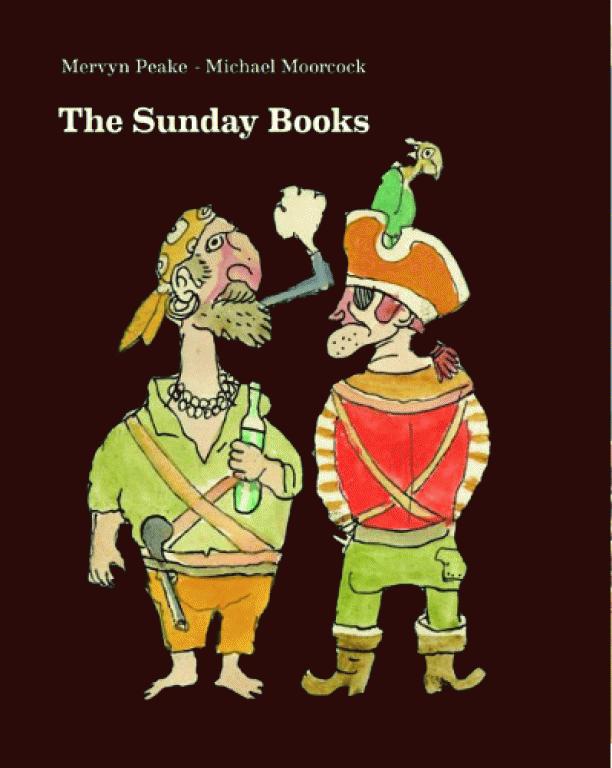
Asked about how their father was able to separate the intense and frequently dark worlds of the imagination peopled with striking grotesques in which he immersed himself from the everyday demands of family life, they said it was just something he was intuitively able to manage. He seemed to find the ordinary world a place of magic and delight anyway, as numerous anecdotes attested. Perhaps his fantastic turn of mind (and the fantastic imagination always finds delight in the grotesque and macabre) was not such a bad attribute when it came to raising inquisitive children who delighted in their own imaginations. The recently published Sunday Books memorialise the stories Peake would tell his children on Sark, accompanying them with spontaneous sketches and drawings. The stories were never written down, but the illustrations remain, and Michael Moorcock, a friend of Mervyn and his wife Maeve’s, has added his own accompanying tales. These Sunday stories show how integral his art was to his family life, and vice versa, something also evident from his innumerable sketches of Sebastian, Fabian and Maeve. As a result, all three children have grown up to be creative in their own particular way. Sebastian edged around the question of the influence of the family on the creation of the Gormenghast books by emphasising the primary importance of his childhood experiences in China on its imaginative construction. Fabian added that, like all artists, he drew from every element of his life, from the deeply felt to the casually observed. They conceded that there was a lot of Maeve in both Fuschia and Gertrude, and Sebastian was the model for the infant Titus (sketches of him adorn the manuscript of Titus Groan). Maeve was remembered by her children as a warmly generous woman who somehow managed to combine the bohemian lifestyle with classic glamour. Other children on Sark would shout out as she was approaching in her Givenchy or Dior-style ‘new look’ dresses, and Sebastian and Fabian would hide behind a hedge. In his memoir A Child of Bliss, Sebastian recalls that she liked to dance to flamenco music on top of the table at the end of her parties, and would always encourage other people to dance.

Mervyn was full of life and vitality, always goofing about and indulging in practical jokes, and his dark, romantic good looks (deriving from his Welsh ancestry, no doubt) and easy charm made him very popular with women. Sebastian recalled his persistent pursuit of a music student at the Royal College of Music whom he sat opposite on the train and wanted to sketch. She demurred and got off at the next stop, but he was not to be deterred. He would turn up at her rehearsals at the College and draw her from the stalls. When she mentioned this to her husband later in life, he commented ‘well, he always did have an eye for the grotesque’. Asked how Maeve felt about such dalliances and his eye for the female form, they said it was accepted with equanimity. Sebastian told the above anecdote with the command of someone who has become expert at public speaking. He above all has been the one who has tirelessly promoted his father’s work over the years. He talks of a moment which defined his father in his eyes. Again, it returns us to Sark, the spiritual centre of the family’s life. Mervyn got the young Sebastian to close his eyes and placed a piece of topaz in his palm. He knew that his father would have had to have climbed down the dangerous cliff-face descending to the sea on the sheer sides of the Coupee, the narrow arête joining the two halves of the island, where deposits of the mineral were to be found. He was also prone to performing daredevil stunts on his bicycle as he raced along the narrow Coupee path. This was what made his father a hero to him, Sebastian said.

All three Peakes gave brief readings. Clare read a passage from her recent memoir Under A Canvas Sky, in which she recalled her father taking her for walks down the Kings Road, near their Chelsea studio flat. He would buy her a Chelsea bun from the baker’s (the Kings Road still had such things in those days), commenting that they were in Chelsea, so they might as well have one; a throwaway remark which would become a running joke between them. They would look in art shops and pick up the tubes of paint, but not the canvasses, which her father couldn’t afford. The evocative names of the paints, the cobalt blues, rose madders, burnt umbers and yellow ochres cast a magical spell, and the studio in which Mervyn worked was a place of warmth and comfort for her. So much so that the smell of turps still has an odd emotional resonance for her.

Fabian, himself a poet and artist, read one of his father’s poems, Love, I Had Thought It Rocklike, written around 1946 and included in the recent Collected Poems volume. It depicts love become evanescent and fragile where once it had seemed so solid and firmly rooted. ‘I had thought it founded like a city of stone’, Peake wrote, ‘but it was thistledown/Or the touch of a wand’. This was one of several poems written at the time (Love’s House, Swans Die and a Tower Falls and Forever Through Love’s Weather Wandering being others) in which Peake seems to articulate a dissociation from his feelings for Maeve. This was perhaps caused by the shock of war and in particular his observation of the horrors of the camp at Belsen. These poems seem to express an inner loneliness, a crisis over the purpose and value of his art. This despair was kept in check to a great extent. It’s certainly not a quality his children remember in him. Sebastian (the oldest of the three children) remembers in his memoir A Child of Bliss that there was a change in his father coming back from the war. He attributes this directly to his experiences in Belsen, asking ‘how can his experience of the camp not have created an eternal helplessness of the soul?’ Indeed, Sebastian became obsessed with the camps himself for a period of time, trying to gain an understanding of just what it was that had wrought such a change in his father.

Mervyn was able to rediscover his love for Maeve (perhaps after a spiritually restorative return to Sark) as the 1948 poem Out of the Chaos of My Doubt makes plain: ‘Out of the chaos of my doubt/And the chaos of my art/I turn to you inevitably/As the needle to the pole’. Fabian interpreted the poem he read in a far less personal way, viewing it as a declaration that the small and fragile can be, in its own way, as strong and vital as the solid and monumental. Drawing an artistic analogy, he said that the thin pencil line can be as forcefully expressive as the thick brush stroke. He sees his father’s approach to poetry as being primarily emotional and instinctive, with technique and structure being applied to subsequently shape such rawly felt material.

Sebastian ended the session with a reading from Titus Awakes, the recently published manuscript of Maeve’s discovered in an old box in his attic. It was her attempt to draw from the skeletal notes made by Mervyn in his declining years outlining ideas for the development of the Titus books and bring his story to a conclusion. But it was also her personal search for the husband who had been taken away from her by the cruel fate of degenerative illness leading to early death. Sebastian reads the final pages, in which Sark once more becomes the magnetic island, drawing Titus to his final place of rest, the endpoint of his quest. As he draws near to the shore, he sees the artist for whom he’s been searching, two boys by his side and a young girl hoisted onto his shoulders. It’s a deeply moving conclusion, both to the book and to the talk, for the artist is clearly Mervyn Peake, and the children Sebastian, Fabian and Clare. Titus is Maeve, returning to Sark one final time, a personal Avalon and blessed isle.

The next day we went to see the wonderful Rabbi Lionel Blue, whose open, liberal approach to religion emphasising kindness and compassion as the values which create a preview of heaven on earth is a welcome corrective to the more judgemental forms which seem prevalent in the modern world. The Rabbi is a little shake and slow on his feet these days after the onset of Parkinson’s disease (and the simple effect of age) but as soon as he sat down he settled into an effortless flow of autobiographical reminiscence, wry observation, modestly offered wisdom and, most of all, jokes. Jewish culture is blessed with one of the richest veins of humour in the world, as documented in Leo Rosten’s excellent dictionary/cultural guide/philosophical treatise and jokebook The Joys of Yiddish. Blue noted how his family and those who lived around them in the Whitechapel area of the East End coped with hardship through humour. He likened this to religion in providing a perspective which allowed people to turn a situation inside out, to view it from a completely different angle. He’s candid about his own struggles with faith, politics and sexuality, an openness which makes him all the better able to empathise with and help those who come to him for advice and spiritual guidance. His view of religion is simple and practical; asked why he is religious and became a Rabbi, he says ‘because it worked for me’. He recalls how horrified his mother was when he announced that he intended to become a Rabbi. She felt that he was turning around and heading straight back into the ghetto from which they’d escaped. It was only when he declared that he was going to seek out a holy man in the Himalayas that she stopped threatening to kill herself and gave him her blessing (the monastic retreat gambit had failed to make the necessary impact). He doesn’t give any easy answers to the complex questions which people bring to him, refusing to supply the magical solutions which some people require of religion. His radical uncertainty (perhaps a healthy development from the radical over-certainty of his youth), his willingness to admit to cluelessness, is refreshing and a sign of unforced wisdom. He says he has no idea what the afterlife will be like, since death involves a cessation of both time and space, the measures by which experience is quantified, but that we can create a preview of heaven through acts of kindness to our fellow creatures.

Along with the jokes, Rabbi Blue also gives us a few lines from some of his favourite songs, in response to a question about what his desert island discs would be (it turns out that he has actually taken part in the programme – twice). He sings a couple of verses of that sentimental old weepie My Yiddishe Momme, guaranteed to have any good Jewish boy weeping within seconds. He also essayed Falling In Love Again, revealing his love of Marlene Dietrich, who, he remarked with a certain amount of fellow feeling, just kept on going, even if they had to glue her elbow to the bar table before the curtains rose. He commented that he tended to listen more these days, in particular to the new female Rabbis (he would have had an opportunity at this festival, as Rabbi Julia Neuberger was also speaking) and was less inclined to immediately leap in with his own opinions. This was presumably an observation of his own division of life into three stages: taking, giving and giving up. He admitted to finding the latter particularly hard to accept. Let’s hope that he continues to resist for a good time yet. The world really needs a gay, ex-Marxist (with remaining tendencies) East End liberal Rabbi right now.

On the Saturday, we went to see Dominic Sandbrook, whose histories of the Macmillan and (first) Wilson eras, Never Had It So Good and White Heat, I enjoyed immensely. These have now been followed up by State of Emergency: The Way We Were: Britain 1970-74, and it was these years which he talked about. He is always keen to separate the myths which accumulate around particular periods with the actuality, and to differentiate the world as seen from a political perspective from actual lived experience. He includes a couple of ‘stealth quotes’ which highlight the complexity of the era, its irreducibility to simplistic divisions. He follows a mention of Germaine Greer’s The Female Eunuch in the context of the rise of a new wave of feminism at the time with a quote which turns out not to be from the book, although its rhetoric makes us believe that it could be. It is in fact taken from a speech by Margaret Thatcher. Similarly, a piece of firebrand revolutionary rhetoric, firmly demarcating the divisions of the class struggle, is made by one Robert Kilroy-Silk. The government of Heath was a hapless and ill-starred enterprise, stumbling from one crisis to the next, but Sandbrook makes it clear that for almost everybody in the country, the material standards of living were higher than at any time before. He begins by setting the scene for the royal wedding of Princess Anne and Mark Phillips in 1973, and imagines what a time traveller from the previous royal wedding (of the Queen) in 1953 would make of the world they found. He concluded that they would be amazed by how well off everyone was, and by the sheer modernity of the period. An interesting observation given the perception of the early 70s as being somehow backward and technologically primitive. For the time traveller looking back from the present (and Sandbrook makes reference to Life on Mars in this context) inequalities were still very much in place in terms of race, gender and sexuality, although feminist and gay rights movements were beginning to make a real impact. Much popular culture still revelled in contemptuous stereotypes which reflected (or partly created) general and largely unchallenged prejudices. Enoch Powell was repeatedly voted the public’s favourite politician at this time.

Sandbrook has a particularly ready and wide-ranging grasp of popular culture, which is what makes his books such excellent evocations of era as experienced by ordinary folk. I suspected from his previous books that he was something of a Doctor Who fan, as he used several quotes, identified as coming from particular episodes, which were perfectly matched to the social and political themes he was addressing. I was able to ask him about this afterwards, and he confirmed that he was indeed a big enthusiast. This would have been pretty self-evident had I had the most cursory browse through State of Emergency, which I bought later from the independent Totnes Bookshop. His chapter on the development of the sixties counterculture and the emergence of the environmental movement, and general turning away from Wilson’s white heat technological optimism, is entitled The Green Death, for a start. He talks of this story’s opposition by the hippyish Wholewheel scientific commune, who join forces with the Doctor, Jo, the Brigadier and Captain Yates, to the sinister Global Chemicals corporation which is directed by the BOSS supercomputer, an artificial intelligence. He quotes James Chapman’s interesting observation that the Earthbound monsters of the Pertwee era tend to be more ‘organic’ in appearance (Silurians, Sea Devils, Axons, Ogrons and, indeed, giant maggots) than the more shiny, metallic and technological creatures of the 60s, and that scientists tend to be villains and destroyers. The Invasion of the Dinosaurs is also mentioned in an ecological context, with its Operation Golden Age, a scientific conspiracy in which the idealistic Mike Yates becomes involved, representing an extreme version of the dream of a return to a pre-technological age. The Doctor defeats its fanatical scheme to return a select section of humanity to a distant past from which it can start again, but is not unsympathetic to its motivating philosophy. Sandbrook also refers to Doomwatch, The Changes, The Survivors and John Christopher’s post-apocalyptic pastoral trilogy The Prince In Waiting, Beyond the Burning Lands and The Sword of the Spirits in this chapter, all of which seem to return to the vision of a reversion to a medieval England imagined by William Morris in News from Nowhere.

Elsewhere, Sandbrook’s introductory example in his chapter on feminism refers to Elizabeth Sladen’s Sarah Jane taking over from Jo Grant as the Doctor’s companion, with a much more assertive manner and a refusal to be reduced to a tea-making role. Liz Shaw was the real equal companion in the Pertwee era, however, a scientist fully capable of keeping up with even the wildest of the Doctor’s theories and offering suggestions herself. Sandbrook also notes how the programme addressed the issues of joining the Common Market in The Curse of Peladon (1972) and the divisions of the miners’ strike in The Monster of Peladon (1974). In both cases, the Doctor opts for the progressive, more radical solution. Sandbrook also points out that Heath’s policy review unit known as The Think Tank was parodied in Tom Baker’s 1974 Who debut story Robot, in which the National Institute for Advanced Scientific Research (inevitably a front for a semi-fascistic scientific conspiracy) is also nicknamed the think tank. Noting the preponderance of rats in 70s popular culture (he must surely be the only prominent historian who would make reference to James Herbert’s novel The Rats, and also notes their appearance in Doomwatch and The New Avengers) he refers to the giant specimen encountered in the sewers in The Talons of Weng Chiang, and makes the reasonable observation that it is ‘one of the worst-realized monsters not merely in the show’s history, but in the history of human entertainment’. Fair enough, although, as is the contradictory way with Doctor Who, it is also one of the series’ finest stories.

Sandbrook makes further reference to fantastic literature and film throughout, suggesting both that he is an enthusiast for the genre, and that this was a particularly fertile period. Angela Carter’s The Infernal Desire Machines of Doctor Hoffmann and The Passion of New Eve are discussed, and Brian Aldiss’ The Malacia Tapestry and JG Ballard’s High Rise mentioned. SF writer Edmund Cooper is cited for his wildly sexist views, broadcast not only in his novels (one of which, Who Needs Men? lends its title to the chapter on feminism and reactionary responses to) but in a 1975 Science Fiction Monthly interview from which Sandbrook quotes. Bagpuss is aptly summed up as being ‘gloriously melancholy’. I would take issue with his dismissal of the late 60s and early 70s output of Hammer, however. Some of its was indeed shoddy, exploitation fare (and not even very full-blooded exploitation at that). But there are some fascinating films amongst the studio’s latterday efforts, some of which genuinely attempt to play new variations on the old formulae, and a very few of which really succeed. And Dracula AD 1972 is hugely enjoyable to watch now, as I noted here. But Sandbrook is generally spot on, and his histories are both insightful and hugely enjoyable, as indeed was his talk. You can see a video of another such on his website and blog, over here, where you can also find extracts of his comments from the extras on the dvd release of the Hartnell Who story The Ark.

Saturday, 9 July 2011

Mervyn Peake Centenary


Today is the centenary of the birth of Mervyn Peake (in Kuling in China) and it is marvellous to see the wide recognition that this significant anniversary is receiving. Peake was a man of diverse talents, literary and artistic, and has always been held in the highest esteem by a devoted coterie of admirers. But he has never achieved the centrality of renown within the canon of twentieth century culture which he merits. Perhaps he has been a victim of his own prolific and unbounded energies. How to encompass someone who was both author, illustrator, painter, poet and playwright? He was also a singular figure, not fitting easily into the dominant strains of modernism and realism which define the English art and literature of the last century for the majority of the critical establishment. He was rediscovered in the 60s, due in no small part to the efforts of his wife Maeve Gilmore and supporters like Michael Moorcock and Langdon Jones. His Gormenghast novels provided an alternative to the all-pervasive influence of Lord of the Rings, although many who expected a similar epic fantasy narrative were put off by its dense, pictorial prose and intense interiority (qualities which those who disliked Tolkien saw as positive virtues). Hopefully the wide ranging mixture of exhibitions, talks and publications which are taking place (and which reflect the wide ranging nature of Peake’s art) will bring him to the fore once more, and establish his reputation on a more permanent basis.

Much of this activity is no doubt down to the tireless efforts of Sebastian Peake to promote his father’s work. He is certainly a very busy man at the moment. He will be interviewed this Wednesday (13th July) at 6.25 pm on Radio 4 Extra by Nick Briggs, better known for his expert voicing of the Daleks in the new incarnation of Doctor Who about the new exhibition of Peake’s illustrations at the British Library, The Worlds of Mervyn Peake (the Library now holds the Peake archive of manuscripts and notebooks). He will be talking about the Gormenghast books on Monday at the British Library, alongside China Mieville, John Sessions and Brian Sibley, an event which also marks the launching of Maeve Gilmore’s continuation of her husband’s work, Titus Awakes. He will return on the 26th July for a celebration of his father, along with his brother Fabian, and with further contributions from Sibley, as well as Clare Penate, Hilary Spurling (who wrote an introduction to the 1974 book The Drawings of Mervyn Peake, and so is evidently a long term fan) and a few filmed words from Michael Moorcock. The British Library has also published a new edition of the Peake gallimaufry Peake’s Progress, which contains a mixture of poetry, short stories, poems, plays and illustrations. There is also an accompanying CD, in which Sebastian and Fabian (both of whom have good reading voices) narrate a series of ‘weird tales’ which Peake wrote for Boxing Night, as well as the long narrative poem The Rhyme of the Flying Bomb and some light nonsense verse.

He will be coming down this way (to the South West) on Wednesday (the 13th), were I will hear him speak with Fabian and sister Clare at the Dartington Ways With Words Festival, set in the beautiful environs of Dartington Hall. The three were interviewed recently in the Telegraph in Clare’s book lined flat, which apparently is hung with a personal gallery of her father’s paintings. They talk of the discovery of Maeve’s manuscript for Titus Awakes, which was discovered in an unremarkable box in the attic a couple of years ago, and which has now been published. Enticingly, Sebastian holds out the hope that there may be more manuscripts to be discovered. None of them knew she was writing it, and it appears to have been an intensely personal artistic attempt to reclaim the Mervyn she had loved but who had slipped away from her through slow, mentally degenerative illness. Gilmore had written a deeply felt and vivid memoir of her husband shortly after his death in 1968, which was published in 1970 under the title A World Away (now published in a joint volume with Sebastian's memoir A Child of Bliss). It brings to my mind another autobiography written as an act of cathartic remembrance after profound loss, this time by Peter Cushing after the death of his beloved wife Helen. Maeve was a fine artist in her own right, and her work can be seen alongside Mervyn’s in an exhibition at the Victor Wynd Gallery in Hackney. The photographic prints are lovely. One, of Mervyn holding a forking branch above his head as a fantastic antler forms the basis of a wonderful painting by Maeve which graces the cover to the 1983 paperback edition of A World Away which I have. There is also a fascinating insight into the Peakes bohemian domestic environment, with a picture of their kitchen at Drayton Gardens, every surface covered in colourful paintings and murals (even the cooker). Drayton Gardens was the Peakes’ home in the 60s, so these decorations are probably mostly Maeve’s work, since Mervyn was by this time very ill.

Sebastian was also our guide to the Channel Island of Sark, which was in many ways his father’s true home, in a radio programme broadcast on Radio 4 on 7th July under the title A Hundred Years of Mervyn Peake. He noted that islands were central to his father’s work, and that Sark was a place of inspiration and renewal for him. He is still remembered by the older Sarkese; and how could he not be, with his generously open nature, flamboyantly colourful clothing, ring pierced ear (quite daring at the time) and tendency to sport a voluminous cloak. Sebastian meets several people who knew Mervyn, one of whom reveals two pictures which he painted on the island which he has never seen before. Clare and Fabian also take part in the programme, with Clare (whose own memoir of her father was published recently) warmly recalling him as ‘a man of enormous affection – abnormally affectionate’. There are also some perceptive and insightful comments from the novelist Joanne Harris, who clearly has more than a cursory knowledge of Peake’s work. She makes the comparison between Gormenghast and Kafka’s Castle, remarking that in both works, the castle is the world. The novels certainly share and absurdist sensibility, with a rigid adherence to meaningless ritual, although Peake has a more Romantic sensibility, as opposed to Kafka’s darkly ironic worldview. She also notes that the geography of Gormenghast seems to be constantly shifting, such that it would be impossible to provide a map to its corridors and towers (in the traditional post-Tolkien fantasy novel manner). Harris will spoke further about Peake with Ian MacMillan on the Radio 3 programme the Verb last night, and will also be speaking at the Mervyn Peake and the Fantasy Tradition conference in Chichester on the 15th July, with Sebastian Peake giving a lecture the following day. Chichester also hosts two major Peake exhibitions, one at the Pallant House gallery and the other at the Otter Gallery in Chichester University.

The BBC is also marking the centenary with a major new six part adaptation of the Gormenghast books, which will include Titus Awakes. Brian Sibley is the man responsible for the new version, a natural choice since he knew Maeve and is described by Sebastian in the radio 4 documentary as being ‘a Peake expert’. Indeed, this is not his first adaptation of the books. He wrote a two part abridgement back in 1984, partly under the aegis of Sting, a huge fan of the books (I seem to recall that he named his daughter Fushcia), who played Steerpike. He also wrote the fine 26 part adaptation of The Lord of the Rings in 1981, with Ian Holm playing Frodo. By the time of Peter Jackson’s films, he had aged into the role of Bilbo. The cast for the Gormenghast adaptation this time around includes David Warner, who is identified as ‘artist’. Extracts played in the radio 4 documentary suggest that there is an overarching narrative voice, which happily means that more of Peake’s descriptive prose should remain intact. Carl Prekopp, a relative newcomer plays Steerpike this time around, a difficult role which is the key to the success or failure of any adaptation, since he is the agent of change and revolution within the otherwise ossified castle world, the generating engine of story, and also the embodiment of the novels’ moral ambiguity. The miscasting of Steerpike in the BBC Gormenghast was one of the major causes of its failure to fully capture the spirit of the books. He is not attractive, more a kitchen rat whose charisma is cast by means of an adaptive cunning, offering people what he perceives they desire. Miranda Richardson should make a fine Gertrude simply by fine-tuning the customary Miranda Richardson role. Tamsin Greig plays Irma Prunesquallor, and her brittle comic middle class persona is ideal for the awkward comedy of manners which provides one of the lighter of the several variations in tone and style in the weave of alternating plot strands making up Gormenghast, the second novel. The marvellous Fenella Woolgar plays Clarice, one of the two easily-led, doll-like twins whose strings Steerpike pulls. Mark Benton, a great hangdog presence in Mike Leigh’s Career Girls, the first Ecclestone Doctor Who and a memorable episode of Stephen Volk’s Afterlife, gets to enjoy a role of theatrical meanness as the head cook of the abyssal kitchens, one of Peake’s gleefully exaggerated grotesques.

As mentioned above, Maeve Gilmore’s novel (for it really must be attributed to her more than Peake) Titus Awake has now been published. She wrote it under the title Search Without End, but acceded to the final title, which would link it more recognisably to the Gormenghast sequence. She had little to go on other than what Mervyn might have told her over the years, two or three introductory pages and a few columns of suggestive lists of paired and grouped words, a filament-thin framework upon which to build. The lists included words such as snows, islands, thieves, actors, psychiatrists, lepers, echoes, fires, poverty, monsters, hypocrites, madmen, bankers, affluence, debt, society, pirates (always an obsession), dreamers, decadents, athletes, invalids, colours and scents. As the American Overlook Press edition puts it, ‘what these books might have been’. For Maeve, the quest is clearly for her husband, with Titus as a surrogate searcher. He meets an artist in a psychiatric ward who is no longer able to paint or write, or even adequately communicate, and who is clearly Mervyn. Titus subsequent efforts to find him again eventually leads him to an island. We don’t need to be told where it is. They’ve returned to Sark, the golden isles. Thursday also saw the publication of the Illustrated Gormenghast, a handsome hardback volume with an introduction by China Mieville, who was one of the four writer contributing to a recent Guardian Review lead article on Peake (the others were Moorcock, with a personal reminiscence of his relationship with the Peake’s and their work - his verse accompaniments to Peake's Sark drawings for his children has just been published as The Sunday Books; Hilary Spurling on his illustrations; and AL Kennedy on Sark and its influence on Peake’s art). There are 100 new illustrations, which range from full page portraits to small, swiftly rendered pencil sketches which nestle in amongst the text. This replicates something of the feel of the notebooks in which Peake first wrote the novels. The language and the visual sketches ran side by side in the composition, the one feeding into the other in an instinctive process. You can imagine him scribbling as sentence and then pausing to sketch the outline of a figure at the side of the page and quickly shade it in, thinking to himself ‘yes, that’s what they look like’. So it is fitting that they should now find publication in this form. The writer and artist finally united in one great volume. There’s never been a better time to discover Peake, and feast on the products of his ceaseless imagination. Enter, the gates to the castle are open.

Wednesday, 16 March 2011

Read and Returned


The Read and Return Bookshop in Exeter is set to shut at the end of this month. It’s pluckily stood for some while against the general trend of second-hand bookshop closures, but its time is finally come. It’s apparently been providing the people of Exeter with popular literature since 1972, and I can certainly vouch for its having been here ever since I arrived in the area some 20 years ago. Bookshops which operated on a part exchange basis used to be scattered all around the country, and were a cost-efficient option for the frugal bookworm. I used to either cycle or catch the number 21 bus into Lewisham to stock up at the Popular Book Exchange there, and discovered many writers who subsequently became favourites, finding paperbacks by the likes of Samuel Delany, Gene Wolfe and Michael Moorcock (along with plenty of Conan and Piers Anthony, which I happily devoured too). I also managed to amass most of the Best of New Worlds and New Worlds Quarterly anthologies, paperback passports back to the experimental excitement of the 60s. I didn’t fully understand the stories and poems in them at the time, but there was something thrilling about their attitude.

The Exeter Read and Return used to be very much a shop of two halves, with a partially screened-off backroom full of ‘adult’ material and the whole place exuded a rather seedy aura of the kind evoked in M.John Harrison’s short story Egnaro, which equated the escapist fantasy of men’s magazines with that of mass market fantasy fiction. A woman took the place over, knocked down the divisions between front and back room and opened it up so that it was much more light and airy, getting rid of the porn and clearing the shop of its furtive atmosphere. But second-hand bookshops (and particularly those concentrating on paperback fiction) are swiftly disappearing from the map. Totnes used to be dotted with them, offering a fine day’s browsing for the idle bibliophile, but they are now mostly gone. Each time I walk up the Charing Cross Road, for a long time the centre of the book trade in London (as immortalised in the book 84 Charing Cross Road by Helen Hanff) there seem to be fewer bookshops. The reasons for all this are well-aired: internet selling, the growth of supermarket book retailing, rising rents and rates, and perhaps even a less traditionally literate public. Much the same arguments can also be adapted and applied to record shops, another dying breed. All of which is saddening for people of my general age and inclinations, but perhaps not of any great concern to anyone else. Anyway, I’m writing this as I sit in for the day in the shop, so let’s have a look at some of the enticing titles on offer (and offer is the right word, since they’re all available on a buy one get one free basis).

Angela Carter’s second novel, Several Perceptions, set in a sixties London which has ceased swinging and is now just nervously twitching, is available in a 1970 Pan paperback edition with a gaudily cartoon-psychedelic Alan Aldridge-esque cover which is very much of its time and all the better for it. It may indeed be by Aldridge for all I know, as he did produce a few covers for Penguin science fiction paperbacks in the latter half of the sixties. Charles Williams’ War In Heaven, in which forces of mundane evil battle for possession of the grail in 20s London and a small home counties village, comes as part of the ‘Dennis Wheatley Library of the Occult’, a series whose prominent use of his name is justified by a brief, half-baked intro (mainly consisting of giving the plot away) by the self-important purveyor of mock-deviltry. David Pringle’s Modern Fantasy: The 100 Best Novels offers a widespread selection of the post-war literature of the fantastic, with 1 or 2 page summaries and assessments giving pointers to a disparate range of greater or lesser known works. Amongst those he includes are: Mervyn Peake’s Gormenghast books, The Dying Earth by Jack Vance, Conjure Wife by Fritz Leiber, The Once and Future King by TH White, The Haunting of Hill House by Shirley Jackson, The Crying of Lot 49 by Thomas Pynchon, The Owl Service by Alan Garner, The Malacia Tapestry by Brian Aldiss, Little Big by John Crowley, Lanark by Alasdair Gray, The Anubus Gates by Tim Powers, The Glamour by Christopher Priest, Mythago Wood by Robert Holdstock, Gloriana by Michael Moorcock, The Unconquered Country by Geoff Ryman, Grendel by John Gardner, Peace by Gene Wolfe and Nights at the Circus by Angela Carter. Fine books, all, several of which I was guided to by this very tome.

There are a number of books by Brian Aldiss, including the three semi-autobiographical novels which go to make up his Horatio Stubbs saga (The Hand-Reared Boy, A Soldier Erect and A Rude Awakening), which traces the bawdy misadventures of the eponymous protagonist through wartime and the post war world. There’s also Moment of Eclipse, a fine collection from 1970 which contains some hauntingly allusive and quietly experimental stories, and Frankenstein Unbound (in normal and film tie-in editions), an homage and love-letter to his literary heroine Mary Shelley. Aldiss himself looks very youthful, clean-cut and respectable in the inside cover photo from a 1961 paperback volume of the Penguin Science Fiction Omnibus. A collection of Fredric Brown stories gathers sheaves of his shaggy dog stories, bathetic squibs, parodic SF and set ups for groansome punchlines. At an average length of a couple of pages, these make for ideal bogside reading.

Jeremy Burnham and Trevor Ray’s Raven is a novelisation of their TV follow up to Children of the Stones, with Phil Daniels bedecked in Arthurian robes on the cover, and some rather nice line drawings inside which promise more than the series is ultimately able to deliver. There are a couple of James Blaylock’s excellent fantasies (The Last Coin and The Digging Leviathan), in which an amicable group of eccentrics, usually living in some gently bohemian enclave of North California, become embroiled in some quest involving arcane lore and long lost artefacts with magical properties. Blaylock always creates a warm and likeable cast of characters, and even his villains tend to have redeeming features. Another Californian writer, Kim Stanley Robinson, appears on the shelves with his novella A Short Sharp Shock, a piece of absurdist SF worthy of Jorge Luis Borges in which an amnesiac man awakes and walks a narrow, rocky isthmus which girdles a watery world, encountering people whom he literally can’t avoid along the way. Samuel Delany’s Neveryona is the lengthy novel from his Neveryon series, in which he examines the nature of heroic fantasy and exercises his acute critical faculties upon its conventions whilst at the same time offering its traditional pleasures, albeit in startling and unconventional form. There’s John Crowley’s debut novel The Deep, with admiring comments from Ursula le Guin on the back cover, and an early novel by Elizabeth Hand, Aestival Tide, which sets her interest in myth and ritual in the context of a planetary romance.

John Sladek’s Roderick at Random (the title a tip of the hat to Tobias Smollett’s 18th century novel, whose picaresque form it follows) is the second half of his tale, both hilarious and poignant, of the education of an innocent, newly created robot who is abandoned (a foundling) and left to make his way in the world. Robert Sheckley’s Mind Swap, in a 1969 Mayflower paperback edition, boasts a far out cover (to slip into period parlance) which mimics the fun house distortions of then voguish photographic portraits taken of reflections in sheets of mirrored mylar (the cover of John McGlaughlin’s Devotion springs to mind here). It’s obviously designed to appeal to a ‘head’ readership. This makes me think of an unusual photograph of Jimi Hendrix, resplendent in crushed velvet finery (though the photo is black and white, I assume it's purple), with feet up, wholly absorbed in reading a volume of the Penguin SF Omnibus (not the one mentioned above, however). Which particular story was commanding his attention to such an intense degree, I wonder.

There’s a copy of Lucius Shepard’s Life During Wartime his novel of future warfare in the jungles of South America which is fought out in the dense undergrowth of the mind as much as amongst the lianas and mangrove swamps of the rain forest. Carl Sagan’s Contact casts his interest in the possibility of extraterrestrial life and the way in which we should go about communicating with it, as well as the conflicts and confluences between scientific and religious world views in fictional form. This is a pre-movie edition. I’ve never seen the film, but there’s an interesting piece about it over here which makes me think that perhaps I should. There are a number of Michael Moorcock paperbacks, mostly his fantasies (many of which he confesses to having knocked out for a bit of ready cash). But there’s also a 1970s Mayflower copy of Behold The Man, his agonised account of a character whoenacts his own martyrdom by travelling back to the time of the crucifixion and taking the place of Jesus (who proves inadequate to the task), providing salvation for his own manifold sins which are magnified by his sense of self-loathing. It’s interesting that such an excoriating psychological portrait (its iconoclasm is largely beside the point – this is no attack on religion) can sit side by side with the escapist likes of Count Brass and The Quest for Tanelorn (not that I’m really knocking these, or denying the need for escapism). The last two novels in the Pyat Quartet, which tells of the progress of another character who is decidedly unheroic (except in his own mind) through the first half of the twentieth century, are here. They join together to form the second clause of the sentence which the titles of the sequence combine to create: Jerusalem Commands The Vengeance of Rome. Moorcock also edits The Best SF Stories From New Worlds 5, which contains The Last Hurrah of the Golden Horde, which offers Norman Spinrad’s American take on the Jerry Cornelius character. Also included are The Death Module, one of JG Ballard’s experimental ‘concentrated novels’, and Brian Aldiss’ The Serpent of Kundalini, one of his acid-head war stories, set in a dazed future England in which reality has been fractured by the after effects of LSD ‘bombing’.

Interzone magazine is also represented by a best of anthology, its overlap with its English antecedent indicated by the inclusion of stories by Ballard, Aldiss and Thomas M Disch, alongside later luminaries such as Geoff Ryman (whose debut story was published in one of the later New Worlds Quarterlies in the 70s), Graham Joyce, Kim Newman, Dave Langford and Brian Stableford. If you wanted to complete your reading of Mervyn Peake’s Gormenghast trilogy, you have a choice of 3 different editions of Titus Alone. The King Penguin copy has Peake’s drawing of Irma Prunesquallor on the cover, which is strange since she makes no appearance in the novel. The 1989 Mandarin edition has a dun coloured watercolour by Mark Robertson on the cover, with romantic ruins in the foreground and in the background what could either be the towers of the city to which Titus is journeying or those of Gormenghast from which he is fleeing cast into a dreamy mirage by slanting shafts of sunlight. The 1998 Vintage edition has entered the age of digital publishing, with Nick Robertson’s cover a computer-aided collage with Peake’s drawing of Gertrude, the Duchess of Groan shrunk to a small reproduction shunted into the lower right hand corner. I think I’d go for the King Penguin, myself, but I’ve already got several copies so that would just be greedy.

Nestled amongst the Kings and Herberts on the horror shelves you can find the more genteel shudders of Marjorie Bowen’s collection of ghost stories The Bishop of Hell and Other Stories, which is not to be confused with Elizabeth Bowen’s essays in the form. Less subtle and more liable to induce feelings of biliousness than chills are the novels of Guy N Smith, of which there are a generous selection here. What would the collective noun for a shelf of Guy N Smith novels be? A slime-trail, a clawful, a jugular spray? There are none of his crab books, alas – someone’s obviously netted those. I remember these cropping up in all the revolving wire racks which used to be found in newsagents and at railway and bus stations. You would have thought that one novel would have pretty much exhausted the variant possibilities of giant crab attacks, but apparently not. They rended and pincered their way through seemingly dozens of the things, all featuring covers in which the monstrous crustraceans advanced, gore dripping claws raised triumphantly to the skies, bent on revenge for all those crab sandwiches in which their brethren met ignoble (but undeniably tasty) ends. Smith’s books all come emblazoned with bylines which attempt to summon up the spirit of the matter within, and illustrate pulp hyperbole at its finest. Blood Show bears what appears to be a parental admonishment taken a step too far: ‘It began as a harmless game – and ended in terror and death’. The Lurkers promises ‘New Terror in a place of Ancient Dread’. Bats out of Hell offers a succinct and vaguely scriptural ‘and with the bats came death’. Accursed, which seems to be an Egyptian mummy tale, goes for the medical metaphor, graphically explaining how ‘an old and terrible evil had been lanced open, spilling out its putrefying essence’, whilst The Pluto Pact simply resorts to hysteria with a gibbering ‘Burn…Burn…Burn…In Screaming Torment’. My personal favourite is the byline for Blood Circuit, which offers a simile of camp ghoulishness: ‘Death clung to her like a haute couture shroud’. We are also confronted by The Slime Beast (‘a monster from Earth or beyond the Stars?’) and Caracal, an African and West Asian lynx which is let loose in a Welsh hippy commune, and whose taxonomical obscurity suggests that Smith and fellow pulp horror writers had by this stage worked their way through the more obviously fearsome ranks of the bestiary. Finally, we have Sabat 3: Cannibal Cult, which unequivocally declares ‘his enemy is the eternal principle of evil made flesh’. Turning to the back cover for more information, we discover that our troubled hero, Mark Sabat, ‘ex-priest, SAS-trained killer, exorcist, is a man with a dreadful mission. Driven and haunted, he has to seek out and destroy his mortal enemy. An enemy who has chosen the Left Hand Path, who embodies the eternal principle of Evil (capitalised, of course). An enemy who is his own brother’. Sounds like he’s got some serious shit to deal with there.

There’s a copy of Italian Nietzschean Gabriel D’Annunzio’s 1900 novel The Flame, in case you want to find out what every self-respecting fascist was reading in the 1920s. James Morrow’s The Last Witchfinder is another of his seriously humourous dissections of faith, rationalism and fundamentalist religion, this one set in 1688 and crossing the Atlantic from London to Salem. Apparently, it’s ‘perfect for fans of Jonathan Strange and Mr Norrell, The Historian and the novels of Terry Pratchett’. Ir it’s anything like his previous satirical and searching fantasiesTowing Jehovah and Blameless in Abaddon it should be well worth reading. There’s a couple of novels from modern Glaswegian writers: James Kelman’s How Late It Was, How Late, written in the vernacular, and Agnes Owens’ A Working Mother, which is graced with a cover by Alasdair Gray, who is friends with and has drawn portraits of both authors. Nell Dunn’s two sixties novels set in the London, both of which were turned onto mildly controversial films, Poor Cow and Up the Junction, are both here, the former with a cover featuring a still from Ken Loach’s film, with Carol White in the main role. There are also film tie-in editions of A Kestrel for a Knave by Barry Hines (an not the usual one with Billy giving the world a two-fingered salute) and Bill Naughton’s Alfie, with Michael Caine instructing one of his ‘birds’.

JB Priestley’s Lost Empires evokes the long-gone world of variety theatres, recently recalled by Michael Grade and his interviewees in a two part BBC series. Colin Wilson, meanwhile, is Adrift In Soho, according to a 1961 semi-autobiographical novel (from a time when he still had a few shreds of his reputation intact) set in the bohemian world of the London district which he and other writers, artists and alcoholics frequented. It was the kind of milieu enjoyed by George Melly, and his rambunctious and thoroughly scurrilous memoir Rum, Bum and Concertina (a title taken from the old naval saying ‘on shore its wine, women and song, but on ship it’s…’). Doris Lessing’s Memoirs of a Survivor is a quietly apocalyptic novel which observes the decay of civilisation from the detached perspective of a suburban housewife who is able to dream a better world beyond the wallpaper which she spends ages gazing at (a nod to Charlotte Perkins Gilman’s story The Yellow Wallpaper, perhaps). Lessing would no doubt not be averse to her novel being called SF, having long been an advocate of the genre within more aloof literary circles.

Finally, there’s Roger Fulton’s Encyclopedia of TV Science Fiction, in case you wanted to remind yourself of the details of a particular episode of The Twilight Zone, or of an old Doctor Who story. There’s also some old curiosities to unearth, such as the 1978 BBC Birmingham production Stargazy on Zummerdown. This takes place in an utopian England (now known as Albion) in the 23rd century, a society in which technology and agriculture are maintained in careful balance by the Commonwealth of New Harmony. Play Away/School presenter and sometime Pagan folkie Toni Arthur starred. Here’s hoping for a screening or a dvd release. Wine of India was a 1970 Nigel Kneale play, alas now wiped. It’s set in the year 2050 and depicts a society in which the aging process has effectively been halted. As a result, however, population growth is kept under control through the imposition of a pre-determined lifespan, with state-enforced euthanasia when your time is up. The play takes place during one couple’s final party, with officials present should they attempt to evade their duty as citizens. It starred Brian Blessed and Annette Crosbie as the youthful-looking 90 year olds, and also re-united Catherine Lacey and Ian Ogilvy from the cast of Michael Reeves’ The Sorcerors. David Ambrose’s 1977 drama Alternative 3 was a fake documentary which, like most such hoaxes, caused a certain amount of consternation amongst some of the more credulous (or insufficiently cynical) viewers. It looked at the potential environmental disasters arising from the escalation of the greenhouse effect and offered three alternatives: cutting population, reducing consumption or leaving the planet, effectively writing it off as a lost cause. The programme’s ‘investigators’ unearthed evidence of scientists setting up bases on Mars and the dark side of the moon, suggesting that the third alternative was the one being actively pursued.

All these and plenty more are available at crazy knockdown prices. So come on down and grab ‘em while you can. This offer is available for a limited time only.