Wednesday, 5 February 2014

Blood On Satan's Claw (1971)


Blood On Satan's Claw is playing in a fantastic double bill with Ben Wheatley's A Field in England this Friday at the Black Swan in York, beginning at 7PM and with an introduction by writer Gavin Baddeley. Two great, great films put on by the estimable Fiendish Thingee. Come and enjoy the country air, but take care not to stray from the path. Following on from the notes on A Field in England, here are some circular thoughts on the other half of the bill.

A film with a title like Blood On Satan’s Claw, splashed on a poster and represented with blunt literalness by a fiendishly taloned paw dipped in gore, might not seem to promise anything from the more refined end of the arthouse cinematic spectrum. The words scream out in lurid red letters, letting you know in no uncertain terms that this will be a rough and ready piece of raw exploitation, a bubbling stew of sex and violence which takes full advantage of the new liberal censorship regime of the early 70s. Shocking in all senses of the word. This might indeed be the primary attraction for certain casual viewers, the poster enticing passersby into the cinema who are looking for precisely for these kinds of potent, slightly grubby thrills. It was certainly the impression that Soho movie hustler and old school East End character Tony Tenser, whose Tigon production company was behind the film, wanted to make. He was concerned with making money, and artistic considerations were not high on his priorities. Having said which, he was responsible for a small clutch of genuine classics in the 60s and early 70s, including Roman Polanski’s first two British features, Repulsion and Cul de Sac.
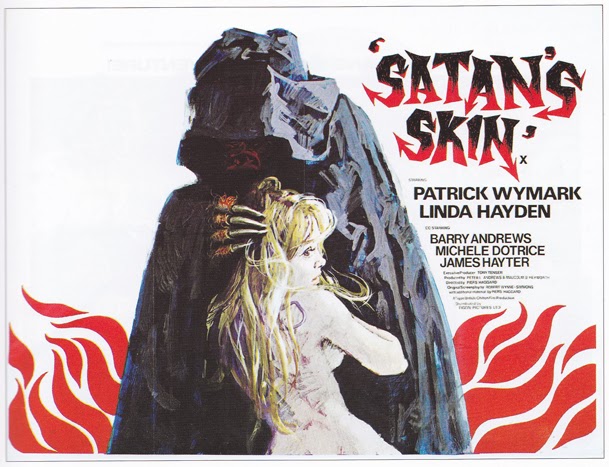
US poster under a different title (just to confuse things)
If the film fails to live up to the expectations aroused by the grasping, bloody claws and the naked flesh which they are poised to rake, there may be a low chorus of disgruntled muttering in the lobby on the way out. We anticipate some lurid and titillating scenes from the offset, murkily and prosaically shot on cheap and hastily erected sets. So the opening scene comes as a considerable and, hopefully, pleasant surprise. It establishes the tone of the film, and immediately introduces some of its prevailing themes. And far from being lurid, shocking and contemptuously cheap, it’s poetic, expertly shot and quite ravishingly beautiful. But don’t worry. There will be disreputable pleasures too.
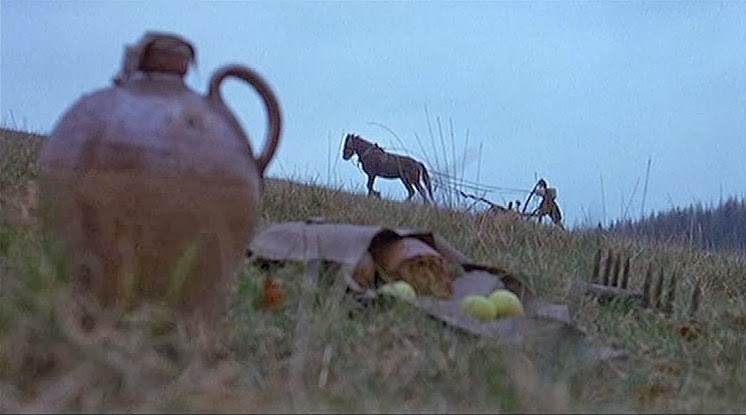
Pastoral and rustic still life
The opening shot is a highly formal blend of rural still life and agricultural landscape. An open, grassy slope, seen in close up from a low, ground level angle, takes up the majority of the screen’s space. Apples, a hunk of bread tucked into a leather pouch and an earthenware jug, presumably filled with cider, are neatly arrayed on the left of the frame – a ploughman’s lunch. And there’s the ploughman, a small figure in the middle distance moving across from the right of the frame. He treads out the horizon, outlined against the narrow strip of sky at the top of the screen. It’s a beautiful composition, almost painterly in its considered balance of elements and division of space. There are other compositions like this scattered through the film, including a lovely shot of a torchlit procession marching in the distance in evenly spaced rank across an evening field. We then get a close up of the soil being turned over by a horse-drawn wooden plough, again shot from ground level. This is a stylistic choice which director Piers Haggard and cameraman Dick Bush (both ex-BBC men) make throughout the film. Haggard is an avowed fan of Japanese cinema, and this may have had some influence in this respect. Yasujiro Ozu was known for his low-angle shots, and the camera in Japanese films often descends to a low angle to share the kneeling perspective of characters in domestic rooms, royal palaces or temples.

Torchlit procession
This ground-level view works on psychological and symbolic levels. It’s an unconventional and disorientating perspective to watch from, and sets the perceptions a little aslant. It also lends the impression that the surface of the world is provisional, a thin skin with deep, accreted layers, both geological and temporal, lying beneath. Forces long-buried and all-but forgotten spirits may worm their way to the surface and re-emerge, the genius loci of centuries past which never wholly dies but diffuses through the soil and reconstitutes itself when the climate is favourable. The low-angled shot is also used to good effect in the haunted attic scenes, creating a sense of incipient unease and suggesting that there is something lurking beneath the floorboards. The attic is the classic symbolic locus of the subconscious in gothic film and fiction, from Jane Eyre through The Owl Service to the Exorcist. It’s the dusty substratum of the mind, its hidden inhabitants, boarded up and kept from the light, waiting to burst through with all the violence built up through years of incarceration.

Ground level shots - the provisional surface
Back to our ploughman; we first gain a proper view of him via his shoes, a rare close-up of period costume footwear. They look authentic enough to my inexpert eye, and are an immediate example of the attention to fine detail which is evident throughout. This can be seen in minor elements such as the use of rush lights, set down in bracket holders, the poignantly half-finished needlework circle left by the fire, and the wooden cage for a pet songbird hung from the ceiling. They all combine to create real depth to the 17th century atmosphere conjured by the set designer Arnold Chapkis. The film-makers were lucky enough to find a perfect period farmhouse in the Bix Bottom Valley for the exteriors of the principal locale in the first part of the film. But the set design for the interiors is equally impressive. It creates a solidly real, lived-in setting, which makes the fantastic and horrific events which are played out within it all the more disconcerting, a disturbing eruption of the irrational into the everyday.

Period fireside detail
This care in creating a believable sense of period extends to the dialogue. There is a real attempt to create a sense of rural speech, with many a ‘she’m’, ‘b’aint’ and ‘it be’ scattered throughout. The odd RADA or RSC vowel slips through, this not being a mode of speech actors are commonly called upon to essay. But it’s a refreshing change from the peasantry in Hammer films and their imitators. They are generally middle Europeans (nominally, at least), but the English character actors who portray them tend to slip at the drop of a hat into a disgruntled cockney shtick of the kind they might use in a BBC Dickens. This is perfectly alright in the context of Hammer’s fairytale worlds. Blood On Satan’s Claw is intent on building a more authentic environment, however. It also creates a sense of a village community defined through the divisions of labour evident throughout. The ploughman, Ralph (Barry Andrews), works for Mistress Banham (Avice Landon), who owns the large house and its surrounding farmland. She also employs Ellen Vespers (Charlotte Mitchell), another of the central adult characters in the film, who works as her domestic servant. The village authorities are represented by the temporarily resident judge (Patrick Wymark), the buffoonish squire (an amusing turn by James Hayter), the unworldly vicar (Anthony Ainley) and, to a lesser or more delimited extent, the ineffectual doctor (Howard Goorney). The peasants do share a general air of disgruntlement and a tendency to mob-handed violence with their Hammer brethren, however. This is treated with a certain amount of wryly self-aware humour by the film-makers. A member of a search party roused by the squire, setting out into the steady rain, mutters ‘silly old fool. Why don’t he go and search his bloody self’. And when the pitchfork and torch-wielding mob heads for the traditional climactic confrontation and conflagration, not a few of the stout locals decide to remain behind and look after the large kegs of ale which have been set up in the churchyard to steel the nerves.

Answer echoes answer - Cathy calls across the valley
The work of Ralph the ploughman (to whom we once more return) is effortful. The soil yields reluctantly to the blunt blade guided by the straining figure who controls the machinery whilst also holding the reins of the horse which draws it forward. This is no sun-dappled eulogy to the purity of the agricultural life. It’s hard labour, carried out against a winter landscape whose predominant tones are dark brown. But there is a lyrical element of English pastoral romanticism here and throughout the film. Ralph pauses in his work to call back across the valley to his sweetheart Cathy (Wendy Padbury), and we see him from her perspective, a small, waving figure against the woods. Ralph and Cathy will remain the innocent heart of the film whilst all around them steadily succumb to devilish enchantment or the hysteria of fear, superstition and rumour. The call across the valley gives us a sense of the dimensions of this local space, and for a moment we seem to be in the territory of AE Houseman and A Shropshire Lad. But then Ralph ploughs up the devil, a head like a grotesque turnip inserted with a glistening eyeball, across which a wet worm inches. It’s the kind of picture which might have graced the cover of a Pan Book of Horror paperback at the time the film was made. I certainly can’t recall any such imagery turning up in any AE Houseman poem I’ve come across.

The devil's turnip - unearthing evil
The devil is gradually and methodically built up from various donated body parts throughout the film, gifted with varying degrees of willingness. We don’t actually get to see much of it, though. It’s no doubt a conscious choice on the part of the director, who’s well aware that what is suggested, or glimpsed in the peripheral shadows of vision, is liable to be more disturbing than what is revealed in the full glare of sun or firelight (particularly on a low budget). But his absence from the greater part of the story is also an indication that this is not the Devil of Revelations-riffling, Carl Orff-chorusing films of fundamentalist orthodoxy to come such as The Exorcist or The Omen. Nor is it the Hellfire Club Devil of salacious Satanists conjured up in Dennis Wheatley adaptations and variations. The offhand climactic unveiling of the near-wholly embodied demon is, in the end, a cursory observance of the required generic formula. But rather than a figure from the St James Bible, it’s a creature of deep folk memory, a product of the danker corners of the natural world, with the sort of half-formed, gurning features which might have emerged from the imagination of a medieval engraver or wood-carver. Indeed, you can find just such creatures in the shadows of Ashcombe church near Exeter in Devon. Its odd, hopping gait (it’s still waiting for that vital last limb to be supplied) adds to a general air of rank toadiness. Indeed, it’s not dissimilar to one of the devils depicted in Danish director Benjamin Christensen’s 1922 film Haxan: Witchcraft Through the Ages.

High priestess of the Dionysian cult - Angel Blake (Linda Hayden)
The physical manifestation which is the source of the malignancy which spreads like a plague through the village is not particularly important. It is the youth cult which emerges and gathers strength and numbers through its guiding spirit, and under the beguiling leadership of its high priestess Angel Blake (Linda Hayden), which forms the central focus of the story. This cult is Dionysian rather than Satanic, a re-birth of old rites and revels, with their attendant sacrifices, which rise to the surface at periodic intervals. There are contemporary parallels with the children’s crusades of the 60s and early 70s, with their wholesale mistrust and rejection of the ‘straight’ adult world. Given that the intoxication of the children leads to cruel indifference of other’s suffering, an absolute us and them division, and orgiastic gatherings which climax in ritualistic murder, this could even be seen as a somewhat reactionary film, reacting with conservative revulsion to the ongoing upheavals stemming from the previous decade.

Jack in the Green
The Dionysian cultists take to the woods for their rites. They appropriate a decorously ruined church (also to be found in Bix Bottom Valley), its remaining stonework held together by the binding roots of ivy, and reconsecrate it for their own heathen purposes. A direct parallel is drawn between this sacred grove and the village church, where attendance at Sunday school steadily dwindles to a stubbornly uncorruptable remnant. We cut from the vicar’s vexations at the empty benches facing his pulpit to the mist-shrouded pagan altar around which the children are gathered. The reversion to the old ways is also suggested by the two boys who become mischievious woodland sprites. We see them peering out through concealing branches and tangles of undergrowth, wicked grins permanently splitting their faces as they contemplate further gleeful pranks. One of them has sharp, elfin features and dresses in Lincoln green, a playfully murderous spirit of the greenwood waiting to lead the unwary astray. The other is a carrot-topped, freckle-faced boy, a Just William whose naughtiness and anarchic japes have crossed the line into active malevolence and evildoing.

May blossom frame
There are several scenes set on the borders of the woodland, with shots looking out from the trees into the fields, ‘innocent’ characters framed by dark winter branches or haloed by sprays of May blossom. The woodland path winding down the slope to Ellen’s cottage is trodden repeatedly, but becomes increasingly vulnerable to the lurking cultists. It forms a borderland between the two territories. The woodland is the wild place beyond the edge of the tamed natural environment of the agricultural landscape. It’s a potent symbol of the deeper, more tangled recesses of the human psyche.

Borderlands - The path through the woods
Back to the beginning again. We see the look of revulsion on Ralph’s face as he looks down at the unspeakable horror he has unwittingly excavated. It’s not so much a skull as it is a dessicated head, a bogman burial compressed and preserved from centuries packed beneath layers of soil until it is a thing of tilth and flint as much as flesh and bone. We get a worm’s eye view looking wetly back up at Ralph, the turnip-head’s eyeball staring him out with mesmeric fixity. A crow hopping on ploughed ridges amongst scattered feathers presages the discovery. Has it supplied the eyeball which it the first step towards the devil’s re-embodiment, granting it vision of the world once more? The crow (or a crow) turns up at various moments in the film, watching proceedings with beadily blinking vigilance from a variety of dark, gnarled branches. It is an emblem of the cruel indifference of nature, a carrion silhouette which seeks out the dead, and has often been taken for death’s uncanny harbinger.

The crow looks on from the edgelands
The resurrection of the devil in the film can be seen as marking the return of nature in its more unrelentingly predatory aspect; a nature which is as much about death as it is about life, the one deriving from the other. The fey flower children of the 60s saw a return to nature as a reclamation of a state of innocence lost in the process of civilisation, industrialisation and the migration to ever-swelling cities. ‘We’ve got to get back to the garden’, as Joni sang in Woodstock. But the children of nature in Blood on Satan’s Claw are very far from being gentle hippies, at one with the birds and trees. The nature with which the cultists are in tune is the way of bloodsoaked predation, which relishes the luring, stalking and dispatch of the prey. Nature red in tooth and (Satanic) claw. This is ignoble rather than noble savagery, self-consciously delighting in its own pitiless viciousness.

All God's creatures - the vicar and the harmless serpent
Sex is part of this return to nature in the raw, too. Romantic love plays no part in it, it is purely and simply a procreative impulse towards the furtherance of one’s own kind – the devil’s kind, in this case. When Peter, the son of Mistress Banham, sees his betrothed led down the stairs from the attic in which she has encountered the reborn spirit of the field demon, she is no longer the coy bride to be of the previous day. She throws him a look of frank lasciviousness which makes it clear that she is now possessed of a carnal knowledge and hunger, and figuratively wants to eat him up. Angel Clare is similarly possessed. As the film progresses, she grows more and more to resemble a lupine creature of the old wilds. Her eyebrows grow dark and bushy and slope upwards with hungry animal alertness, and her cheeks become flushed with the arousal of the predatory carnivore sensing its kill. Close-ups of her blue-grey eyes also make for a very lycanthropic, wolfen look. In contrast, the vicar is a passive lamb, led off to the slaughter when Angel, putting on a mask of wounded innocence, accuses him of abuse and murder. He keeps nature tamed and domesticated in the form of his pet rabbit, tethered to his desk and hand fed. It’s a symbolic representation of his own carefully corralled nature. He is first encountered studying a slow worm he has discovered at the edge of the woodland (that borderland between states), declaring that all animal’s are God’s creatures. This writhing serpent is, contrary to appearances, a harmless beast. He is aware of this, and allows it to slither up his sleeve. Evil, or predatory and poisonous nature, is just as likely to take a pleasing form, as he will later discover.


One more time to the beginning. We move from the shot of Ralph looking down at the head, and the head staring back at him, and arrive at the title sequence. This is heralded by a full-beak close-up of the crow blinking its empty, black eyes, perched impassively on its branch. We are then introducued to the opening, stridulant strokes of Marc Wilkinson’s extraordinary score, which seem to echo the twitching movements of the bird. Wilkinson’s music brings together and entwines the different moods of the film. There is a lovely, sweeping theme in the strings, all Vaughan Williams pastoral romanticism, with hints of old folk tunes at its heart. Curling around it like a parasitic vine is a serpentine, descending theme with no definite tonal centre. It’s both intoxicatingly beautiful and disconcertingly off-kilter, the dying fall of a leaf spiralling to the ground. This theme is played on the Ondes Martenot, and early electronic keyboard instrument which was a favourite of the French composer Olivier Messiaen. There’s certainly something in Wilkinson’s score of the woozy, reeling Ondes Martenot love theme from Messiaen’s Turangalila Symphony, heard in the Chant D’Amour sections. The cimbalom is also used as a resonantly ringing shadow tinting the music at various points. The cimbalom is an Eastern European hammered dulcimer. It has often been used in soundtracks to indicate the incursion of something other, a shadowy presence from elsewhere stealing unnoticed into familiar surroundings. It was used as such in many a Cold War spy movie, to the point where it became something of a cliché.
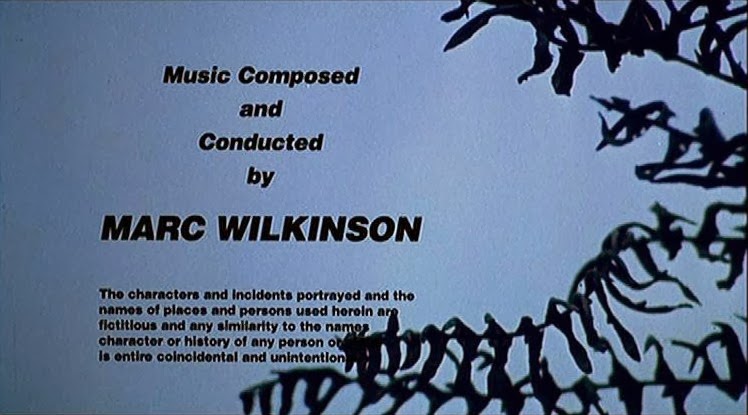

Wilkinson’s gorgeous score, which has happily been released on Trunk Records, accompanies a title sequence of great beauty. The credits are placed within framing curves and arcs of thorns and winter branches, furled ferns and spent seedheads. The separate shots resemble book plates or illuminated chapter headings in some exquisite folio edition, pages with decorated margins. The title sequence leads us to anticipate something quite special, an expectation which the title had singularly failed to raise.

Vermeer interiors - Margaret's tale
There are, naturally, some shortcomings attendant upon a film made on a very limited budget and timescale. The original plan had been for an omnibus film in the Amicus mould, with three stories taking place in different historical periods. Writer Robert Wynne-Simmons duly produced three separate tales, only for the producers to change their minds and decide that they wanted a single story set in the 17th century. Michael Reeves’ film Witchfinder General had been a big success for Tigon, and this was now considered to be a marketable period. Harshly realistic historical horror set in a pre-industrial rural England was, Tony Tenser and his partners decided, the new thing. The joins between the three patched-together stories still show to a certain degree, although the story still forms a coherent whole. In fact, it inadvertently displays the classic three act structure recommended by the gurus of formulaic Hollywood scriptwriting. Part one is the tale of Peter and his bride to be, and largely takes place in the farmhouse and its attic. Part two concerns the growth of the cult and its effect on Ellen and her children. It takes veers between her cottage, the woodland and its makeshift shrine and the village church. It’s also the tale of Cathy and the loss of innocence, of childhood’s end. Part three concerns the hunting down of the cult, and takes place in farmhouse and barn, village, woodland, lakeside and a chalk pit, against whose crumbling white cliffs Angel, in her soiled white shift, appears all the more like a desperate, fallen incarnation of her given name. It is also the pitiful tale of Margaret (Michelle Dotrice), who finds herself exiled from the cult and from Angel’s favours. Margaret is at the centre of the one scene which directly emulates the tone and subject matter of Witchfinder General. She is ‘ducked’ in a lake in the middle of a pine wood. This is a brief diversion to Black Park in Bucks, a home counties location familiar from dozens of Hammer films, in whose waters an unfamiliar victim is often found floating.

Angel as genius loci of the chalk pits
The comparison with Witchfinder General is an interesting one. Blood on Satan’s Claw actually takes place at a later date than the Civil War period in which Reeves’ film was set, and a significant shift in attitudes has taken place. The days of hysterical accusations are over, and the persecution of ‘witches’ is seen as a historical aberration. The clothes of Mistress Banham’s husband, who we are told died 10 years ago, hang from the rafters in the attic gathering dust, and represent an era of history being packed away along with the culture and beliefs which went with it. These old-fashioned garments have the haunting quality of any clothes hung in storage, empty of the bodies which once inhabited them. The Judge, dwells at his leisure in Mistress Banham’s farmhouse, and it is made plain that they were intimate acquaintances in the past. He raises a glass to ‘his Catholic Majesty King James III in exile’, adding ‘may God keep him in France’. It’s an ambiguously phrased toast from a measured and enlightened man who chooses his words carefully, and it leaves us none the wiser as to whose side (if any) he’s on. It places the period as post the Glorious Revolution of 1688, which brought William of Orange and his wife to the throne of England, displacing the hugely unpopular Catholic monarch James II. James bore a son in the self-same year, and naturally enough called him James. When James II died in 1701 in France, his son became the exiled pretender to the throne, the James III in question. So Blood on Satan’s Claw can be considered to take place in the early 18th century. The last witches to be executed in England are generally thought to be the 3 ‘Bideford Biddies’, who were tried and found guilty in Exeter in 1682. The trial was a considerable embarrassment to the judiciary, who believed the charges to be superstitious nonsense but bowed to the strength of local opinion. The superstitions and folkloric hearsay which fuelled it were dying out even in such benighted corners of the country, however.

The Judge as Enlightenment scourge
The Judge in Blood on Satan’s Claw is deeply sceptical about the return of what he terms the ‘old superstitions’, and is a man of the dawning age of enlightenment. When Peter suggests that ‘there’s evil in this house’, the Judge takes a firmly rationalist stance and advises him ‘you must cleanse your mind of such fancies’. Peter later visits him in London to inform him of the grim developments in the village, and tells him that ‘witchcraft has returned’, the implication being that it has been absent from people’s minds for some time. The Judge remains sceptical, however. When he does return to mete out justice, he declares ‘I mean to run this devil of yours to earth, if he exists’, and demands some form of evidence before he proceeds. Once he has that evidence, however, he becomes a terrible scourging angel, coming not to bring peace, but with a sword; and a huge ceremonial cruciform one at that. There is also a sense in which he is burning away the last remnants of the old magical thinking, making way for a new world of scientific rationalism which will disperse the shadows of the 17th century and the bedevilled medieval mindset in its clear, illuminating light.

Howard Goorney, Barry Andrews and Charlotte Mitchell
The cast of Blood on Satan’s Claw has an interesting genre pedigree. Several had appeared in Hammer films. Barry Andrews worked in the archetypal Hammer tavern in Dracula Has Risen from the Grave, whilst Linda Hayden played one of the daughters of the trio of hypocritical Victorian patriarchs who were wooed over to the dark side by Christopher Lee’s Count in Taste the Blood of Dracula. Howard Goorney, who plays the very 1970s doctor, had made a very minor incursion into the world of Hammer, playing a drunk in the 1964 movie The Evil of Frankenstein. This was the film in which Hammer misguidedly tried to reappropriate the Jack Pierce Karloff look for the monster. Goorney was a graduate of Joan Littlewood’s Theatre Workshop, and went on to write an invaluable history, The Theatre Workshop Story, which drew on personal reminiscences as well as interviews with the actors he had worked with.

Wendy Padbury as Cathy
There’s a double Dr Who connection. Wendy Padbury (Cathy) played the longstanding companion Zoe alongside Patrick Troughton’s Doctor in the 1960s, whilst Anthony Ainley would go on to play the re-incarnation of the Doctor’s nemesis The Master from the latter episodes of the Tom Baker era through to the very last ‘classic Who’ story Survival opposite Sylvester McCoy. Patrick Wymark was also in the running to play the regenerated Doctor in the 60s. Blood on Satan’s Claw was to be his last film, and he died before it was released in the cinemas. He gives a strong and characterful performance in defiance of his poor state of health. He’d appeared in Witchfinder General, and was also in Roman Polanski’s Repulsion, a Tony Tenser production from the pre-Tigon days of Compton Films. Michelle Dotrice plays Satan’s disciple a couple of years before she entered the nation’s hearts as Betty, the long-suffering wife of Frank Spencer in the immensely popular sitcom Some Mothers Do ‘Ave ‘Em. Her breathy invocation ‘hail Behemoth, spirit of the dark. Take thou my blood, my flesh, my skin and walk’ was sampled and used to great effect on the stirring track Scarlet Ceremony on the Ghost Box album The Owl’s Map by Belbury Poly, which gives an idea of the kind of territory in which the film has exerted a pervasive influence.

Milton Reid patiently waits his call
Milton Reid, the Judge’s implacable enforcer, was an interesting character too. Born in India of an English father and Indian mother, he moved to England in his teens and became a professional wrestler after the war. He also took small parts in films, his imposing frame and bulldog head making for a striking onscreen presence. He invariably played stone-faced executioners, intimidating genies or other Arabian Nights heavies (and you can imagine him leaning on an unfeasibly large scimitar), or standard issue mute thugs. He was highly effective in these supporting roles, creating an immediate and lasting impression, and adopting a less is more approach to acting. He really just had to be there. He was in the splendid Hammer smuggling swashbuckler Captain Clegg, which featured Peter Cushing at his dashing, athletic peak (an English Errol Flynn in his day), and was later in Dr Phibes Rises Again and The People That Time Forgot, the Amicus follow-up to the Michael Moorcock-scripted Edgar Rice Burroughs adaptation The Land That Time Forgot. Robin Davies, who plays Cathy’s brother Mark, had just appeared in the TV series Catweazle, set on another farm. He played Carrot, the farmer’s son who befriends the tetchy wizard and introduces him to the bewildering magic of the modern world into which he has fallen. He also turned up earlier as one of the ‘scum’ knocking up a fry-up in the lower levels of the emblematic school in Lindsay Anderson’s If…

Robin Davies
Director Piers Haggard never quite matched the strange and potent magic of Blood on Satan’s Claw in his subsequent work, although the 1979 Quatermass serial with John Mills again makes highly evocative use of the English rural landscape. He seems proud to have created a film which has built up such a lasting cult reputation over the years, though. It’s a reputation which is well deserved.


Thursday, 30 January 2014

A Field In England


A Field In England is showing at the Black Swan in York on Friday 7th February 2014 in an absolutely cracking double bill with Blood on Satan's Claw, once more showing the immaculate taste of the good people behind Fiendish Thingee. It all starts at 7pm, and you'll leave with the smell of loamy (and bloodsoaked) English soil in your nostrils. These really are wonderful films, both boasting extraordinary soundtracks, and it's a privilege to be able to see them screened together. Here's some notes for A Field In England, which I've fallen for utterly on a second viewing. More on Blood on Satan's Claw to come, hopefully. You might want to note the presence of SPOILERS below.


A Field In England is the fourth feature made by Ben Wheatley, one of the most exciting new British directors of recent years. It is also the third film on which he has collaborated with his other half Amy Jump, who wrote the script and co-edited the footage. It’s a difficult film to define or safely corral within familiar genre boundaries. As such, it continues in the line of his previous films, which have tended to meld various generic elements into a seamless whole. His debut, Down Terrace, was a tale of small time gangsters which felt more like a Mike Leigh film. Kill List also inhabited geezerish gangster territory, but the macho conventions were subject to critical scrutiny and transformed by the emergence of a horrific occult conspiracy plot which also laid bare the roots of power and spiritual corruption. Sightseers was a comedy drama which once more brought Mike Leigh to mind, but which also showed a keen poetic eye for the English landscape and a sharp awareness of cultural and class divisions in the country. A Field In England harks back to Down Terrace in terms of its delimited location, and its ingenuity within a limited budget. But we’re a long way from modern day Brighton here. Wheatley and Jump take us back instead to rural Monmouthsire in the mid-17th century, at the height of the English Civil War.


As soon as you start trying to place the film, you come adrift, however. The very mutability and lack of fixed form has led to a certain amount of confusion in its reception. The first word that has sprung to mind for most people that I know when summing it up is ‘weird’, usually preceded by an emphatic ‘very’. It’s set in a specific historical period, with authentic costumes (previously used in the excellent TV Civil War drama series The Devil’s Whore). But it’s certainly not a costume drama, and has little interest in the specificities of historical event. It also has some affinity with the Jodorowsky-esque head films which were so prevalent in the late 60s and early 70s, but it would be doing it (and Jump’s carefully through-composed script in particular) a huge disservice to reductively label it a trip movie (hallucinatory history, a 17th century trip, five go off their heads in a field etc.) with the concomitant assumption that it’s all just incoherent and self-indulgent weirdness for its own sake. The gorgeous black and white photography, elliptical narrative and measured pace lend it a classical European arthouse sensibility, too. The ghosts of Ingmar Bergman and the Tarkovsky of Andrei Rublev and Stalker are definitely hovering somewhere. The filmmakers have also cited Japanese writer and director Kaneto Shindo’s 1964 film Onibaba, which takes place entirely within a landscape of tall lakeside reeds, another peripheral zone just beyond a world upturned by savage internecine war. It shares Field’s mixture of the poetic and the earthy, and is also charged with an atmosphere of myth, magic and the supernatural. Peter Watkins’ 1964 BBC drama Culloden is another influence invoked by the Field team. It’s semi-documentary approach to depicting the progress and context of the 1764 battle (drawing on John Prebble’s revisionist history) takes an entirely different approach to history, making it specific and real through attention to detail and a concentration on the experience of the ordinary soldier. The actors in Culloden were drawn from historical re-enactment societies, and Wheatley’s initial inspiration for A Field In England came from a desire to document the activities of the Sealed Knot Civil War re-enactment society. They are an invisible presence at the start of the film, providing the authentic sounds of battle beyond the hedgerow.


At the same time, however, there is a blokey vein of cheerfully and unashamedly coarse humour running throughout the film. This serves to ground the arthouse elements and stop things from getting too rarefied and high-minded. There’s even a touch of the Carry On historical romp at times, with much dwelling upon bodily parts and functions. Whitehead’s analysis of Jacob’s penile problems is particularly amusing, the look on his face as he inspects the infected member through a magnifying glass held at arms length priceless. The two fingers and ripe raspberries of Sid James and the gang have here been replaced by a more direct vulgarity, with the full range of Anglo-Saxon slang regularly employed. The violence sometimes verges on the slapstick as well, with characters clocked on the head by shovels only to stagger up with little more than a groan.

Extra-cinematic influences also come into play. There’s a shared sensibility with the absurdist theatre of the post-war period (which also fed into European cinema of the 50s and 60s). In the plays of Beckett, Pinter and Pirandello, characters were generally confined to some netherworld, often with no fixed sense of place or time, leaving them disconnected from the real or the tangible. These worlds were simple and stark, and the dramas which unfolded within them were stripped down, and filled with elliptical or gnomic dialogue. The interrelationships of the characters were condensed and reduced to their essentials within this minimal framework, and the fundamental structures of power and influence were laid bare. The pit dug in A Field In England is an archetypal absurdist locale. It supposedly contains a treasure the nature of which nobody seems certain, but effectively becomes a communal, self-excavated grave. With its props and ladders, and the schisms in status which the division of labour in its digging and maintenance reveals, it could also almost anticipate the trenches of the First World War. And, as with all pits, it has myriad symbolic associations. It becomes a place dislocated from specific geography and time. The skull discovered in its depths could come from any era, past or future.

Tableau poses - the living woodcut
Field is also that most unfashionable of things in an age of realism and naturalistic drama: an allegory. This makes its period setting particularly apposite. It was, after all, the age of John Bunyan (who fought in the Civil War), and a time in which revolutionary sentiments were often couched in such terms, the political inextricably intertwined with the spiritual. The phrase ‘the world turned upside down’ (which was also the title of a contemporary ballad) is a phrase often used to sum up the spirit of the age; the possibility of fundamental and permanent transformation which lay behind the political, social and religious upheavals spreading through the land. The phrase is uttered by the alchemist O’Neill in Field, who adds the cynical addendum ‘and so is its pockets’, the philosophy of the ruthlessly opportunistic materialist who would seek to exploit and thereby undermine the idealistic spirit. We are offered a giddily literal visualisation of the phrase towards the end of the film, when the field becomes an airy sky, and the sky a grassy heaven. The religious element is central to the film (as it was in a more tacit fashion to Kill List), which again makes it boldly unfashionable. There are several still tableaux staged throughout the film, which are intended to capture the flattened perspective of the woodcut illustrations of the period, but which also lend a further air of sacred ritual to the proceedings.

We begin the film by crossing a threshold, pushing blindly through a thick and high hedgerow, fern and thorn parting before the panicked point of view which we share. The hedgerow is a barricade which separates us and the four characters we come across from the war, which proceeds loudly but invisibly beyond. This barrier immediately cuts us off from the world of historical event and the kind of film which attempts to give it colour and life. The brevity of the cameo appearance by Julian Barratt (Howard Moon in The Mighty Boosh), abruptly truncated by a pike through the guts, also assures us that surreal comedy won’t be the primary mode of the film, although it will be present throughout. This is essentially a film to be taken seriously, even if its bawdiness and rough demotic, blending period fustian with up to date swearing, ensure that it is also eminently approachable and entertaining.

The three characters who stumble across each other in the field beyond the war are an ignoble trio. Whitehead (Reece Shearsmith), dressed in Puritan black with the lacily collared and cuffed shirt of a bookish man (he later confesses to have been ‘mainly amongst books’) is the first we come across. He flees the conflict and his enraged commander (a mercenary called Trower – the Barratt character – as we later discover) in abject terror. Jacob (Peter Ferdinando) is a hard-headed, individualistic and anti-authoritarian soldier whom we discover robbing the corpse of Whitehouse’s commander, unbooting it and hacking off the finger to get to the ring. He uses the third character, a bumpkin from rural Essex in a peasant’s headcap (played by Wheatley regular Richard Glover), who we later learn is a cooper, as a pillow to rest on, assuming that this is another corpse. It is only after he gets up that this daydreamer, a sleepy fool who wanders through life in a blissful daze, wakes from his deathly doze. These three are definite and distinct types, differentiated from each other through the divisions and variances of class, intelligence, piety and manner of speech. They are joined by a fourth, a shifty type called Cutler (Ryan Pope), who promises them a share of the food he is cooking just over the field’s brow. After this, he promises, he will show them the way to an ale house which lies a short way beyond. He is a false prophet, offering them a straight path to a phantom paradise (the ale house as heaven), an illusory Land of Cockayne in which their appetites will be forever sated and no-one need be sober again. Once they begin to follow him, the sounds of the war grow suddenly silent. They have crossed some kind of boundary, passed through into a space separate from the world.

Power dressing - O'Neill dons the mantle of absolute authority
Jacob and the cooper are soon dancing to Cutler’s tune, having eagerly wolfed down his mushroom-doped stew. They are enslaved by their appetites, which they are unable to control. Whitehouse refuses Cutler’s entreaties to eat, however, and more direct and brutal means of persuasion must be used to force him into the labour which they have all been enticed here to perform. He indicates his pistol, holstered around his groin, which remains an embarrassingly obvious phallic symbol throughout, the source of his cocky power. It as it this point, some 30 meandering minutes in, that the film’s antagonist, the alchemist O’Neill (Michael Smiley, another member of Wheatley’s regular repertory company), enters the field and the story, dragged in by the three reluctant recruits in the face of an apparently crushing weight of gravity, or against an immensely powerful counterforce. It’s as if another invisible presence is trying to prevent O’Neill from leaving whatever otherplace he currently inhabits (down below, perhaps). Having given his assistant a round kicking, as if he were a recalcitrant dog or a despised, bungling lackey, he dons his clothes whilst standing beneath a tree, the hallway in which he prepares to go out into this world. He finishes it all off with a billowing cloak, his symbolic mantle of authority, and stops to admire himself in the black glass of his scrying mirror. He turns this world in miniature upside down and lets everyone know in no uncertain terms that they are now under his power, and that he has brought them here to do his bidding (‘I conjured you’). They will seek buried treasure which his arts have divined is hidden somewhere in the field. We discover at this juncture that O’Neill is the alchemist whom Whitehead has been charged with tracking down and arresting for the theft of his master’s documents, manuscripts filled with formulae for magical transformations. He attempts an arrest, but is brushed aside with contemptuous scorn. The balance of power is wholly and humiliatingly against him.

So much for the basic plot, which proceeds from this point as an initially hopelessly unbalanced struggle between the divided trio of Whitehead, the cooper and Jacob on the one hand, and O’Neill and Cutler, the devil’s right hand man, on the other. This struggle obviously resonates beyond the surface narrative plane, however. It can be interpreted in any number of ways, not all of which have to mutually exclusive. Separate versions can be superimposed or positioned side by side, alternate realities to be contemplated at one and the same time.

Dead Man - William Blake guided by Nobody
The field could be a kind of purgatory, a no-place interzone where sins can be purged, allowing the soul to move on. Or it could be a curiously English version of the Tibetan Buddhist bardo, the space beyond death which the soul must navigate, either consciously attaining Nirvana or, assailed by the demonic shadows attaching to wrong actions in previous lifetimes, being cast back into the world in some guise or another. In this sense, Field would bear some resemblance to Jim Jarmusch’s Dead Man, a film which is also shot in rich monochrome. Johnny Depp’s character, who is called William Blake but has no knowledge of his namesake, is the dead man, shot in the gut early on, who is guided through a Western version of the bardo by a Native American called Nobody. He is pursued by demonic, cannibalistic bounty hunters, but becomes transformed into a figure of death himself as he journeys on. O’Neill and Cutler are two more demonic figures, relishing the cruelties they deal out, and there is a hint that the meat and bones in the stew they serve up is in fact human flesh. References to God watching in judgement, Cutler’s remark that ‘you are as good as dead this side of the hedgerow’, the uncanny impression that ‘we’re only shadows here’, and Whitehouse’s reflection that ‘whilst we live in fear of Hell, we have it’ all support such readings.

Another religious interpretation could see this as a confrontation between the Devil and a curious and unlikely incarnation of the Trinity. The cooper is a holy fool whose simple, vacant utterances occasionally express unalloyed and penetrating truths. It is he who identifies O’Neill’s true aspect, mildly observing ‘it does not surprise me that the Devil is an Irishman, although I would’ve thought a little taller’ (probably my favourite line in the film). He also reflects, apropos of nothing, ‘I think I have worked out what God is punishing us for – everything!’ They have taken on the sins of the world. Whitehead undergoes his own Passion, driven by O’Neill across the field like a vacant puppet to divine the position of the treasure. Later, he crams his gullet full of mushrooms, a sacrament of sorts (he has already drunk the drugged wine) and cries out ‘I shall consume all the ill future which you are set to unleash’. He is the innocent lamb who takes on the sins of the world, absorbing the infections of devils like O’Neill. Towards the end, he lies down in the grass and holds his hands together in prayer. When he folds them outwards in an open gesture which embraces the world, they are filled with blood, as if stigmata had manifested.

The Divided self - O'Neill recumbent

The divided self - Whitehouse recumbent
Moving away from such religious interpretations, this could also be seen as an allegory of the divided self. O’Neill and Whitehouse are opposing polarities of a singular being (something visually represented by filming their initial dialogue through isolated, intercut profile close-ups), intellectuals and seekers of knowledge with differing aims and pleasures. O’Neill is vain and materialistic, seeing in bookish wisdom a route to power in the world. He is wholly and violently male. Whitehouse is more feminine, having developed a liking for lacemaking, and is not brave or powerful in a physical sense. O’Neill imposes his superior male physicality on the splintered aspect of his dual self (a duality which he acknowledges later on by shouting that they are ‘two halves of the same man’) by raping Whitehouse in his tent. This subjugation represents what he intends to do to the entire world. Whitehouse is effectively the only representative of the female spirit in the film, something acknowledged by the very male Jacob’s mordant remark that ‘what this party lacks is the civilising influence of women’ (a line of dialogue that is possibly also a wry comment from its female writer).

Body over mind - Jacob as the embodiment of the purely physical
Jacob himself is a representative of the basic physical self, and Cutler is his opposite. He is obsessed with bodily functions, constantly uses sexual swearwords (to really swear at the time you would blaspheme), and suffers terribly in the region of his arse and his cock. If Whitehouse looks up at the stars to effect his divinations, living in the celestial realm of the intellect, then Jacob is firmly rooted to the ground (to which he effortfully adds his own earth at one point). The holy fool, meanwhile, is on his own. He has no dual self. He is, in his own way, whole, if insubstantial. In their trinity, he is the holy spirit, sometimes hardly there at all. This insubstantiality lends him a certain immortality, and he rises from the dead on several occasions (‘you’ve risen more times than fucking Lazarus’, an exasperated Jacob exclaims). He can’t even grasp the notion of the celestial bodies which Whitehouse tries to explain to him. But when he sings his song, the old Scottish lullaby Baloo My Boy, it is like a hymn, pure and true.

Spade head - the depersonalisation of forced labour
The divided self can also be seen as a symbolic reflection of the division of the general populace against itself. Whitehouse, Jacob and the cooper are reduced to slavery by O’Neill, and yet initially they do nothing to help each other. The inebreiated duo cavort behind Whitehouse as he is brutally driven through the field, and Jacob initially mocks his book learning. He comes to be thankful for it later, however, recognising its worth as a soothing balm is applied to his burning member. The servitude and individual erasure of forced labour is represented by still shots in which heads are eclipsed by the spatulate flat of a shovel’s business end, and the shovel is also used as a weapon to turn against the serf who dares to defy orders and put it down. Jacob and the fool fight each other in the pit they dig and are effectively cast into, a political dispute over the latter’s refusal to recognise his servile state (‘I’ll be a better slave than you’, he boasts). It is only when they join together, unite in action, that they are able to confront O’Neill and Cutler. Thus the story can also be seen as a political fable about the need for a common purpose and fixed resolve to raise the commonality from their servitude. ‘I am my own master’, Whitehouse determines as he rises above the humiliations of his subjugation.

Embracing the world
So what is the field, then? It is the world in miniature, the nation encompassed within the boundaries of a hedgerow. If the period in question saw the world turned upside down, then this is the world inverted, the great contained within the small. There is some wonderful early morning photography which captures the details of the miniature world made immense: dandelion seedheads eclipsing the sun, a spider’s web framing O’Neill, a caterpillar bending a blade of grass. During his final holy delirium, as they are crawling through the grass, Whitehouse tells Jacob that he proposes writing a book and calling it ‘A Field in England, or the Myriad Particulars of the Common Weevil’. They have been reduced to the scale of scurrying insects. The giant black sun which Whitehouse sees swelling above the field, its dark absence of light relentlessly spreading to swallow the world entire, is also the circular void of his pupil (and of the black circle of the scrying glass), a projection of his own expanding vision. The field is also a region of inner space, a New Worlds/Ballardian concept about which Ben Wheatley and Amy Jump, whose next film is an adaptation of JG Ballard’s High Rise, are clearly well-acquainted. ‘You cannot escape the field’, O’Neill bellows at one point, because there is nothing beyond. The field is the world, and it is also an interior landscape encompassed by the walls of Whitehouse’s skull. ‘Then I shall become it’, Whitehouse responds. His exhalation becomes a gale force wind, several marks on the Beaufort scale above the divine breezes riffling the undergrowth in Tarkovksy’s Mirror, flattening the grass and sending O’Neill’s tent ballooning into the sky. An inhalation and it is over, the breath of the world drawn back in. In the end, Whitehouse returns through the hedgerow he’d first struggled through. But he doesn’t find himself in the thick of war. He’s back in the field, and Jacob and the cooper are there waiting for him. The last we see of them, they are standing in a row, proud and upright, the re-united aspects of a once divided whole.

The divided soul made whole
A final mention should be made of the film’s soundtrack. It’s a brilliant combination of ancient and modern which perfectly matches the film’s own sensibility. Jim Williams’ folkish songs and instrumentals create an ideal atmosphere for the more reflective moments of the film. He also blends a mournful chug resembling the sound of a viol consort (like a slowed down Michael Nyman) with the rising crescendo of an Ennio Morricone score, which finally bursts out in spaghetti western fuzz guitar at the climax of the film. Williams gets to sing the fool’s song, Baloo, on the credits, a demo recording which the filmmakers cheekily used against his expressed wishes. He has nothing to be ashamed of – it’s a lovely rendition. Contrasting with this aspect of the soundtrack are pieces of electronic music and sound design. Martin Pavey’s Metallic Fields is a piece of musique concrète which derives its sources from the resonances of struck gongs. It has a misty vaporousness and shimmering absence of attack reminiscent of Delia Derbyshire’s Blue Veils and Golden Sands. Chernobyl, a track taken from the debut (and thus far only) album by electronica artist Blanck Mass (aka Benjamin Power, one half of the Fuck Buttons), accompanies Whitehouse’s slow-motion emergence from O’Neill’s tent, and adds a huge emotional charge to what is already a powerful scene. The soundtrack received a limited edition vinyl release, long sold out, but will hopefully see wider distribution at a later date. It’s certainly worthy of it.

This is a film which gained a great deal from a second viewing, and it’s certainly one which I shall return to many more times. You can return to the field time and again, if indeed you ever really left it. Enjoy your trip, but perhaps it would advisable to pass on the mushroom soup when you return to the bar downstairs.

Friday, 10 January 2014

The Haunting (1963)


The Haunting is being shown at the wonderfully atmospheric Black Swan pub in York, thanks to the auspices of the local enthusiasts behind Fiendish Thingee, on 24th January, accompanied by the acclaimed short The Screaming Skull by Ashley Thorpe and with an introduction from horror author Mark Morris. It all starts at 7.30pm and should be a fabulous evening of chilling entertainment. There's a fine selection of ales downstairs with which to calm your nerves afterwards. Anyway, here's some accompanying notes:


The Haunting, directed by Robert Wise in 1963, is one of the great cinematic ghost stories. But is it really a ghost story at all? The film concerns a paranormal investigation taking place in a New England mansion with a twisted history and a warped architectural plan. It is certainly a story in which a haunted house looms large, its darkly malevolent façade the first and last thing we see, and its labyrinthine, logic-defying interior the claustrophobic confines in which the characters (and we, the viewers) are shut in almost from the beginning. The opening narration introduces the house as if it were a character itself, with a life of its own and a distinctly unpleasant personality. As we look at a silhouetted outline of its turreted towers and gabled wings, we are told that ‘Hill House had stood for 90 years and might stand for 90 more. Silence lay still against the wood and stone of Hill House. Whatever walked there walked alone’.

Hill House looms
The film is a fairly faithful adaptation of Shirley Jackson’s superb novel The Haunting of Hill House, from which these prefatory words are adapted. They are spoken by Dr John Markway (Richard Johnson), whose name is changed from the John Montague of the book. He is the academic who has set up this investigation into the supernatural, which has been his passionate interest since childhood. His eager attitude is summed up by his assertion that ‘an evil old house, the kind some people call haunted, is like an undiscovered country waiting to be explored’. Markway may be a respectable professor of anthropology, but at heart he is a ghost hunter. His scientific detachment is seriously compromised by the boyish excitablility with which he approaches his work, and by his evident desire to uncover, or if necessary stir up, some verifiable supernatural phenomena. To achieve his ends, he has gathered some subjects selected for their ‘sensitivity’ to the paranormal, who will act as foci for any manifestations of the uncanny, and, he hopes, be finely attuned to whatever forces lie latent within the wall of the house.

Eleanor and Theo
Eleanor (Julie Harris) lived in a house upon whose roof a shower of stones rained for several days in her childhood, a deluge which everyone assumed was connected with her intensely inward psyche. The talents of Theodora (Claire Bloom) have been brought to light more recently after she strode into a university laboratory and correctly identified the vast majority of the cards held up by the experimental tester behind a screen (these being Zener cards, presumably). This pairing is much diminished from his original list. They are the only two who have accepted his invitation, perhaps because they are the only two whose lives have reached such a state of impasse that they need a radical departure from the norm. In a scene cut from the film (but present in the book) we would have learned that Theodora (or Theo, as she prefers to be called) has just walked out after a massive row with her girlfriend. Her evident interest in Eleanor makes it clear enough that she’s looking for someone new in her life, however. The unsensationalised, matter of fact presentation of a lesbian character is one of the film’s incidental pleasures. Dormant or hidden sexuality is another current between the four temporary inhabitants of Hill House. It’s another potent source which the house’s malevolent genius loci can tap, distort and use for its own ends. At one point, a leering statue of Pan peers mockingly down at Eleanor as she runs panicked through the corridors. It’s a symbolic embodiment of this aspect of the house’s manipulative spirit.

Eleanor checks out Theo's Mary Quant gear
Eleanor is looking to escape the trap of her family home, where her sister treats her with as much controlling contempt as her mother, whose care has eaten up most of her life, had done before her recent death. A third guest in the house, Luke (Russ Tamblyn), is here on sufferance, at the insistence of his aunt, the house’s owner. He’s there both to keep an eye on the property he will eventually inherit, and to keep him out of her way for the weekend. He also serves, with his earthy and thoroughly cynical attitude, as a useful control element for the experiment. Someone who won’t believe in anything unless he can touch it, hold it and preferably make some money out of it. The costumes tell us a good deal about these characters. Theo dresses with modish confidence in Mary Quant gear. Eleanor is tweedily indistinct, buttoning herself up in plain blouses to render herself prematurely spinsterish. Dr Markway is smart casually professorial, with tie tucked neatly under warm pullover (those nights watching for spooks could get chilly) and jackets in sensible check and classic heavy elbow-patched corduroy.

Mrs Dudley or Mrs Danvers
Eleanor and Theo are psychologically primed to feel uneasy and full of dread from the moment they arrive, when they are greeted by Mr and Mrs Dudley, the Grant Wood American Gothic couple who keep the grounds and house. They look and sound as if they have wondered in from other stories. Mr Dudley is the doomsaying gardener, the kind of tersely disdainful ‘local’ type who instinctively takes a dislike to anyone and anything beyond a five mile radius from his place of birth and breeding; the like of which was parodied by Stella Gibbons in Cold Comfort Farm. He’s played with immaculate grumpiness by Valentine Dyall, who would later go on to foretell more ill as The Black Guardian in a trilogy of Dr Who stories from the Peter Davison era. Mrs Dudley (a nice cameo from Rosalie Crutchley) is a stony-faced Mrs Danvers, who tries a bit too hard to be unsettling and discouraging, going through all the things which she won’t do, and is easily dismissed with parody and laughter. She allows herself a thin-lipped smile when she announces that ‘there’ll be no-one to hear you in the night, in the dark’, a small flicker of pathetically twisted pleasure which almost makes you feel sorry for the emptiness of the life which prompts it. This cold couple are almost like emanations of the house itself, scarcely more animate than the unhappy family statue group in the glasshouse. They are a warning of the effect which prolonged proximity to Hill House has on the human soul.

Professor Markway expounds
Dr Markway’s experiment allows for a certain amount of disquisition on the nature of hauntings and psychic phenomena. He, and to a certain extent Shirley Jackson, her screen adaptor Nelson Gidding and director Robert Wise, see the haunted house as a laboratory, testing the psychological roots of fear which underpin the nature of the ghost story itself. Dr Markway is one in a long line of ghost hunters and investigators. More modern manifestations of the type tend to blend a rationalistic approach with an underlying need or desire to believe, or a forthright determination to dispel the occluding fog of such superstitious thinking. These investigators can be rather isolated, driven individuals, sometimes a little sad or cranky, sometimes amusingly eccentric. Examples include Tully in the episode of Sapphire and Steel set on an old railway station, whose platform is trod by the ghost of a First World War soldier; Dr Barrett in Richard Matheson’s The Legend of Hell House; Peter in Alan Garner’s Dramarama Spooky episode The Keeper; the hardnosed commercial scientist who would turn spirits into profits in Nigel Kneale’s The Stone Tape; Florence Cathcart, the post-First World War ghostbuster in the recent British film The Awakening; and, more comically, Milton Guest (Peter Sallis) in the 1978 HTV children’s drama The Clifton House Mystery, and Neil McCarthy as Professor Pogmore in The Ghosts of Motley Hall. After Markway’s experiment goes horribly wrong (I hope I’m not giving too much away, but you wouldn’t expect anything less, would you), Shirley Jackson has his career and boyhood enthusiasms sadly fade away. She notes dryly that ‘Dr Montague (as he is called in the book) finally retired from active scholarly pursuits after the cool, almost contemptuous reception of his preliminary article analysing the psychic phenomena of Hill House’.

Noises at the door
The house, with its off-kilter architecture designed to disorient and disturb, acts as a receptor and amplifier of human anxieties and buried fears. It’s a huge, rechargeable psychic battery, drawing on the minds of any inhabitants who stray into its corridors and hallways, and discharging the resultant energies to power a creaking, groaning dynamo of wood, plaster and brick. Spirits inherent in the house are manifested sonically; either through extreme noise terror (rhythmic pounding which threatens to buckle doors and crash through ceilings) and white noise blizzards or, more disturbingly, small sounds half heard. Rodent scrabble, muttering, slurred incantations, hysterical laughter and the crying of a child. These are the sinister resonances (pace David Toop) heard in the dead hours, noises with no evident source from things which shouldn’t be in the house with you. There is, however, one instance of apparent physical contact which provides one of the great chill down the spine moments in supernatural fiction and film.

Eleanor alone
The night terrors in The Haunting are all the more unnerving because we are made to care about the characters, and about Eleanor in particular. We hear her inner voice throughout, sounding with a hollow reverberation which only serves to underline her isolation in the world. It grants us an intimate knowledge of her wandering thoughts, a close-up view of her psyche as it battles bravely with low self-esteem, loneliness and despair. All the characters have their own vulnerabilities which the house seems to have an uncanny ability to sense and exploit. This is a portrait of the haunted house as an overbearing, pitiless bully, one who, like all bullies, knows how to choose allies with their own weaknesses in order to gang up on their chosen victim. Hill House is a microcosm of an uncaring and unsparingly competitive world as perceived by the psychologically wounded or vulnerable. The characters who gather together within its walls are haunting their own lives, and thus prove ideal ghosts in the making, spirits waiting to be extracted and trapped in its maze of corridors. But, as we have been told, whatever walks there, walks alone. Whomsoever the house singles out, it will work to isolate them, set them against the others and the others against them. Any harm which ultimately befalls them will derive from each other.

Luke disarmed
It’s also a dark inversion of the house as the symbolic heart of family comfort, warmth and protection. It has a terrible family history, springing from a cruel patriarch, and it is unhappy family relationships which it picks upon in Markway’s guests (a temporary family of sorts in themselves), expanding upon any inherent guilt or resentment attaching to them. The pounding on the walls amplifies the thumping with which Eleanor’s mother used to summon her (and which she chose to ignore on one fateful night). Theo’s friendship with Eleanor echoes her relationship with her girlfriend, and she is pushed into becoming domineering and bullying once more, thus pushing away the object of her affections. Markway’s wife turns up and pours scorn on his whole project, and it becomes clear that she holds his dearest beliefs, and by extension himself, in contempt. And Luke is forced to confront the emptiness and weath-cushioned drift of his rootless life.

Demonic faces in the wallpaper
Everyone spirals inward, and this plunge into the psychic void is embodied in the loosely attached iron spiral staircase, which winds up towards a narrow attic entrance (the route into the subconscious) and in the terrifyingly distorted visage which emerges from the wallpaper which Eleanor stares at, and which seems to leak the sounds of past sufferings from its shadowy maw. The idea of a wallpaper revealing hidden patterns when stared at too long brings to mind Charlotte Perkins Gilman’s classic short story The Yellow Wallpaper, a tale of domestic mental disintegration. These are terrors which manifest themselves when people are trapped within interiors, and within the constraints of lives which limit a more expansive spirit. These spirals and shifting, sinister crannies create a sense of psychological vertigo, of a self-hypnotic drawing towards the edge, an invitation to fall. The compulsion to let oneself go, to plummet into the centre of a beckoning void, goes hand in hand with the surrender of the self. It is the wilful dissipation of the persona, which atomises like so much particulate dust, whirled away and dispersed. One day, it might by caught in a beam of afternoon light shining through a gauzy window, and appear to an imaginative eye to take on some kind of momentary form, a face with a look of sad bewilderment. The Haunting can, at times, be a quite extraordinarily bleak and psychologically harrowing film; a glimpse into the void, opening up in the embossed interstices of an old and faded wallpaper pattern.

The compulsion to fall
The haunted house as the maze of a mind turned in on itself is an idea which is also explored in The Shining by Stanley Kubrick. Kubrick makes the metaphor literal by having Jack Nicholson’s increasingly unstable husband and father stare fixedly down upon a model of the maze in the gardens. He later loses himself utterly in the real version and becomes a frozen statue amongst its snow drifted hedgerows. Wise’s maze, with its unstable spiral at the centre, is subtler, more elegant and disconcerting however. It is also realised with a great deal more humanity and compassion. And Wise certainly didn’t need to torment any of his actors to get the performances he wanted from them.

Fancy staying the night?
The film may be set in New England, but there is something very old English about its atmosphere. This is not least because it was shot in the UK, at MGM’s Boreham Wood studios in Hertfordshire, one of the home counties film worlds ringing London. The exteriors were shot at the neo-gothic pile of Ettington Park near Stratford Upon Avon. It’s now been turned into an upmarket hotel, so you can stay the night if you wish. Although you should perhaps be advised that the AA deems it the most haunted hotel in the country. You might also think of asking for a change of room if you find yourself put in the old nursery.

A warm welcome to Hill House - Valentine Dyall as Mr Dudley, the caretaker
The cast has a distinctly English pedigree, too. Rosalie Crutchley and Valentine Dyall were both character actors often seen on stage and television. Someone else must have drawn the comparison with Cold Comfort Farm, too, since Crutchley appeared as Judith Starkadder, the mother of the doom-loving rural clan, in a 1968 TV adaptation. Richard Johnson was a British stage actor who had just been appearing in a RSC adaptation of Aldous Huxley’s The Devil’s of Loudon (also the basis for Ken Russell’s notorious 1971 film) at the time The Haunting started filming. Julie Harris was also spotted by Robert Wise on stage. The quality of the actors adds immeasurably to the complexity and depth of the characters in The Haunting. Claire Bloom had been appearing on stage and screen since her teens, and was at this stage playing classic romantic roles such as Anna Karenina and Cathy in Wuthering Heights on British television. Lois Maxwell, who plays Markway’s wife, appears just a year after she had first played Miss Moneypenny, the character with whom she would become synonymous, in Dr No. Russ Tamblyn came with Robert Wise from his previous film West Side Story, and brings one of the few authentically American elements to the set up.


It’s worth noting that Robert Wise made The Haunting in between West Side Story and The Sound of Music. Prior to this, he had made the science fiction classic The Day The Earth Stood Still, and turned his hand to crime thrillers, films noirs, boxing pictures (two of these), social issue and boardroom melodramas and submarine-set war movies. Talk about diverse! The Haunting took him back to the territory of his directorial debut, however. He made The Curse of the Cat People with producer Val Lewton in 1944. It was a lovely, poetic, tangential sequel to Cat People, the first of the literate, beautifully written horror b-pictures which Lewton made for RKO in the 40s. It too features a haunted house, a lonely girl whose perspective we share, and damaged relations within families. The house is haunted by the living ghosts of an aging actress who has retreated into a fantasy of her past, and her sad daughter, whose life has been dominated and eclipsed by her overbearing and flamboyant mother; Another point of comparison with The Haunting. Wise also directed The Bodysnatcher for Lewton, based on Robert Louis Stevenson’s gruesome short story, and he brought out a quite superb performance from Boris Karloff.

For The Haunting, he used low angle shots looking upwards from ground level to give the impression of a confining space, of walls and ceilings pressing in. He also used a new lens which was still in development, and which at this point had a flaw which entailed a certain amount of distortion at the edge of the picture. He ignored the pained pleas of the technician involved, insisting that this ‘imperfection’ created precisely the look he was after. In tandem with unconventional angles and camera placements, it gives a powerful effect of disorientation, adding to the sense of a malign, oppressive architecture and interior design already created by Elliott Scott’s impressive sets. Wise’s shooting of the scenes on and around the spiral staircase are particularly effective. He erected a pole parallel to it, so that the camera could be smoothly manoeuvred up and down, and could floatingly observe whoever was climbing it, or view it from above or below. He also had the camera’s point of view glide up, down and around the hand rail, a readymade track. This is used to dizzying ends when we whirl rapidly down, as if hurtling out of control down a helter skelter.


Wise’s assured directorial touch and imaginative response to material with which he was obviously sympathetic, along with his handling of a fine cast, make this one of the greatest films of the fantastic in cinematic history. Now who’s that knocking on the door so loudly and vigorously at this time of the night?