Tuesday, 24 February 2015

The Holcombe Rogus Time Traveller


It was a freezing January morning when I lifted my bike off the train at Tiverton Parkway station and wheeled it down the ramp into the carpark. The station is nowhere near Tiverton (it’s actually just outside Sampford Peverell), but it is near the Great Western canal which winds its way across mid-Devon from Tiverton in the West to Greenham and the River Tone in the East (it used to continue as far as Taunton). A telling proximity, given that the coming of the railways meant that the canal never extended its watery vein from Bristol to English Channel as originally planned. It was eastwards that I was bound, to the village of Holcombe Rogus just a short, winding turn of a country road from the Great Western’s terminal tunnel. I pedalled off, crunching the ice glazing puddles and sending the silhouettes of crows flapping into the sky from the skeletal branches of their winter roosts. The path alongside the canal immediately passes beneath a concrete road bridge carrying the busy A361 traffic. It’s a bleakly functional signifier of the decline of the railways, which is why you can no longer get anywhere in mid-Devon (Tiverton included) by train.


The canal is frozen over, lengths of anchored reed emerging from the pale blue plane of its surface and forming acutely angled peaks. The reflections of these sharply outlined reed strokes combine to create rectilinear groupings of wonky rhomboids. Nature’s formalist abstract compositions. I lose myself in their strangely perfect patterns for a while, but then an electric blue peripheral eyeflash and I immediately look up to see a kingfisher dart in a frictionless glide over the icy channel. I follow its flight in staggered cycle stints, from bullrush perches to branch overlooks to weir post plinths. In the colour drained winter landscape it is a tiny splash of vivid orange and blue life, a mesmerising will-o-the-wisp drawing me inexorably onward. At times it levitates into the air above unfrozen stretches of the canal, hovering blurrily before plummeting with mercurial suddenness into the icy waters. Its beauty is at times quite breathtaking, and I am entranced for a lengthier period than I had bargained for, or had factored into my admittedly extremely loose and largely notional schedule.


On the other side of the canal, I pass a perfect pastoral scene, sheep grazing beside an oak tree spreading bare branches before a small chapel in the middle of a field the size of a large garden. Had it been a burnished autumn day, it could have been a composition from a Samuel Palmer painting, the Darenth Valley superimposed over the rolling plains of mid-Devon. The building was Ayshford Chapel, dating from the 15th century and attached to the medieval seat of the Ayshford family, a manor which was recorded in the Domesday Book. 16th and 17th century monuments to successive generations of Ayshfords can be found in the church at Burlescombe nearby. From the latter part of the 17th century onward, manor house became farmhouse and, by the looks of it, remains so to this day. The location of a chapel in a farm field occupied by a placidly grazing flock of sheep suggests an obvious symbolism of the sort the more pious Pre-Raphaelites would have used unhesitatingly. It was also an incongruous and delightful sight to happen upon.


There were techno pastoral vistas to be viewed from the towpath, too, as the canal was paralleled by the striding giant frames of pylons. Crackling lines were held up by upraised, ceramic insulator-braceleted arms sloping from hunched, vorticist shoulders, strung in slackly undulant lines from one giant to the other. They crossed the canal and marched off over the gentle rise of the slope beyond, marking out distance with dwindling perspective as they approached the horizon. Blue reflections in half-frozen water contrasted with the quills of bulrushes on the bankside, coiled and pendant tubes of insulators the hollowed out forms of the erect, solid seed heads, chocolate brown and cigar-shaped. Passing under the power lines, I paused to tune into the harsh electron drone, the white heat overtone hum of modernity. I’m travelling back to the pre-modern age, alongside an early modern industrial transport network. I’ll soon arrive in a time when technologies of the electric (now digital) age, long since taken for granted, would have been considered miraculous, magical and quite possibly the work of the Devil.


The canal now ends just beyond the twin nooks of old limekilns, entering a dark, narrow tunnel of the sort to produce claustrophobic nightmares, or inspire a ghost story by LTC Rolt or Robert Aickman (both founders of the Inland Waterways Association in the post-war period). Pushing my bike up the slope to the bridge above, I travel the short distance along a contour winding country road to the village of Holcombe Rogus. The church is at the further end of the street which gently winds up between tidy cottages, raising its square, crenellated, copper weather vane-crested tower above them all. It is bordered by the imposing façade of Holcombe Court, a 16th century Tudor house built by Sir Roger Bluett, and inhabited by the Bluett family until they sold the estate in 1858. We will discover a good many Bluett’s inside the church, and will find the divisions so unequivocally demarcated by the manorial walls looming above the humbler dwellings of the villagers below will be replicated in its sanctified but far from unworldly space. The venerable Nikolaus Pevsner says of Holcombe Court that ‘its entrance front is the most spectacular example of the Tudor style in Devon’. The gates are connected to an intercom with attached number code pad, a clear signal for the uninvited to clear off. I take a quick photograph and then briskly retreat before the current incumbents release the hounds.


Walking up the path to the church, the present started to seem more attenuated, the sense of still suspension engendered by the clear winter chill intensifying the effect. The mud and lack of preservation gloss allowed for a true sense of the surroundings inhabited by our medieval forebears, much more so than many buildings which have been cleaned up, fenced around and littered with signage and presented to us as prime cuts of our heritage. A sturdily buttressed, roughly-bricked building bordered the narrow approach, lying long, heavy and squat. This was once the church house, the hall where the villagers would gather for meetings, church ales and seasonal revels. Festivities would no doubt spill out into the surrounding streets and even into the graveyard and the nave of the church, its public space. The high west wall of the graveyard is also the wall of the Tudor manor house, and its roofs and chimneys rise ostentatiously above its top edge. A door in the wall gave direct personal access to the churchyard for the Bluett family, a private passage and short processional leading to the south porch.


I enter the porch and turn the iron ring on the oak door upward. The latch inside lifts with a decisive thunk and I push the door open, the creek of iron hinges echoing around the still interior. There is always a slight thrill upon finding an old church open, and knowing that you will now be able to explore its layers of history, to become attuned to its hushed ambience and subtle resonances. These must be haunted spaces to inhabit at night, with only a flickering candle to hold back the murmuring darkness.


I wander along the aisles of the nave, head craned upward so that it’s a wonder I don’t run slam bang into a pillar or crack my shin on a bench end. It’s not long before I spot my first Green Man, carved on the capital of one of the 15th century stone columns. A two-faced head in peasant’s hood, its features an uncommon portrait of a common villager, folds itself around a corner. Its Janus gaze takes in the unscrolled landscape of historical time and untold visions of far futurity, finding no distinctions between them. The head’s dumbly gaping mouth spews forth plaited oak shoots decorated with acorn cups both empty and full, which garland the columnar circumference. This symbolic figure of the woodlands, emblem of vegetative renewal, has proliferated within the church, manifesting itself on the trunks of several columns.


One Green Man has leaflike ears and a mild porcine face, hawthorn-like branches and leaves issuing from its gullet. Another capital is carved with a fourfold Green Man, one face for each corner. Their varying moods and visages seem to reflect the shifting tempers of the seasons. One stares blankly with gummy vacancy, hardly there at all. Another looks ferociously out with sharp-eyed, sharp-toothed hunger. And another has a bovine mien, ears devilishly pointed but with the blunt, squared-off teeth of the herbivorous ruminant. A fourth face, thoughtful and human, a wreath of hair crowning the ridges of a bony forehead, looks down on the benches below, the eyes alert and intelligent. They are all tethered together by ropes of ivy which shoots forth from generative mouths, the sprouting language of the greenwood.


That other perennial inhabitants of medieval churches, the memento mori skull, is also present in bony profusion. Church’s are death-haunted spaces, full of memorials to those who have passed through and beyond. Here is Death etched in slate on the floor, ebony features smoothed by centuries of soles. He wears a wreath, the Emperor of his own domain, and one eye socket has a tiny grain of red lodged in it. He crowns one of the Bluett memorials, kingly pate bounded by a crown, although sans the crown of his teeth, his hollow gaze focussed on an unearthly distance beyond the heraldic eagle and squirrel perching on milky helmets before him. He is at the root of another Bluett tomb, cracked open like one of the squirrel’s nuts. And he is carried by the ghost effigies of the Bluett children like some dark-lit Hallow’s Eve punkie. He is everywhere, inescapable. You cannot evade him whichever route through the aisles you take.


Low winter light pours in through the windows at the east end of the church. It illuminates the marble globes fixed into smooth craters in the gray, lunar stone of the reredos, the screen behind the altar. It looks like they might long ago have worn the dishes of those craters through repeated rolling rotations. The red, black and grey patterning of the spheres resembles the plateaus, rifts, oceans, deserts and mountain ranges of planetary surfaces, the warmly reflective glow hinting at habitable worlds.


I ascend the narrow spiral of stairs which used to lead the dizzy climber to the rood screen dividing nave from chancel, secular from sacred, the public from the priesthood. It’s no longer there, the steps ending in empty space, a small rectangle of hardwood acting as a token barrier. The colourfully patterned organ pipes rise in swelling and ebbing graphs, physically charting the relative masses of sound, the volumes of air which will be displaced. I imagine a protean organ chord suddenly erupting from the arrayed pipes, tumbling me back down the stairs in a Peanuts roll. I could potentially jump from the narrow top stair on which I perch, feet placed toe to ankle in a sideways alignment, and land on the roof of the organ, sending up a thick billow of age-old dust like a volcanic ashcloud. But I suspect my dashing leap, Phantom of the Opera theatrics on a parochial scale, would result in my crashing straight through the ceiling leaving me trapped within the belly of the musical beast.


From the precarious vantage point of the top stair, you can get a close view of the stained glass angels in the upper tracery of the East window arches. Created in 1892, they are Arts and Crafts creatures. But they also look curiously like comic book characters from the 1970s, or golden haired rockers from an album cover by Jim Fitzpatrick. The Victorian artists may have left out extraneous detail which wouldn’t have been visible to the congregation below, but the resultant simplification of form apparent from closer quarters results in a surprising modernity. These are timeless angels. A thread of spidersilk spans one of the angelic panes, anchoring a spun which gently trembles with its seething black cargo. Soon the face of the angel will be occluded by a crawling arachnid shadow of tiny scuttling dots.


Another pane has a two-dimensional cookie-cutter strip in the form of a clover leaf intertwining with a triangle in a puzzling Escher embrace. The three lobes of the clover the leaf and the three points of the triangle are perhaps symbolic of the Trinity, a linking of the divine symmetry of nature with the ideal geometries born of the rational mind.


I turn to descend the spiralling stair once more. Halfway down, I pause to look through the diamond lozenges of the centuries old windows. They are frosted with a fine cracquelure of scratches, cracks and webs which seem to have fused the surface, all spotted and coloured with dots and blots of lichen and mold. The windows frame the gravestones, manor house wall, church house and trees, freezing them in a blue-green light. It resembles the gelid tint of the icebound canal. The world outside is lent the semblance of worn and abraded antiquity. It’s as if the speed of light has grown sluggish in its passage through this obscuring glass, and I am looking out at a scene from some indeterminate period of the past. Will I witness a stern figure in Puritan black walk determinedly up to the churchyard gate? Or church ale revellers in medieval tunics stumble out of the church house? I turn from such reveries and tread the last few downward steps to re-enter the main body of the church.


I cross to the North side of the chancel where a screen brought from St Peter’s in Tiverton in 1854 now encloses the Bluett family chapel. The screens proclaim this as a private space, the Bluetts exercising manorial rights even in death. It contains the elaborate tombs of two generations of the family. Richard Bluett and his Mary Chichester are dressed in sober black, their heads resting on the pleated plates of their capacious ruffs. Richard died in 1616, some years after Mary. His effigy rests on its side, propped up on an elbow, and looks down on the recumbent form of his wife below. His eyes are clear, and the brown-irised pupils shift their gaze sideways to focus upon her face. Mary’s eyes are turned upward, and are glazed with the sightless film of death, focussed on nothing visible in this world. Richard’s lips are full and ruddy, still flushed with life; Mary’s are thin, drawn and pale within her drained marble features. Two panels of text above the couple proclaim her virtues in gold lettering, declaring that ‘a modest matron here doth lye/A mirror of her kind’, being ‘Godly, chaste and hospitable’.

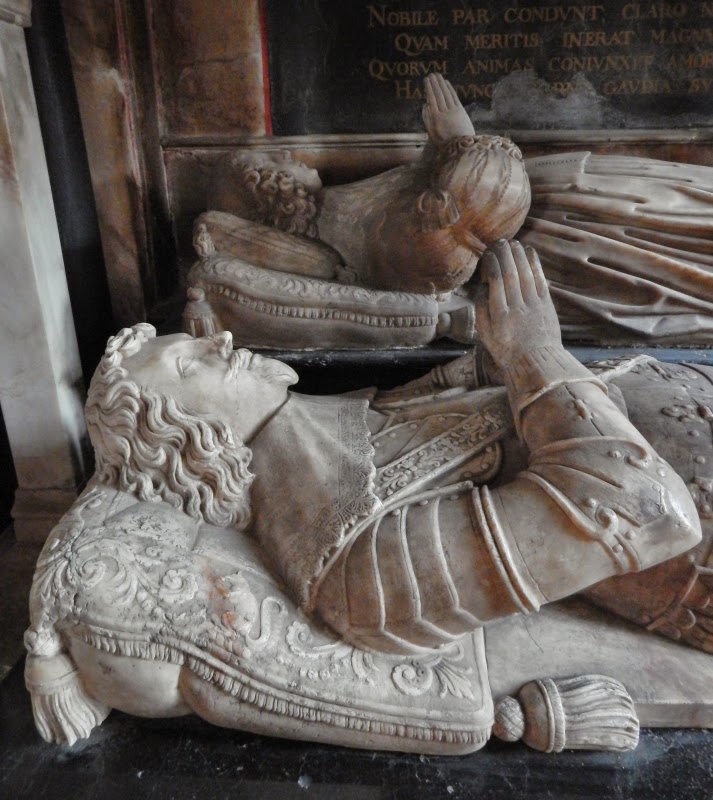


The subsequent generation, Sir John Bluett (d.1634) and Elizabeth Portman opt for more formal tomb attire and poses and restrict themselves to monochrome marble. He is encased in armour, with a frilly lace collar adding a courtly touch and making it clear that the protective plating is purely ceremonial. His face has suffered some minor damage over the years, however; and a crack across the bridge of the nose and from the mouth to the cheek (the latter appearing as if it has been partially disguised by the growth of a moustache) are suggestive of duelling scars or war wounds. Lady Elizabeth has on her finest dress, with expansively puffed out sleeves making the point that she doesn’t expect to be doing any practical work. They both stare blankly upward at the ceiling of their funerary fourposter, their heads resting on tasselled pillows of stone, hands pressed stiffly together and raised in permanent prayer. At their feet, loyal heraldic beasts keep eternal guard. Elizabeth has a small house dog curled up by her pointed slippers, ready to yap ferociously at any potential desecrators. Sir John has a bushy-tailed squirrel nibbling on a nut clutched in its tiny paws. It’s a creature which also perches atop the heraldic helm crowning the tomb. A perplexing and potentially comical choice. But perhaps the squirrel’s storing up of its nuts represents a pragmatic conflation of the worldly husbandry of wealth with the promise of spiritual fulfilment in the life hereafter. Heaven is a place where you have an endless supply of nuts. The squirrel is, of course, of the red variety, its transatlantic grey hoodlum brethren yet to have been introduced to take over the whole park bench feeding racket in the 20th century.


At the side of the cold stone bed, the Bluett children obediently line up in an orderly rank. They were all daughters (and thus none could inherit the estate) and they float spectrally in palled marble, gowns sweeping the floor. Some carry flowers, some have hands pressed in prayer, others carry skulls before them. These are the unlucky ones, these bony tokens memento mori of their own early passing, outlived by their parents. I briefly became fascinated by the views of a varying array of intricately twined topknots visible from behind, a rare insight into the details of period hairdressing.
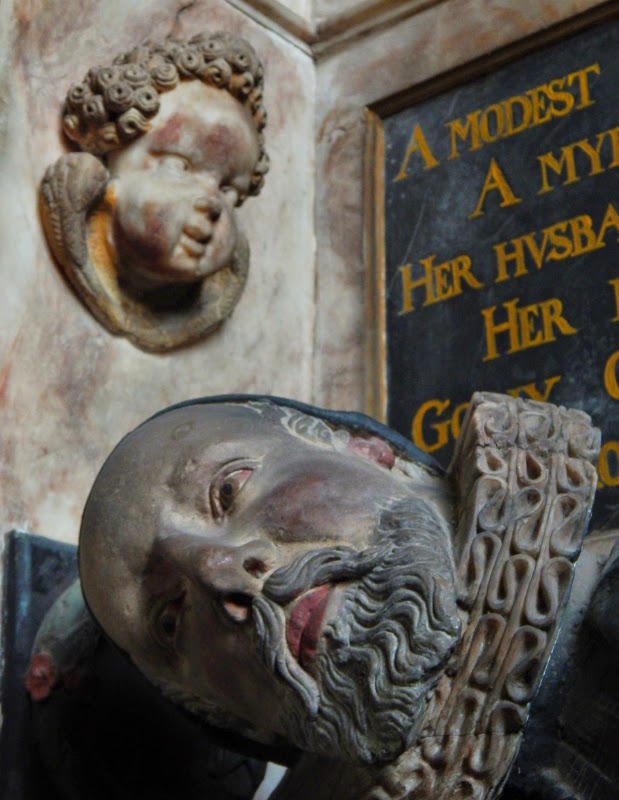


Both pairs of Bluetts are overlooked by the vague presences of Putti, disembodied infant heads fluttering about with the aid of wings attached to their neck stumps. They look like they they’ve alighted for the briefest moment and, easily distracted, will flit off elsewhere at any instant. On my way out of the chapel, I notice a slab tombstone on the floor memorialising another Bluett along with his wife, Kerenhappuch. What a name! And she lived to the age of 94, dying in 1759. A fine innings, seeing out significant social and constitutional changes, and no doubt aided by the medical advances of the 18th century age of reason.


Adjoining the Bluett memorial chapel is the Bluett Pew, the living taking their place alongside the dead. It’s a clear statement of continued lineage, of power and wealth (and spiritual capital) inherited and maintained into the present generation and beyond. The tall screens boxing off seats reserved for the Bluetts and guests resemble the rood screen which divided the congregation in the nave from the sacred rituals performed by the priesthood in the sacristy. But here, the division is between titled landowner and commoner. Perhaps a better analogy, then, one devoid of sacred connotations, would be a private box at the theatre or opera. The screen, carved in the early 17th eentury Jacobean period, is topped by 15 oval medallions, each a small theatrical proscenium framing scenes from the early books of the Bible – the Pentateuch. The stars arcing across the borders suggest a bounding firmament containing this earthly stage with in its circling embrace. It’s rather like Shakespeare’s wooden O from the prologue of Henry V, both the Globe theatre and the world at large which it strives to represent on its stage.


The sequence of narrative tableaux within the medallions is full of vivid life. The carved figures are simplified, but are all the more potently present for it. Eve in particular, who features in three scenes (the temptation, the expulsion from Eden and the raising of the first children, Cain and Abel) is filled with primal power and spirit. She looks timeless, both ancient and new, not rooted in any particular style of the period in which she was fashioned. Suckling the younger child, Abel, she as the look of a mother Goddess figure, an icon of fertility rooted to the landscape in which she sits, and which she also blesses with her fecundity. She is haloed by dusty cobwebs, canopies gilded by silvery sunlight – Our Lady of the Spiders.


In the temptation scene, Eve reaches up to pick a second fruit to hand to Adam who stands on the other side of the dividing bole of the Tree of Knowledge. She faces us full on, a frontal boldness which makes her the focus of the composition, the active subject. The serpent is knotted in the crown of the tree above, its head hanging down like the questing tip of a parasitic vine. The whole, and Eve in particular, is reminiscent of Gauguin’s treatment of the same subject (in painting and woodcarving). The same direct, elemental quality he found in the art of the South Sea Islands is present here in an English village church. In the expulsion from Eden carving, the angel border guard hastens Adam and Eve on their way with what looks like a well-aimed Chaplinesque boot up the bare backside. Adam pushes Eve ahead of him with a shove to the head, a violent gesture which makes it clear who will bear the blame for this exile and fall. Or is he perhaps simply preventing her from looking back at the paradise garden which they are leaving behind forever.


Behind them, a palm tree raises a feathery headdress. Trees feature in a number of the carvings, partly as a means of dividing the scene into separate sections. The also act as central props to ensure structural stability. The various stylised specimens range from fluting, tapered columns to the arching trunk of the burning bush (coiled with ivy and tipped with deciduous leaves) and a smoothly-barked, bulbous-based baobab besides which Moses stands. His head is parallel with the top branches, as if he were a towering giant.


The knotted, worming line of the serpent recurs too. Snakes writhe away from the burning bush and drape themselves in the tree beneath which Adam and Eve raise their children (the lurking poison which will enter Cain’s heart). Moses sets up a copper effigy of a snake as a protective talisman for his people, the sight of which inures them to the deadly effect of the fiery serpents which God has set on them as a punishment for doubting him.


Some of the figures are wearing the clothing of Tudor times, an anachronism which serves to bring an immediacy to the stories being related. Adam is a gentleman farmer in early 17th eentury ruff and tunic, ploughing the fields whilst a stormy-faced Cain beats the oxen with a stick. The mysterious giant in the first medallion sports Tudor headgear with a feather rakishly attached. Balaam, meanwhile, has something of the look of a Turk about him, complete with broad, bushy moustache. Two later carvings, made in 1858 during a restoration, and depicting Israelite spies returning from Canaan with a huge bunch of grapes and the bearing of the Arc of the Covenant by armed guards, are more open to the possibilities and pleasures of historical fantasia.


There is much here of the violence and retribution spattering the Old Testament. Cain’s murder of Abel, the primal fratricide which introduces death and murder into the world, is shown in all its brutal, bludgeoning savagery. Balaam’s encounter with the warrior angel which bars his way is pregnant with suspended actions and imminent bloodshed. The angel draws its sword in readiness to kill the disobedient messenger, its scything wings emphasising its muscular power. Balaam in turn beats his donkey, who turns aside from the heavenly assassin to whose presence his master is blind, thus saving his ungrateful hide. Moses raises his dagger to slaughter his son, Isaac, in a sacrifice demanded by God. His killing arm is physically restrained by an angel which leans into the world from the starry border. Moses sits above a thicket of pikes, spears and halberds bristling beyond a battlefield tent. His arms are held up by his brother Aaron and companion Hur. As long as these arms remain upraised (in a gesture of prayer and praise), the battle will go in favour of the Israelites, and Joshua, their military chief, will defeat their enemy, the Amelekites, ‘with the edge of a sword’.


Another medallion depicts a giant figure (Goliath?) striding towards a richly garbed man with a wine jug at his belt leading an ox (a sacrificial offering, perhaps). The giant holds a sword on which a severed head is impaled like a cocktail nugget. His shield bearing arm is flung out behind him and would appear to have knocked a fool to the ground. This subservient figure tumbles in his wake, grovelling body hunched in a compact, serpentine squiggle. The snake this time takes human form.


The preponderance of scenes from the life of Moses can perhaps be seen as an illustration of the rectitude of authority and power. Those who oppose Moses oppose God, and they are punished accordingly. The assertion of the divine right of kings was still extant at the time the carvings were created. There was a related sense, propagated by those whom it served, that the social order was ordained by heavenly decree. The tableaux depicting Moses bringing down the tablets from Mount Sinai and chastising the Israelites for worshipping the golden calf; of his remote direction of the course of a battle; and of his protection of his people through the creation of a magical talisman (the copper snake – an acceptable idol). All were illustrations of the rightness of authority, and the wisdom of following the appointed leader. These medallions face outwards from the seats of the Bluetts, the local face of authority and landowing power. They gave something of visual interest for the congregation of commoners to contemplate, to look up to. The establishment of authority and power is also evident in the scene in which Melchisedcck, a king and priest of Salem, pays due homage to Abraham in the victorious wake of a number of battles, and receives a grant of land in return.


Whatever political message or subliminal lessons might be encoded in the choice of biblical stories and their placement above an enclosure reserved fro the local landowning aristocracy, the carvings themselves are beautifully crafted, the figures full of life and character. I turn from my contemplation of them, neck a little sore from craning upwards, and head for the door. On my way out, I notice another stone-carved figure on a capital at the back of the nave. This one looks as though he might be a king, trimly bearded and crowned .Who could he be? Few of the Tudors sported beards, and he is certainly too gaunt to be the lustily full-faced Henry VIII. An earlier medieval monarch, perhaps. I also notice the Victorian stained glass in the rear window, which depicts the visitation of the three kings and the shepherds to the infant Christ in his stable crib. One of the shepherd’s, ostentatiously robed in purple fur, has bought his bagpipes along and is giving them a full, Dizzy-cheeked blast. I can’t help feeling this is a poor choice of instrument with which to lull a newborn baby.


I pick up the pen to sign the visitors’ book, and realise that my fingers are too frozen to grasp it firmly. The stone vault of the church is like one great refrigerator. I write my appreciative comments in a palsied script. Outside, the sunlight is approaching its golden hour glory, and I spend a few minutes wandering amongst the graves, their shadows sharp and clearcut. A couple of neat tussocks of moss top the flat plateau of one headstone, their green humps contrasting pleasingly with the smooth, granitic grey – a miniature moorland landscape. As the hedgerows and hilltop copses begin to make intricately brachiated silhouettes against the sky, I realise that it is time to move on. I pass by the church house, now casting its shadow over the muddy path to the church, and push off onto the country road which will lead me to the canal path, and thence once more to the age of future present.

Wednesday, 11 February 2015

Terror and Wonder: The Gothic Imagination at the British Library

PART TWO


Charles Dickens is the perfect figure to usher us into the Victorian world, and into the dark, narrow and crowded streets of the rapidly expanding, noisily industrial capital. A clip of the recent BBC adaptation of Bleak House, with Gillian Anderson as a ghostly Lady Dedlock, shows us the scene in which Jo the crossing sweeper takes her to the gates of the paupers’ cemetery. The bones lie on the surface in some parts, and Jo remarks of the man she is searching for (known only as ‘Nemo’ at this point) that ‘they put him wery nigh the top. They was obliged to stamp upon it to get it in. I could unkiver it, with my broom, if the gate was open’. He then excitedly points out a rat, which runs into the ground to feast. This depiction of the bodies of the dead protruding from their shallow graves, seen through the eyes of a streetchild for whom it is wholly unremarkable, is a grim Gothic touch which Dickens drew from factual observation. Victorian London was, for many, a Gothic city, but one marked by poverty and squalor rather than elegantly decaying castles and crypts. A staggered pile of booklets on display were a reminder of the part published format of the book, episodically issued in 1852. The public would devour the story in monthly instalments, eager to discover what happened next.

Woman in Black - Gillian Anderson as Lady Dedlock in the BBC adaptation of Bleak House
Gothic had become a flavour or shade which could be added to the kind of multilayered work of which Dickens was a master. It might be associated with a a particular character, plot strand or setting. It was a transferable style which could be employed in a variety of contexts. Dickens wrote a number of ghost stories as well, including The Signalman, an enduring classic of the subgenre, and the collaborative collection The Haunted House, whose framing story (written by Dickens) introducing separate tales anticipates the Amicus portmanteau films of the 1960s and 70s. It was a form which would become increasingly popular as the Victorian period progressed. It was an era much preoccupied with mortality and the memorialisation of the dead. The great necropolises which were built on the outskirts of the rapidly expanding urban centres were themselves like miniature cities of the dead. They would prove ideal Gothic locations, particularly as the years added attractive layers of gentle ruination and ivy entanglement. For Dickens, the Gothic could also encompass an element of social comment or psychological portraiture. The graveyard in Bleak House is disturbing for its exposure of appalling poverty as much as the rat-gnawed bones of the dead. Lady Dedlock drifting blankly through Chesney Wold and Miss Havisham presiding over the cobweb-strewn Satis House in Great Expectations are both spectres prematurely haunting their decaying homes. They are portraits of mental and moral paralysis.


For Dickens, the true Gothic locale was not a remote, ruined abbey or centuries old castle but the dark alleys and dilapidated houses of London. Its gaslit Gothic atmosphere is perfectly captured in the engravings Gustav Doré produced for the book London, A Pilgrimage, a journalistic record of travels through the city which highlighted the huge gulf between the rich and poor. Plates depicting the rookery of Bluegate Fields, the night-time pavement sellers of Harrow Alley in Houndsditch, the ragged wraiths working in the Lambeth gasworks and the mazes of back to back terraces in the sooty shadow of arcing railway viaducts are densely shaded with an almost palpable darkness.


The Gothic followed in the wake of mass migrations from field to factory and relocated to the city. Urban Gothic was formed in the choking fogs of London; fogs like those described in the opening scenes of Bleak House, in which Dickens imagined the possibility of encountering ‘a Megalosaurus, forty feet long or so, waddling like an elephantine lizard up Holborn Hill’. The primeval swamp seeps through into the streets of the modern city. Urban Gothic bred its own monsters and mythologies which were promulgated in the rough pages of the Penny Dreadfuls and Penny Bloods. These episodic works featured sensational cover illustrations which dramatically depicted scenes of horror and bloodshed. Precursors of the EC comics of the 50s, their potential effect on the minds of the masses who read them occasionally troubled the moral guardians of Victoria’s realm. But they generally fell so far below the literary lighthouse beam that they escaped any real censure. The dreadfuls introduced the likes of Varney the Vampire, with his impulsive thirst for blood; Sweeney Todd, the demon barber and fresh meat merchant; and Spring Heeled Jack, a proto-supervillain who could effortlessly leap over the rooftops of London, and who gradually morphed into an enigmatic superhero in the Batman mould. A copy of The Mysteries of London by George WM Reynolds was also on display, explicitly inviting the reader imagine their city as a labyrinth of hidden terrors, lurking and ready to spring. The prolific Reynolds also wrote an early werewolf tale with his 1846-7 series Wagner the Were-Wolf. Some of Dave McKean’s original full-colour illustrations for the Batman story Arkham Asylum were displayed as an example of a modern version of the urban Gothic of the Penny Dreadfuls.

Harry Clarke's illustration for Poe's William Wilson
Edgar Allan Poe was a central (perhaps THE central) figure in mid-19th century Gothic literature, and his morbid sensibility spread like an enervating virus, distilling fever dreams from the unconscious underworld of a motley spectrum of writers and artists, from French Decadents through Edwardian illustrators of children’s books to subversive Surrealists. One of Poe’s letters was on display, allowing us to inspect his neat handwriting and feel a sense of communion with the man who wrote it. Truth to tell, it doesn’t provide a very edifying portrait. Addressed to Fanny Osgood, one of a series of women with whom he became obsessed in his short lifetime, and whose patronage and hospitality he frequently called upon, its fulsome and fawning praise of her literary efforts is embarrassingly transparent in its bid for her favour. Poe’s influence on the late Victorian and Edwardian imagination is clearly visible in the illustrations from various editions of his work. On display here were Edmund Dulac’s plate for The Raven, Harry Clarke’s for William Wilson, Arthur Rackham’s for The Oval Portrait and John Buckland Wright’s woodcut for The Tell-Tale Heart. Presiding over this gloomy Poe corner was the magisterial voice of James Mason, narrating the expressionistic 1953 animated interpretation of The Tell-Tale Heart, with designs by Warner Bros. background artist Paul Julian, who would, appropriately enough, go on to work with Roger Corman. Mason explains his actions in a patient and scrupulously rational manner: ‘it was his eye, yes, that eye. His eye, staring, milky white film. The eye, everywhere in everything. Of course I had to get rid of the eye’.

Aubrey Beardsley's illustration for The Masque of the Red Death
Poe’s work certainly informed the Yellow Book Decadance of the fin de siecle period, the dying days of the Victorian period. A copy of the Yellow Book was on display here. And indeed its cover was an exquisite shade of yellow, an instantly distinctive object to be seen with tucked under your arm, connoting an all-embracing aesthetic worldview. One of Aubrey Beardsley’s Poe illustrations was also on display, a depiction of a scene from The Masque of the Red Death, full of leering, deformed grotesques and limp, opiated beauties. Oscar Wilde’s Picture of Dorian Gray was presented as the emblematic story from this movement, a self-reflexive myth for, and about, its participants. It’s a mythic encapsulation of the cost of the pursuit of excess and all-consuming sensual indulgence cast in Gothic form. The figurative is made manifest and hidden away in the attic. Wilde was the public spokesman for the Aesthetic movement (French-style Decadence in all but name). His elegant dandyism and elevation of the passing witticism into an exquisitely crafted artform promoted the idea of art as an all-encompassing worldview, affecting mannerisms and modes of dress as much as any actual creative artefact which might be produced in time remaining. This was a philosophy which would resonate throughout the 20th century, finding expression in the theatricality of latter day Goths as well as the self-reflective (or obsessed) art of the likes of Gilbert and George and a number of the YBAs. Indeed, there were some works by the Chapman Brothers later in the exhibition. Wilde’s own penchant for the Gothic, as well as his conflation of life and art, were displayed in the calling cards he had printed after he emerged from Reading Gaol. He cloaked himself in the pseudonym Sebastian Melmoth, adopted from Charles Maturin’s 1820 novel Melmoth the Wanderer. Wilde thereby cast himself as the cursed exile who had made an ill-advised pact with the Devil and is now fated to tread a lonely, immortal path through the world.

Richard Mansfield as Jekyll...and Hyde
Another key work of the late Victorian period was Robert Louis Stevenson’s Strange Case of Dr Jekyll and Mr Hyde, originally published in 1886 as a Shilling Shocker (a complete work as opposed to the Penny Dreadful’s serialisations – hence the slightly inflated price and altered alliteration). Stevenson’s story is a subtly suggestive study of the duality inherent in the human psyche, its terrors remaining relatively subdued. It was the hugely successful theatrical production of 1887, written by JR Sullivan and starring Richard Mansfield in the twinned title role(s), which changed the tone of the story, and set the pattern for future adaptations. The bifurcation into ‘good’ and ‘evil’ selves, or rather selves which suppressed the desire for sensual pleasure and gave it full, destructive reign. Jekyll and Hyde became another myth of fin-de-siecle Decadence, a companion piece to The Picture of Dorian Gray. Richard Mansfield’s performance was particularly noted for its remarkable transformation scene, aided by theatrical lighting and make-up. A photograph displayed here gives us an idea of the thrills which the Victorian theatregoers would have experienced. Using the developing room magic or double exposure, we see the upright Dr Jekyll, face a saintly picture of benevolent intentions, transformed into the hunched, bestial figure of Hyde, hands clawed and poised to grab whatever they can grab a hold of. Hyde really does appear to be a shadow self in this photograph, a parthenogenetic homunculus tearing itself free from its noble progenitor.


The theatrical production of Jekyll and Hyde, which Stevenson professed to hate, was running at the time that the Jack the Ripper murders began to impinge on the public consciousness in 1888. The two became superimposed in the minds of many, Jack and Edward Hyde becoming mirrored selves. Theatrical fiction and factual speculation percolated together to form the beginnings of the potent myth which distilled the dark essence of late Victorian London. The city of terrible night, its narrow Whitechapel streets filled with the stench of poverty and despair. One of the most startling exhibits was a work of fiction purporting to be fact; another example of the fakery which seems to play such a prominent part in the history of Gothic (and which lives on in ‘found footage’ horror movies). A letter written in red ink boasting of murderous exploits and promising more horrors to come is signed Yours Truly Jack the Ripper (‘Don’t mind me giving the trade name’). Undoubtedly a hoax, it has nevertheless accumulated a certain amount of legendary cachet, being the first of a welter of such fevered missives, stoked by sensationalist newspaper reportage. Alan Moore, in his kaleidoscopic Ripper epic From Hell, has two journalists from the Daily Star compose the letter in a Wapping flat, giving the public a fiend whose luridly outlined exploits they can gorge themselves on (in the page of The Star, of course).


Robert Bloch’s story Yours Truly, Jack the Ripper draws on the letter’s signature, and imagines Jack as an immortal who surfaces in various eras to commit his ritualistic killings, which serve to keep him alive. The subsequent pairing in Harlan Ellison’s 1967 Dangerous Visions anthology of Bloch’s A Toy for Juliette and Ellison’s own A Prowler In the City At the Edge of the World takes as its basis the way in which ‘Jack’ was transformed into an almost supernatural figure, an elusive trickster constantly eluding his pursuers with mocking ease. He was an inheritor of the powers of Spring Heeled Jack, and a precursor of the regrettable archetype of the superhuman serial killer in modern culture. Harlan Ellison reduces him to a pathetic puppet of greater, more debased forces at the end of his story, a conclusion which has considerable moral and allegorical force, and once more addresses the role of the media in creating and feeding an appetite for such atrocities.

Laird Cregar in the 1944 version of The Lodger
The Ripper murders, as filtered through Jekyll and Hyde and proto-tabloid journalism, gave rise to Belloc Lowndes’ 1911 novel The Lodger. The entrance of Ivor Novello’s titular character in Alfred Hitchcock’s 1926 film version, face disguised beneath the mummifying wrap of a scarf , ragged wisps of illuminated fog dissipating behind him, is an electrifying expressionistic rendering of the mystery and fear fuelling the ever-expanding Ripper mythos. Actually, the 1944 version of The Lodger, with a mesmerising performance by Laird Cregar at its heart, better evokes the social gulfs within Victorian society which the Ripper murders so horrifically exposed. It’s also interesting to note the narrowing gap between literary source and cinematic adaptation. Only 38 years separate The Lodger from the Ripper murders and Richard Mansfield’s theatrical transformation into Hyde (and 32 from the 1920 John Barrymore film), the cinema from the music hall, the gas lamp from the electric light, the horse drawn Hackney cab from the motor car. They really do seem worlds apart.

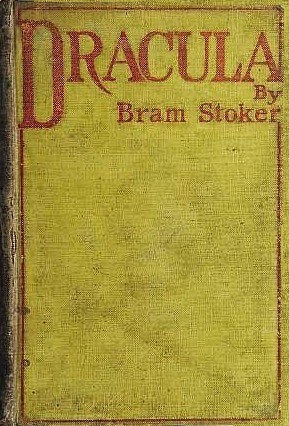
First edition of Dracula in fin-de-siecle yellow book covers
The final work from the late Victorian period explored here is of such moment that it merited a whole room to itself. The visitor was obliged to make a detour from their natural winding progression through the exhibition’s dimly lit corridors, turning into this sealed off sepulchre which immediately felt like a sacred space. Indeed, so caught up was I in the cultural current leading me eagerly on from one thematic display to another that it wasn’t until I’d reached the end and exited into the light of the British Library’s lofty atrium that I paused and thought ‘hang on, there was something missing there’. Retracing my steps, I discovered the hidden sanctum which I’d initially passed by. The book in question is, of course, Bram Stoker’s Dracula, first published in 1897. Its influence on the horror genre and on popular culture in general is pervasive and profound, and anything in this compacted space could offer a partial survey at best. The literary exhibits were particularly fascinating. There was a pleasing congruity to the inclusion of some of the books which Stoker consulted in the British Library whilst researching the background of his story. Perhaps some of them were even the same copies.

Of particular significance was a book written by William Wilkinson, Esq., ‘Late British Consul Resident at Bukarest’, which blended colonial memoir, history lesson and traveller’s tales, and was given the fustily prosaic title An Account of the Principalities of Wallachia and Moldovia: With Various Political Observations Relating to Them. Stoker initially read this not at the British Library but in the subscription library in Whitby, the seaside town on the Yorkshire coast where he was staying for his summer holidays in 1890. The historical passages make reference to King Ladislas of Hungary forming an alliance with the Wallachian Voivode Dracula in 1444 to fight the Turks. It was in Whitby, therefore, that Stoker found the name for his vampire lord, although he would transform him from a prince (voivode) into a count. There was no such noble rank in Wallachia in the 15th century, but the baleful influence of Lord Byron together with the antics of his acolytes on the European continent had created an indelible impression. Vampires and Gothic villains in general had become strongly associated with dissipated Western European aristocrats.

The illustration included in the 1901 edition of Dracula
Stoker followed the established convention by ennobling his title character, even though he envisaged him as a stout military figure with a thick Central Eastern European moustache. This explicitly described appearance (roughly reproduced in the illustration in 1901 edition) would seldom be acknowledged in subsequent adaptations. Wilkinson also notes that Dracula in the Wallachian language means Devil. This could connote evil, although it could also use refer to the folk devil as a trickster figure. As such, it could be used in a complimentary sense as a badge of bravery or ingenuity in warfare or matters of state. Wallachia was also entirely separate from Transylvania, but such cavils are irrelevant. Dracula is not a historical novel, and the local colour and geographical detail Stoker derived from Wilkinson’s book and other accounts of the area provided a richly mysterious and haunted backdrop for Jonathan Harker’s arduous journey to Dracula’s castle and the final pursuit through the Transylvanian landscape. The mountainous and thickly forested world which he conjured up from his reading room travels was shrouded in fogs of superstition and venerable custom. Journeying there was akin to falling back in time to a pre-industrial era, leaving behind the nascent modernity of the late Victorian period in which electric lighting was already beginning to banish the shadows and returning to the Middle Ages. It was a reiteration of the Gothic’s abiding delight in resurrecting the spectres of primitive (and imaginary) histories which contrasted with the comforts of the present.


The demons of Lewtrenchard
Another book which Stoker consulted, Charles Boner’s Transylvania: Its Products and its People, contained fold-out maps (one of which was spread out here) which facilitated imaginary exploration, mental expeditions into the Carpathian Mountains via the Borgo Pass. Also on display was the Reverend Sabine Baring-Gould’s The Book of Were-Wolves, a collection of legend and lore which provided the inspiration for the wolves Dracula heralds as ‘the children of night’, and for his own transformation into a great hound which leaps onto the shore of Whitby from the deck of the wrecked Demeter. Baring-Gould was the parson of Lewtrenchard church, nestled in the shady valleys west of Dartmoor. In addition to collecting local folklore and folk music, he was a dedicated antiquarian, endeavouring to save the church furnishings and decorations of the Gothic period which other Victorian clergymen were busy discarding and destroying. His small church is a treasure house packed with objects rescued from diverse parts, restored and refitted. And hidden on the side of the pulpit facing the east wall are a pair of grinning demons carved from wood by the Pinwill sisters, Esther and Violet, in imitation of medieval originals. They would certainly not have looked out of place in Dracula’s castle.


More demons lodging in Lewtrenchard - call for the Rev. Sabine-Gould, demon hunter
Also included here was a manuscript Stoker wrote for a theatrical version of his novel. Scrappily assembled, with passages cut and pasted from the printed page, this was evidently dashed off with great haste. It was an exercise to establish theatrical copyright and prevent others from hijacking his ideas, distorting them and profiting from the thinly veiled results. Perhaps he had the success of JR Sullivan and Richard Mansfield’s Jekyll and Hyde in mind. It also suggested that Stoker was highly conscious of the fact that Dracula was a work which had the potential for broad popular appeal. The script formed the basis for a theatrical reading at the Lyceum Theatre in 1897, staged concurrently with the novel’s publication. Present in the select audience was Henry Irving, the actor-manager for whom Stoker acted as personal assistant and factotum in all things. Irving was an imposing figure, an archetypally demanding and egotistic theatrical, and a dominant force in Stoker’s life, source of both reverence and fear. Some have claimed him as a model for Dracula. Its certainly likely that some of his characteristics found there way into the portrayal of the commanding count. His approval or even mild encouragement was vital for Stoker; but all he received after the show was brusque brush-off. The self-absorbed Irving had no time to dispense the words of praise he demanded and required for himself.


Projected onto the back room of the Dracula room were scenes from the finale of FW Murnau’s 1922 film Nosferatu, expressionist shadows taking on a life of their own, extending grasping claws ahead of the rodent-toothed creature casting them. Stoker’s worries about the unauthorised appropriation of his material seems to have been justified, since the German company who produced the picture, Prana Films, had made no effort to seek approval for their adaptation. The widowed Florence Stoker’s attempts to gain recompense merely resulted in the company going bust. In order to discourage further such incidences, she managed to get a court order requiring all copies to be destroyed. Fortunately, this celluloid auto-da-fé wasn’t altogether thorough in its execution, and surviving prints resurfaced in later years. As a result, we can still enjoy what has become established as an enduring classic of German expressionism and cinematic Gothic. Stoker’s character and vampiric lore would soon spread with the exponential infectiousness of a blood-borne virus, putting it well beyond any possibility of containment.

The exhibits here briefly sampled the cultural shadow cast by Dracula over the long decades of the 20th century. His looming presence was in some ways a counter-reaction to the forces of modernism and rapid technological progress; a renewed example of the Gothic finding inspiration and escape in a time of social transformation through the resurrection of the past. The character as Stoker envisaged him was eager to embrace the possibilities afforded by new technologies and economic channels. That was the reason for his move to England. But this is one of a number of the novel’s aspects (including his Eastern European military bearing) which have been abandoned in successive cinematic incarnations. Christopher Lee’s repeated pleas to the Hammer hierarchy to return to the book as a direct source fell on deaf ears.

Vampire - Edvard Munch
The female vampire had already found its way into the broader European literary and artistic stream as a symbolic character. In Baudelaire’s poem The Vampire it stands as a very French metaphor for the destructive nature of love, and the fear of the devouring woman. It was also a stock pre-Freudian fever dream figure in Symbolist art, an image to set alongside the many personifications of Death in chill Nordic and Baltic landscapes. Edvard Munch’s Vampire, aka Love and Pain (1894), could almost be an illustration for Baudelaire’s bitterly misogynistic poem. Rudyard Kipling’s poem The Vampire was a rather surprising inclusion in the exhibition, serving as a representation of these literary adoptions, and another version of the vampire as belle dame sans merci. Appropriately enough, it was written in 1897, the year of Dracula’s publication. He’s certainly not somebody you’d associate with such Decadent company. But then he’s a writer to whom many misconceptions have become attached over the years. The printed poem was accompanied by an illustration by Philip ‘son of Sir Edward’ Burne-Jones, an explicitly erotic tableau which bears some relation to Fuseli’s Nightmare. It was this image which gave birth to the poem in Kipling’s imagination, an example of visual art exerting a direct influence upon literature.


Edward Gorey’s Dracula toy theatre brought his mordant drawings to marvellous pop-up life, and demonstrated the broadening appeal of the whole mythos. The sets are actually models for the stage designs he produced for the 1977 Broadway production of Dracula. His lugubriously amusing figures prove eminently suitable to the novel’s characters and scenarios. A slight element of mockery is appropriate given their familiarity at this stage, but is obviated by the beauty and care with which they are drawn. And his Dracula has a moustache! A lovely artefact for Gothic children to exercise their morbid imaginations upon – the cardboard Lucy Westenra’s head can easily be stuck back on with sellotape.


It’s but a few short steps from here to Sesame Street’s delightfully numerate Count, the vegetarian vampire duck of Cosgrove-Hall’s Count Duckula and the vampire grandpas and uncles-next-door of The Munsters and Alan Moore’s Bojeffries Saga The latter features the wonderfully weird Uncle Festus Zlüdotny, whose spluttered speech-bubble utterances are rendered in the undecipherable symbols of a mysterious yet somehow inherently violent alphabet. A vampire slaying kit, with tools and substances covering most recommended means of undead extermination, was on display in its own standalone cabinet, its components housed in a neatly portable valise whose compartments concertinaed out with ingenious pragmatism. It had no apparent provenance, and its presence was therefore rather anomalous, but fun nevertheless.

Christopher Lee endures the Scars of Dracula
A design for Frank Langella’s Count in John Badham’s 1979 film of Dracula suggested future developments of the character, and of the vampire in general, as a romantic figure. The animalistic bloodsucking and viral furtherance of the undead plague were increasingly relegated to the background, incidental details eclipsed by the old fashioned seductions of the irresistible Heathcliff anti-hero. Alas, there was nothing here to match the display of Christopher Lee’s Dracula: Prince of Darkness costume in the BFI’s Gothic display a couple of years ago. Hammer was represented (and represented it simply HAD to be, of course) by more of Scott MacGregor’s set designs, this time for Scars of Dracula. Indisputably the nadir of Hammer’s Dracula cycle, and quite possibly of its Gothic output at large, the designs indicate just how far the studio (and director Roy Ward Baker) was prepared to go in its determination to keep up with contemporary trends and add new elements of explicit gore. In the bedroom set, a bloody corpse sprawls across the four-poster, severed body parts scattered to the side along with the saws and knives which have been used in this clumsy dissection. The echoes of the grim finale of Witchfinder General are all too evident. Perhaps thankfully, this scenario was never realised in the completed film. Christopher Lee’s Dracula merely leaps into the chamber and stabs Anoushka Hempel’s vampire seductress with a knife whose rubbery flexibility is all too plain. It’s a gratuitous scene which is as risible as it is illogical and inexplicable. MacGregor’s set for the castle roof is an atmospheric Gothic arena, a stage for dramatic confrontations. Sadly, the final realisation fell far short of his vision, the greatly reduced budgets of the 60s and 70s more than usually evident.

As with Frankenstein, Dracula made it through to the vinyl age too. Displayed here was the cover of the Studio2Stereo LP Dracula with Christopher Lee, a compilation of Hammer soundtracks. A real treat, this one, with James Bernard’s stirring score for the original Hammer Dracula set in context by Lee’s narration. It also features cues from Bernard’s score for She, as well as contemporary composer John McCabe’s music for the 1972 psycho-thriller Fear in the Night, Harry Robinson’s lushly romantic themes from The Vampire Lovers and extracts from David Whittaker’s score for the stylish Dr Jekyll and Sister Hyde, wittily scripted by the late Brian Clemens. The 70s provenance of the LP was clear from its use of a promo still from Dracula AD 1972 on the cover, Christopher Lee tucking into the jugular of poor old Caroline Munro.

Leaving the Dracula room, we also take our leave of the 19th century, and enter a new era in which the medium of cinema, with its large, darkened palaces, would prove a perfect site for the expansion of the shadow worlds of the Gothic. But those shadows often originated and drew their raw sustenance from the archetypal monsters, human and otherwise, which emerged from the gaslight illuminated fogs of the Victorian imagination.

Wednesday, 4 February 2015

Terror and Wonder: The Gothic Imagination at The British Library

PART ONE


The British Library exhibition Terror and Wonder: The Gothic Imagination began, appropriately enough, with a descent. After a brief introductory film in which four explorers of diverse Gothic realms (Neil Gaiman, Sarah Waters, Ben Wheatley and Mark Daneilewski) outlined the shadowy territory we were about to stumble blindly into, we walked down a set of stairs and entered a gloomy, crypt-like space. The ‘rooms’ we passed through were separated by draped veils of funereal black which shivered in currents of a spectral wind with no evident point of origin (yes, it was the air conditioning, but let’s not break the mood here). Darkness prevailed. It was all is it should have been; as it was fated to have been.

Surrealist Gothic - Jan Svankmajer's The Castle of Otranto
The first room concerned itself almost exclusively with Horace Walpole, his antecedents, friends and those he went on to influence. He was portrayed as an origin figure for Gothic literature and its subsequent cultural offshoots. Most notably, this was due to his anonymous self-publication in 1764 of the novel The Castle of Otranto, which established many of the staples of Gothic fiction to come: the incursions of the supernatural, the medieval castle with its secret vaults, the revivification of buried histories and ancient curses, the menaced and imperilled heroine and the general air of barely suppressed hysteria. It may be a story seldom read today, but its influence can be felt through its still proliferating lineage. The Czech animator, filmmaker and artist Jan Svankmajer paid homage to it in his short 1979 condensation of the novel, which was shown in the upper entrance room. Period illustrations come to animated life as a book’s pages are riffled by an invisible hand. The framing device for the film has a historian and literary archaeologist claim to have discovered the real Castle of Otranto at Otrhany, near Nachod in the Czech Republic. It is this which Walpole used as the basis for his fictional locale, he claims. As well as suggesting a rediscovery of a half-forgotten text, it’s a clever way of having the Gothic world of imaginary derangement infect and invade what is presented as rational documentary realism. Svankmajer is a contemporary inheritor of the surrealist sensibility, and as such his co-option of the Castle of Otranto is an acknowledgement of the prominence of Walpole and the Gothic in general within the surrealist canon, its curated cabinet of curiosities. A 1765 edition of the novel was displayed in the exhibiton, with Walpole, safely assured of the novel’s success, identifying himself as the author. It now bears the subtitle ‘a Gothic story’. Thus the genre was coined.

The exhibition took care to point out Walpole’s own influences, making it evident that The Castle of Otranto didn’t appear magically formed from a pure and untrammelled imagination. Shakespeare’s ghosts and supernatural beings offer a clearly defined precedent (if such a description is apposite for such immaterial manifestations and half-glimpsed sprites). Walpole’s 1728 copy of The Merchant of Venice was included here, as was Henry Fuseli’s highly dramatic and very physical rendering of the appearance of the ghost of Hamlet’s father in a 1796 engraving. A 1529 edition of Malory’s La Morte d’Arthur and a 1617 edition of Spenser’s Faerie Queene further outlined the appeal of antiquity and of a dream medievalism, a fantasy of the past replete with quests and allegorical stories, strange landscapes inhabited by demons and monsters waiting to devour souls which strayed from the righteous path.

Johann Muntz's print of Strawberry Hill
Walpole’s fashioning of his own private Gothic domain at Strawberry Hill on the winding banks of the Thames below Twickenham from 1747 onwards was an attempt at realising this fantasy world in solid, architectural form. He was thus the progenitor of Gothic revival architecture in addition to recasting it in a new literary form. Some of the original plans for the house’s elaborate Gothicisation were included, serving to emphasise its general air of studied artifice. It was pointed out the Walpole intended his home to be a showpiece from the outset, charging visitors for admission once it was completed. It was a series of theatrical sets which the imagination was prompted to fill with shadowy figures and strange happenings. The spirit of Strawberry Hill, the experience of inhabiting the living dream of a self-created Gothic fantasy, inspired the writing of The Castle of Otranto.

Chatterton by Henry Wallis (1856)
Walpole initially published the novel anonymously, claiming that it was a translation made by one William Marshal of a work originally written by an Italian with the florid name of Onuphrio Muralto and printed in 1529. This may partly have been a device designed to shield him from any adverse reaction to the story’s sensational aspects. But once more, Walpole set the trend for the literary work as ‘discovered’ manuscript. Included here were two of the best known 18th century forgeries: James Macpherson’s ‘translation’ of Fingal, an early Gaelic epic by an ancient poet known as Ossian; and the ‘discovery’ of a number of manuscripts by 15th century Bristolian poet Thomas Rowley by the teenage would-be poet Thomas Chatterton, best known today as an exquisite corpse in Henry Wallis’ Pre-Raphaelite painting of 1856. Chatterton’s doctored manuscripts were on display, pasted into a large scrapbook. The crude attempts to make them appear timeworn and antiquated, with brown staining liberally splashed across the vellum he acquired from the attorney’s office in which he worked, now appear charmingly amateurish. That people were prepared to accept them as genuine is testament to the 18th century intoxication with antiquity, the intense desire to commune with voices from the past.

Walpole's Becket Reliquary
Walpole found fulfilment of this desire through his dedicated antiquarianism. He collected objects from centuries past, both in England and on his journeys through Europe, and filled up every niche and corner of Strawberry Hill with his diverse finds. A particularly beautiful 13th century enamelled reliquary chest dedicated to Thomas Becket was included in the exhibition, housed in a glass cabinet in the middle of the room which enhanced its sacrosanct air. This was an object to be circled and gazed at from all angles, but not touched. A certain distance was maintained, as it would have been for pilgrims centuries ago. It must have been thrilling for Walpole to be able to pick it up whenever the fancy took him, to open the small, hinged lid and peer reverently inside, imagining what it once contained. Alongside the reliquary was a book by his friend George Vertue, a catalogue of the antiquities he drew up whilst staying at Strawberry Hill, opened to show the page on which a colour study of the adjacent object was printed.

John Dee's 'shew stone'
Most intriguing, however, was another artefact which Walpole owned, one which, whilst looking fairly unprepossessing, was imbued with great power and mystery. This was John Dee’s spirit mirror. On loan from the British Museum, it is a smooth, flat disc of polished obsidian, darkly and depthlessly reflective. The accompanying tooled leather case bears a handwritten label by Walpole indicating the nature of its content. Walpole bought the mirror in 1777, and it was used by Dee in the late 16th century. But it originally found its way over to Europe from what is now Mexico, part of the plunder of the Conquistadors in the 1520s and 30s. Dee was obviously aware of its provenance as a mirror for divination and conjuration used by the Mexica priests. Dee himself was a magician, mathmetician, alchemist, cartographer and court astrologer to Queen Elizabeth, all disciplines which were regarded as part of an undivided body of knowledge. A fascinating character, he has proved irresistible to a number of writers and artists, and appears prominently in Derek Jarman’s film Jubilee, John Crowley’s Aegypt sequence of novels, Alan Moore’s Promethea comics, Peter Ackroyd’s The House of Dr Dee, Michael Moorcock’s Gloriana and Gustav Meyrink’s The Angel of the West Window. Dee became acquainted with a young man called Edward Kelley, who claimed to commune with angels. Dee spent an increasing amount of his time attempting to make such a communication himself, with Kelley as intercessory bridge. The black reflecting mirror, or ‘shew stone’, was supposedly given to him by an angel and gave him access (via Kelley) to dimensions normally inaccessible to human vision. Whether or not you give any of this the slightest credence (and the question of whether the stone was ever in Dee’s possession is open to debate) there is a thrill in seeing this myth-infused occult object which such a fascinating historical figure firmly believed opened up higher planes of knowledge and existence, and allowed him to make contact with the beings who possessed and inhabited them.

Edward Young's Night Thoughts illustrated by William Blake
Walpole’s shared schooldays and later acquaintance with Thomas Gray also forges a connection between him and the so-called graveyard poets. This short-lived branch of English poetry, epitomised by Gray’s Elegy Written in a Country Churchyard (1751) and Edward Young’s Night Thoughts (1742), gave expression to the morbid musings of young men who wandered around graveyards contemplating mortality, their own and others. The graveyard became the Gothic locus of a strange, inverted form of romanticism, pale, drawn and half in love with Death. The cold idyll of the graveyard, drained of bright colour save for the odd bunch of fading blooms and the red of the poisonous berries on the yew tree, would provide the trysting place for Mary Godwin and Percy Shelley. They would rendezvous by the grave of Mary’s mother in St Pancras churchyard. Neil Gaimain’s novel The Graveyard Book (which features later in the exhibition) also uses the graveyard as a romantic locale within the fenced and gated bounds of which the tale of a young boy’s growth to maturity takes place.

William Blake's Vala or The Four Zoaz
A 1797 edition of Edward Young’s Night Thoughts was illustrated by William Blake, who wrapped his angels, demons and tormented sleepers around a central pane containing the text. Pages of this book, which was only ever partially published, were on display here. It was a troubled commission, and only a fraction of the watercolours Blake produced as sketches for later engravings finished in final printed form. He retained many of the proofs which remained unused and began writing his own poem in the blank, squared-off spaces intended for Young’s words. The night journey undertaken by the figures he had drawn influenced the dark prophecies and troubled invective in Vala, or The Four Zoas, written shortly after the altercation with a soldier in the Sussex village of Felpham which had almost led to his trial for sedition. Never published in his lifetime, it was rediscovered in 1889, surfacing in a fin-de-siecle period the mood of which suited its intensely expressed visions of doom and apocalyptic fire. The pages exhibited here showed that the Gothic was capable of inspiring and encompassing extraordinary visionary height, and even more profound depths.

Fonthill Abbey - the ultimate Gothic folly
As the Gothic form developed, so it expanded to explore and colonise new areas, testing the boundaries of aesthetic, social and even physical tolerance by pursuing new extremes. There was an architectural model of William Beckford’s Fonthill Abbey on display which has long outlasted the extravagant fantasy for which it served as a template. Fonthill was designed to be the ultimate Gothic dwelling, leaving Strawberry Hill in its extensive shadow in terms of its scale and obsessive detail. It proved a hubristic structure, however, built without the accumulated knowledge of the medieval masons. The gargantuan spire, now a fairly obvious symbol of overweening male ego rather than a physical manifestation of heavenly aspiration, was from the beginning an unstable structure, which collapsed several times. Beckford eventually gave up on his expensive dream and built a structure which, perhaps in wry recognition of the true nature of Fonthill, resembled a folly; the tower which still raises its finger on the hills above Bath. Beckford’s novel Vathek (1786), a copy of which was on display in the exhibition, took the Gothic into the realms of the Arabian Nights fantasy. The ‘exoticism’ that this form afforded, its distance from the norms of Western civilisation and from familiar narratives and settings, allowed for new extremes of cruelty, violence and depravity. Naturally, the notoriety which ensued did nothing to harm the success of the book.


The exhibition notes made the observation that the levels of sex and violence in Gothic novels increased markedly in the wake of the French Revolution and the bloody Terror into which it descended in the 1790s. Matthew Lewis’ The Monk was the prime example offered here, which also throws in a good deal of anti-clericalism for good measure. The horrors of the Inquisition and the Counter-Reformation became another staple of Gothic fiction, memorably featuring in Edgar Allan Poe’s The Pit and the Pendulum (another subject of a Jan Svankmajer film). The figure of the depraved or pitiless monk, a terrifying cowled and faceless presence possessed of unassailable power and authority, took its place amongst the repertory of Gothic characters. The English Reformation cast a long shadow, and Catholic institutions and rituals could still be relied upon to elicit a shudder if cast in a suitably sinister light.


German Gothic novels, which drew on a rich heritage of folklore connected with mountains and dense forests, were renowned (or notorious) for being even more graphic than their English counterparts. They were briefly in fashion towards the end of the 18th century. In Jane Austen’s parody of Gothic literature, Northanger Abbey (1818), the heroine is offered a list of seven novels to read after she has finished Ann Radcliffe’s The Mysteries of Udolpho and The Italian, or the Confessional of the Black Penitents. Some are German, whilst others ape the Germanic style. They are all, however, perfectly ‘horrid’, she is assured. They have therefore come to be known as the Northanger Horrid Novels, and all turn out to have been real, published works. Austen evidently had in-depth knowledge of contemporary Gothic. Editions of these obscure works were laid open side-by-side in a central display cabinet so that we might glimpse something of their appalling nature. The Castle of Wolfenbach (1793) and The Mysterious Warning (1796), subtitled A German Tale (as the former may as well have been too) were both by the English novelist Eliza Parsons. The Orphan of the Rhine (1798) by Eleanor Sleath was another German tale written by an English writer, whilst Clermont (1798) was by the Irish writer Regina Maria Roche. The Midnight Bell (1798) by Dutch author Francis Latham not only claimed to be ‘A German Story’ in its subtitle, but also to be ‘Founded On Incidents in Real Life’. The final two novels were the genuine article, even if they claimed not to be. The Horrid Mysteries (1796), or ‘A Story From the German Of The Marquis Of Grosse’ was actually a translation of the novel Der Genius by Carl Grosse. The Necromancer or The Tale of the Black Forest (1794) by Ludwig Flammenberg sounds particularly intriguing (and particularly German). Disappointingly, the splendidly named Flammenberg turns out to be another pseudonym, a florid mask for more mundanely monickered Carl Friedrich Kahlert.

Henry Fuseli - The Nightmare (1781)
Henry Fuseli was Swiss rather than German, and a long-term resident of the British Isles. There remained something Germanic about the fantastical, grotesque nature of much of his work, however. In 1781 he painted The Nightmare, a print of which was exhibited here. It remains one of the definitive images of the Gothic imagination, and was hugely popular at the time, reproduced in many subsequent engravings. The demonic imp crouching on the chest of the uncomfortably sprawled, restlessly sleeping woman and the marble-eyed, phantom horse materialising from the shadows have been the subject of much pastiche and parody over the years. This powerfully physical representation of a dream state is viewed with disturbing objectivity from a viewpoint exterior to the dreamer, as if these were real demonic beings inducing night terrors in the unknowing sleeper. The sideways stare of the homunculus, meeting the gaze of the picture’s viewer, makes it feel as if we have come across a scene we should not have borne witness to. It is a tableau of temporary suspension, full of the potential for sudden and very rapid subsequent action. The poster for Ken Russell’s 1986 film Gothic, his and writer Stephen Volk’s version of the events of that famously stormy night at the Villa Diodati (which we’ll come to in a moment), restages The Nightmare for a cinematic tableau.

Theodor von Holst's frontispiece illustration for an 1831 edition of Mary Shelley's Frankenstein
The Nightmare is a bridge into the Romantic era. The exhibition notes suggested that the Romantic artists largely diverged from Gothic themes. However, there were exceptions; manuscripts of Coleridge’s Christabel (a forerunner of Poe’s poetry) and Wordsworth’s The Vale of Esthwaite were included to show that they did sometimes descend into the shadows. And it was from the milieu of the Romantic movement that a work would emerge which would profoundly influence the direction which Gothic would take and form the ground from which new generic hybrids would sprout and flourish. Not the least of these would be science fiction, which Brian Aldiss defines, in Billion/Trillion Year Spree, as being ‘characteristically cast in the Gothic or post-Gothic mode’. The work in question is, of course, Mary Shelley’s Frankenstein (1818). Included here was an 1831 edition with illustrations by Theodor von Holst. His depiction of the monster bears a resemblance to William Blake’s The Ghost of a Flea. The title page print depicts with stark simplicity the horror Frankenstein feels towards his creation, and his abandonment of the bewildered newborn man, who sprawls like a loose-limbed puppet in the laboratory.

Shelley’s revised manuscript for the 1831 edition was on display, handwritten on blue paper. Also present was a letter written by Lord Byron, protesting that no impropriety had taken place during that storm-wracked evening at the Villa Diodati on the shores of Lake Geneva where he had played host to Mary Godwin, Percy Shelley, his physician John Polidori and Clair Clairmont, his mistress of the moment. Given his reputation, and such protest was liable merely to stoke further salacious speculation, and he would probably have been better advised to hold his silence. That evening, Byron had been reading ghost stories aloud as the storm rumbled and flashed outside (and German ghost stories at that!) He also read lines from Coleridge’s Christabel, which sent the unhinged Shelley fleeing from the room with a wild shriek. The reading led on to the suggestion that everyone should write their own horror story to complement the fearsome atmosphere of the night beyond. This challenge, instantly mythologised by all parties present, resulted in the first outline of Frankenstein. Mary Godwin (soon to be Shelley), who had already lost a child of her own, and whose mother had died as a result of her own delivery into the world, came up with the idea of the blasphemous birth of a new, monstrous man through the generative, galvanic powers of science; powers which wholly excluded motherhood and female agency.


Frankenstein functions as a gateway into the world of modern Gothic, largely via the numerous cinematic variations which have evolved from the central idea. The clip of Bride of Frankenstein playing on a loop was really our first glimpse of Gothic as the major stylistic component of the horror genre as it developed in the twentieth century. Frankenstein’s creation evolved (or devolved) from the tormented haunter of the wilderness, the self-educated outsider abandoned by his father, into Boris Karloff’s innocent, shambling brute, both pitiful and terrifying. Frankenstein provides us with our first classic horror monster. The novel opens a nocturnal window onto the twentieth century, giving us a brief prospect of the encroaching shadows of Gothic horror whose tendrils would extend into every aspect of popular culture. There was a copy of the 1967 Brunswick LP An Evening With Boris Karloff and his Friends, contained soundtrack clips from the great Universal monster movies introduced by the now elderly actor. Also on display were some of Scott MacGregor’s set designs for the late Hammer film Frankenstein and the Monster from Hell (1974). This served as a self-reflective and melancholic conclusion to the studio’s series of Frankenstein pictures, almost invariably starring Peter Cushing as a particularly amoral Doctor, which had been so central to their output. Along with the Dracula films, they were instrumental in building their reputation as purveyors of quality Gothic to the masses. MacGregor’s designs are sketches for a dream film which could no longer be realised with Hammer’s dwindling resources in the bleak years of the mid-70s. Interestingly, Frankenstein and his creation have been conspicuously absent from recent revivals and revisitations of the Gothic canon. The single shambling monster has been largely supplanted by hordes of shuffling, moaning zombies. Maybe it is time for the creature to rise from the slab once more.


Frankenstein was the progenitor of many literary forms and ideas. But it can also be seen as an endpoint in terms of ‘pure’ Gothic fiction, if indeed there is a beast of such pedigree. Its Romantic sensibility and use of landscapes giddy with sublime terror (alpine peaks and Arctic wildernesses) as exteriorised expressions of interior states mark it apart from the more generic Gothic novel. The spectres of 18th and early 19th century Gothic arose from the historical past (real or fabled). Frankenstein’s monster, on the other hand, is created through the application of scientific rationalism, Henry Frankenstein himself the modern Prometheus who fashion his own relentless Nemesis. And so, we leave the 18th and early 19th century Gothic rooms and pass through the doorway into the period which has surpassed them in terms of furnishing the modern imagination with its ‘classic’ Gothic props – the Victorian age. And naturally, the writer who ushers us into this fogbound, gaslit world is Charles Dickens.